Digital Disimpaction: Procedure, Benefits and Risks

Updated: 2 days ago
Written and medically reviewed by Dr. Baraa Alnahhal, MD · Last reviewed: November 2026 · How we review
Quick Answer
Digital disimpaction is a procedure where a provider uses a gloved, lubricated finger to break up and remove hard, trapped stool from the rectum. It relieves fecal impaction and severe constipation that hasn't improved with laxatives, stool softeners or enemas. Only a trained professional should do it, never yourself. Risk is low when done correctly.
What the research says
Fecal impaction can cause serious complications: a review of 280 reported cases of fecal impaction found 43.5% were in people over 65 and 49% had chronic constipation; 346 complications were recorded, most from the hard stool pressing on the bowel wall (Serrano Falcón B et al., BMC Geriatrics, 2016) [2]
Enemas and oral medicine both cleared impaction in children: in a trial of 90 children aged 4 to 16 with rectal fecal impaction, disimpaction succeeded in 80% with daily enemas and 68% with high-dose oral PEG, but PEG caused more leaking and watery stools (Bekkali NL et al., Pediatrics, 2009) [3]
Key takeaways
Digital disimpaction removes hard stool from the rectum by hand.
It's used when laxatives and enemas haven't worked.
Only a trained professional should do it.
Relief often comes within minutes.
Risks are low when done correctly.
What is digital disimpaction?
It treats fecal impaction, a mass of hard stool stuck in the rectum. Nurse practitioners, physicians, physician assistants or registered nurses may perform it. Sources: [1]
Who needs it
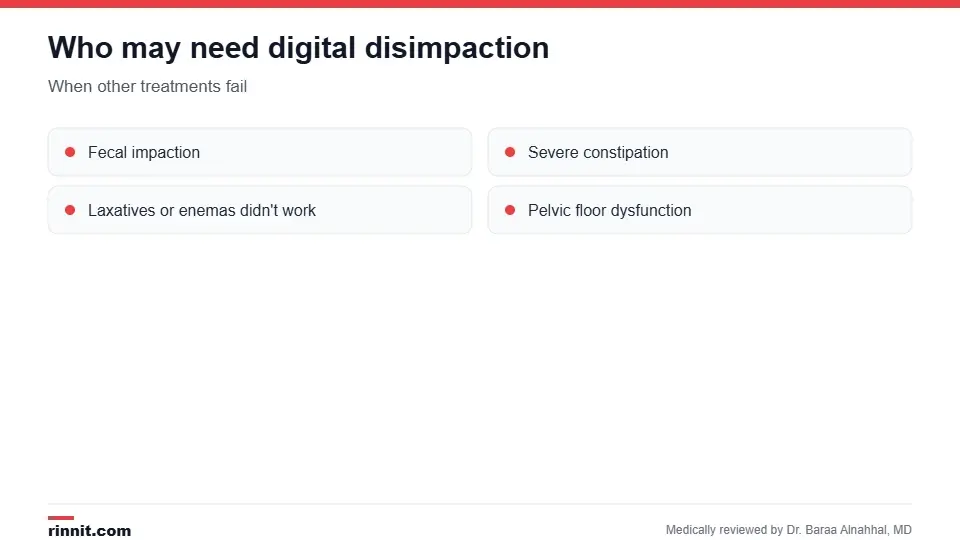
Providers usually try other treatments first.
Fecal impaction.
Severe constipation that hasn't improved with other treatments.
Conditions that prevent regular bowel movements, such as pelvic floor dysfunction. Sources: [1]
What happens during the procedure
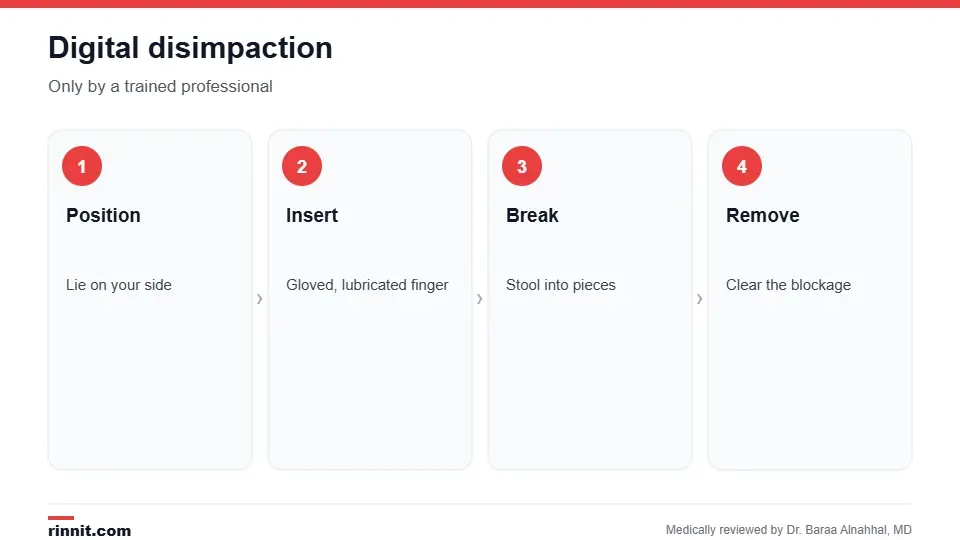
It's done in an office, or under anesthesia for severe cases.
You lie on your side with your knees drawn toward your belly.
The provider inserts a gloved, lubricated finger into your rectum.
They sweep the finger around or through the stool to break it up.
They remove the pieces to clear the blockage. Sources: [1]
Risks

Never try it on yourself.
When | Possible problems |
Done correctly | Low risk |
Done incorrectly | Irregular heartbeat, fainting, anal fissures, damage to the anus, rectum, sphincter or bowel, infection |
Uncommon | Vagus nerve overstimulation causing fainting or a brief irregular heartbeat |
Sources: [1]
Recovery
Because it isn't surgery, most people return to normal a few minutes afterward, unless anesthesia was used. Ask your provider when you can lift heavy things or exercise. Sources: [1]
Benefits
Quick relief from severe constipation and rectal discomfort.
Belly pain, nausea and poor appetite often ease within minutes.
It may prevent complications such as bowel sores, bleeding, fecal incontinence, perforation and megacolon. Sources: [1, 2]
When to call your provider
Belly pain.
Constipation or diarrhea.
Loss of appetite.
Nausea. Sources: [1]
Conclusion
Digital disimpaction can quickly clear a stubborn blockage when other constipation treatments fail. Ask your provider how to prevent impaction from happening again.
Keep learning: read about fecal impaction and constipation.
Frequently asked questions
What is digital disimpaction?
Removing hard, trapped stool from the rectum with a gloved finger.
What are other names for it?
Manual disimpaction or digital evacuation.
When is it needed?
When laxatives, stool softeners or enemas haven't worked.
Who performs it?
A trained nurse, nurse practitioner, physician or physician assistant.
Can I do it myself?
No. Only a trained professional should do it.
Does it hurt?
It can be uncomfortable; severe cases may use anesthesia.
How fast will I feel better?
Often within minutes.
What are the risks?
Low when done correctly; rarely fainting or anal tears.
Is there recovery time?
Usually just a few minutes.
What happens if impaction isn't treated?
It can cause bowel sores, leaking stool or perforation.
Related Reading
Fecal Impaction: Symptoms, Causes, Diagnosis, Treatment and Outlook — What You Need to Know the condition it treats.
Constipation: Symptoms, Causes, Diagnosis and Treatment — What You Need to Know an overview of constipation.
Laxatives: Types, How They Work, Safe Use and When to Get Help medicines tried first.
Enema: What It Is, Types, How to Use One Safely and Risks another treatment option.
Fecalith and Fecaloma: Symptoms, Causes, and Removal hardened stool masses.
References
Cleveland Clinic. Digital Disimpaction: What It Is, Procedure & Risks. Cleveland Clinic. Last updated September 6, 2023. https://my.clevelandclinic.org/health/treatments/25237-digital-disimpaction
Serrano Falcón B, Barceló López M, Mateos Muñoz B, et al. Fecal impaction: a systematic review of its medical complications. BMC Geriatrics. 2016;16:4. PMID 26754969. https://doi.org/10.1186/s12877-015-0162-5
Bekkali NL, van den Berg MM, Dijkgraaf MG, et al. Rectal fecal impaction treatment in childhood constipation: enemas versus high doses oral PEG. Pediatrics. 2009;124(6):e1108-e1115. PMID 19948614. https://doi.org/10.1542/peds.2009-0022
Medical disclaimer
This article is for general education only and does not replace advice from a qualified healthcare professional. Talk to your doctor about your own diagnosis and treatment, and seek emergency care right away for severe or sudden symptoms.



Comments