Depth Perception Test (Stereopsis Test): Types, How It's Done and What Results Mean

Updated: 2 days ago
Written and medically reviewed by Dr. Baraa Alnahhal, MD · Last reviewed: November 2026 · How we review
Quick Answer
A depth perception test (stereopsis test) checks whether the two eyes work together and whether the brain combines their images to judge depth and distance in 3D. It's quick, painless and doesn't need dilating drops. It's especially important for children at risk of lazy eye or crossed eyes, which can permanently reduce depth perception if not treated early.
What the research says
Classic stereotests are only moderately accurate at spotting amblyopia: a study comparing four classic stereovision tests for detecting amblyopia and its risk factors found accuracy (AUC) of 0.70 for the Lang II test, 0.78 for the Stereo Fly test and 0.75 for the Frisby test, while an AI-based random-dot test reached 0.91 (Csizek Z et al., Frontiers in Medicine, 2023) [2]
Combining tests catches most problems in young children: in a school-based vision screening of 4- to 5-year-olds, 26.5% had a vision problem and 5.9% had amblyopia; a combination of five screening tools correctly identified 84% of children with a problem, though specificity was only 49% (Nishimura M et al., BMJ Open, 2019) [3]
Key takeaways
Checks how well your eyes work together to judge depth and distance.
Uses 3D images with special glasses, physical objects or electronic devices; some tests suit babies under 1 year.
Quick, painless, no dilation; results are given right away.
Results describe depth perception as present, limited or absent.
Online and at-home tests aren't reliable substitutes for professional testing.
What is depth perception?
Depth perception lets you judge how far away objects are and see the world in three dimensions. Each eye sees from a slightly different angle, and your brain merges the two images into one 3D picture, a process called stereopsis. If one eye sees poorly, turns in or out, or the brain ignores one eye, depth perception suffers. A depth perception test checks this teamwork between the eyes and brain. Sources: [1]

A depth perception test takes no more than 15 minutes.
Who needs a depth perception test?
Children, as part of school-age vision screening.
Children with lazy eye (amblyopia) or crossed or wandering eyes (strabismus).
Adults with eye conditions, injuries or neurological problems that affect how the eyes work together, such as binocular vision dysfunction.
People whose jobs demand good depth judgment. Sources: [1]
Amblyopia that isn't corrected early enough can cause permanent loss of depth perception and poorer vision, which is why early screening matters. Sources: [1]
Types of depth perception tests
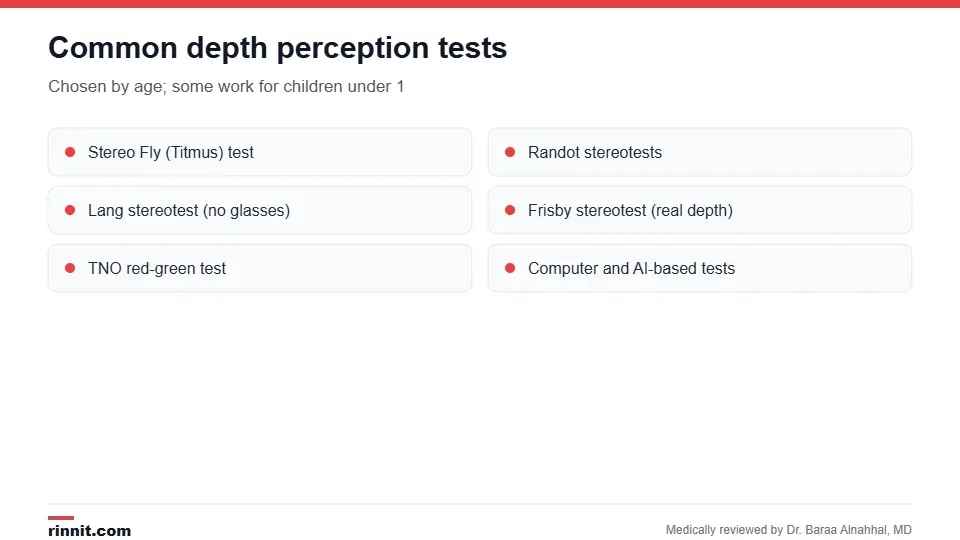
Your eye specialist chooses a test that fits your age.
Test | How it works |
Stereo Fly (Titmus) | A booklet viewed through polarized glasses; a fly, animals and circles appear to stand out |
Randot | Random-dot patterns with hidden shapes seen through polarized glasses |
Lang stereotest | Random-dot card that works without glasses, useful for young children |
Frisby | Clear plates with real depth, no glasses needed |
TNO | Random-dot images viewed through red-green glasses |
Some tests use printed books, some use physical objects and some use electronic devices. Your specialist, an optometrist or ophthalmologist, chooses the right one for your age. Sources: [1, 2]
How do I prepare?
No preparation is needed. Wear your glasses or contacts if you use them. Adults are usually tested in a medical office, and children may be tested at school. Sources: [1]
What happens during the test?
You put on special glasses if the test needs them.
You look at a series of images or objects.
You say or point to which shapes appear raised or closer.
The images get harder until you can no longer see the depth, which shows your level of stereoacuity. Sources: [1]
The test takes no more than 15 minutes. As part of a full eye exam, the visit may take up to 90 minutes, though usually less than an hour. There are no risks or side effects. Sources: [1]
Understanding your results

Classic stereotests are useful but not perfect screeners.
Your specialist gives results right away, describing your depth perception as present, limited or absent. Next steps depend on the cause: glasses, patching or eye drops for amblyopia, vision therapy, or strabismus surgery for misaligned eyes. Sources: [1]
Because no single stereotest catches every problem, screening programs combine depth testing with a visual acuity test and other checks. Sources: [2, 3]
Living with reduced depth perception
People who've had depth perception problems since early life usually compensate with other cues, such as shadows, size and movement. Those who develop problems later often adapt over time, and a specialist can teach techniques to judge distance more safely. Sources: [1]
Conclusion
A depth perception test is a quick, painless way to check that your eyes and brain work together. For children, early testing can catch amblyopia and strabismus while they're most treatable. If you notice trouble judging distances, bumping into things or eye strain, ask for a professional eye exam.
Keep learning: read about amblyopia and how depth perception works.
Frequently asked questions
What does a depth perception test check?
How well your eyes work together and how your brain judges depth and distance.
How long does the test take?
No more than 15 minutes on its own.
Do I need eye drops?
No. Dilation isn't required.
Can babies be tested?
Yes. Some tests work for children under 1 year old.
What results can I get?
Depth perception that's present, limited or absent.
Can I test my depth perception online?
Online tests aren't reliable substitutes for professional testing.
What causes poor depth perception?
Commonly amblyopia, strabismus, poor vision in one eye, eye injuries or neurological conditions.
Can depth perception be improved?
Treating the cause early, especially in children, can help; adults often learn to compensate.
Is the test the same as a vision test?
No. A vision test measures sharpness; a depth test measures how the eyes work together.
Who performs it?
An optometrist or ophthalmologist, or a trained screener at school.
Related Reading
Understanding Depth Perception: How You See the World in 3D how depth perception works.
Lazy Eye (Amblyopia): Symptoms, Causes, Treatment & Complete Guide the most common cause of poor depth perception in children.
Strabismus Surgery: How Eye Muscle Surgery Realigns the Eyes, Recovery and Risks treatment for misaligned eyes.
What Is Binocular Vision Dysfunction (BVD)? Symptoms, Causes, Diagnosis, and Treatment Explained a condition where the eyes don't work together well.
Eye Exam: What Happens, Tests Included and How Often to Go the routine exam that may include depth testing.
References
Cleveland Clinic. Depth Perception Test: What It Is & How It Works. Cleveland Clinic. Last updated January 15, 2024. https://my.clevelandclinic.org/health/diagnostics/depth-perception-test
Csizek Z, Mikó-Baráth E, Budai A, et al. Artificial intelligence-based screening for amblyopia and its risk factors: comparison with four classic stereovision tests. Front Med (Lausanne). 2023;10:1294559. PMID 38196833. https://doi.org/10.3389/fmed.2023.1294559
Nishimura M, Wong A, Cohen A, et al. Choosing appropriate tools and referral criteria for vision screening of children aged 4-5 years in Canada: a quantitative analysis. BMJ Open. 2019;9(9):e032138. PMID 31558460. https://doi.org/10.1136/bmjopen-2019-032138
Medical disclaimer
This article is for general education only and does not replace advice from a qualified healthcare professional. Talk to your doctor about your own diagnosis and treatment, and seek emergency care right away for severe or sudden symptoms.



Comments