Understanding Depth Perception: How You See the World in 3D

Updated: 3 days ago
Medically reviewed by Dr. Baraa Alnahhal, MD · Last reviewed: October 2026
Quick Answer: What is depth perception?
Depth perception is the ability to see objects in three dimensions, allowing you to estimate their size and distance [1]. Your eyes capture light, and the brain's visual cortex combines those signals into a single 3D image [1]. Binocular vision is standard for accurate depth, though the brain can sometimes adapt to monocular vision [1] [2]. Healthy depth perception is essential for everyday safety.
What the research says
The brain can adapt to monocular cues. A review of three-dimensional endoscopy in sinus surgery notes that conventional two-dimensional endoscopy loses binocular vision and limits depth perception, yet its clinical role for 3D has been limited in part by the successful adaptation of endoscopic surgeons to the monocular cues offered by 2D technology (PubMed: Singh and Saraiya, Curr Opin Otolaryngol Head Neck Surg, 2013 [2]).
Treating eye misalignment is about restoring binocular function. A Cochrane systematic review of four randomized trials (242 participants) comparing botulinum toxin with surgery for strabismus found low-certainty evidence that surgery may be more likely to improve or correct strabismus (RR 0.72, 95% CI 0.53 to 0.99), and low-certainty evidence that botulinum toxin may have little to no effect on achieving stereopsis compared with surgery in children with acquired or infantile esotropia (RR 0.86, 95% CI 0.59 to 1.25) (PubMed: Bort-Martí et al., Cochrane Database Syst Rev, 2023 [3]).
Binocular vision problems can be treated. A Cochrane network meta-analysis of 12 trials (1,289 participants) in convergence insufficiency, a common binocular vision disorder, found high-certainty evidence that office-based vergence/accommodative therapy with home reinforcement increases the chance of a successful outcome in children compared with home-based pencil/target push-ups (RR 2.86, 95% CI 1.82 to 4.35) or placebo (RR 3.04, 95% CI 2.32 to 3.98) (PubMed: Scheiman et al., Cochrane Database Syst Rev, 2020 [4]).
The Visual Pathway of Depth Perception
Depth perception is not just an eye function; it is a collaborative effort involving several anatomical structures. The process begins when light enters your eyes and strikes the retinas at the back. These light signals are then converted into electrical information and sent through the optic nerves [1].
The optic nerves meet at an X-shaped junction called the optic chiasm before reaching the brain's visual cortex [1]. Here, the brain takes the slightly different images from each eye and merges them into the cohesive, three-dimensional view you experience. This binocular fusion is what gives objects their perceived depth and volume.
Stage | Anatomical Part | Primary Function |
|---|---|---|
Capture | Retinas | Interpret light and send signals to optic nerves |
Transmission | Optic Nerves | Carry visual data to the brain via the optic chiasm |
Processing | Visual Cortex | Combine signals into a single 3D image |
Why Depth Perception Matters
Without depth perception, the world would appear as a flat, two-dimensional surface, similar to a photograph. This ability is fundamental to navigating your environment safely and effectively. It allows you to distinguish between the text on a screen and the device itself, or to judge the speed and distance of an oncoming car while driving [1].
In sports, depth perception is what tells an athlete when to swing a bat or catch a ball [1]. In daily life, it helps you walk up stairs without tripping and allows you to know exactly where other people are on a crowded sidewalk. Essentially, depth perception provides the spatial context necessary for almost every physical movement you make.

Conditions That Impact Depth Perception
Because depth perception depends on both eyes working in tandem, any condition that affects overall vision can disrupt it. Common disorders include strabismus (crossed eyes) and amblyopia (lazy eye) [1], where the brain may begin to ignore signals from one eye. This can lead to less accurate depth estimation.
Physical injuries to the eye or trauma that damages the optic nerves can also have a significant impact [1]. Symptoms of depth perception issues often include blurry or double vision, persistent eye pain, and increased sensitivity to light [1]. Interestingly, night blindness does not naturally cause a loss of depth perception [1], though poor lighting can make it harder to see surroundings clearly.

Care and Treatment for Better Vision
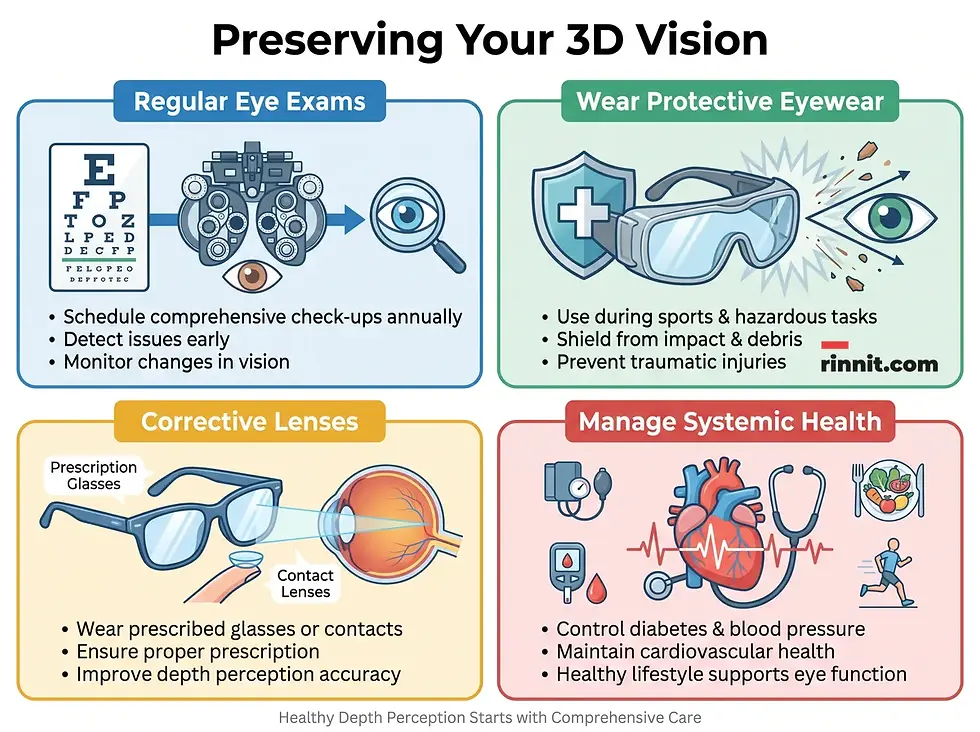
Most depth perception issues are manageable through standard vision correction. If your 3D vision is failing, it may simply mean you need a new prescription for glasses or contact lenses [1]. Eye care providers test depth perception with stereo tests viewed with both eyes, and they also check each eye individually [1] to identify any differences in visual acuity.
Protecting your eyes during high-risk activities is also vital. Wearing proper eye protection during sports or manual labor [1] can prevent traumatic injuries that might lead to permanent vision loss. If you experience sudden vision changes or severe eye pain, seeking immediate emergency care is essential [1] to preserving your sight and depth perception.
Conclusion
Depth perception is a sophisticated visual tool that provides the shape and distance information necessary for modern life. By allowing you to see the world in three dimensions, it keeps you safe and helps you interact with your environment with precision. Maintaining this ability through regular eye care and protection ensures you can continue to navigate the world with confidence and clarity.
Take the next step: If you notice that objects are appearing flatter than usual or you are struggling to judge distances, schedule an eye exam today. Early detection of vision changes is the best way to protect your depth perception and overall eye health.
Frequently Asked Questions (FAQ)
1. What is depth perception?
Depth perception is the ability to see objects in three dimensions and judge how far away they are from you.
2. Does depth perception require two eyes?
While binocular vision (two eyes) is standard for accurate depth, some people with monocular vision can still perceive depth as their brains adapt.
3. What is the visual cortex?
The visual cortex is the area of the brain responsible for processing all visual information and creating the images you see.
4. What are common signs of depth perception issues?
Common signs include blurry vision, double vision, and difficulty judging distances while walking or driving.
5. Can glasses improve depth perception?
Yes, most depth perception issues caused by poor vision can be corrected with glasses or contact lenses.
6. What is strabismus?
Strabismus, or crossed eyes, is a condition where the eyes do not align properly, which can significantly impact depth perception.
7. Does night blindness affect depth perception?
Night blindness affects your ability to see in low light, but the amount of light does not directly change your depth perception.
8. How do doctors test depth perception?
Providers often test it as part of a comprehensive eye exam, sometimes by checking each eye's vision independently.
9. What is amblyopia?
Amblyopia, or lazy eye, occurs when the brain favors one eye, potentially leading to reduced depth perception.
10. When should I see a doctor for vision changes?
You should see a provider as soon as you notice any changes in your vision or experience persistent eye pain.
Related Reading
Depth Perception Test (Stereopsis Test): Types, How It's Done and What Results Mean explains the test that checks how well the eyes work together to judge depth.
References
Cleveland Clinic. Depth Perception. Cleveland Clinic. Last updated May 3, 2023. https://my.clevelandclinic.org/health/body/24956-depth-perception
Singh A, Saraiya R. Three-dimensional endoscopy in sinus surgery. Curr Opin Otolaryngol Head Neck Surg. 2013;21(1):3-10. doi:10.1097/MOO.0b013e32835bf58c. PMID: 23277168.
Bort-Martí AR, Rowe FJ, Ruiz Sifre L, Ng SM, Bort-Martí S, Ruiz Garcia V. Botulinum toxin for the treatment of strabismus. Cochrane Database Syst Rev. 2023;3(3):CD006499. doi:10.1002/14651858.CD006499.pub5. PMID: 36916692.
Scheiman M, Kulp MT, Cotter SA, Lawrenson JG, Wang L, Li T. Interventions for convergence insufficiency: a network meta-analysis. Cochrane Database Syst Rev. 2020;12(12):CD006768. doi:10.1002/14651858.CD006768.pub3. PMID: 33263359.
Medical Disclaimer
This article is for informational purposes only and does not constitute medical advice. Always seek the advice of your physician or other qualified health provider with any questions you may have regarding a medical condition. Never disregard professional medical advice or delay in seeking it because of something you have read here.



Comments