Cranioplasty: What It Is, How It's Done, Recovery Time and Risks

Updated: 6 days ago
Written and medically reviewed by Dr. Baraa Alnahhal, MD · Last reviewed: October 2026 · How we review
Quick Answer: What is a cranioplasty?
Cranioplasty is a major surgery that repairs a hole or defect in the skull, most often after a craniectomy, a traumatic head injury, or a growth abnormality. A surgeon replaces, repairs, or reshapes the skull using bone, titanium, or a custom implant. It usually takes up to three hours, and recovery takes one to three months. [1]
What the research says
About 1 in 7 cranioplasties needs a second operation. A network meta-analysis of 31 studies found surgical revision in 14% of cases (316 of 2,032), infection in 8% (463 of 4,667), and implant exposure in 6%. (Henry et al., Neurosurgery, 2021) [6]
Very early repair may raise the chance of fluid build-up in the brain. Across 25 studies and 3,126 adults, cranioplasty done within 90 days of craniectomy carried about 2.4 times higher odds of hydrocephalus than later repair, with no difference in infection, bleeding, seizures or overall complications. (Malcolm et al., J Clin Neurosci, 2016) [7]
A patient's own bone can slowly break down after it is put back. In a review of 30 studies, bone resorption occurred in 15.1% of cranioplasties using the patient's own bone and in none using synthetic materials; overall complications were about 1.5 times higher with own bone (risk ratio 1.56). (Gerstl et al., Acta Neurochirurgica, 2022) [8]
Key takeaways
A cranioplasty repairs, replaces or reshapes part of the skull to protect the brain. [1]
It is most common after a traumatic brain injury, a growth abnormality, or earlier skull surgery. [1]
The operation usually lasts up to three hours under general anesthesia. [1]
Most people stay in hospital for about five days and recover in one to three months. [1]
Complications occur in nearly 40% of cases, so follow-up visits and early reporting of symptoms matter. [1]
Cranioplasty at a glance
Question | Short answer |
What is it? | Surgery to repair a defect (hole) in the skull [1] |
Common reasons | Traumatic head injury, growth abnormality, previous skull surgery [1] |
Anesthesia | General anesthesia (you are asleep) [1] |
How long it takes | Usually up to 3 hours [1] |
Hospital stay | Monitored unit overnight, then up to about 5 days on a ward [1] |
Recovery time | Usually 1 to 3 months [1] |
Follow-up visits | Typically at 1 week, 1 month and 3 months [1] |
Overall complication chance | Nearly 40% [1] |
What is a cranioplasty?
A cranioplasty is a surgical procedure that repairs a defect in the skull, the bone that surrounds and protects the brain. [1]
During the operation, a surgeon may do one or more of the following:
Replace a missing part of the skull.
Repair damage to the skull.
Reshape (contour) the skull.
It is often the second half of a two-step treatment. Some people first need a craniectomy or another type of brain surgery, and the cranioplasty later closes the gap that surgery left behind. [1]
Cranioplasty is an elective procedure. This means it is planned in advance rather than done as an emergency. Your surgeon decides whether you are a candidate and when it is safe to operate. [1]
Why would someone need a cranioplasty?
A cranioplasty is needed when part of the skull is missing, damaged or misshapen in a way that leaves the brain exposed or changes the shape of the head. [1]
The surgery is most common after:
A traumatic head injury.
A growth abnormality of the skull.
Previous cranial (skull) surgery.
It can treat:
Condition | What the surgery fixes |
Congenital conditions (birth defects) | Skull shapes present from birth, such as those seen in craniosynostosis |
Damage after a traumatic injury | Broken or missing skull bone |
Skull shape irregularities | Cosmetic defects and dents |
Vulnerable areas of the skull | Spots where the brain could be injured |
A hole left by earlier surgery | The gap after a craniectomy |
Source: [1]
Is cranioplasty a major surgery?
Yes, cranioplasty is a major surgery because it is performed very close to the brain. [1]
That location is why the procedure carries a moderate-to-high level of risk. Your surgical team plans each step carefully to keep that risk as low as possible. [1]
How do you prepare for a cranioplasty?
Preparing for a cranioplasty starts with a meeting with your surgeon, who reviews your full medical history and examines you. [1]
Tests you may need:
Blood tests.
X-ray.
MRI scan.
CT (computed tomography) scan.
Your surgeon chooses the repair material before the operation. Special imaging may be used to measure the defect so a prosthetic can be made to fit it exactly. [1]
Medicine changes:
You may be asked to stop blood thinners, such as warfarin or factor Xa inhibitors, before surgery.
Never stop a medicine on your own. Only do so when your healthcare provider tells you to.
Your surgeon may prescribe antibiotics or anticonvulsants (anti-seizure medicines) to lower the risk of infection or other complications. [1]
Smoking and alcohol:
If you smoke or drink alcohol, cut down or stop at least one week before surgery and for a couple of weeks after. Both can slow healing and raise the risk of complications. [1]
What happens during a cranioplasty?
A cranioplasty is done under general anesthesia, so you are asleep and pain-free throughout. An anesthesiologist gives you the medicines that keep you asleep and control pain. [1]

In the operating room, the surgeon will:
Prepare the site. Hair around the incision is shaved and the skin is cleaned.
Open the scalp. An incision is made in the skin. If you had a craniectomy, it usually follows the same or a similar line.
Expose the skull. Tissue and muscle are moved aside to reach the area that needs repair.
Repair the defect. The missing piece is replaced, or the damaged area repaired, using bone, a custom implant or another material.
Secure the repair. Titanium plates and screws hold the material in place.
Close the wound. Tissue and muscle are moved back over the repair and the skin is closed. [1]
How long does it take? A cranioplasty usually lasts up to three hours. It can take longer depending on what the surgeon needs to do. [1]
What materials are used in a cranioplasty?
Cranioplasty materials include your own skull bone, a bone graft, bone-like synthetics, titanium, or a custom-made implant. [1]
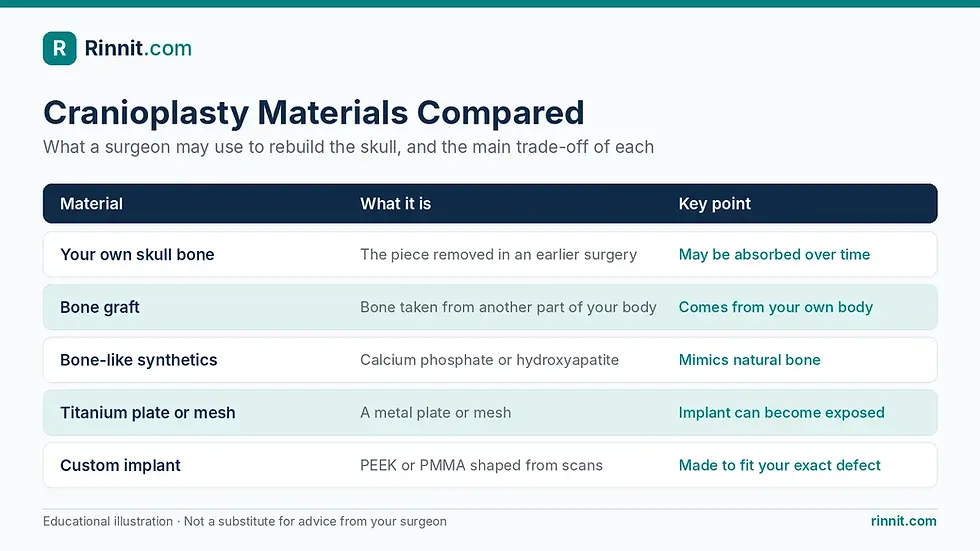
Material | What it is |
Your own skull bone | The piece removed during a previous surgery |
Bone graft | Bone taken from another part of your body |
Synthetic bone-like material | Calcium phosphate or hydroxyapatite, which mimic natural bone |
Titanium | A metal plate or mesh |
Customized implant | Polyetheretherketone (PEEK) or polymethyl methacrylate (PMMA), shaped to fit |
Source: [1]
Your surgeon picks the material that best meets the needs of your operation while keeping your risk of complications as low as possible. [1]
What happens after a cranioplasty?
After a cranioplasty, most people spend the first night in a monitored (step-down) unit so the care team can watch their progress closely. [1]
If there are no complications, you move to a regular hospital bed. Monitoring there lasts up to about five days on average, or longer if needed. [1]
What to expect in hospital:
Headache-like pain. This is common. Your care team will give you pain medicine.
Head elevation. Rest with your head raised and supported on pillows.
Imaging before discharge. You will have scans of your head to check that everything is healing as expected. [1]
At home:
Follow your surgeon's specific care instructions.
Avoid strenuous activities.
Get plenty of rest.
Don't drive until your healthcare provider says it is safe. [1]
What are the benefits of a cranioplasty?
The main benefits of a cranioplasty are protecting the brain and restoring the shape of the head. [1]
Other benefits include:
Reshaping the head.
Fixing the dimpling (sunken area) left after a craniectomy.
Reducing headaches.
Possibly improving brain function. [1]
What are the risks and complications of a cranioplasty?
Studies show there is nearly a 40% chance of some risk or complication after a cranioplasty. Your personal risk depends on what needs to be repaired and on your general health. [1]
Type | Complications |
Most common | Infection, blood clot, brain injury or damage, pneumonia |
Can be life-threatening | Hydrocephalus (fluid build-up in the brain), seizure, stroke |
Source: [1]
The good news is that these complications are treatable when they are found early. This is why follow-up appointments and quick reporting of new symptoms are so important. [1]
How long does it take to recover from a cranioplasty?
Recovery from a cranioplasty usually takes between one and three months. The exact time depends on why you needed the surgery and how much repair was done. [1]

Time after surgery | What usually happens |
First night | Close monitoring in a step-down unit |
Up to ~5 days | Hospital ward stay; head scan before you go home |
1 week | First follow-up appointment |
1 month | Second follow-up appointment |
3 months | Third follow-up appointment |
1–3 months | Most people recover; some need rehabilitation |
Source: [1]
You may need extra visits if a complication such as an infection develops. Some people also take part in rehabilitation during recovery. [1]
When should you call a doctor after a cranioplasty?
Call your healthcare provider after a cranioplasty if you notice any of these signs: [1]
A severe headache that doesn't go away.
Fever.
Swelling.
Fluid leaking from the surgical site.
Call 911 or your local emergency number right away if you have a seizure or any signs of a stroke. [1]
Conclusion
A cranioplasty is a planned surgery that repairs or rebuilds part of the skull, most often after a craniectomy or a head injury. It protects the brain, restores the shape of the head, and may ease headaches and improve brain function. [1]
It is a major operation with a real risk of complications. Most of those problems can be treated when they are caught early, so keep every follow-up visit and report warning signs quickly. [1]
Feeling anxious before a second surgery is completely normal. Write down your questions and go through them with your surgeon — about the material they plan to use, the timing, and what your recovery will look like.
Want more clear, doctor-reviewed health guides? Explore more health guides on Rinnit.com and share this guide with anyone preparing for skull repair surgery.
FAQ
Is cranioplasty a major surgery?
Yes. Cranioplasty is a major surgery with a moderate-to-high risk because it is performed very close to the brain. [1]
How long does a cranioplasty take?
A cranioplasty usually takes up to three hours, but it can take longer depending on what the surgeon needs to repair. [1]
How long will I stay in hospital after a cranioplasty?
Most people spend one night in a monitored unit and then stay on a regular ward for up to about five days, or longer if needed. [1]
What is the recovery time for a cranioplasty?
Recovery from a cranioplasty usually takes between one and three months, depending on the reason for the surgery and how extensive it was. [1]
What is used to replace the skull in a cranioplasty?
Surgeons may use your own skull bone, a bone graft, calcium phosphate or hydroxyapatite, a titanium plate or mesh, or a custom PEEK or PMMA implant. [1]
Will my hair be shaved for a cranioplasty?
Yes. Hair is shaved around the incision site before the skin is cleaned and opened. [1]
Can a cranioplasty improve brain function?
Cranioplasty can improve brain function in some people, and it can also reduce headaches and fix the dimpling left after a craniectomy. [1]
When can I drive after a cranioplasty?
You should not drive until your healthcare provider tells you it is safe. [1]
What are the warning signs after a cranioplasty?
Call your provider for a severe headache that won't go away, fever, swelling, or fluid leaking from the wound. Call emergency services for a seizure or signs of a stroke. [1]
How soon after a craniectomy is a cranioplasty done?
Timing depends on how well the brain and scalp have healed and on your overall health. It is usually done weeks to months after the craniectomy, and your surgeon will choose the best time for you.
Related reading on Rinnit.com
References
Cleveland Clinic. Cranioplasty: What It Is, Procedure, Recovery & Risks. Cleveland Clinic. Last updated April 18, 2023. https://my.clevelandclinic.org/health/treatments/24924-cranioplasty
Andrabi SM, Sarmast AH, Kirmani AR, et al. Cranioplasty: indications, procedures, and outcome — an institutional experience. Surgical Neurology International. 2017;8:91. PMID 28607825. https://doi.org/10.4103/sni.sni_45_17
Mee H, Anwar F, Timofeev I, et al. Cranioplasty: a multidisciplinary approach. Frontiers in Surgery. 2022;9:864385. PMID 35656088. https://doi.org/10.3389/fsurg.2022.864385
Ong AA, Manning JP, Vincent AG, et al. Cranioplasty. Facial Plastic Surgery. 2021;37(6):698-702. PMID 34521150. https://doi.org/10.1055/s-0041-1735560
Piazza M, Grady MS. Cranioplasty. Neurosurgery Clinics of North America. 2017;28(2):257-265. PMID 28325460. https://doi.org/10.1016/j.nec.2016.11.008
Henry J, Amoo M, Taylor J, et al. Complications of cranioplasty in relation to material: systematic review, network meta-analysis and meta-regression. Neurosurgery. 2021;89(3):383-394. PMID 34100535. https://doi.org/10.1093/neuros/nyab180
Malcolm JG, Rindler RS, Chu JK, et al. Complications following cranioplasty and relationship to timing: a systematic review and meta-analysis. Journal of Clinical Neuroscience. 2016;33:39-51. PMID 27499122. https://doi.org/10.1016/j.jocn.2016.04.017
Gerstl JVE, Rendon LF, Burke SM, et al. Complications and cosmetic outcomes of materials used in cranioplasty following decompressive craniectomy — a systematic review, pairwise meta-analysis, and network meta-analysis. Acta Neurochirurgica. 2022;164(12):3075-3090. PMID 35593924. https://doi.org/10.1007/s00701-022-05251-5
Disclaimer
This article is for general education only and is not a substitute for professional medical advice, diagnosis or treatment. Always talk to your surgeon or healthcare provider about your own situation. If you have a seizure or signs of a stroke, call 911 or your local emergency number immediately.



Comments