Commissurotomy: How Surgery Frees a Narrowed Mitral Valve

Updated: 6 days ago
Written and medically reviewed by Dr. Baraa Alnahhal, MD · Last reviewed: October 2026 · How we review
Quick Answer: What is a commissurotomy?
A commissurotomy is heart surgery that widens a mitral valve narrowed by rheumatic heart disease, using small cuts to separate the valve's fused flaps so blood flows more easily. Doctors usually try a less invasive balloon procedure first. Most people stay in hospital about a week, and many need a valve replacement later in life. [4] [5]
What the research says
Balloon and surgical commissurotomy give similar durability. A review of 7 randomized trials (553 patients) found no convincing difference in how often the valve narrowed again or needed another procedure, while the balloon approach carried less risk around the time of treatment. (Singh et al., Heart, 2020) [1]
Open commissurotomy holds up well against valve replacement over 20 years. In 249 people with severe rheumatic mitral stenosis (average follow-up 11.4 years), serious long-term problems were similar after commissurotomy and mechanical valve replacement (36.9% vs 44.6% at 20 years). Major bleeding was lower after commissurotomy (4.4% vs 22.5%), and valve area rose from 0.90 to 1.56 cm² at 15 years. (Park et al., Ann Thorac Surg, 2026) [2]
Results can last decades. Among 268 patients followed for up to 50 years, about 89% of those who had open commissurotomy were free from repeat surgery at 10 years, and about 79% at 30 years. (Reichart et al., J Thorac Cardiovasc Surg, 2012) [3]
Key takeaways
A commissurotomy treats mitral valve stenosis caused by rheumatic heart disease.
It works by releasing the valve's fused commissures (the corners where the two flaps meet).
It is usually open-heart surgery and is relatively uncommon today.
Balloon valvuloplasty is usually tried first. Commissurotomy is for people who can't have it or didn't improve.
Expect about a week in the hospital, starting with a couple of days in the ICU.
It helps blood flow well, but many people need a valve replacement later.
What is a commissurotomy?
A commissurotomy is surgery that improves blood flow through a heart valve, most often the mitral valve. [5]
Your mitral valve is the "door" between two chambers on the left side of your heart:
Left atrium: the top left chamber
Left ventricle: the bottom left chamber
It is also called the bicuspid valve because it has two flaps (cusps) that open and close to control blood flow. [5]
In mitral valve stenosis, the valve can't open as wide as it should. Less blood reaches the left ventricle, and blood backs up in the heart. Over time, this strains the heart and lungs and can lead to complications such as heart failure. [5]
A mitral commissurotomy is one treatment option for mitral stenosis in its early stages. [5]

What are commissures?
The commissures are the corners where the mitral valve's two flaps join. Normally, they separate easily each time the valve opens. [5]
Here is a simple way to picture it:
Smile in a mirror without parting your lips. The pointed corners of your mouth are like the valve's commissures.
Your lips are like the valve's two flaps.
Now press a finger firmly on each corner so your lips can't separate. It becomes hard to open your mouth wide.
That "stuck corners" effect is what happens in rheumatic mitral stenosis, except the result is reduced blood flow through the valve. A commissurotomy uses small surgical cuts to release those fused corners. [5]
Who needs a commissurotomy?
A commissurotomy is recommended for people with mitral valve stenosis whose other treatments haven't helped or who can't have balloon valvuloplasty. Your doctor may recommend it if you have mitral valve stenosis and: [5]
Other treatments haven't helped you, or
You're not a candidate for balloon valvuloplasty, often because of your heart's anatomy
It may also be recommended if you need other heart procedures. The surgeon can do them during the same operation. [5]
Why the cause of stenosis matters
Not everyone with mitral stenosis can have a commissurotomy. It depends on the cause. [4] [5]
Rheumatic mitral stenosis | Degenerative mitral stenosis | |
Cause | Damage from rheumatic heart disease | The valve breaks down over time |
What goes wrong | Commissures become thickened or fused | Commissures are usually not damaged; other valve parts need repair |
Can commissurotomy help? | Yes, it's designed for this | Usually not |
Typical alternatives | Balloon valvuloplasty, commissurotomy, or replacement | Other types of mitral valve repair, or mitral valve replacement |
[5]
In rheumatic mitral stenosis, an autoimmune illness called rheumatic fever damages the heart valve. That damage often doesn't show up until many years later. [5]
How do you prepare for an open commissurotomy?
Preparing for an open commissurotomy starts weeks or months before surgery, with a full medical evaluation and heart tests. Your care team usually includes a primary care physician, a cardiologist and a cardiothoracic surgeon. [5]
Medical evaluation:
A thorough physical exam
Blood tests
A review of your symptoms and medical history
Heart tests to check the mitral valve and look for blockages in the coronary arteries:
Echocardiography (heart ultrasound)
CT scan
Coronary angiography
Before surgery day:
Follow your team's instructions on when to stop eating and drinking.
Ask which medicines to change or pause.
If you smoke or use tobacco, quit before surgery to lower your risk of complications. Ask your provider for support.
Write down your questions. Getting clear answers can help you feel calmer.
[5]
How is a commissurotomy done?
A commissurotomy is done through an incision in the breastbone while a heart-lung machine takes over, so the surgeon can release the fused commissures on a still heart. The surgical team follows these steps: [4] [5]
Anesthesia puts you into a deep sleep.
Median sternotomy: the surgeon makes an incision down the middle of your breastbone (sternum).
Heart-lung machine: you're connected to cardiopulmonary bypass. It takes over for your heart and lungs, so the surgeon can work on a still heart while blood keeps flowing to your organs.
The surgeon opens the left atrium.
The surgeon examines the mitral valve.
Small cuts are made in the commissures so they're no longer fused.
You're taken off bypass, and your heart and lungs start working again.
A transesophageal echocardiogram (TEE), an ultrasound through the esophagus, checks the valve and confirms the repair worked.
Sometimes surgeons repair other valves, such as the aortic or tricuspid valve, or do other heart procedures during the same operation. Your team will tell you ahead of time if this applies to you. You can learn more in our guide to open-heart surgery. [5]

What is recovery like after a commissurotomy?
Recovery after a commissurotomy usually means about a week in the hospital, starting with a couple of days in the intensive care unit (ICU). [5]
Stage | What to expect |
First couple of days | Intensive care unit (ICU), with close monitoring for complications |
Total hospital stay | About one week |
Before you go home | Guidance on cardiac rehab, incision care, and when to drive or resume activities |
Going home | Arrange for someone to drive you home |
[5]
Cardiac rehab is a supervised program for people recovering from heart surgery. It helps you rebuild strength for everyday tasks. [5]
Incision care matters because it lowers your risk of infection and helps the wound heal. [5]
What are the benefits of a mitral commissurotomy?
A mitral commissurotomy relieves mitral stenosis, helps blood flow better through your heart and reduces strain on your heart and lungs. In short, a commissurotomy can: [5]
Relieve mitral stenosis and its symptoms
Help blood flow better through your heart
Reduce strain on your heart and lungs
Lower your risk of complications
It is a good fit when the stenosis isn't severe enough to need a valve replacement, and other treatments either haven't helped or a balloon procedure isn't possible. [5]
What are the risks of a commissurotomy?
The most common complication of open commissurotomy is mitral valve regurgitation, a leaky valve. [5]
Other possible complications | |
Reaction to anesthesia | Confusion or trouble thinking |
Heart attack | |
Bleeding | Incision infection |
Stroke |
[5]
Your risk is lower at a major medical center with surgeons experienced in valve surgery. [5]
Health conditions that can raise your risk:
Chronic obstructive pulmonary disease (COPD)
Diabetes
Kidney disease
Obesity
Peripheral artery disease
Talk with your doctor about your personal risk and what you can do to lower it. [5]
How does a commissurotomy compare with other mitral stenosis treatments?
A commissurotomy sits between balloon valvuloplasty, which is usually tried first, and mitral valve replacement, which is used when the valve is too damaged to repair. [5]
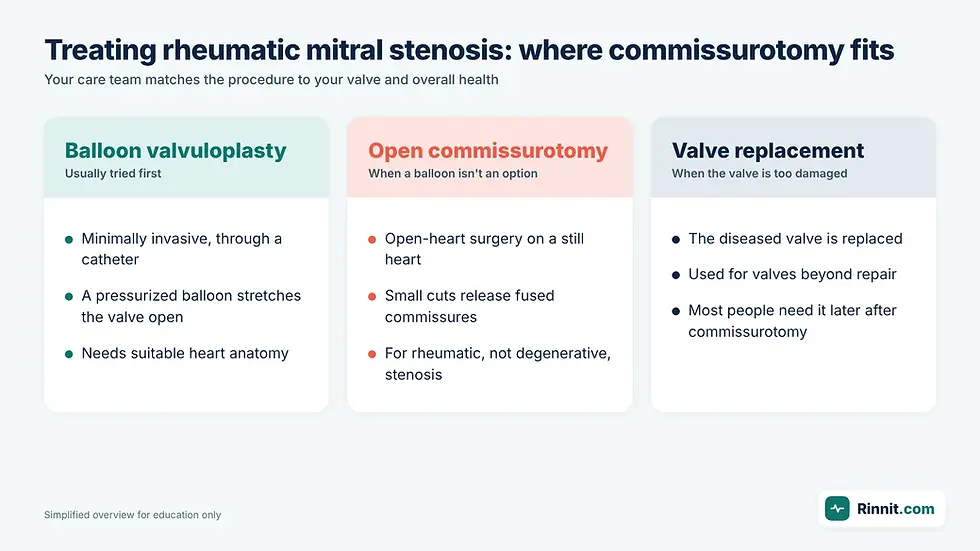
Balloon valvuloplasty | Open commissurotomy | Mitral valve replacement | |
Approach | Minimally invasive, through a catheter | Open-heart surgery | Surgery to replace the valve |
How it works | A pressurized balloon stretches the valve open | Small cuts release fused commissures | The diseased valve is replaced |
When it's used | Usually the first-line option | When a balloon isn't possible or hasn't helped | When the valve is too diseased to repair |
Key point | Depends on suitable heart anatomy | Best suited to rheumatic stenosis | Many people who have a commissurotomy need it later |
[5]
What is the outlook after a commissurotomy?
The outlook after open mitral commissurotomy is excellent: the surgery usually relieves the narrowing and improves blood flow. [5]
It is not a final treatment, though. Many people who have a commissurotomy eventually need a mitral valve replacement. [5]
Your outlook depends on:
Your age
Your overall health
How much damage your mitral valve had before surgery
Your doctor is the best person to explain your personal prognosis. [5]
When should you call your doctor after a commissurotomy?
Call your healthcare provider during recovery if you notice signs of infection or heart trouble: [5]
Chest pain, pressure or discomfort
Fever
Redness or drainage near your incision
Call your local emergency number right away if you have:
Signs of a heart attack
Slurred speech or other signs of a stroke, such as those described in our thrombotic stroke guide
What is an aortic commissurotomy?
An aortic commissurotomy is similar to a mitral commissurotomy. Both use small cuts in a heart valve to improve blood flow through it. [5]
The difference is who usually has them:
Aortic commissurotomy: usually done in babies with congenital heart defects that affect the aortic valve
Mitral commissurotomy: usually done in adults with rheumatic mitral stenosis
[5]
Conclusion
A commissurotomy is a proven way to reopen a mitral valve narrowed by rheumatic heart disease. By releasing the valve's fused corners, it helps blood move freely again and eases strain on your heart and lungs.
If your doctor recommends it, it usually means a balloon procedure isn't right for you, yet your valve isn't damaged enough to need replacement. Feeling nervous about heart surgery is normal. Your care team is there to answer your questions and guide you through each step.
Want to understand your valve condition better? Read our complete guide to mitral valve disease, then bring your questions to your cardiologist. For more clear, doctor-reviewed heart health guides, explore the Rinnit Health Library.
FAQ
What is a commissurotomy in simple terms?
It is heart surgery that makes small cuts where a valve's flaps have fused together, so the valve opens wider. It's most often done on the mitral valve.
Is a commissurotomy open-heart surgery?
Usually, yes. The surgeon opens the chest through the breastbone and uses a heart-lung machine while working on a still heart.
Who is a candidate for a mitral commissurotomy?
People with rheumatic mitral stenosis whose other treatments haven't helped, or who can't have balloon valvuloplasty. People with degenerative mitral stenosis usually aren't candidates.
How long is the hospital stay after a commissurotomy?
About one week, usually starting with a couple of days in the intensive care unit.
What is the most common complication of a commissurotomy?
Mitral valve regurgitation, or a leaky valve. Other risks include bleeding, abnormal heart rhythms, infection, stroke and heart attack.
Will I need another heart surgery after a commissurotomy?
Possibly. A commissurotomy works well, but many people eventually need a mitral valve replacement.
How is a commissurotomy different from balloon valvuloplasty?
Balloon valvuloplasty is minimally invasive and stretches the valve with a balloon through a catheter. A commissurotomy is usually open-heart surgery that cuts the fused commissures directly. The balloon is usually tried first.
Can a commissurotomy be done with other heart surgery?
Yes. Surgeons sometimes repair other valves, such as the aortic or tricuspid valve, or do other heart procedures during the same operation.
How long does recovery take after a commissurotomy?
Most people stay in hospital about a week and then recover at home over several weeks. Your care team will tell you when you can drive, work and exercise again.
Will I need antibiotics after a commissurotomy?
Many people with rheumatic heart disease take antibiotics long term to prevent rheumatic fever from coming back and damaging the valve again. Your doctor will tell you if you need them and for how long.
Related Reading
Mitral Valve Stenosis: Symptoms, Causes, Diagnosis, and Treatment Explained explains mitral valve stenosis symptoms, causes and treatment.
Understanding Rheumatic Heart Disease: Causes, Symptoms, and Management explains how rheumatic fever damages heart valves over time.
Valvuloplasty: A Minimally Invasive Procedure for Heart Valve Stenosis describes balloon valvuloplasty for opening narrowed heart valves.
Mitral Valve Replacement: Surgery, Valve Types and Recovery explains mitral valve replacement surgery, valve types and recovery.
References
Singh AD, Mian A, Devasenapathy N, et al. Percutaneous mitral commissurotomy versus surgical commissurotomy for rheumatic mitral stenosis: a systematic review and meta-analysis of randomised controlled trials. Heart. 2020;106(14):1094-1101. PMID 31974210. https://doi.org/10.1136/heartjnl-2019-315906
Park I, Ahn JH, Sung K, et al. Long-Term Outcomes of Open Mitral Commissurotomy vs Mechanical Mitral Valve Replacement in Rheumatic Mitral Stenosis. Ann Thorac Surg. 2026;122(2):402-411. PMID 41865964. https://doi.org/10.1016/j.athoracsur.2026.03.018
Reichart DT, Sodian R, Zenker R, et al. Long-term (≤ 50 years) results of patients after mitral valve commissurotomy--a single-center experience. J Thorac Cardiovasc Surg. 2012;143(4 Suppl):S96-S98. PMID 22047683. https://doi.org/10.1016/j.jtcvs.2011.09.064
Bishop MA, Alahmadi MH. Surgical Mitral Commissurotomy. StatPearls. Treasure Island (FL): StatPearls Publishing; updated 2024 Oct 28. PMID 33085410. https://pubmed.ncbi.nlm.nih.gov/33085410/
Cleveland Clinic. Heart Valve Commissurotomy. Cleveland Clinic. Last updated September 16, 2022. https://my.clevelandclinic.org/health/treatments/24188-commissurotomy
Medical disclaimer
This article is for general education only and is not a substitute for professional medical advice, diagnosis or treatment. Always talk with your doctor or heart team about your own care.



Comments