Clitoroplasty: Purpose, Procedure, Risks and Recovery

Updated: 6 days ago
Written and medically reviewed by Dr. Baraa Alnahhal, MD · Last reviewed: October 31, 2026 · How we review
Quick Answer: What is clitoroplasty?
Clitoroplasty is a surgical procedure that reduces, repositions, reshapes or creates the clitoris while aiming to keep its sensation. It treats conditions such as clitoromegaly, congenital adrenal hyperplasia and atypical genitalia, and some adults choose it for comfort or appearance. Surgery takes one to two hours, and full recovery usually takes six to 12 weeks. [1]
What the research says
Reoperation is uncommon, but depends on technique. In 104 children with congenital adrenal hyperplasia followed for a mean of 37.7 months, 8.6% needed a repeat clitoroplasty — 17.3% after reduction surgery versus 2% after recession alone and 0% after girth reduction with recession. (Jun et al., Int J Environ Res Public Health, 2021)
Nerve-sparing methods can preserve sensation. In a multicenter study of 37 girls with congenital adrenal hyperplasia, a technique that preserves the clitoral bodies kept genital sensitivity intact, no patient reported pain, and 90% of caregivers rated the cosmetic result good or satisfactory. (Massuqueto et al., J Pediatr Urol, 2026)
Long-term evidence is still limited. A review of 11 studies found most patients report good clitoral sensation after surgery; poor sensation was linked to repeat operations, tissue removal or nerve injury, and narrowing of the vaginal opening was frequent. All evidence was low quality. (Jesus, J Pediatr Urol, 2018)
Key takeaways
Clitoroplasty can reduce, reposition, reshape or create a clitoris.
Children, teens and adults can have it — for congenital conditions, injury repair, gender-affirming goals or cosmetic reasons.
Most people go home the same day after a one- to two-hour operation.
Avoid sex and anything inside the vagina for at least six weeks.
The biggest concern is loss of sensation; chronic pain, vaginal narrowing and urine leakage are also possible.
Fever of 38°C (100.4°F), chills, uncontrolled pain or pus from the wound need a call to your doctor.
What is clitoroplasty surgery?
Clitoroplasty surgery is an operation on the clitoris that either changes how it looks or creates one where it is missing. The clitoris is a small nub of tissue at the top of the vulva (the external genitals). It contains more than 8,000 nerve endings and is the center of sexual pleasure.
The goal is to change the clitoris's size, position or shape while keeping its pleasure function. Because the area is so rich in nerves and blood vessels, there is a real risk of problems with sensation or blood flow.
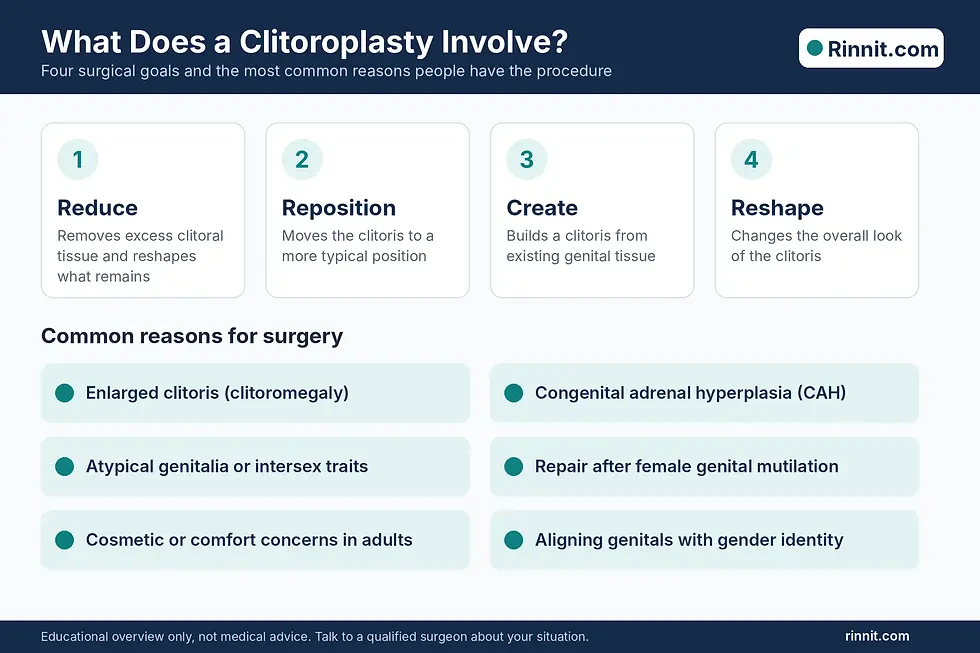
A clitoroplasty can involve:
Reducing the size of the clitoris
Repositioning the clitoris
Creating a clitoris from existing tissue
Changing the appearance of the clitoris
Why do people have a clitoroplasty?
People have a clitoroplasty to treat a condition they were born with, to repair damage, to match their genitals with how they feel about themselves, or to change the clitoris's appearance. Common reasons include:
Being born without a clitoris but with other female genitals
Wanting a smaller or differently shaped clitoris
Wanting a clitoris so the genitals align with gender identity
Repairing damage from female genital mutilation (female circumcision)
What conditions does clitoroplasty treat?
Clitoroplasty treats several congenital conditions (present from birth) and some acquired changes. It can be done alone or as one step in a series of surgeries that reshape the genitals or build new genitalia from existing tissue.
Condition | What it means | How clitoroplasty helps |
Clitoromegaly | An enlarged clitoris, present at birth or developing later, most often from exposure to androgens (male-type hormones) | Gives the clitoris a more typical size and shape |
Congenital adrenal hyperplasia (CAH) | A hormone (endocrine) condition that can make the clitoris enlarge and resemble a penis | Shapes the tissue into a more typical-looking clitoris |
46,XX difference of sex development (formerly "female pseudohermaphroditism") | Ovaries and internal female organs, but external genitals that look male | Forms part of feminizing genital surgery |
Atypical genitalia or intersex traits | Sexual anatomy that doesn't look classically male or female, noticed at birth or later | Helps achieve the external genitals the person wants |
Cosmetic concerns | An adult clitoris that has changed and affects comfort or sexual pleasure | Reduces or repositions the clitoris |
For more on these conditions, read our guide to atypical genitalia in infants.
Should children have clitoroplasty?
Whether children should have clitoroplasty is a decision parents should make carefully with their child's healthcare team, because surgery has lifelong effects. For some infants and children with congenital conditions, the procedure can support medical and emotional well-being as they grow. However, it remains controversial, and studies on long-term results in children and teens are still ongoing.
How should I prepare for a clitoroplasty?
Preparing for a clitoroplasty starts with a consultation where your healthcare team reviews your full health history, your goals and the risks. This is the time to ask every question about surgery and recovery.
Before surgery, your team may:
Order blood tests or imaging
Do a physical and wellness exam to confirm you're ready
Ask about allergies and every medicine you take
Tell you when to stop eating and drinking, and when to arrive
What happens during a clitoroplasty?
During a clitoroplasty, the surgeon removes, reshapes or rebuilds clitoral tissue and closes the cuts with stitches. The exact method depends on why you're having surgery and how complex it is.
Step | What to expect |
Anesthesia | Local anesthesia (you're awake, the area is numb) or general anesthesia (you're asleep) |
Reduction or reshaping | Excess clitoral tissue is removed and the remaining tissue is reshaped |
Creating a clitoris | For congenital differences, the surgeon builds a clitoris from the genital tissue that is present |
Closing | Incisions are closed with stitches |
Length | Usually one to two hours |
Going home | Most people go home the same day (outpatient surgery) |
What happens right after a clitoroplasty?
Right after a clitoroplasty, your team watches your blood pressure, breathing and heart rate until they're satisfied you can go home. Arrange a driver, and plan for extra help at home for the first 24 to 48 hours.
Expect some pain, swelling and discomfort. Your provider may advise taking at least one to two weeks off work or school and cutting back on physical activity.
How long does it take to recover from a clitoroplasty?
Recovery from a clitoroplasty usually takes six to 12 weeks, depending on how complex the surgery was and how your body heals. Swelling should improve within six weeks, but the area may still look swollen for up to three months.
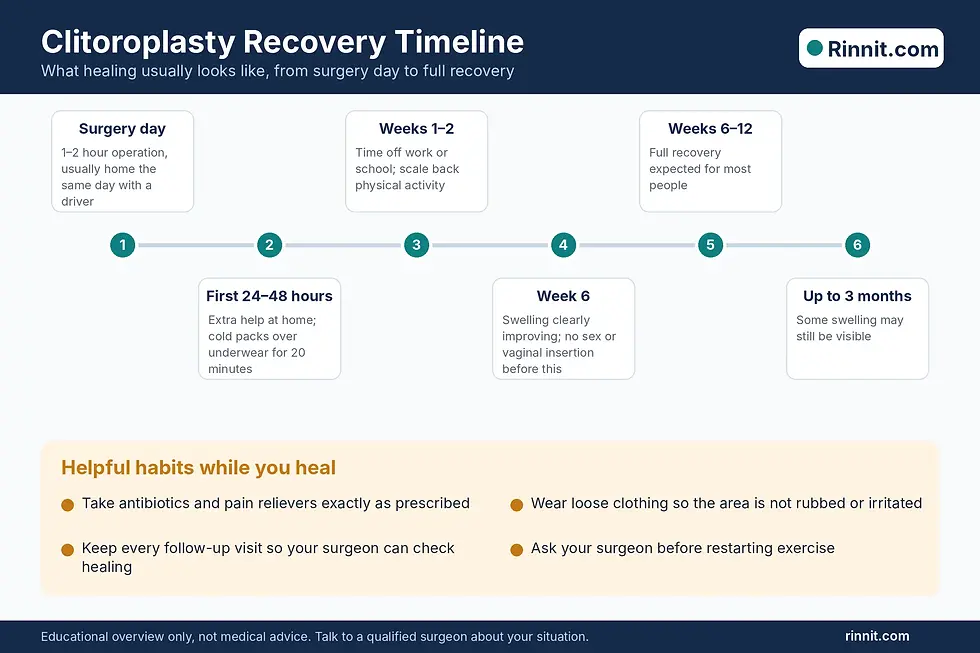
Time after surgery | What's typical |
Day of surgery | Home the same day with a driver |
First 24–48 hours | Extra support at home; pain and swelling |
Weeks 1–2 | Time off work or school; reduced activity |
Week 6 | Swelling improving; earliest point to consider sex, only with your surgeon's OK |
Weeks 6–12 | Full recovery for most people |
Up to 3 months | Some visible swelling may remain |
Your surgeon will schedule follow-up visits to check how the clitoris is healing.
How can I make clitoroplasty recovery easier?
You can make clitoroplasty recovery easier by controlling swelling, protecting the area and following your medicine plan:
Apply a cold pack over your underwear for 20 minutes, several times a day
Take antibiotics and pain relievers exactly as directed
Wear loose clothing to avoid rubbing the area
Don't have sex or put anything in your vagina for six weeks
Ask your surgeon before returning to exercise
What are the benefits of clitoroplasty?
The benefits of clitoroplasty can be physical, functional, emotional and psychological. For some children with congenital conditions, surgery can support medical and emotional well-being as they develop.
For others, clitoroplasty can:
Reduce pain during sex
Increase sexual pleasure
Repair an injury or other trauma to the area
What are the risks of clitoroplasty?
The main risk of clitoroplasty is losing nerve sensation, and some providers believe that risk outweighs cosmetic benefits when the condition isn't causing pain. Chronic pain after surgery is another serious risk, and it can be very hard to live with.

Risk | What it means |
Nerve damage | Reduced or lost clitoral sensation |
Chronic pain | Ongoing pain that persists after healing |
Vaginal stenosis | Narrowing of the vagina — see our guide to vaginal stenosis |
Urinary incontinence | Leaking urine — see our urinary incontinence guide |
Urethrovaginal fistula | An abnormal opening between the urethra and vagina — learn more about fistulas |
Bleeding or bruising | Common around any genital surgery |
Clitoroplasty is also a controversial procedure. People hold different views on whether and when it is necessary, and research on outcomes — especially in children and teens — is still ongoing.
Is clitoroplasty the same as labiaplasty or vaginal rejuvenation?
Clitoroplasty is not the same as labiaplasty or vaginal rejuvenation: clitoroplasty changes the clitoris itself, while labiaplasty reshapes the labia (vaginal lips). Read more about labiaplasty and vaginal rejuvenation procedures.
When should I call my doctor after a clitoroplasty?
Call your doctor after a clitoroplasty if you notice signs of infection or pain that isn't controlled:
Fever of 38°C (100.4°F) or higher
Chills
Pain that doesn't improve with pain medicine
Pus, bloody discharge or a foul smell from the surgical area
Conclusion
Clitoroplasty can help people physically, emotionally and in how they feel about their bodies — whether the goal is treating a condition present from birth, repairing an injury or changing appearance. It is also a life-changing operation with real risks, especially to sensation, and success isn't guaranteed. The best outcomes start with an honest conversation with an experienced surgical team about your goals, expectations and the trade-offs.
Next step: If you're considering clitoroplasty for yourself or your child, write down your goals and questions and bring them to a consultation with a qualified urologist, gynecologist or reconstructive surgeon. For related reading, explore our guide to painful intercourse (dyspareunia) and browse more women's health guides on Rinnit.com.
FAQ
What is a clitoroplasty?
A clitoroplasty is surgery that reduces, repositions, reshapes or creates the clitoris while aiming to keep its sensation.
Who can have a clitoroplasty?
Children, teens and adults can have a clitoroplasty — for congenital conditions, injury or genital mutilation repair, gender-affirming goals or cosmetic reasons.
How long does clitoroplasty surgery take?
Clitoroplasty surgery usually takes one to two hours, and most people go home the same day.
How long is recovery after clitoroplasty?
Full recovery usually takes six to 12 weeks. Swelling improves within six weeks but may last up to three months.
When can I have sex after clitoroplasty?
Wait at least six weeks, or until your surgeon says it's safe, before having sex or placing anything in the vagina.
Will I lose sensation after clitoroplasty?
Loss of nerve sensation is the main risk of clitoroplasty. Ask your surgeon how their technique protects the nerves.
Is clitoroplasty done under general anesthesia?
It can be done under general anesthesia (asleep) or local anesthesia (awake, with the area numbed), depending on the surgery.
What are the warning signs after clitoroplasty?
Call your doctor for fever of 38°C (100.4°F) or higher, chills, pain not eased by medicine, or pus, bleeding or a foul smell from the wound.
Is clitoroplasty the same as clitoral hood reduction?
No. Clitoroplasty changes the clitoris itself, while clitoral hood reduction removes extra skin from the fold that covers the clitoris. Some people have both at the same time.
How much time off work will I need after clitoroplasty?
Your provider may advise taking at least one to two weeks off work or school. Full recovery usually takes six to 12 weeks.
Related Reading
Clitoral Hood Reduction: Procedure, Recovery, Risks and Benefits explains surgery that removes extra skin over the clitoris.
Labiaplasty: Understanding the Procedure, Recovery, and Benefits describes labia reshaping surgery, recovery and expected results.
What Is Congenital Adrenal Hyperplasia (CAH)? Symptoms, Causes, Diagnosis & Treatment Explained explains an inherited hormone condition that can affect genital development.
Atypical Genitalia in Infants: Causes, Diagnosis, Treatment & Complete Guide covers causes, testing and care options for atypical genitalia in babies.
References
Cleveland Clinic. Clitoroplasty. Cleveland Clinic Health Library. Last updated July 26, 2023. https://my.clevelandclinic.org/health/treatments/16253-clitoroplasty
Jun J, Song SH, Park S, et al. Surgical Outcomes of Clitoroplasty in Children with Congenital Adrenal Hyperplasia and Clitoral Hypertrophy: A 19-Year Experience of a Single Surgeon. Int J Environ Res Public Health. 2021;18(21):11152. PMID 34769670. https://doi.org/10.3390/ijerph182111152
Massuqueto E, Venturini B, Moura IMS, et al. Clitoroplasty with corporoplasty in feminizing genitoplasty: Multicenter evaluation of sensory and cosmetic outcomes. J Pediatr Urol. 2026;22(3):105797. PMID 41762992. https://doi.org/10.1016/j.jpurol.2026.105797
Jesus LE. Feminizing genitoplasties: Where are we now? J Pediatr Urol. 2018;14(5):407-415. PMID 29793846. https://doi.org/10.1016/j.jpurol.2018.03.020
Disclaimer
This article is for educational purposes only and is not a substitute for professional medical advice, diagnosis or treatment. Always speak with a qualified healthcare provider about your situation.



Comments