Atypical Genitalia in Infants: Causes, Diagnosis, Treatment & Complete Guide

Updated: 2 days ago
Medically reviewed by {{Dr. Baraa Alnahhal, MD|https://www.rinnit.com/dr-baraa-alnahhal}} · Last reviewed: October 2026
Quick Answer
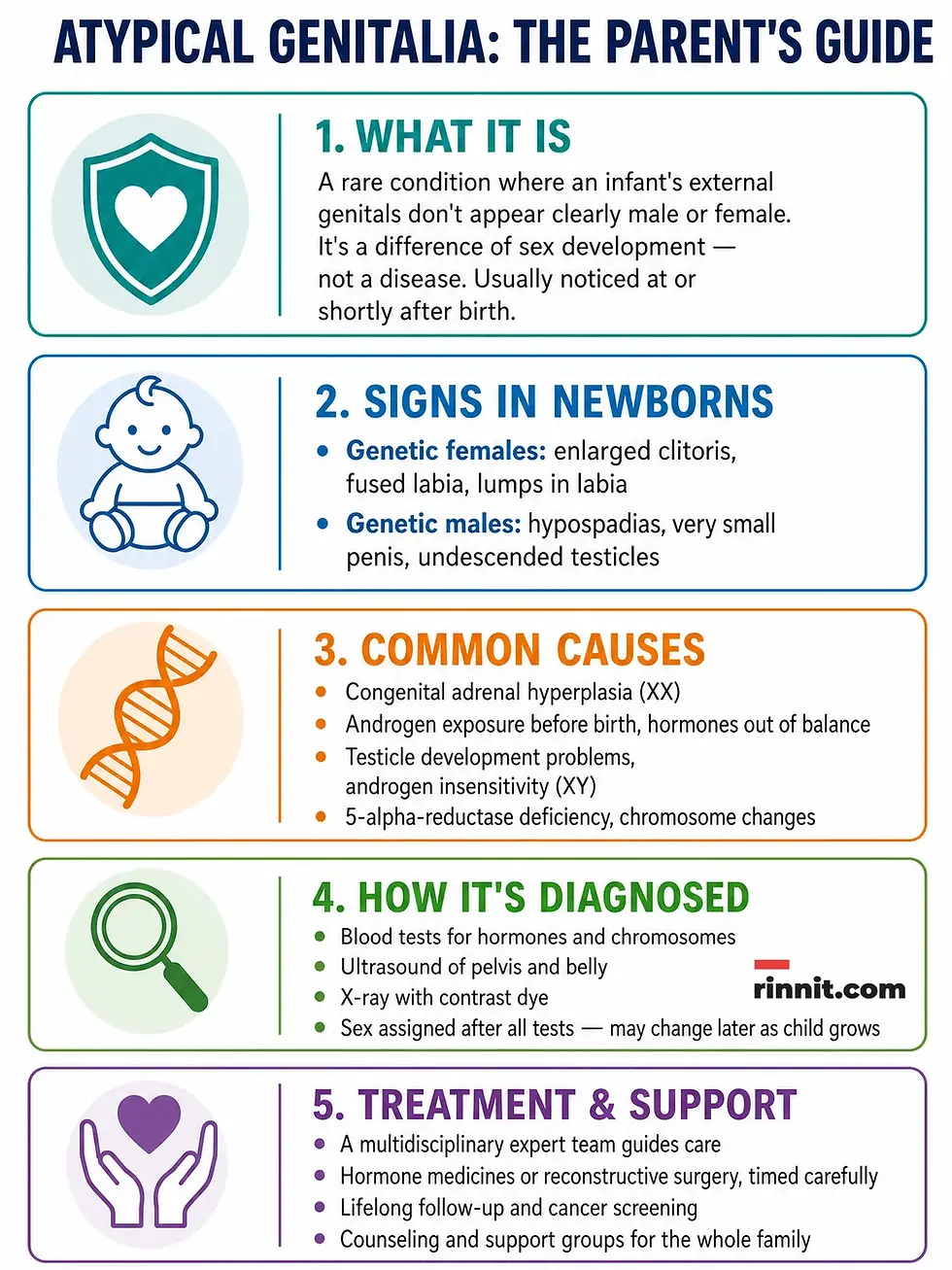
Atypical genitalia, formerly called ambiguous genitalia, is a rare condition in which an infant's external genitals do not appear clearly male or female. It is not a disease but a difference of sex development. It is usually noticed at or shortly after birth, and a medical team works to find the cause and guide treatment decisions.
What the research says
The first priority is ruling out life-threatening causes, with a multidisciplinary team. A clinical review of how ambiguous genitalia is evaluated stresses first assessing for dangerous causes such as salt-wasting congenital adrenal hyperplasia (CAH) or syndromes with other organ problems, involving specialists from endocrinology, urology, genetics, psychology, neonatology and more, and using caution with irreversible treatments, since karyotypic sex is not equivalent to gender. (Stambough et al., Curr Opin Obstet Gynecol, 2019) [3]
Tumor risk in some forms rises with age, which matters for the timing of gonadal surgery. A systematic review of 386 articles (2,037 people with differences of sex development who had gonadal surgery; median age 17 years) found germ cell tumors were found more often when surgery was done around age 15 or older, regardless of risk category, while 5-year survival for people with germ cell tumors was still above 80% and long-term outcomes for the precancerous stage (GCNIS) were excellent. (Morin et al., J Pediatr Urol, 2020) [4]
Fertility is often possible in congenital adrenal hyperplasia. A review of reproductive care in CAH notes that although women with classic CAH have decreased fecundity, they are able to conceive, with glucocorticoid optimization first and ovulation induction if needed, plus preconception genetic counseling. (Maher et al., Rev Endocr Metab Disord, 2023) [5]
Atypical Genitalia at a Glance
Aspect | Summary |
Definition | Rare difference of sex development; external genitals not clearly male or female |
Former name | Ambiguous genitalia |
When noticed | At or shortly after birth; occasionally during pregnancy |
Genetic females (XX) | Enlarged clitoris, fused/closed labia, lumps in labia |
Genetic males (XY) | Hypospadias, micropenis, undescended or missing testicles |
Main causes | CAH, androgen exposure, testicle/testosterone problems, androgen insensitivity |
Diagnosis | Hormone blood tests, chromosome blood tests, ultrasound, contrast X-ray |
Treatment goal | Long-term mental health, social well-being, and maximum function and fertility |

What Is Atypical Genitalia?
Atypical genitalia, formerly called ambiguous genitalia, is a rare condition in which an infant's genitals don't appear to be clearly male or female on the outside. In a baby with the condition, the genitals may not be fully developed, may look different from what is expected, or the baby may have features of more than one sex.
Understanding the condition starts with three basic building blocks:
Term | Meaning |
External genitals | The sex organs on the outside of the body — the vaginal opening, labia, clitoris, penis, and scrotum |
Internal genitals | The sex organs inside the body — the vagina, fallopian tubes, uterus, prostate, ovaries, and testicles |
Genetic sex | Set by sex chromosomes — typically XX for females and XY for males; gonads (ovaries and testicles) make the sex hormones |
With atypical genitalia, the sex organs on the outside may not match the sex organs on the inside — and they may not match the genetic sex. One crucial reassurance frames everything about this condition:
Atypical genitalia is not a disease; it's a difference of sex development.
It can usually be seen at or shortly after birth, and it can be very distressing for families. The medical team's job is to find the cause and provide the information and counseling that guide decisions about the baby's sex and any needed treatment.
What are the signs and symptoms of atypical genitalia in infants?
Atypical genitalia can vary widely in appearance. Differences depend on when during genital development the hormone changes occurred and on the underlying cause. The medical team is usually the first to notice the signs soon after birth; sometimes the condition is suspected before birth.
Signs in Genetically Female (XX) Babies
Babies with two X chromosomes may have:
An enlarged clitoris that may look like a penis
Closed labia, or labia that include folds and look like a scrotum
Lumps that feel like testicles in the fused labia
Signs in Genetically Male (XY) Babies
Babies with one X and one Y chromosome may have:
Hypospadias — a condition in which the urethra, the narrow tube that carries urine and semen, doesn't fully extend to the tip of the penis; if the opening is on the underside, it is called hypospadias
A very small penis with the urethral opening closer to the scrotum
One or both testicles missing in what appears to be the scrotum
Undescended testicles (remaining in the body) with an empty scrotum that looks like labia, with or without a micropenis
Baby's genetic sex | Possible signs |
Female (XX) | Enlarged clitoris; closed or folded labia resembling a scrotum; lumps in the fused labia |
Male (XY) | Hypospadias; very small penis; missing or undescended testicles; empty scrotum resembling labia |
How do sex organs form, and how does atypical genitalia occur?
Atypical genitalia usually happens when hormone changes during pregnancy stop or disturb an unborn baby's developing sex organs.
The normal pathway
A baby's genetic sex is set at conception. The egg contains an X chromosome; the sperm contains either an X or a Y. A baby receiving an X from the sperm is a genetic female (XX); one receiving a Y is a genetic male (XY).
Male and female sex organs develop from the same tissue. Whether that tissue becomes male or female organs depends on the chromosomes and the presence or absence of hormones called androgens, which cause male genitals to develop. In a fetus with a Y chromosome, a region on that chromosome triggers the development of testicles, which make androgens — and male genitals develop in response. In a fetus without a Y chromosome, and without the effects of androgens, the genitals develop as female.
Sometimes a chromosomal change may make it hard to figure out the genetic sex at all.
Where the process can vary
A change in the steps that influence fetal sex development can produce a mismatch between the external genitals and the internal organs or genetic sex:
If a genetic male fetus doesn't make enough androgens, atypical genitalia can result.
If a genetic female fetus is exposed to androgens during development, her external genitalia become atypical.
Changes in certain genes can affect fetal sex development directly.
Atypical genitalia can also be a feature of rare or complex syndromes affecting many organs, including chromosome changes such as a missing or extra sex chromosome.
Sometimes no cause can be found.
Possible causes in genetic females
Cause | How it works |
Congenital adrenal hyperplasia (CAH) | A genetic condition in which the adrenal glands make too many androgens |
Hormone exposure before birth | Some drugs contain androgens or cause the pregnant person's body to make them, masculinizing developing female genitals; a maternal hormone-imbalance condition can also expose the fetus to excess male-genital hormones |
Tumors (rare) | A tumor in the pregnant person can make hormones that drive male-genital development |
Possible causes in genetic males
Cause | How it works |
Testicle development problems | May result from gene changes or unknown causes |
Androgen insensitivity syndrome | Developing genital tissues don't respond as they should to the hormones made by the testicles |
Problems with the testicles or testosterone | Issues with how the testicles form, how testosterone is made, or with the proteins in cells that signal response to testosterone |
5-alpha-reductase deficiency | Not enough of this enzyme impairs production of the hormones that drive male genital development |
What are the risk factors for atypical genitalia in infants?
A family history of certain conditions may raise the risk of atypical genitalia, because many differences of sex development result from inherited gene changes. Possible risk factors include a family history of:
Unexplained deaths in early infancy
Infertility, absent menstrual periods, or heavy facial hair in females
Atypical genitalia
Atypical physical development during puberty
Congenital adrenal hyperplasia, a group of genetic conditions affecting the adrenal glands that run in families
If your family carries any of these risk factors, talk with your healthcare professional before trying to get pregnant — genetic counseling can help you plan ahead.
What are the complications of atypical genitalia?
Complications of atypical genitalia may include infertility and a higher risk of certain cancers, depending on the specific diagnosis.
Infertility — whether someone can have children depends on the specific diagnosis. For example, genetic females with congenital adrenal hyperplasia usually can get pregnant if they choose.
Higher risk of certain cancers — some differences of sex development are linked with a higher risk of certain cancer types.
How is atypical genitalia in infants diagnosed?
The condition is usually diagnosed at birth or shortly after. Sometimes healthcare professionals suspect it during pregnancy when blood tests of the unborn baby's sex differ from ultrasound imaging of the genitalia — but the diagnosis is generally made after birth, when the professionals who assist with delivery notice the signs.
Determining the Cause
Finding the cause matters because it guides treatment and decisions about the baby's sex. The process begins with questions about family and medical history, and a physical exam that checks for testicles and evaluates the genitalia. The baby will likely have these tests:
Test | What it looks for |
Blood tests — hormone levels | Measures hormone levels to identify imbalances |
Blood tests — chromosomes | Shows the genetic sex (typically XX or XY) and conditions caused by gene changes affecting sex organ development |
Ultrasound — pelvis and belly | Looks for undescended testicles, a uterus, or a vagina |
X-ray with contrast dye | Gives a clear picture of pelvic and abdominal structures |
Minimally invasive surgery (sometimes) | Collects a tissue sample of the reproductive organs through one or more small cuts using tiny cameras and surgical tools |
Deciding the Baby's Sex
Using the information gathered, the healthcare professional may suggest a sex for the baby. The suggestion is based on the cause, genetic sex, anatomy, future reproductive and sexual potential, probable adult gender identity, and discussion with the parents.
Some families decide within a few days of birth, but it is important to wait until all tests are finished. Sex assignment can be complex and delayed — and parents should know that as the child grows, the child may make a different decision about gender identification.
How is atypical genitalia treated?
The goal of treatment is long-term mental health and social well-being, along with as much sexual function and fertility as possible. When treatment begins depends on the child's specific situation.
Because the condition is complex and uncommon, managing it may require a team of experts:
Pediatricians and neonatologists (experts in newborns with medical conditions)
Pediatric urologists (children's urinary system specialists) and pediatric general surgeons
Endocrinologists (hormone experts)
Medical geneticists
Mental health professionals such as psychologists or social workers
Medicines
Hormone medicines may correct or manage hormones that are out of balance. For example, in a genetic female with a slightly enlarged clitoris caused by mild congenital adrenal hyperplasia, hormone replacement may be the only treatment needed.
Surgery
Surgery in children with atypical genitalia aims to keep healthy sexual function and create genitals that appear more typical. Its timing depends on the child's situation. Some healthcare professionals prefer to postpone surgery done only for appearance, suggesting the person be mature enough to take part in the sex-assignment decision.
Importantly, the sex organs may work properly despite how the genitals look on the outside. For girls, if the vagina is hidden under the skin, childhood surgery can support later sexual function. For boys, reconstructing a partially developed penis may create a more typical appearance and make erections possible; surgery to move the testicles into the scrotum may also be needed.
Surgery results are often satisfying, but repeat surgeries may be needed. Risks include a disappointing appearance or problems with sexual function, such as trouble reaching an orgasm.
Ongoing Care
Children with atypical genitalia need ongoing medical care — including watching for complications and keeping up with cancer screenings into adulthood.
How can families cope with atypical genitalia and find support?
If your baby has atypical genitalia, you may worry about the baby's future. Mental health professionals can help you deal with a difference you didn't expect — ask your child's healthcare professional for a referral to one experienced in your situation. In-person or online support groups can help, and your child may benefit from ongoing counseling and choose to join support groups into adulthood.
Not knowing the sex of your newborn right away might turn a hoped-for celebration into a stressful time. Your medical team can provide updates and information as quickly as possible, answer questions, and talk with you about your child's health. Consider waiting to make a formal birth announcement until testing is done and you've created a plan with advice from your medical team — and give yourself time to learn about your child's condition before answering questions from family and friends.
How should you prepare for an atypical genitalia appointment?
If your baby is born with atypical genitalia, you may be referred to a medical center with doctors and professionals experienced in managing the condition.
Before the visit:
Ask if there's anything you need to do to prepare your baby for tests and procedures.
Discuss family history with blood relatives — parents, grandparents, cousins — and bring key personal information, including any family history of genetic conditions such as atypical genitalia.
Take a family member or friend along — it can be hard to remember everything said during an appointment.
Make a list of questions for your healthcare professional.
Questions to ask may include:
What caused my baby's atypical genitalia?
What genetic testing has been done, and what other tests might my baby need?
What is the best treatment plan, and what are the alternatives?
Is there a generic option to the medicine being prescribed?
Are there special instructions I need to follow?
Should my baby see other specialists?
What options are there for counseling and support for our family?
Do you have printed material or suggested websites to help me learn more?
What to expect from your doctor — questions such as: Does your family have a history of atypical genitalia, genetic conditions, or health conditions that run in the family? Have you ever had a miscarriage, or a child who died in infancy? Be ready to answer so you have time to discuss what matters most to you.
Frequently Asked Questions
What does "atypical genitalia" mean in a newborn?
Atypical genitalia is a rare condition in which an infant's external genitals don't appear clearly male or female. It is considered a difference of sex development, not a disease, and the external organs may not match the internal organs or the genetic sex.
Is atypical genitalia inherited?
Many cases result from gene changes that can run in families — for example, congenital adrenal hyperplasia is genetic. A family history of unexplained infant deaths, infertility, or atypical puberty development can raise the risk, which is why genetic counseling helps before pregnancy.
Can atypical genitalia be detected before birth?
Sometimes it is suspected during pregnancy when blood tests of the baby's sex disagree with ultrasound imaging of the genitalia. However, the diagnosis is generally made at or shortly after birth.
What tests are used to find the cause?
Doctors use blood tests to measure hormone levels and examine chromosomes, an ultrasound of the pelvis and belly, contrast X-ray studies, and sometimes minimally invasive surgery to collect a tissue sample of the reproductive organs.
Do children with atypical genitalia need surgery?
Surgery may be used to preserve healthy sexual function and create a more typical appearance, but timing depends on the situation — some specialists prefer to wait until the person is old enough to take part in the decision. In some cases, hormone medicine alone is enough.
Can someone with atypical genitalia have children?
It depends on the specific diagnosis. For example, genetic females with congenital adrenal hyperplasia usually can get pregnant if they choose. Some other forms carry a higher risk of infertility, which is part of why lifelong follow-up care matters.
Conclusion
The main lessons of this guide:
Atypical genitalia is a rare difference of sex development, not a disease — the external genitals simply don't appear clearly male or female, and the cause is usually hormone-related during pregnancy.
Finding the cause comes first — blood tests, imaging, and sometimes a tissue sample guide both treatment and the decision about the baby's sex, which may be revisited by the child later in life.
Outcomes are genuinely hopeful — with a multidisciplinary expert team, hormone medicines, carefully timed surgery, lifelong follow-up, and counseling, families can support a healthy, full life for their child.
This guide walks you through everything parents need to know: how sex development normally works, what the signs look like in newborns, the causes by genetic sex, how diagnosis unfolds, and how treatment protects long-term health, function, and well-being. An unexpected diagnosis is overwhelming — but you don't face it alone, and your medical team will move as fast as the situation allows.
Disclaimer: This article is for general informational purposes only and is not a substitute for professional medical advice, diagnosis, or treatment. Always seek the advice of a qualified healthcare provider with any questions about a medical condition.
References
Mayo Clinic. Atypical genitalia — Symptoms & causes. Accessed October 12, 2026. https://www.mayoclinic.org/diseases-conditions/atypical-genitalia/symptoms-causes/syc-20369273
Mayo Clinic. Atypical genitalia — Diagnosis & treatment. Accessed October 12, 2026. https://www.mayoclinic.org/diseases-conditions/atypical-genitalia/diagnosis-treatment/drc-20369278
Stambough K, Magistrado L, Perez-Milicua G. Evaluation of ambiguous genitalia. Curr Opin Obstet Gynecol. 2019;31(5):303-308. PMID 31425174. https://doi.org/10.1097/GCO.0000000000000565
Morin J, Peard L, Vanadurongvan T, et al. Oncologic outcomes of pre-malignant and invasive germ cell tumors in patients with differences in sex development — a systematic review. J Pediatr Urol. 2020;16(5):576-582. PMID 32564942. https://doi.org/10.1016/j.jpurol.2020.05.002
Maher JY, Gomez-Lobo V, Merke DP. The management of congenital adrenal hyperplasia during preconception, pregnancy, and postpartum. Rev Endocr Metab Disord. 2023;24(1):71-83. PMID 36399318. https://doi.org/10.1007/s11154-022-09770-5



Comments