AV Node Ablation: A Permanent Solution for Atrial Fibrillation

Updated: 3 days ago
Medically reviewed by Dr. Baraa Alnahhal, MD · Last reviewed: October 2026
Quick Answer
AV node ablation is a permanent procedure that uses heat or cold energy to destroy the atrioventricular (AV) node, which carries electrical signals between the heart's upper and lower chambers. [1] It stops irregular heartbeats from atrial fibrillation or SVT. [1] Because the heart can no longer signal itself to beat, every patient needs a permanent pacemaker. [1]
What the research says
A large meta-analysis found low early mortality after ablate-and-pace, but called the long-term evidence limited. Across 93 studies (11,340 patients; 9,105 with right ventricular pacemakers and 2,235 with biventricular pacemakers), pooled 30-day mortality was 1.08% (95% CI 0.65–1.77%). Over a median follow-up of 19.9 months, overall mortality was 0.43% per month (95% CI 0.36–0.51) and cardiac death was 0.27% per month (95% CI 0.22–0.32). The authors concluded that solid long-term evidence supporting AV node ablation with pacing is lacking, and that younger patients with reduced ejection fraction may need cardiac resynchronization therapy (PubMed: Baudo et al., Int J Cardiol, 2022) [2].
Conduction system pacing is a safe, feasible alternative to biventricular pacing after AV node ablation. A systematic review of 25 studies, with a comparative meta-analysis of five (1,652 patients with conduction system pacing and 369 with biventricular pacing), found a narrower QRS duration with conduction system pacing (−35.8 ms; 95% CI −61.8 to −9.72) and a larger improvement in NYHA class (mean difference −0.53; 95% CI −1.01 to −0.04). Change in left ventricular ejection fraction was not significantly different (+3.36%; 95% CI −0.75 to 7.47), and periprocedural complications were comparable (PubMed: Mavilakandy et al., Europace, 2025) [3].
In heart failure with permanent AFib, left bundle branch area pacing was linked to lower mortality than biventricular pacing after AV node ablation. A network meta-analysis of 13 studies (1,257 patients) found that left bundle branch area pacing reduced all-cause mortality compared with biventricular pacing (OR 0.10; 95% CI 0.01–0.78) and had a lower pacing threshold than His bundle pacing. Both His bundle and left bundle branch area pacing narrowed QRS duration compared with biventricular pacing (PubMed: Ding et al., J Interv Card Electrophysiol, 2025) [4].
What is AV node ablation?
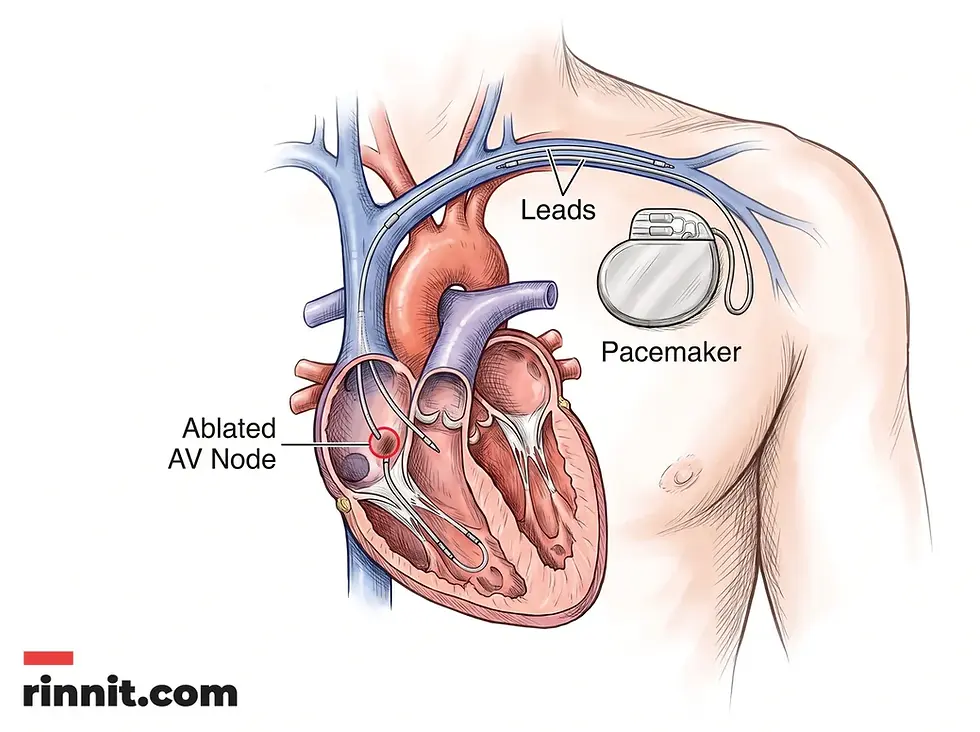
Atrioventricular (AV) node ablation is a specialized medical procedure used to manage persistent abnormal heart rhythms, most commonly atrial fibrillation (AFib). [1] The procedure involves the intentional destruction of the AV node, a small cluster of cells that serves as the electrical bridge between the heart's upper chambers (atria) and lower chambers (ventricles). By eliminating this bridge, the irregular electrical signals originating in the atria are prevented from reaching the ventricles, thereby stabilizing the heart's pumping action. [1]
It is important to note that AV node ablation is a permanent and irreversible treatment. [1] Once the AV node is destroyed, the heart can no longer transmit its own natural electrical signals to the lower chambers. [1] Consequently, every patient who undergoes this procedure must have a permanent pacemaker installed to regulate their heartbeat for the remainder of their life. [1]

Why is AV node ablation performed?
Healthcare providers typically recommend AV node ablation when other, less invasive treatments for heart rhythm disorders have proven ineffective or unsuitable. [1] [2] It is often considered a “last resort” for managing atrial fibrillation, atrial flutter, or supraventricular tachycardia (SVT). [1]
Common indications for the procedure include:
Treatment-Resistant AFib: When medications and other types of ablation (such as pulmonary vein isolation) fail to control symptoms. [1] [2]
Medication Intolerance: When a patient cannot take rhythm-control drugs due to severe side effects. [1]
Existing Pacemaker: Patients who already have a pacemaker but continue to experience symptomatic arrhythmias. [1]
Heart Failure Prevention: When out-of-sync heart contractions lead to a weakening of the lower heart chambers.
What happens during the AV node ablation procedure?
The AV node ablation process is minimally invasive and typically involves several distinct stages, from mapping the heart's electrical system to the final application of energy. [1]
Stage | Action | Description |
Preparation | Pacemaker Placement | A permanent pacemaker is installed weeks before, during, or immediately after the ablation. [1] |
Mapping | EP Study | An electrophysiology (EP) study maps the heart's signals to locate the exact position of the AV node. [1] |
Access | Catheter Insertion | Small tubes are inserted into veins in the groin, neck, or arm under local anesthesia. [1] |
Treatment | Ablation | Heat (radiofrequency) or cold (cryoablation) energy is applied to the AV node to burn the tissue. [1] |
The entire procedure can last anywhere from less than one hour to several hours, depending on the complexity of the patient's heart anatomy and the specific equipment used. [1]
What are the benefits and success rates of AV node ablation?
The success rate of AV node ablation is exceptionally high, approaching nearly 100% in terms of successfully disrupting the AV node and controlling the target arrhythmia. [1] The primary goal is not necessarily to cure AFib, but to eliminate the symptoms and complications associated with a rapid or irregular heart rate.
Key benefits include:
Symptom Relief: Significant improvement in quality of life and the ability to engage in physical activity. [1]
Reduced Hospitalizations: Fewer emergency visits related to heart failure or symptomatic arrhythmias. [1]
Simplified Medication: Reduced need for complex heart rhythm medications, although blood thinners (anticoagulants) may still be required to prevent stroke. [1]
What are recovery and the long-term outlook after AV node ablation?
Recovery from AV node ablation is generally swift. After the catheters are removed, medical staff apply pressure to the insertion site for approximately 15 minutes, and the patient is required to lie flat for several hours to prevent bleeding. [1] Most patients spend one night in the hospital for observation and can return to normal daily activities within a few days. [1]
Long-term care involves regular follow-up appointments to monitor the pacemaker's function. The first check typically occurs one month after the procedure, followed by annual or semi-annual visits. [1]

What are the risks and warning signs after AV node ablation?
Complications of AV node ablation are rare, but it is a serious procedure with specific risks. These include pericardial effusion (fluid buildup around the heart), the development of different types of abnormal rhythms, and a slight risk of decreased left ventricle function. [1]
Patients should contact their healthcare provider immediately if they experience:
Conclusion
AV node ablation offers a highly effective, permanent solution for individuals struggling with treatment-resistant heart rhythm disorders. By intentionally disrupting the heart's electrical bridge and relying on a permanent pacemaker, patients can achieve a stable heart rate and a significantly improved quality of life. While the decision to undergo a non-reversible procedure is significant, the high success rate and reduced risk of heart failure make it a vital option for many.
Frequently Asked Questions
1. Is AV node ablation reversible?
No, AV node ablation is a permanent procedure that cannot be reversed. Once the AV node tissue is burned or frozen, it no longer functions, which is why a lifelong pacemaker is required.
2. Why do I need a pacemaker after this procedure?
The AV node is the natural electrical bridge between the heart's upper and lower chambers. When it is destroyed, the heart can no longer signal itself to beat. The pacemaker takes over this job permanently.
3. What is the success rate of AV node ablation?
The procedure has a success rate of nearly 100% in successfully destroying the AV node and preventing irregular signals from reaching the ventricles.
4. How long does the recovery take?
Recovery is usually very quick. Most patients stay in the hospital for one night and can return to their normal activities within a few days, though they may feel tired for a short period.
5. Will I still need AFib medication after the ablation?
While you may no longer need drugs to control your heart rhythm, your doctor may still require you to take blood thinners to reduce the risk of stroke associated with AFib.
6. What are the main risks of the procedure?
Complications are rare but can include fluid buildup around the heart (pericardial effusion), different heart rhythm issues, or a decrease in the pumping strength of the left ventricle.
7. How often will my pacemaker need to be checked?
You will typically have a follow-up visit one month after the procedure. After that, most patients only need their pacemaker checked once or twice a year.
8. Can I be active after AV node ablation?
Yes, one of the primary benefits of the procedure is an improved ability to participate in physical activity due to better heart rate control and reduced symptoms.
9. What happens if my pacemaker fails?
Modern pacemakers are highly reliable. However, if you experience fainting, dizziness, or shortness of breath, you should seek medical attention immediately to ensure the device is functioning correctly.
10. Is AV node ablation the same as pulmonary vein isolation (PVI)?
No. PVI targets the electrical signals where they start in the pulmonary veins and does not usually require a pacemaker. AV node ablation targets the central "bridge" of the heart and always requires a pacemaker.
Related Reading
Atrial Fibrillation (AFib): Symptoms, Causes & Treatment Guide explains AFib symptoms, stroke risk and treatment options.
Permanent Pacemakers: A Complete Guide to Heart Rhythm Management describes the pacemaker needed after AV node ablation.
Catheter Ablation: How It Works, Success Rates, Risks and Recovery covers ablation that targets the source of an abnormal rhythm.
Biventricular Pacemaker: How It Works, Who Needs One, Benefits, Risks and Daily Life explains a pacemaker that paces both lower heart chambers together.
References
Cleveland Clinic. What Is AV Node Ablation? Cleveland Clinic. Sep. 13, 2025. https://my.clevelandclinic.org/health/treatments/23013-av-node-ablation
Baudo M, D'Ancona G, Trinca F, et al. Atrioventricular node ablation and pacing for atrial tachyarrhythmias: A meta-analysis of postoperative outcomes. Int J Cardiol. 2022;363:80-86. PMID 35764203. https://doi.org/10.1016/j.ijcard.2022.06.058
Mavilakandy A, Abdelrazik AM, Abouelmagd K, et al. A comparative analysis of conduction system pacing and biventricular pacing in patients undergoing atrioventricular node ablation: a systematic review and meta-analysis. Europace. 2025;27(7):euaf106. PMID 40644356. https://doi.org/10.1093/europace/euaf106
Ding JW, Jiang YA, Wang QT, et al. Left bundle branch area pacing prevails over His bundle pacing for heart failure patients undergoing atrioventricular node ablation in permanent atrial fibrillation: a network meta-analysis. J Interv Card Electrophysiol. 2025;68(6):1363-1372. PMID 40178725. https://doi.org/10.1007/s10840-025-02034-7
Medical Disclaimer
This article is for informational purposes only and does not constitute medical advice. Always seek the advice of your physician or other qualified health provider with any questions you may have regarding a medical condition. Never disregard professional medical advice or delay in seeking it because of something you have read here.



Comments