Autopsy: What It Is, Types, Why It's Done and How Long Results Take

Updated: 2 days ago
Written and medically reviewed by Dr. Baraa Alnahhal, MD · Last reviewed: November 2026 · How we review
Quick Answer: What is an autopsy?
An autopsy is a medical examination of a body after death to find out why, and sometimes how, a person died. A pathologist examines the body and internal organs and takes tissue and fluid samples. The two main types are forensic and medical autopsies. The exam takes 2 to 4 hours, and full results take 6 weeks. [1]
What the research says
Autopsies still uncover diagnoses that were missed in life. A meta-analysis of 42 studies covering 6,305 autopsies of people who died in intensive care found that 19.3% had a major missed diagnosis. In 6.5%, the missed diagnosis might have changed treatment or survival, and this rate did not fall over time. (Marcoen et al., Intensive Care Medicine, 2024) [2]
Imaging-based "virtual" autopsies can't yet fully replace a standard autopsy. A systematic review of 16 studies found that combining CT and MRI scans agreed with a conventional autopsy on the cause of death in 70% of cases. Adding CT angiography and biopsies raised sensitivity to 90.9%. The review also notes that autopsy rates are declining worldwide. (Blokker et al., European Radiology, 2016) [3]
Diagnostic errors found at autopsy have fallen, but autopsies are done less often. At a Swiss teaching hospital, the autopsy rate dropped from about 90% (1972 to 1992) to 54% in 2002, while major diagnostic errors found at autopsy fell from 30% to 7%. (Schwanda-Burger et al., Modern Pathology, 2012) [4]
Key takeaways
An autopsy is a medical exam of the body after death to find out why, and sometimes how, a person died. [1]
A forensic autopsy is part of a legal investigation; a medical autopsy helps explain a death from illness. [1]
A pathologist performs the exam, which usually takes 2 to 4 hours. [1]
Preliminary results may come in 2 to 3 days; full results of a medical autopsy take about 6 weeks. [1]
Autopsies can protect public health, improve medical care and uncover genetic conditions that matter to relatives. [1]
What is an autopsy?
An autopsy is a medical examination of a body after death. Its main goal is to find or confirm the cause of death and, in some cases, how the person died. [1]
A pathologist performs the autopsy. Pathology is the branch of medicine that studies body tissues to understand disease. The pathologist examines the outside of the body and the internal organs, then writes a report of the findings for healthcare providers. [1]
An autopsy is ideally done as soon as possible after death. After about 24 hours, organs and tissues start to break down, which can make some tests harder. Even so, forensic pathologists can still examine bodies that have decomposed or been exhumed (removed from the ground). [1]
What are the types of autopsy?
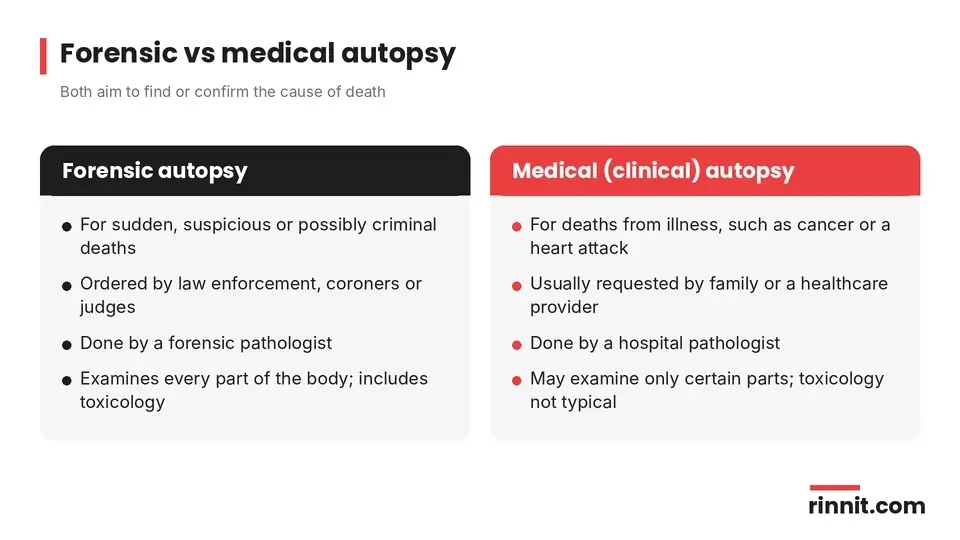
There are two main types of autopsy: [1]
Feature | Forensic autopsy | Medical (clinical) autopsy |
When it's done | A death is sudden, suspicious or possibly criminal, or linked to a medical procedure or surgery | A death from natural causes, such as cancer, a heart attack or an infectious disease |
Who asks for it | Law enforcement, coroners or judges | Usually the next of kin (family) or a healthcare provider |
Who performs it | A forensic pathologist | A hospital pathologist |
How much is examined | Every part of the body | May examine only certain parts of the body |
Toxicology testing | Typically included | Typically not included |
Sources: [1]
A medical examiner is usually a forensic pathologist who works for the government. [1]
Why is an autopsy done?
Every autopsy aims to find or confirm the cause of death. A forensic autopsy also aims to: [1]
Identify an unknown person, sometimes with help from fingerprints or DNA
Confirm the manner of death, such as an accident or a homicide, based on medical evidence
Estimate the time of death
Autopsies also benefit families and the wider public: [1]
Preventing more deaths: Forensic pathologists have helped identify public health emergencies, such as the anthrax attacks, and dangers such as faulty cribs or car seats.
Improving medical care: Findings deepen understanding of diseases and help improve future treatment.
Finding genetic conditions: An autopsy can uncover an undiagnosed genetic condition, helping blood relatives understand their own risk.
Providing legal evidence: Forensic autopsies often support homicide cases and may support lawsuits.
What happens during an autopsy?

A forensic autopsy is usually very thorough and often includes a crime scene investigation and toxicology testing for poisons, drugs and chemicals. A medical autopsy may focus only on certain parts of the body. [1]
In general, the pathologist: [1]
Places the body on an examination table in a lab.
Examines the outside of the body and notes anything unusual.
Takes or requests photographs and X-rays if needed.
Makes an incision from the collarbone to the lower abdomen and examines the organs and tissues, removing all of them or only specific ones.
Takes small tissue samples to study under a microscope.
May open the scalp and skull to examine the brain.
Tests samples of body fluids, tissues and organs. In forensic cases, any foreign material, such as debris or bullets, is collected and tested.
Once all exams and tests are complete, the pathologist writes a report of the findings. [1]
How long does an autopsy take?
The pathologist's examination usually takes 2 to 4 hours. [1]
When are autopsy results ready?

Stage | Typical timing |
The examination | Usually 2 to 4 hours |
Preliminary results | Possibly within 2 to 3 days |
Full results of a medical autopsy | About 6 weeks |
Full results of a forensic autopsy | Usually longer than a medical autopsy |
Sources: [1]
A forensic report gives both the cause of death and the manner of death. The manner of death falls into one of five categories: accident, natural causes, homicide, suicide or undetermined. [1]
Pathologists can make mistakes or may not be able to determine what happened. When that occurs, family members or legal authorities may request a second autopsy by a different pathologist. [1]
Are there any downsides to an autopsy?
An autopsy can bring up difficult feelings. Possible downsides include: [1]
Emotional distress for family and friends, especially for people whose cultural or religious beliefs discourage autopsy, or who are uncomfortable with the idea
Minor damage to the body, which could affect funeral arrangements
A delayed funeral or burial, which can lengthen the grieving process
Pathologists handle every body with care and respect. If you have concerns, ask the care team or medical examiner's office what to expect. [1]
Questions to ask the care team
Is an autopsy required, or is it our choice?
Will this be a forensic or a medical autopsy?
Will the whole body be examined, or only certain parts?
How might the autopsy affect funeral or burial plans?
When will we receive preliminary and final results?
Could the findings show a genetic condition that relatives should know about?
Conclusion
An autopsy is a careful medical examination after death that answers the question of why someone died. A forensic autopsy is part of a legal investigation, while a medical autopsy helps families and doctors understand a death from illness.
The exam usually takes a few hours, early findings may come within days, and a full medical autopsy report takes about 6 weeks. Beyond answers for loved ones, autopsies help prevent future deaths, improve medical care and reveal inherited conditions that relatives may need to know about.
Keep learning: Read our guides to biopsy, genetic testing, sudden cardiac arrest and sudden infant death syndrome.
FAQ
What is an autopsy?
An autopsy is a medical exam of the body after death to find out why, and sometimes how, a person died. [1]
What are the two main types of autopsy?
A forensic autopsy is done for sudden, suspicious or possibly criminal deaths, and a medical autopsy helps explain a death from illness. [1]
Who performs an autopsy?
A pathologist, a doctor who studies body tissues; forensic autopsies are done by forensic pathologists. [1]
Who can request a medical autopsy?
A medical autopsy is usually requested by the next of kin or a healthcare provider. [1]
Who orders a forensic autopsy?
Law enforcement, coroners or judges order forensic autopsies. [1]
How long does an autopsy take?
The pathologist's examination usually takes 2 to 4 hours. [1]
How long do autopsy results take?
Preliminary results may come within 2 to 3 days, and full medical autopsy results take about 6 weeks; forensic results usually take longer. [1]
Can you have a funeral after an autopsy?
Yes, though an autopsy may delay the funeral or burial and can cause minor damage to the body that may affect arrangements. [1]
What are the five manners of death?
Accident, natural causes, homicide, suicide and undetermined. [1]
Can a family ask for a second autopsy?
Yes. If findings are unclear or disputed, family members or legal authorities may request a second autopsy by a different pathologist. [1]
Related Reading
Learn more in our guide to Sudden Cardiac Arrest: Symptoms, Causes, Diagnosis, and Treatment Explained.
Learn more in our guide to Sudden Infant Death Syndrome (SIDS): Causes, Risk Factors, and Prevention.
Learn more in our guide to What Is Ventricular Fibrillation? A Plain-Language Guide to the Heart Emergency Behind Sudden Cardiac Death.
References
Cleveland Clinic. Autopsy: What It Is & Why It's Done. Cleveland Clinic. Last updated June 4, 2025. https://my.clevelandclinic.org/health/diagnostics/autopsy
Marcoen B, Blot KH, Vogelaers D, Blot S. Clinical vs. autopsy diagnostic discrepancies in the intensive care unit: a systematic review and meta-analysis of autopsy series. Intensive Care Med. 2024;50(12):1971-1982. PMID 39287650. https://doi.org/10.1007/s00134-024-07641-y
Blokker BM, Wagensveld IM, Weustink AC, et al. Non-invasive or minimally invasive autopsy compared to conventional autopsy of suspected natural deaths in adults: a systematic review. Eur Radiol. 2016;26(4):1159-1179. PMID 26210206. https://doi.org/10.1007/s00330-015-3908-8
Schwanda-Burger S, Moch H, Muntwyler J, Salomon F. Diagnostic errors in the new millennium: a follow-up autopsy study. Mod Pathol. 2012;25(6):777-783. PMID 22362052. https://doi.org/10.1038/modpathol.2011.199
Medical disclaimer
This article is for general education only and does not replace advice from a qualified healthcare professional. Talk to your doctor about your own diagnosis and treatment, and seek emergency care right away for severe or sudden symptoms.



Comments