Sudden Infant Death Syndrome (SIDS): Causes, Risk Factors, and Prevention

Updated: 1 hour ago
Medically reviewed by Dr. Baraa Alnahhal, MD · Last reviewed: September 2026
TL;DR
Sudden infant death syndrome (SIDS), sometimes called crib death, is the unexplained death of a baby, usually younger than one year old, who appears to be healthy. It often happens during sleep. The exact cause is unknown, but it may involve the area of an infant's brain that controls breathing and waking from sleep. Risk is highest between months two and four of life. While there is no definite way to prevent SIDS, safe-sleep practices — especially placing a baby on the back to sleep — can help lower the risk.
Quick Answer
What is sudden infant death syndrome (SIDS)? SIDS is the unexplained death of a baby, usually less than a year old, who seems to be healthy. It often happens during sleep and is sometimes called crib death because infants often die in their cribs. The cause is unknown, but it may be caused by problems in the area of an infant's brain that controls breathing and waking up from sleep. Researchers have identified risk factors — such as sleeping on the stomach or side and overheating — and protective steps, with placing a baby on the back to sleep as the most important action.
What Is Sudden Infant Death Syndrome?
Sudden infant death syndrome is the unexplained death of a baby. The baby is usually less than a year old and seems to be healthy. It often happens during sleep.
This condition also is known as SIDS. It is sometimes called crib death because infants often die in their cribs. The cause of SIDS is unknown. Researchers believe it may be caused by problems in the area of an infant's brain that controls breathing and waking up from sleep.
One important fact for parents: while there is no definite way to prevent SIDS, researchers have found steps you can take to help your baby sleep more safely. The most important action may be to place a baby on the back to sleep.
What Causes Sudden Infant Death Syndrome?
The exact cause of SIDS is unknown. But it may be caused by problems in the area of an infant's brain that controls breathing and waking up from sleep. Researchers have found that both physical factors and sleep-related factors put an infant at risk, and these factors vary from child to child.
Physical Factors
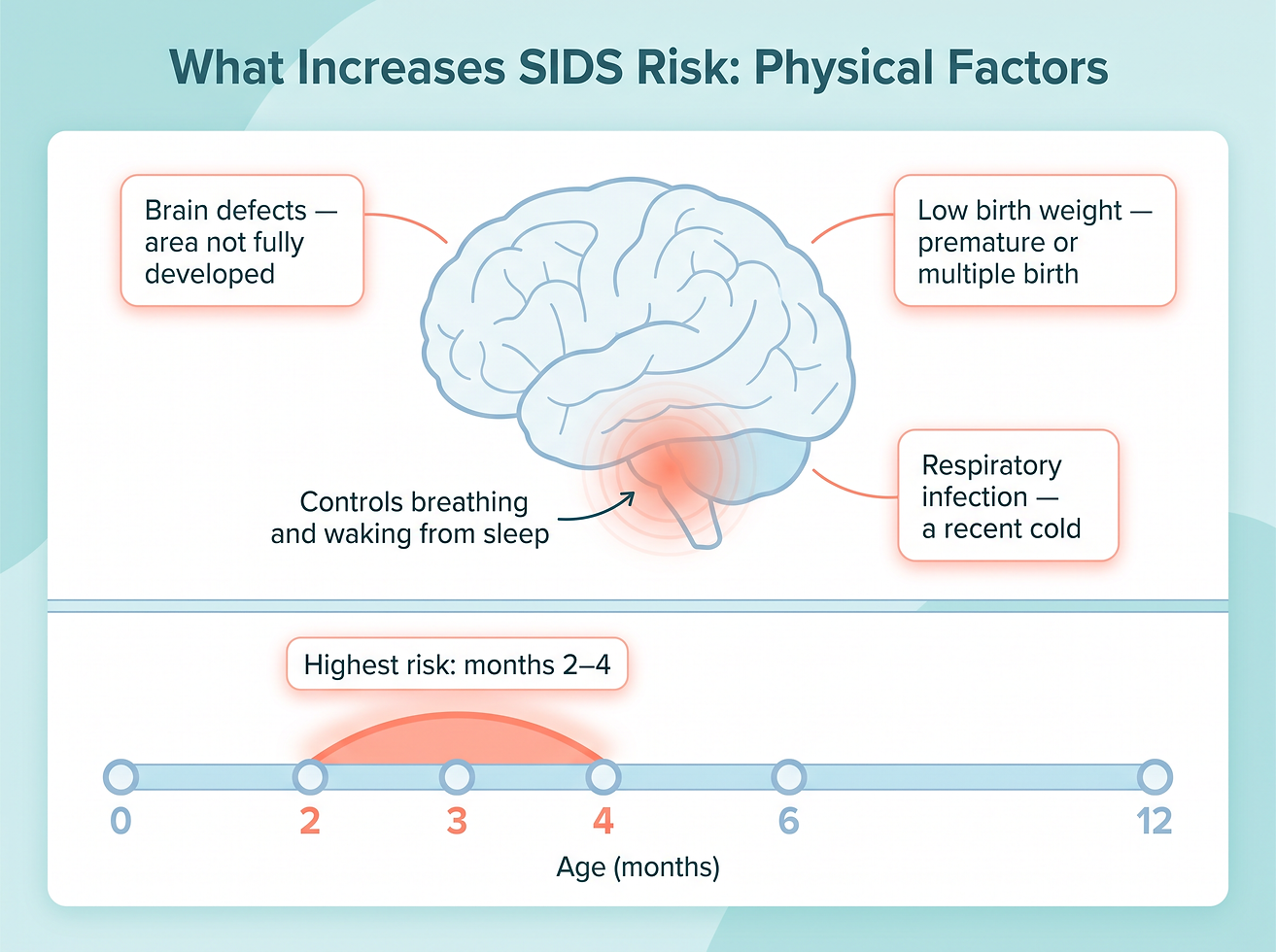
Some infants are born with problems that make them more likely to die of SIDS. In many of these babies, the part of the brain that controls breathing and waking up from sleep has not developed enough to work properly.
Being born early or being part of a multiple birth increases the chances that a baby's brain has not fully developed at birth. The baby may have less control over such automatic processes as breathing and heart rate. Many infants who died of SIDS had recently had a cold, and a cold may lead to breathing problems.
Physical Factor | What It Means |
Brain defects | Some infants are born with problems that make them more likely to die of SIDS; in many of these babies, the part of the brain that controls breathing and waking up from sleep has not developed enough to work properly |
Low birth weight | Being born early or being part of a multiple birth increases the chances that a baby's brain has not fully developed, with less control over automatic processes such as breathing and heart rate |
Respiratory infection | Many infants who died of SIDS had recently had a cold; a cold may lead to breathing problems |
Sleep Factors
A baby's sleeping position, items in the crib, and other conditions may increase the risk of SIDS. Babies placed on their stomachs or sides to sleep might have more trouble breathing than those placed on their backs.
Lying face down on a fluffy comforter, a soft mattress, or a waterbed can block an infant's airway. The risk of SIDS also rises if a baby sleeps in the same bed with parents, siblings, or pets — though it may help if the infant sleeps in a separate bed in the same room with parents. Being too warm while sleeping can increase a baby's risk of SIDS as well.
Sleep Factor | How It Raises Risk |
Sleeping on the stomach or side | Babies placed in these positions might have more trouble breathing than those placed on their backs |
Sleeping on a soft surface | A fluffy comforter, soft mattress, or waterbed can block an infant's airway when lying face down |
Sharing a bed | Risk rises if a baby sleeps in the same bed with parents, siblings, or pets; a separate bed in the same room may lower the risk |
Overheating | Being too warm while sleeping can increase a baby's risk of SIDS |
Who Is at Risk?
SIDS can happen to any infant. But researchers have found several factors that might raise the risk. These include characteristics of the baby, the family's circumstances, and factors during pregnancy.
Risk Factor | How It Raises Risk |
Sex | Boys are slightly more likely than girls to die of SIDS |
Age | Infants are at higher risk between the second and fourth months of life |
Race | For reasons that are not well understood, SIDS occurs more often in Black, Native American, and Alaska Native infants |
Family history | Babies with siblings who died of SIDS are at higher risk |
Secondhand smoke | Babies who live with smokers have a higher risk of SIDS |
Premature birth | Being born early and having a low birth weight increase a baby's chances of SIDS |
Risk factors during pregnancy also matter. A mother's choices and circumstances can affect her baby's risk of SIDS, especially if she is younger than 20, smokes cigarettes, uses drugs or alcohol, or does not receive good medical care while pregnant.
How to Help Protect Your Baby
There is no definite way to prevent SIDS. But you can help your baby sleep more safely by following evidence-based tips centered on sleep position, the crib environment, and room sharing.
Back to Sleep
Place your baby to sleep in the correct position — on the back. Use the back position every time you or anyone else puts your baby to sleep, for the first year of life. Do not trust that others will place your baby to sleep correctly: insist on it. The back position will not be needed once your baby can roll over both ways without help.
Do not put your baby on the stomach or side to sleep. Advise a caregiver to only use the stomach position when the baby and caregiver are both in the same room and both are awake. Short periods of tummy time help a baby build muscle strength, but the baby should never be left alone during tummy time.
Keep the Crib as Bare as Possible
Use a firm, flat mattress and make sure the mattress does not sit at an angle higher than 10 degrees. Avoid placing your baby on thick, fluffy padding, such as lambskin or a thick quilt. Do not leave pillows, fluffy toys, or stuffed animals in the crib — they can cause problems with breathing if your baby's face presses against them.
Keep Your Baby From Overheating
To keep your baby warm, try a sleep sack. Or dress your baby in layers instead of using blankets. Do not cover your baby's head.
Sleep in the Same Room, Not the Same Bed
If possible, your baby should sleep in your room with you, but not in the same bed. Have your baby sleep alone in a crib or bassinet with a mattress designed for infant bedding. Your baby should sleep in the same room with you for at least six months.
Adult beds are not safe for infants. A baby can become trapped and suffocate between the headboard slats — the spaces between the mattress and the bed frame — or in the space between the mattress and the wall. A baby can also suffocate if a sleeping parent accidentally rolls over and covers the baby's nose and mouth.
Other Protective Steps
Breastfeeding for at least six months to a year lowers the risk of SIDS. Sucking on a pacifier at nap time or bedtime may also reduce the risk; make sure the pacifier does not have a strap or cord. If you are breastfeeding, wait to offer a pacifier until you and your baby have settled into a nursing routine, which usually takes three to four weeks. If your baby is not interested, do not force it, and if the pacifier falls out during sleep, do not put it back in.
One caution: do not use baby monitors and other commercial devices that claim to reduce the risk of SIDS. Pediatricians discourage these devices because they do not prevent SIDS and cannot be used instead of safe sleep practices. Finally, there is no evidence that recommended vaccine shots to protect against diseases increase the risk of SIDS — some evidence shows that such shots may help prevent SIDS.
Safe-Sleep Step | What to Do |
Back to sleep | Place baby on the back every time, for the first year, until the baby can roll over both ways |
Bare crib | Firm, flat mattress at less than a 10-degree angle; no pillows, fluffy toys, or thick padding |
Avoid overheating | Use a sleep sack or layers instead of blankets; never cover the head |
Room-share | Baby sleeps in a crib or bassinet in your room for at least six months, not in your bed |
Breastfeed | Breastfeeding for at least six months to a year lowers the risk |
Pacifier | Offer at nap and bedtime without a strap or cord; wait 3 to 4 weeks if breastfeeding |
Skip devices | Baby monitors and devices claiming to reduce SIDS risk do not prevent it |
Vaccinate | Recommended shots do not increase SIDS risk and may help prevent it |
What Happens After a Loss
There is no treatment for SIDS. But your baby's pediatrician or other healthcare professional can talk with you about any risks your baby may have, and about ways to help your baby sleep safely.
For parents who have lost a baby to SIDS, getting emotional support is critical. You might feel guilty as you grieve the loss of your baby, and you are also likely dealing with a police investigation into the cause of death, as required by law. Talking to other parents whose lives have been affected by SIDS may bring comfort, and your doctor or care team can suggest a support group in your area or online. A trusted friend, mental health professional, or clergy member can also help.
Healing takes time. It is understandable to cry unexpectedly and to find holidays and milestones difficult. Losing a child can put a terrible strain on a relationship, so being as open as possible with a spouse or partner matters, and counseling helps some couples understand and express their feelings.
Conclusion
Sudden infant death syndrome is the unexplained death of a baby, usually under one year old, often during sleep. The exact cause is not known, but it may involve the brain area that controls breathing and waking. Risk is highest between the second and fourth months of life, and factors such as stomach sleeping, a soft crib surface, and overheating can raise that risk. Although there is no definite way to prevent SIDS, consistent safe-sleep practices — back to sleep, a bare crib, room-sharing without bed-sharing — give your baby the best protection.
Take the next step: talk with your baby's pediatrician about any risks your baby may have and how to set up a safe sleep space.
Frequently Asked Questions
What is sudden infant death syndrome (SIDS)?
Sudden infant death syndrome is the unexplained death of a baby, usually less than a year old, who seems to be healthy. It often happens during sleep and is sometimes called crib death because infants often die in their cribs. The cause is unknown, but it may be related to problems in the area of an infant's brain that controls breathing and waking up from sleep.
Is there a warning sign before SIDS?
SIDS gives no warning sign. The baby usually seems healthy, and the death is unexplained. It most often happens during sleep and often in the crib, which is why the condition is sometimes called crib death. Because there is no warning, safe-sleep practices are the main way to help protect a baby.
What age is SIDS most likely?
Infants are at higher risk between the second and fourth months of life. The back-to-sleep position should be used every time the baby is put down to sleep for the first year of life, until the baby can roll over both ways without help.
Does sleeping position affect SIDS risk?
Yes. Babies placed on the stomach or side to sleep might have more trouble breathing than those placed on their backs. Placing a baby on the back to sleep may be the most important protective action available. Caregivers should be told to use the stomach position only when the baby and caregiver are both awake in the same room.
What should be in a baby's crib?
The crib should be kept as bare as possible. Use a firm, flat mattress that does not sit at an angle higher than 10 degrees. Avoid thick, fluffy padding such as lambskin or a thick quilt, and do not leave pillows, fluffy toys, or stuffed animals in the crib, since they can cause breathing problems if the baby's face presses against them.
Should my baby sleep in my bed?
No. The risk of SIDS rises if a baby sleeps in the same bed with parents, siblings, or pets. Adult beds are not safe for infants — a baby can become trapped and suffocate between the headboard slats or between the mattress and the wall, or a sleeping parent can accidentally cover the baby's nose and mouth. The baby should sleep in the same room with you, but alone in a crib or bassinet, for at least six months.
Can SIDS be prevented?
There is no definite way to prevent SIDS. But researchers have found steps that may help lower the risk, including placing the baby on the back to sleep, keeping the crib bare, avoiding overheating, breastfeeding for six months to a year, offering a pacifier at nap and bedtime, and keeping vaccines up to date. Baby monitors and devices claiming to reduce SIDS risk do not prevent it.
Is there support for parents who lose a baby to SIDS?
Yes. Emotional support is critical after losing a baby to SIDS. Parents may feel guilt while grieving and are also likely dealing with a police investigation into the cause of death, as required by law. Talking to other parents affected by SIDS, joining a support group, or working with a mental health professional or clergy member can help, and counseling can support couples grieving together. Healing can take time.
External Links
This article is for general informational purposes only and is not a substitute for professional medical advice, diagnosis, or treatment. Always seek the advice of your physician or other qualified health provider with any questions you may have regarding a medical condition. Never disregard professional medical advice or delay in seeking it because of something you have read on this website.
Comments