Assisted Reproductive Technology (ART): Fertility Procedures and Techniques

Updated: 3 days ago
Medically reviewed by Dr. Baraa Alnahhal, MD · Last reviewed: October 2026
Quick Answer
Assisted reproductive technology (ART) refers to fertility treatments in which eggs, sperm or embryos are handled outside the body in a laboratory. Used mainly for infertility or to prevent passing on genetic disorders, it includes IVF and ICSI. It typically involves ovarian stimulation, egg retrieval, fertilization and embryo transfer, with U.S. success rates averaging approximately 21% per cycle. [1]
What the research says
Success depends heavily on age, and repeated cycles raise the cumulative chance of a live birth. In a UK study of 156,947 women and 257,398 IVF cycles, the live-birth rate for the first cycle was 29.5%. For women under 40 using their own eggs it was 32.3% in the first cycle and 68.4% cumulatively after six cycles; for women aged 40 to 42 it was 12.3% for the first cycle and 31.5% after six; and for women over 42 every per-cycle rate was below 4% (PubMed: Smith et al., JAMA, 2015 [2]).
ICSI did not improve live birth over conventional IVF when the male partner's sperm count and motility were normal. In a randomized trial of 1,064 couples, live birth after the first embryo transfer was 35% (184 of 532) with ICSI versus 31% (166 of 532) with conventional IVF (risk ratio 1.11; 95% CI 0.93 to 1.32), and fertilization failure occurred in 5% versus 6% of couples (PubMed: Dang et al., Lancet, 2021 [3]).
ART can add pregnancy risks on top of those linked to infertility itself. In a Massachusetts study of singleton deliveries from 2013 to 2017, infertility diagnoses such as tubal disease, PCOS, other ovulatory conditions and endometriosis were linked to higher obstetric risks than in fertile women, and within each diagnosis the use of ART consistently increased the risk of placental problems (adjusted relative risk 1.49 to 2.86) (PubMed: Stern et al., Fertil Steril, 2022 [4]).
What is assisted reproductive technology (ART)?
Assisted reproductive technology (ART) represents a significant advancement in medical science, providing individuals and couples with options when natural conception is difficult or impossible. By definition, ART includes any treatment or procedure that involves the handling of human eggs, sperm, or embryos in a laboratory to achieve pregnancy. While it is a highly specialized field, it accounts for about 2.5% of all annual births in the United States. [1]
Individuals may seek ART for various reasons, including diagnosed infertility, underlying health conditions that prevent natural conception, or the desire to avoid passing specific genetic disorders to their children. [1] The process is collaborative, involving a fertility team that guides patients through the benefits, risks, and financial considerations of each technique.
What are the common types of assisted reproductive technology (ART)?
Assisted reproductive technology (ART) is an umbrella term for several specialized fertility techniques. The choice of procedure often depends on the specific cause of infertility and patient preferences.
Procedure Type | Description | Key Characteristic |
In vitro fertilization (IVF) | The most common ART; eggs are fertilized by sperm in a lab before being placed in the uterus. | Comprehensive laboratory fertilization. |
Intracytoplasmic sperm injection (ICSI) | A single sperm is injected directly into the center of a mature egg. | Targeted fertilization for male-factor infertility. |
Donor gametes | Use of donated eggs or sperm from another individual to achieve pregnancy. | Utilizes third-party genetic material. |
Cryopreservation | The process of freezing eggs or embryos for future use. | Preserves fertility for later pregnancy. |
Gestational surrogacy | An arrangement where another person carries the pregnancy for the intended parents. | Involves a third-party carrier. |
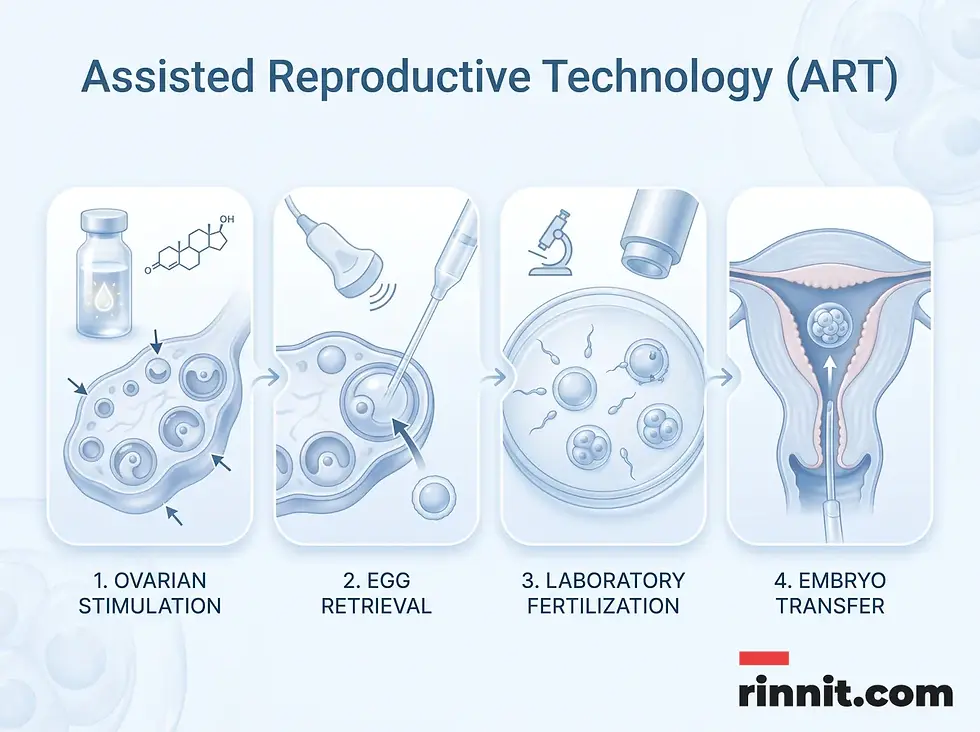
What are the steps of an assisted reproductive technology (ART) procedure?
Most assisted reproductive technology (ART) cycles follow the same core steps: ovarian stimulation, sperm preparation, egg retrieval, fertilization, embryo monitoring and embryo transfer.
Ovarian stimulation: Patients take hormone medications to encourage the ovaries to produce multiple mature eggs simultaneously. [1]
Sperm preparation: The fertility team performs "sperm washing" to ensure the sperm used for fertilization are healthy and active. [1]
Egg retrieval: A healthcare provider uses a thin needle, typically guided by ultrasound, to remove mature eggs from the follicles in the ovaries.
Fertilization: In the laboratory, eggs and sperm are combined. In cases like ICSI, a provider may manually inject sperm into the egg to facilitate fertilization. [1]
Embryo monitoring: Fertilized eggs (embryos) are watched closely in specialized incubators for several days to identify which are most likely to result in a healthy pregnancy. [1]
Embryo transfer: The final clinical step involves placing one or more selected embryos into the uterus to achieve implantation.
Some patients also opt for preimplantation genetic testing (PGT) during the monitoring phase. This allows providers to screen embryos for specific genetic disorders before they are transferred. [1]
What are the benefits and considerations of assisted reproductive technology?
The primary benefit of ART is the opportunity it provides for individuals to become parents when other methods have failed. It also offers significant control over the timing of family building through preservation techniques. However, the process involves several important considerations.
"Using ART to start a family is a big and important step. Your fertility team knows you’ll have questions. They’ll help you understand the benefits, risks, costs and steps." (Cleveland Clinic)
Potential Risks and Side Effects
Multiple births: There is a higher risk of conceiving twins, triplets, or more compared to natural conception. [1]
Ovarian hyperstimulation syndrome (OHSS): A rare but serious side effect of the hormone medications used during the stimulation phase. [1]
Physical and emotional stress: The process can be demanding, often requiring multiple cycles to achieve success. [1]
Ectopic pregnancy: ART carries a slightly higher risk of the embryo implanting outside the uterus. [1]
Financial cost: Fertility treatments are expensive, and insurance coverage varies significantly between plans. [1]

What are the success rates and outlook for assisted reproductive technology?
The success of assisted reproductive technology is influenced by numerous factors, including the patient's age, the underlying cause of infertility, and the quality of the embryos produced. According to data from the Centers for Disease Control and Prevention (CDC), the overall average success rate for ART in the United States is approximately 21% per cycle. [1]
Factor | Impact on Success |
Age | Generally, younger patients have higher success rates. |
Health history | Underlying conditions can affect egg production or implantation. |
Egg source | Success may vary depending on whether own or donor eggs are used. |
Laboratory quality | The experience and technology of the specific fertility clinic play a role. |

Conclusion
Assisted reproductive technology has transformed the landscape of modern medicine, offering hope to millions of people worldwide. While the journey through ART can be complex and challenging, it remains a highly effective path for those seeking to build a family under difficult circumstances. Open communication with a fertility specialist is essential for understanding which techniques are best suited to an individual's unique health profile and goals.
Frequently Asked Questions
1. What exactly is assisted reproductive technology?
Assisted reproductive technology (ART) includes any fertility treatment or procedure where eggs, sperm, or embryos are handled in a laboratory to help a person achieve pregnancy.
2. What is the most common type of ART?
In vitro fertilization (IVF) is the most common and well-known form of assisted reproductive technology used today.
3. How successful is ART on average?
In the United States, the overall average success rate for assisted reproductive technology is approximately 21% per cycle, according to CDC data.
4. Does ART always result in multiple births?
No, but there is a higher risk of multiple births (such as twins or triplets) with ART compared to natural conception.
5. What is ICSI in the context of ART?
Intracytoplasmic sperm injection (ICSI) is a technique where a single sperm is injected directly into an egg to facilitate fertilization, often used for male-factor infertility.
6. Can ART help avoid passing on genetic disorders?
Yes, techniques like preimplantation genetic testing (PGT) can be used to screen embryos for specific genetic conditions before they are transferred to the uterus.
7. What is ovarian stimulation?
Ovarian stimulation involves taking hormone medications to encourage the ovaries to produce multiple mature eggs for retrieval during an ART cycle.
8. Is egg freezing considered a type of ART?
Yes, cryopreservation (freezing eggs or embryos) is a form of assisted reproductive technology that allows individuals to preserve their fertility for future use.
9. What are the main risks of ART?
The primary risks include multiple births, ovarian hyperstimulation syndrome (OHSS), increased stress, a slightly higher risk of ectopic pregnancy, and significant financial costs.
10. How common is ART in the United States?
ART is relatively uncommon, accounting for about 2.5% of all babies born in the U.S. each year.
Related Reading
In Vitro Fertilization (IVF): A Comprehensive Patient Guide walks through each step of an IVF cycle.
Intracytoplasmic Sperm Injection (ICSI): A Targeted Approach to Fertility explains how a single sperm is injected into an egg.
Embryo Freezing (Cryopreservation): How It Works, Risks, and Success describes how embryos are frozen and stored for later use.
Intrauterine Insemination (IUI): A Comprehensive Guide to Artificial Insemination covers a simpler fertility treatment that places sperm in the uterus.
References
Cleveland Clinic. Assisted Reproductive Technology (ART): Technique & Types. Cleveland Clinic. Aug. 25, 2025. https://my.clevelandclinic.org/health/treatments/assisted-reproductive-technology
Smith ADAC, Tilling K, Nelson SM, et al. Live-birth rate associated with repeat in vitro fertilization treatment cycles. JAMA. 2015;314(24):2654-2662. PMID 26717030. https://doi.org/10.1001/jama.2015.17296
Dang VQ, Vuong LN, Luu TM, et al. Intracytoplasmic sperm injection versus conventional in-vitro fertilisation in couples with infertility in whom the male partner has normal total sperm count and motility: an open-label, randomised controlled trial. Lancet. 2021;397(10284):1554-1563. PMID 33894833. https://doi.org/10.1016/S0140-6736(21)00535-3
Stern JE, Liu CL, Cui X, et al. Assisted reproductive technology treatment increases obstetric and neonatal risks over that of the underlying infertility diagnosis. Fertil Steril. 2022;117(6):1223-1234. PMID 35397876. https://doi.org/10.1016/j.fertnstert.2022.02.009
Medical Disclaimer
This article is for informational purposes only and does not constitute medical advice. Always seek the advice of your physician or other qualified health provider with any questions you may have regarding a medical condition. Never disregard professional medical advice or delay in seeking it because of something you have read here.



Comments