What Is Rotavirus? A Plain-Language Guide to the Stomach Bug Behind Childhood Diarrhea

Updated: 3 days ago
Medically reviewed by Dr. Baraa Alnahhal, MD · Last reviewed: October 17, 2026
Quick Answer
Rotavirus is a viral infection that causes watery diarrhea and most often affects children under age 5 [1]. Fever and vomiting usually come first, followed by diarrhea lasting a few days to a week [1]. It spreads through traces of stool on hands and objects [1]. Its main danger is dehydration [1]. There is no medicine [2], but fluids and rest help most children recover.
What the research says
Rotavirus vaccines sharply cut illness and hospital stays. A meta-analysis of 20 randomized trials and 38 case-control studies found that Rotarix lowered the risk of rotavirus gastroenteritis (relative risk 0.316) and of rotavirus hospitalization (odds ratio 0.347); RotaTeq results were similar (relative risk 0.350; odds ratio 0.272). No rotavirus vaccine showed an increased risk of serious adverse events. (Sun et al., JAMA Pediatr, 2021) [6]
In trials, vaccination did not significantly raise the risk of intussusception. Pooling 15 randomized controlled trials, the overall relative risk was 0.81 (95% CI 0.53 to 1.23), so there was no statistically significant difference between vaccinated and control groups. Intussusception is still a rare, known complication, so the warning signs described below still matter. (Wang et al., Front Pediatr, 2023) [7]
Rotavirus is still a leading cause of diarrhea in young children in lower-middle-income countries. In a 2026 meta-analysis covering 35,704 children under 5 with diarrheal infection, the pooled prevalence of rotavirus was 24% (95% CI 19.6% to 28.3%), even after vaccine introduction. (Ayele et al., PLoS One, 2026) [8]
What Is Rotavirus, and Who Does It Affect?
Rotavirus is a type of germ called a virus. Illness from the virus is called a rotavirus infection. These infections most often affect children under age 5, and they cause watery stools, called diarrhea [1].
In adults, rotavirus infection doesn't tend to cause symptoms, or it causes mild symptoms [1] [3]. Rotavirus is a familiar stomach bug for most families with young children — and the good news is that diarrhea from a rotavirus infection gets better over time [2].

What Are the Symptoms?
Symptoms often start within two days of exposure to the virus [1]. The illness usually unfolds in two stages:
Even after the diarrhea clears up, it may take a few weeks for stools to return to their typical appearance and patterns [1].
How Does Rotavirus Spread?
Rotavirus passes from one person to another because it is present in stool [1]. Here is the unusual part: the virus is in stools at least two days before symptoms start, and it can be present up to 10 days after symptoms begin [1].
The spread follows a simple path:
It's possible to get a rotavirus more than once, but the first infection usually has the worst symptoms [1] [3].
Who Is Most at Risk?
Rotavirus infections are most common in children under 5 years old, and more-serious illness occurs in children under 3 years old [1]. Interestingly, infants under 3 months old usually don't get rotavirus infections [1] [3].
Because the disease spreads so easily, outbreaks may occur in child-care settings [1] or children's hospitals. In the United States, the risk of rotavirus is highest in winter and spring [1].
What Complications Should Parents Watch For?
Parents should watch for dehydration, the most common complication of rotavirus [1], and for intussusception, a rare complication that blocks the intestine [1].
Why Is Dehydration the Main Danger?
The most common complication of a rotavirus infection is dehydration — a large loss of water and important salts and minerals [1] [4]. Both vomiting and diarrhea can cause dehydration [1] [4]. Young children may not be able to take in as many fluids as they've lost, which is particularly true for those with weakened immune systems [1].
If dehydration is not treated, it can cause organ damage, other serious disease, and death [1]. In a serious case, fluids are added directly to the bloodstream in the hospital [1] [2].
What Is Intussusception?
A rare complication of a rotavirus infection is intussusception (in-tuh-suh-SEP-shun). This is when one part of the intestine slides into another part, like a telescope folded up [1] [5]. It blocks the intestine and cuts off blood flow to that section [1] [5]. Symptoms include intense stomach pain, vomiting, and bloody stools [1]. This complication needs immediate medical care [1]. In most cases of intussusception, the cause is not known [1] [5].
When Should You Call a Doctor?
Call a doctor about rotavirus if a child shows signs of dehydration, or if an adult has prolonged diarrhea, high fever, frequent vomiting or bloody stools [1].
For Children
Call your child's healthcare professional if your child has any of the following:
Warning Sign | Detail |
Diarrhea | For more than 24 hours [1] |
Fever | 102°F (38.9°C) or higher; or 100.4°F (38°C) or higher in children under 3 months [1] |
Frequent vomiting | Repeated episodes |
Intense pain | In the stomach or rectum [1] |
Stool changes | Black or tarry stools, or stools with blood or pus [1] |
Dehydration signs | Any of the signs listed below |
Signs of dehydration in children may include excessive thirst or dry mouth, crying without tears, low energy, little urination or no wet diapers for three or more hours, sunken eyes or cheeks, a sunken soft spot on a baby's skull, and loss of skin elasticity [1] [4].
For Adults
Call your healthcare professional if you have diarrhea for more than two days, fever of 102°F (38.9°C) or higher, frequent vomiting, intense pain in the stomach or rectum, six or more stools in 24 hours, black or tarry stools or stools with blood or pus, or symptoms of dehydration [1]. In adults, dehydration symptoms include excessive thirst or dry mouth, less urination than typical or dark urine, extreme tiredness, sunken eyes or cheeks, loss of skin elasticity, and lightheadedness or fainting [1].
How Is Rotavirus Diagnosed?
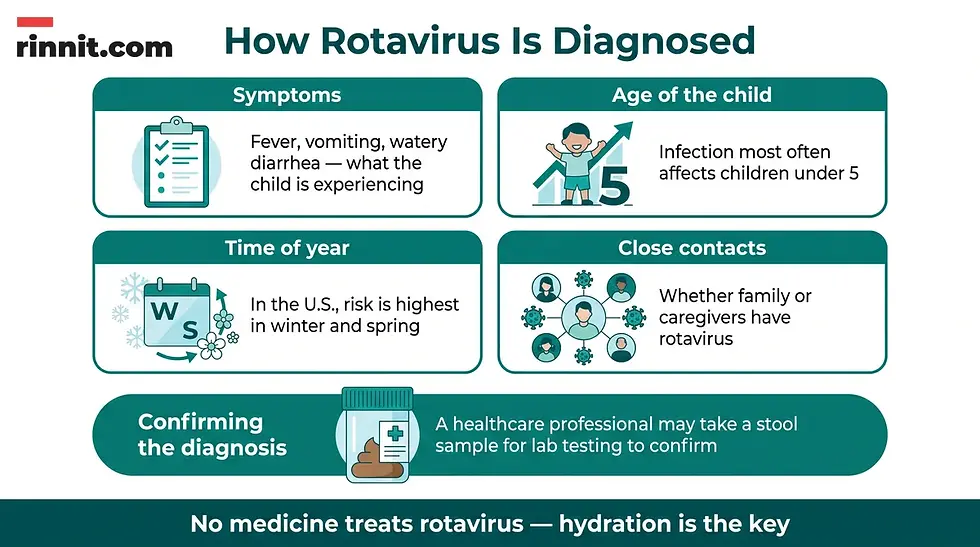
A diagnosis of rotavirus infection is based on symptoms, the age of the child, the time of year, and information about close contacts who have rotavirus [2]. A healthcare professional may take a stool sample for lab testing to confirm the diagnosis [2].
How Is Rotavirus Treated?
Rotavirus infection has no medicine to treat it, and anti-diarrheal medicines are not recommended for children [2]. Diarrhea gradually improves but may last up to a week [2].
Preventing or treating dehydration is the most important treatment goal [2]. Drinks designed to keep children hydrated include Enfalyte, Pedialyte, and others. These provide water and important salts and minerals [2]. Use them as directed, and ask your healthcare professional any questions about using these products. Serious dehydration may mean a hospital stay to get fluids directly into the bloodstream [2] [4].
What Foods Help?
A baby can continue regular breastfeeding or drinking formula as usual. Some infants who drink formula may benefit from a lactose-free formula [2]. Children can eat when they feel ready, and bland foods may help [2]:

How Can Families Prevent Rotavirus?
Families can prevent rotavirus with careful handwashing, regular cleaning of shared surfaces and the rotavirus vaccine for infants [1].
What Home Habits Slow the Spread?
To prevent the spread of the virus, wash your hands with soap and water after using the toilet, after changing a diaper or helping a child use the toilet, and before and after eating [1].
If someone in your family has a rotavirus infection, clean surfaces more often [1]. Use soap and water to clean shared objects, such as toys, and things that are touched often, such as diaper bins, doorknobs, and toilet handles [1]. An antiviral cleaning product or bleach solution can disinfect surfaces — you can make a bleach solution with 1/3 cup (79 milliliters) of bleach and 1 gallon (3.8 liters) of room-temperature water [1].
What About the Vaccine?
Rotavirus vaccine for infants is part of the childhood vaccine schedule [1], with two options:
Children can get the vaccine until they turn 8 months old [1] [3], and there is a catch-up schedule [1]. The vaccines are considered 74% effective or better in preventing rotavirus infection, and 96% or better for preventing serious illness — with effectiveness lasting for the first 2 to 3 years of life [1].
Intussusception is a rare complication of the vaccines, too. In the United States, there is an estimated one case for every 20,000 to 100,000 vaccinations [1] [3]. Its symptoms — intense stomach pain, vomiting, and bloody stools — need immediate medical care [1].
How Should You Prepare for Your Appointment?
You'll likely see your primary care professional. If there are serious complications, you may see a specialist in digestive conditions, called a gastroenterologist [2].
What Should You Ask?
Preparing a list of questions will help you make the most of your time:
Question to Ask | What It Covers |
What's the likely cause of these symptoms? | Includes other possible causes |
Is there a need for tests? | Confirms whether a stool test is needed |
What's the best treatment approach? | Includes other options |
Is there a need to take any medicine? | Clarifies the no-medication approach |
How can I ease the symptoms? | Practical comfort measures |
What Will Your Doctor Ask?
Your healthcare professional may ask when symptoms began, whether the symptoms have been continuous or come and go, how bad the symptoms are, what seems to improve them, and what appears to worsen them [2].
What is the bottom line on rotavirus?
Rotavirus is the classic stomach bug of the preschool years: it most often strikes children under 5 [1], announces itself with fever and vomiting that ease by day two, and then brings watery diarrhea that can linger for up to a week [1]. The virus spreads with frustrating ease — present in stool before symptoms start and for up to ten days after [1] — moving from hands to toys, doorknobs, and toilet handles, then back to the mouth. The illness itself runs its course with no specific medicine to treat it [2], but the complication that matters is dehydration, and the treatment that matters is replacing water and the salts and minerals children lose. With rest, hydration drinks, and appropriate bland foods, most children recover at home; the moments to act fast are the signs of dehydration, high fevers, six-plus stools a day, and any bloody or tarry stools. And because it can be caught more than once, prevention pays year after year: soap-and-water hand-washing, regular surface cleaning, and the routine childhood vaccine that is 96% or better at preventing serious illness [1].
Take the Next Step
If your child has watery diarrhea with fever or vomiting, start the home plan today: offer a hydration drink designed for children, continue breastfeeding or formula as usual [2], and provide bland foods like whole-grain crackers, lean meats, yogurt, and fruits and vegetables when they feel ready. Wash your hands with soap and water after every diaper change and before meals, and disinfect frequently touched surfaces. Then watch the warning list closely — diarrhea lasting more than 24 hours in a child, fever of 102°F or higher, no wet diaper for three or more hours, crying without tears, or black or bloody stools all call for a call to your child's healthcare professional. If your family hasn't completed the rotavirus vaccine schedule yet, ask your pediatrician about the catch-up options before your child turns 8 months [1].
Frequently Asked Questions
What is rotavirus?
Rotavirus is a type of germ called a virus, and the illness it causes is called a rotavirus infection. It most often affects children under age 5 and causes watery stools, called diarrhea [1].
What are the symptoms?
Symptoms often start within two days of exposure [1]. Fever and vomiting are usually the first symptoms and tend to improve by the second day [1]. Diarrhea can last a few days to a week, and it may take a few weeks for stools to return to normal [1].
How does it spread?
The virus is present in stool — at least two days before symptoms start and up to 10 days after [1]. Unwashed hands carry it to objects like toys, doorknobs, and toilet handles, and it then passes from hands or objects to the mouth [1]. Even invisible contact with stool can spread it [1].
Can you get rotavirus more than once?
Yes. It's possible to get a rotavirus more than once, but the first infection usually has the worst symptoms [1].
Who is most at risk?
Children under 5 are most commonly infected, and more-serious illness occurs in children under 3 [1]. Infants under 3 months usually don't get rotavirus infections [1] [3]. Outbreaks may occur in child-care settings and children's hospitals, and in the U.S. the risk is highest in winter and spring [1].
What is the main complication?
Dehydration — a large loss of water and important salts and minerals caused by both vomiting and diarrhea [1] [4]. If untreated, it can cause organ damage, other serious disease, and death [1].
What is intussusception?
A rare complication in which one part of the intestine slides into another part, like a telescope folded up [1]. It blocks the intestine and cuts off blood flow, causing intense stomach pain, vomiting, and bloody stools. It needs immediate medical care [1].
Is there a medicine to treat it?
No. There is no medicine to treat rotavirus infection, and anti-diarrheal medicines are not recommended for children [2]. The most important treatment goal is preventing or treating dehydration, typically with hydration drinks such as Enfalyte or Pedialyte [2].
What should my child eat and drink?
Babies should continue regular breastfeeding or formula, and some formula-drinking infants may benefit from lactose-free formula [2]. Children can eat when ready — bland foods like whole-grain breads or crackers, lean meats, yogurt, and fruits and vegetables may help [2]. Avoid fatty foods, fruit juices, drinks with added sugar, and sweets [2].
When should I call the doctor?
For children, call for diarrhea lasting more than 24 hours, fever of 102°F or higher (or 100.4°F or higher under 3 months), frequent vomiting, intense stomach or rectal pain, black or bloody stools, or dehydration signs like no wet diaper for three hours or crying without tears [1]. For adults, call for diarrhea lasting more than two days, six or more stools in 24 hours, or similar warning signs [1].
Is there a vaccine?
Yes. Rotavirus vaccine is part of the childhood schedule [1]. RV5 (RotaTeq) is given by mouth in three doses at 2, 4, and 6 months; RV1 (Rotarix) is a liquid given in two doses at 2 and 4 months [1] [3]. Children can get it until they turn 8 months [1] [3]. The vaccines are 74% effective or better against infection and 96% or better against serious illness [1].
How do I stop it spreading at home?
Wash hands with soap and water after using the toilet, after changing diapers, and before and after eating. Clean shared objects and frequently touched surfaces with soap and water, and disinfect with an antiviral cleaning product or a bleach solution made from 1/3 cup (79 ml) bleach and 1 gallon (3.8 L) of room-temperature water [1].
Related Reading
References
Mayo Clinic Staff. Rotavirus: Symptoms and causes. Mayo Clinic. Last updated August 18, 2025. Accessed October 14, 2026. https://www.mayoclinic.org/diseases-conditions/rotavirus/symptoms-causes/syc-20351300
Mayo Clinic Staff. Rotavirus: Diagnosis and treatment. Mayo Clinic. Last updated August 18, 2025. Accessed October 14, 2026. https://www.mayoclinic.org/diseases-conditions/rotavirus/diagnosis-treatment/drc-20351306
Centers for Disease Control and Prevention. Epidemiology and prevention of vaccine-preventable diseases: Rotavirus. CDC. Accessed October 14, 2026. https://www.cdc.gov/pinkbook/hcp/table-of-contents/chapter-19-rotavirus.html
Merck Manual Professional Version. Dehydration in children. Merck Manuals. Accessed October 14, 2026. https://www.merckmanuals.com/professional/pediatrics/dehydration-and-fluid-therapy-in-children/dehydration-in-children
Merck Manual Professional Version. Intussusception. Merck Manuals. Accessed October 14, 2026. https://www.merckmanuals.com/professional/pediatrics/gastrointestinal-disorders-in-neonates-and-infants/intussusception
Sun ZW, Fu Y, Lu HL, et al. Association of rotavirus vaccines with reduction in rotavirus gastroenteritis in children younger than 5 years: a systematic review and meta-analysis of randomized clinical trials and observational studies. JAMA Pediatr. 2021;175(7):e210347. PMID: 33970192. https://doi.org/10.1001/jamapediatrics.2021.0347
Wang G, Zhang K, Zhang R, et al. Impact of vaccination with different types of rotavirus vaccines on the incidence of intussusception: a randomized controlled meta-analysis. Front Pediatr. 2023;11:1239423. PMID: 37583623. https://doi.org/10.3389/fped.2023.1239423
Ayele F, Assebe T, Mandefro M, et al. Prevalence and genotype distribution of norovirus and rotavirus among children under five with diarrheal infection in lower-middle-income countries after rotavirus vaccine introduction: a systematic review and meta-analysis. PLoS One. 2026;21(10):e0359886. PMID: 42868165. https://doi.org/10.1371/journal.pone.0359886
Disclaimer: This guide is for general information only and is not a substitute for professional medical advice, diagnosis, or treatment. Always seek the advice of a physician or other qualified health provider with any questions about a medical condition. Never disregard professional medical advice or delay seeking it because of something you have read here.



Comments