What Is Mycosis Fungoides? A Plain-Language Guide to This Rare Skin Lymphoma

Updated: 3 days ago
Medically reviewed by Dr. Baraa Alnahhal, MD · Last reviewed: October 2026
Quick Answer
Mycosis fungoides is a rare, slow-growing non-Hodgkin lymphoma in which changed T cells attack the skin, forming rashes, patches, plaques and sometimes growths. [1] Despite its name, it is not caused by a fungus. [1] Diagnosis relies on skin exams and biopsies, often repeated over time. [2] Treatment includes skin-directed therapies, such as creams and light therapy, and whole-body treatments. [2]
What the research says
Juvenile-onset mycosis fungoides has an excellent outlook. In a single-centre review of 118 patients diagnosed between 1987 and 2023, 97% had early-stage disease (stages IA to IIA) at diagnosis and 13% developed disease progression, after a median of 2 years. Five-year and ten-year overall survival were 99% and 98%, disease-specific survival was 100% at both points, and no patient died of the disease. (Lohray et al., J Am Acad Dermatol, 2026 [3])
Mogamulizumab helped most when the blood was involved. In a post hoc analysis of the phase 3 MAVORIC trial (372 patients with relapsed or refractory mycosis fungoides or Sézary syndrome), the objective response rate in patients with the most blood involvement (class B2) was 37.4% with mogamulizumab versus 3.2% with vorinostat. Overall, 43.5% of patients on mogamulizumab had at least a 50% improvement in their skin score (mSWAT), compared with 22.0% on vorinostat. (Cowan et al., J Eur Acad Dermatol Venereol, 2021 [4])
Blood inflammation markers may help predict outcomes. In a retrospective study of 195 patients with mycosis fungoides, blood inflammation markers were higher in advanced-stage than in early-stage disease, and only the pan-inflammation value (PIV) and the systemic immune-inflammation index (SII) independently predicted poorer overall and progression-free survival in multivariable analysis. (Jung et al., Br J Haematol, 2025 [5])
What Is Mycosis Fungoides?
Mycosis fungoides is a rare type of lymphoma, a cancer that begins in the lymphocytes, a type of white blood cell that is part of the body's germ-fighting immune system. Lymphomas are usually divided into two broad categories: Hodgkin lymphoma and non-Hodgkin lymphoma. Mycosis fungoides falls into the non-Hodgkin group. [1]
It begins in white blood cells called T cells (also called T lymphocytes). These T cells undergo changes and turn into cancer cells, and in mycosis fungoides, those cancer cells attack the skin. [1] Mycosis fungoides is one of a few lymphomas that affect T cells in the skin. These are called cutaneous T-cell lymphomas.
The disease typically grows slowly. As it grows, it sometimes spreads to the lymph nodes, the blood, and the organs. [1] It is often hard to diagnose early because it usually looks like other common skin conditions, such as eczema (also called atopic dermatitis) and psoriasis, when it starts. [1]
A mycosis fungoides rash can sometimes lessen or go away and then come back. This cycle can repeat for months or years before the rash becomes worse. [1] The condition is also easy to miss on tests such as biopsies when it first appears, because the sampled cells might look like cells from a typical rash under the microscope. Sometimes cells have to be sampled and studied many times before a diagnosis is reached. [1]

Why Is It Called “Mycosis Fungoides” If It Isn't a Fungus?
The name comes from the appearance of some of its skin growths, which may look like mushrooms. [1] It is not caused by a fungus. The name describes how certain growths look, not what causes the disease.
What Are the Different Types of Mycosis Fungoides?
There are several types of mycosis fungoides, each with its own look and the groups it tends to affect.
Type | What It Looks Like | Who It Typically Affects |
Hypopigmented mycosis fungoides | Scaly patches that look lighter in color than the surrounding skin | Children and people with Black and brown skin [1] |
Folliculotropic mycosis fungoides | Bumps, acne-like spots, or patches (it affects the hair follicles, where hair grows from) | Adult men, though children also may be affected [1] |
Granulomatous slack skin | Loose, hanging folds in the skin, plus cell clusters called masses in areas like the armpits and groin | Men in their 20s and 30s [1] |
Pagetoid reticulosis | One wart-like or scaly patch, typically on a hand or foot | Men in their 40s and 50s, but can happen at any age [1] |
Poikiloderma mycosis fungoides | Thin patches of skin that are wrinkled, light and dark, and show blood vessels [1] | Varies |
You may also hear about Sezary syndrome, another cutaneous T-cell lymphoma that is often compared with mycosis fungoides. Like mycosis fungoides, Sezary syndrome looks like eczema and psoriasis in its early stages. It differs in that it usually expands quickly, can eventually cause a rash over the whole body, and often affects the blood early in the disease. [1]
What Does Mycosis Fungoides Look Like?
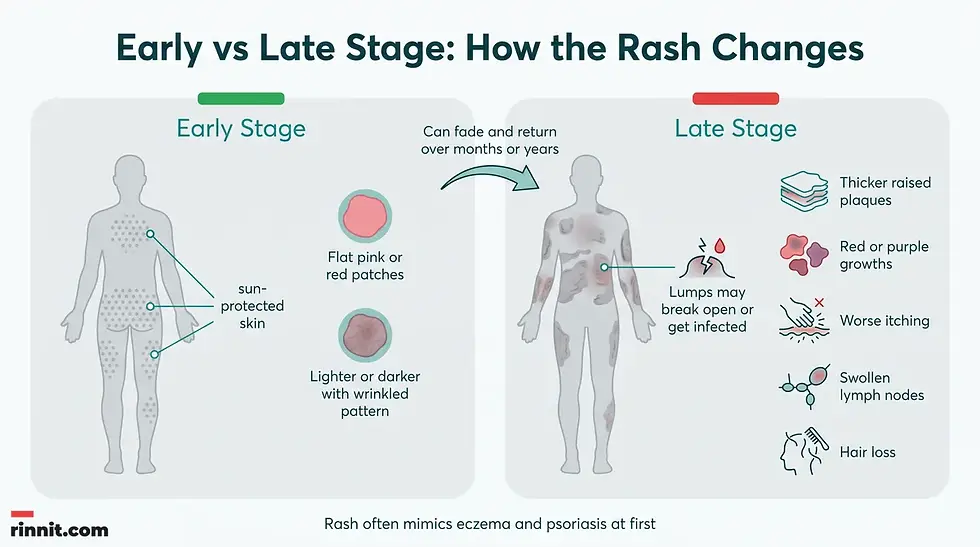
Signs and symptoms vary depending on the area of skin affected and whether the cancer is in early or late stages. [1]
Early-stage symptoms include:
Patches of rash on the skin. These usually show up on skin that doesn't get much sun, including the breasts, buttocks, and upper thighs. They can also appear on the face, scalp, palms, and soles, though that is less common. On white skin, the patches may look pink or red. On brown skin, they might look pink, red, deep red, or purple. On Black skin, they may look pink, purple, gray, or dark brown. [1]
Patches that can be lighter or darker than the surrounding skin and have a wrinkled pattern. [1]
Patches of scaly skin.
Skin that may itch constantly or from time to time.
Spots on the skin that come in different shapes and sizes. [1]
Late-stage symptoms include:
What Makes Mycosis Fungoides Hard to Diagnose?
Getting the right diagnosis may take time. The rash tends to stay around, and it can sometimes lessen or go away and come back from time to time. This cycle can repeat for months or years before a diagnosis is made. On top of that, early samples are easy to miss: the rash looks like eczema and psoriasis when it starts, and the sampled cells might look like cells from a typical rash under the microscope. Sometimes cells have to be sampled and studied many times before a diagnosis is reached.
What Causes Mycosis Fungoides?
Mycosis fungoides begins in white blood cells called T cells. The T cells undergo changes and turn into cancer cells. A cell's DNA holds the instructions that tell the cell what to do and when to die. [1] Because of these DNA changes, the cells stop dying. They usually multiply and form a skin patch or a mass. Exactly why the DNA changes happen is not known. [1]
Who Is at Higher Risk?
The risk of mycosis fungoides may be higher in certain groups. There is no known way to prevent it. [1]
Risk Factor | What the Evidence Shows |
Older adults | The condition can happen at any age, but it's more common in people in their 50s and older [1] |
People born male | Twice as common in people who were born male than in people who were born female [1] |
Black people | Black people have the highest risk and are more likely to get the cancer at an earlier age [1] |
What Complications Can Happen?
Mycosis fungoides may lead to skin infections due to breaks in the skin. [1]
When Should I See a Doctor?
Make an appointment with a healthcare professional if you have symptoms that worry you or are not going away. [1] That is especially important for any rash that behaves like mycosis fungoides does: appearing on sun-protected skin, fading and returning over months or years, and not responding to ordinary skin care.
How Is Mycosis Fungoides Diagnosed?
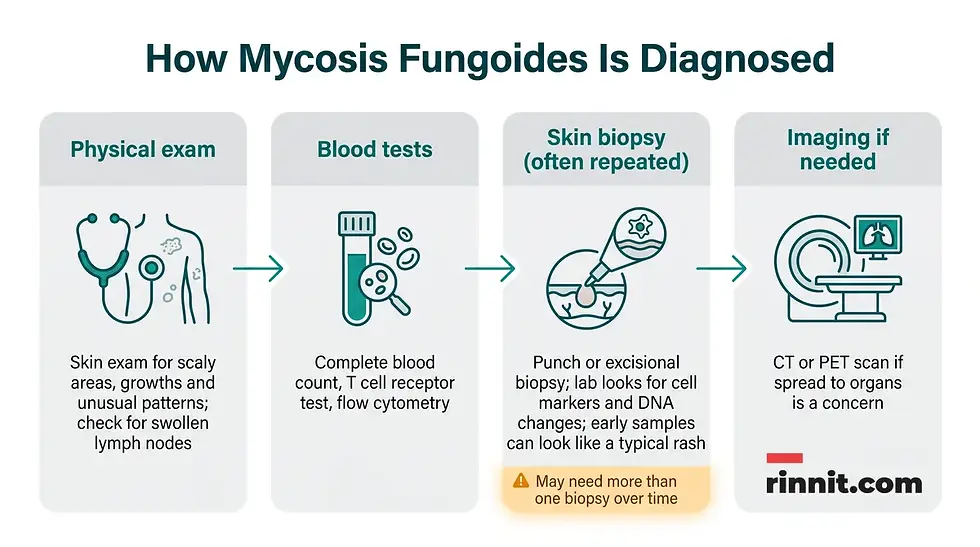
A dermatologist typically begins with a skin exam, and tests and procedures likely will include blood tests, skin biopsies, and imaging tests. [2]
Physical exam
A healthcare professional starts by looking over your skin for scaly areas, growths, and unusual patterns. [2] You likely will be asked how your symptoms have behaved over time. The professional also will usually check for other signs, such as swollen lymph nodes. [2]
Blood tests
Tests such as a complete blood count, a T cell receptor test, and flow cytometry could give information about your condition. [2]
Skin biopsy
A skin biopsy is a necessary part of getting a diagnosis. [2] The procedure collects cells from suspicious tissue on the surface of the body so they can be tested in a lab, and the tests can show whether cancer cells are present in the skin. A healthcare professional might take the sample with a circular cutting tool, called a punch biopsy, or, for larger areas and growths, with a small knife, which is called an excisional biopsy.
Skin biopsies don't always confirm that cancer cells are present. A biopsy might show microabscesses in the skin cells under the microscope: tiny clumps of cells in the top layer of the skin that are not typical cells. Sometimes sampled cells from a biopsy might look like cells from a typical rash under the microscope. Because of this, you might need more than one skin biopsy over time to arrive at the diagnosis. [2]
Imaging tests
An imaging test takes pictures inside the body and can show the location and extent of the disease if it involves internal organs. If there is concern that the cancer cells have spread to other parts of the body, your healthcare professional might suggest a computerized tomography (CT) scan or a positron emission tomography (PET) scan.
Testing lymphoma cells in the lab
Cancer cells collected from a biopsy go to a lab for testing. Under the microscope, the cancer cells have a different appearance compared with healthy cells. To decide whether the cells are mycosis fungoides cells, the healthcare professionals in the lab look for two things: proteins on the surface of the cancer cells, which are known as markers and are identified by the presence or absence of certain proteins, and changes in the cancer cells' DNA, which cause the cells to stop dying and start multiplying rapidly. [2]
How Is Mycosis Fungoides Treated?
Treating mycosis fungoides depends on the symptoms, how much skin is involved, and whether the cancer is limited to the skin or has spread to the lymph nodes, organs, or blood. Treatment often involves skin-directed therapies and systemic treatments, which are treatments that work throughout the whole body. [2]
People with early-stage mycosis fungoides are usually seen by a dermatologist first, and then could be referred to a cancer specialist called a hematologist if skin-directed therapies are not working. People with more advanced forms are typically seen jointly by a hematologist/oncologist and a dermatologist. A radiation oncologist could be involved if radiation therapy is needed. [2]
Treatment may include medicines, radiation therapy, light therapy, and bone marrow transplant. Mycosis fungoides typically cannot be cured, but many treatments can help reduce symptoms and improve the skin, and your treatment plan may include a mix of treatments. [2]
Skin Creams and Ointments
Some medicines are applied directly to the skin as creams, gels, and ointments. Steroid medicines are commonly used, either applied to the skin or taken as pills, and can help control rash and itchiness. [2] Chemotherapy medicines can also be applied to the skin.
Light Therapy
Light therapy involves shining a certain kind of light on the skin to kill the cancer cells. During treatment, you stand in a treatment area while lamps shine on your skin. The treatment often is given a few times a week for several weeks. [2] Sometimes light therapy also uses a medicine to make the cancer cells easier to kill with the light. [2] This is called PUVA (psoralen plus ultraviolet A light).
Radiation Therapy
Radiation therapy treats cancer with powerful energy beams, most often X-rays or electrons for mycosis fungoides. [2] The treatment might target a small area of cancer on the skin, or it can be given to all the skin on the body, which is called total skin irradiation.
Medicines by Mouth or Through a Vein
Some medicines are given in pill form or through a vein, so the medicine travels through the body and can treat the cancer wherever it is growing. [2]
Medicine Type | What It Is | What It Does |
Chemotherapy | Strong medicines | Kill the cancer cells [2] |
Targeted therapy | Medicines that attack specific chemicals in the cancer cells | By blocking these chemicals, targeted treatments can cause cancer cells to die |
Immunotherapy | Medicine that helps the body's immune system kill cancer cells | Helps immune cells find and kill the cancer cells that survive by hiding from the immune system |
Bone Marrow Transplant
A bone marrow transplant, also called a bone marrow stem cell transplant, involves putting healthy bone marrow stem cells into the body. These cells replace cells hurt by chemotherapy and other treatments. It might be used when mycosis fungoides is far along or comes back after other treatments. [2]
What Is the Outlook?
A cancer prognosis tells you how likely it is that the cancer can be treated successfully. Your healthcare team can get a general sense of your outlook based on the stage of the cancer when you were first diagnosed and other factors such as your overall health. Mycosis fungoides usually has a better outlook when it is in early stages and is still limited to the skin. [2] The cancer typically gets harder to treat as the stage advances or the disease spreads beyond the skin. [2] Your healthcare team will talk with you about treatment options that give you the best opportunity for a good outcome.
What Can I Do at Home to Ease the Itching?
Many people with mycosis fungoides have itchy skin, and caring for your skin may help. Besides what your healthcare professional gives you to control itching, it also may help to use mild soap with no scent, which might help ease itching, and to wash your skin with warm, not hot, water. It also helps to keep skin moisturized with a gentle lotion, cream, or ointment with no scent after showers and baths, and to use the moisturizer throughout the day as needed to ease itching. [2]
How Should I Prepare for My Appointment?
Start by making an appointment with a doctor or other healthcare professional if you have symptoms that worry you or are not going away.
Before you go, ask if there's anything you need to do beforehand. For example, you may be told not to eat before a certain test. Then make a list of your symptoms (including any that don't seem related to the reason for your appointment, and when they began), key personal information (major stresses, recent life changes, and family medical history), all medicines, vitamins, and other supplements you take with their doses, and questions to ask your healthcare professional. If possible, bring a family member or friend to help you remember the information you're given in case you feel overwhelmed at the appointment. [2]
Questions to ask your doctor
What's likely causing my symptoms?
Other than the most likely cause, what are other possible causes?
What medicines or creams can I use to help manage my rash?
What tests do I need?
What's the best course of action?
I have other health conditions. How can I best manage them together?
Are there restrictions I need to follow?
Should I see a specialist?
Are there brochures or other printed material I can have? What websites do you suggest?
What your doctor may ask you
When did your symptoms begin?
Do you have symptoms all the time, or do they come and go?
How bad are your symptoms?
What, if anything, seems to make your symptoms better?
What, if anything, seems to make your symptoms worse?
Be sure to ask as many questions as you need to understand what is ahead.
The Bottom Line
Mycosis fungoides is a rare, slow-growing non-Hodgkin lymphoma in which changed T cells attack the skin. Despite its mushroom-inspired name, it is not caused by a fungus. It is often hard to diagnose early because its rash mimics eczema and psoriasis and can fade and return for months or years, sometimes needing repeated biopsies before cancer cells are confirmed. There is no known way to prevent it, and risk is highest in older adults, people born male, and Black people. When it is caught early and limited to the skin, the outlook is usually better, and a mix of skin-directed and whole-body treatments can manage symptoms, protect the skin, and improve quality of life. If a rash on your sun-protected skin won't go away, keep following up with a healthcare professional until you have a clear answer.
Take the Next Step
If you have a persistent rash that fades and returns, especially on your chest, buttocks, or thighs, don't let it slide. Bring your history, your photos of the rash over time, and this guide to your appointment. Ask about a skin biopsy, ask what else the rash could be, and ask whether you should see a dermatologist or a specialist. Early, clear answers matter for a condition this easy to miss, and your healthcare team can put together a plan that matches your stage and your skin.
Frequently Asked Questions
What is mycosis fungoides?
Mycosis fungoides is a rare type of non-Hodgkin lymphoma that mainly affects the skin. It begins in white blood cells called T cells, which undergo changes, turn into cancer cells, and attack the skin.
Is mycosis fungoides caused by a fungus?
No. The name comes from the mushroom-like look of some of its skin growths. It is not caused by a fungus.
Is mycosis fungoides a type of skin cancer?
Mycosis fungoides is a type of lymphoma, a blood-cancer family that affects the immune system's white blood cells, rather than a cancer that starts in skin cells themselves. But it mainly affects the skin, so it is grouped with cutaneous (skin-affecting) T-cell lymphomas.
Why is it so often mistaken for eczema or psoriasis?
When it starts, the rash usually looks like these common skin conditions, it can lessen or go away and come back, and early biopsy samples can look like cells from a typical rash under the microscope. The cycle can repeat for months or years before a diagnosis is made.
Who is most likely to get mycosis fungoides?
The condition can happen at any age, but risk is higher in people in their 50s and older, people born male (about twice as common as in people born female), and Black people, who have the highest risk and may be affected at an earlier age.
How is it diagnosed?
A dermatologist usually starts with a skin exam, then blood tests, skin biopsies, and imaging tests if needed. Because early biopsies can look like a typical rash, more than one biopsy over time may be needed. Lab tests on the biopsy cells look for protein markers on the cell surface and DNA changes.
Can mycosis fungoides be cured?
Mycosis fungoides typically cannot be cured, but many treatments can reduce symptoms and improve the skin. Treatment may mix skin-directed therapies (creams, light, radiation) with whole-body medicines, and a bone marrow transplant is an option when the disease is advanced or returns.
What can I do at home to help with the itching?
Use mild soap with no scent and warm (not hot) water when washing, and keep skin moisturized with a gentle, unscented lotion, cream, or ointment after showers and baths, reapplying through the day as needed.
Is mycosis fungoides contagious?
No. Mycosis fungoides is a lymphoma, not an infection, so it cannot spread to other people through touch or shared items.
What are the stages of mycosis fungoides?
It often starts as flat patches, which can turn into thicker raised plaques and, in some people, growths called tumors. In later stages it can affect the lymph nodes, blood or other organs, and the stage helps guide treatment.
Related Reading
What Is Multiple Myeloma? A Plain-Language Guide to Symptoms, Causes, and Treatment
What Is Multiple System Atrophy? A Plain-Language Guide to Symptoms, Causes, and Treatment
What Is Mantle Cell Lymphoma? A Plain-Language Guide to This Rare Blood Cancer
What Is Muscular Dystrophy? A Plain-Language Guide to the Group of Diseases That Weaken Muscles
References
Mayo Clinic Staff. Mycosis fungoides - Symptoms & causes. Mayo Clinic. May 12, 2026. https://www.mayoclinic.org/diseases-conditions/mycosis-fungoides/symptoms-causes/syc-20600799
Mayo Clinic Staff. Mycosis fungoides - Diagnosis & treatment. Mayo Clinic. May 12, 2026. https://www.mayoclinic.org/diseases-conditions/mycosis-fungoides/diagnosis-treatment/drc-20600801
Lohray R, et al. Long-term outcomes in juvenile-onset mycosis fungoides. J Am Acad Dermatol. 2026;95(2):409-415. PMID 41780598. https://doi.org/10.1016/j.jaad.2026.02.095
Cowan RA, et al. Efficacy and safety of mogamulizumab by patient baseline blood tumour burden: a post hoc analysis of the MAVORIC trial. J Eur Acad Dermatol Venereol. 2021;35(11):2225-2238. PMID 34273208. https://doi.org/10.1111/jdv.17523
Jung JM, et al. Systemic immune-inflammation index and pan-immune value as prognostic indicators of clinical outcomes in mycosis fungoides: A retrospective cohort study. Br J Haematol. 2025;207(5):1902-1911. PMID 40947534. https://doi.org/10.1111/bjh.70151
Medical disclaimer
This article is for general informational purposes only and does not constitute medical advice. Always consult a qualified healthcare professional for diagnosis and treatment decisions.



Comments