What Is Molluscum Contagiosum? A Plain-Language Guide to This Common Childhood Skin Infection

Updated: 2 days ago
Medically reviewed by Dr. Baraa Alnahhal, MD · Last reviewed: October 2026
Quick Answer: Key Facts About Molluscum Contagiosum
Molluscum contagiosum is a common viral skin infection that causes small, round, firm, painless bumps with a dent at the top. It is most common in children ages 1 to 10 and spreads through skin contact and shared items. Bumps usually disappear on their own in 6 months to 2 years, so treatment is often unnecessary, though removal options exist. [1] [2]
Question | Answer |
What it is | A common viral skin infection that causes small, round, firm, painless bumps with a small dent at the top. |
Who gets it | Most common in children ages 1 to 10; can also affect adults with weakened immune systems or, through sexual contact, healthy adults. |
How it spreads | Skin-to-skin contact, shared towels and clothing, contaminated pools and hot tubs, wrestling mats and kickboards, and scratching or shaving over the bumps. |
How long it lasts | Bumps usually disappear on their own in 6 months to 2 years without treatment. |
How it is treated | Often no treatment is needed; options include irritating medicines, blistering medicine (cantharidin), scraping, freezing (cryotherapy), and laser therapy. |
What the research says
Molluscum often takes longer to clear than parents expect. In a UK study that followed 306 children aged 4 to 15, the average time to clear was 13.3 months. About 30% still had bumps at 18 months, and 13% at 24 months. (Olsen et al., Lancet Infect Dis, 2015) [4]
No treatment has been proven clearly better than waiting. A Cochrane review of 22 trials with 1,650 people without immune problems found that no single treatment was convincingly effective, so natural resolution remains a strong option. (van der Wouden et al., Cochrane Database Syst Rev, 2017) [5]
Some treatments clear bumps more often than placebo, but side-effect data are thin. A network meta-analysis of 25 trials (2,123 people) found that cryotherapy cleared bumps far more often than placebo (odds ratio 16.81; 95% CI 4.13–68.54), but data on adverse effects were too scarce to compare treatments. (Chao et al., J Dtsch Dermatol Ges, 2023) [6]
What Is Molluscum Contagiosum?
Molluscum contagiosum (say it: mo-LUS-kum kun-tay-jee-OH-sum) is a fairly common skin infection caused by a virus. It causes round, firm, painless bumps on the skin. The bumps range in size from a pinhead to a pencil eraser. [1]
The bumps usually have a small dent or dot at the top. They can look skin-colored or take on a pink color. If the bumps are scratched or injured, the infection can spread to nearby skin. The virus also spreads through person-to-person contact and contact with infected objects. [1]
The condition is most common in children, but it can affect adults too. Adults with weakened immune systems are at higher risk. Adults with healthy immune systems can develop the infection through sexual activity with an infected partner. [1]
Left untreated, the bumps usually disappear in 6 months to 2 years. [1] [2] Once the bumps are gone, you are no longer contagious. [2]

What Do the Bumps Look and Feel Like?
The bumps of molluscum contagiosum have a few features that set them apart from other rashes. They are raised, round, and usually skin-colored. Each bump is small — typically under about 1/4 inch (smaller than 6 millimeters) in diameter. The most telling feature is a small dent or dot at the top near the center of each bump. [1]
The bumps are firm and painless, though they can be itchy and turn pink. [1] A quick way to describe them: they look like tiny firm pearls sitting on the skin with a dimple in the middle.
Where on the Body Do the Bumps Appear?
Where the bumps show up depends partly on how the person caught the virus. In children, the bumps most often appear on the face, trunk, arms, and legs. In adults, if the infection was sexually transmitted, the bumps appear on the genitals, lower abdomen, or inner thighs. [1]
Why Does Molluscum Contagiosum Happen?
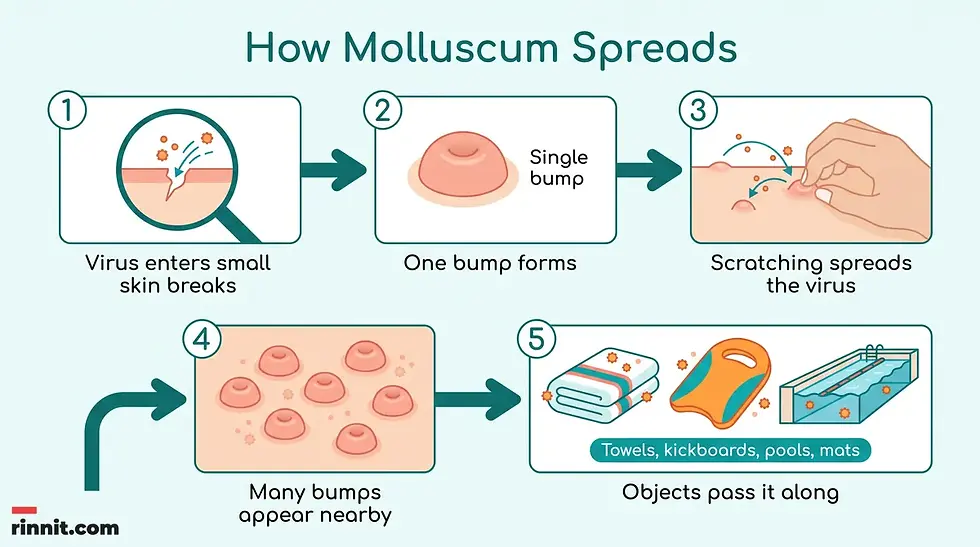
A virus causes molluscum contagiosum, and that virus spreads easily in several ways. [1] The virus enters the skin through tiny breaks and starts growing in the top layers, forming the characteristic bumps.
How It Spreads | Examples |
Skin-to-skin contact | Touching the bumps of an infected person [1] |
Infected objects | Towels, kickboards, wrestling mats [1] |
Contaminated water | Swimming pools or hot tubs [1] |
Sexual contact | With an affected partner [1] |
Scratching or rubbing | Spreads the virus from one bump to nearby skin [1] |
The last row matters a lot for everyday care. Scratching or rubbing the bumps spreads the virus to nearby skin, which is why one bump can turn into many. [1]
Who Is More Likely to Catch It?
Three groups face higher risk. Children ages 1 to 10 are the most likely to develop molluscum contagiosum — it is simply the most common age group for this infection. [1] [3]
People with weakened immune systems also face higher risk. Conditions and treatments that weaken the immune system include leukemia, HIV, and cancer treatments. [1]
People with atopic dermatitis are another higher-risk group. Atopic dermatitis is a common skin condition that causes a dry, itchy rash. The rash typical of atopic dermatitis creates an entry point for the virus that causes molluscum. [1]
Can Molluscum Contagiosum Cause Problems?
Usually the infection is mild and resolves without complications. [3] But the bumps and the skin around them may become inflamed. This is thought to be an immune system response to the infection. [1]
If the bumps are scratched, they can become infected and heal with scarring. And if sores appear on the eyelids, pink eye (conjunctivitis) can develop. [1]
How Is Molluscum Contagiosum Found?
Health care providers usually can diagnose molluscum contagiosum just by looking at it. [2] The bumps have such a distinctive look — round, firm, with a dent at the top — that most cases are identified on sight.
If there is any doubt, the provider may take skin scrapings from the infected area and view them under a microscope. [2] That is usually the only testing needed.

Should You Get Treatment, or Wait It Out?
Many people with molluscum contagiosum can wait it out, while severe or widespread cases may be referred to a dermatologist for removal options. The good news is that the infection usually gets better without treatment in 6 months to 2 years. Once the bumps are gone, you are no longer contagious. [2]
However, there is one catch to be aware of. After healing, it is possible to become reinfected with the virus. Catching it again later is not the old infection returning — it is a new infection. [2]
For severe or widespread disease, a health care provider might refer you to a specialist in skin conditions (a dermatologist) to discuss options for removing the bumps. [2]
What Treatments Remove the Bumps?
Molluscum contagiosum bumps can be removed with one treatment or a combination of options. [2]
Treatment | How It Works |
Irritating medicine | A medicine such as retinoic acid or benzoyl peroxide irritates the sores to encourage healing [2] |
Blistering medicine (cantharidin) | Causes blisters, which lifts off the bumps [2] |
Scraping | Physically removes the bumps [2] |
Freezing (cryotherapy) | Freezes the bumps off [2] |
Laser therapy | May be an option for people with a weakened immune system [2] |
Some procedures can be painful, so a health care provider may numb the skin first. The possible side effects of treatment are infection and scarring. [2] That trade-off is worth weighing, since the infection often clears on its own. In the U.S., two prescription treatments are FDA-approved for molluscum: cantharidin solution (Ycanth), applied in the office, and berdazimer gel (Zelsuvmi), used at home.

How Can You Stop It From Spreading?
Good habits can slow or stop the spread of the virus. Hand washing is the first line of defense — keeping hands clean helps prevent spreading the virus. [1]
Avoid touching the bumps. Shaving over the infected areas can also spread the virus, so avoid shaving in affected areas. [1]
Do not share or borrow personal items. This includes clothing, towels, hairbrushes, and other personal items. [1]
If you have molluscum contagiosum on or near the genitals, avoid sexual contact until the bumps are treated and gone. [1]
Cover the bumps with clothing when around others to prevent direct contact. Leave the affected area open to the air when not around others — this promotes healthy skin. When swimming, cover the bumps with a watertight bandage. [1]
Prevention Step | Why It Helps |
Wash hands | Stops the virus from moving to new skin [1] |
Don't touch the bumps | Scratching spreads the virus to nearby skin [1] |
Don't share towels or clothing | The virus lives on personal items [1] |
Avoid sex until bumps are gone | Prevents sexual transmission [1] |
Cover bumps around others | Prevents direct contact; open air promotes healing [1] |
How Should I Prepare for My Doctor Appointment?
You will likely start by visiting your or your child's health care provider. You may also be referred to a doctor who specializes in treating skin conditions (a dermatologist). [2]
Before the appointment, write a list that answers these questions:
What symptoms are you or your child experiencing?
What, if anything, seems to improve the symptoms?
What, if anything, appears to worsen the symptoms?
What medications and supplements do you or your child take on a regular basis? [2]
Your health care provider may ask:
When did the symptoms begin?
Do the symptoms come and go or are they nonstop?
Have you or your child had similar bumps in the past?
Has anyone close to you or your child had similar bumps? [2]
When Should You Call a Doctor?
If you suspect you or your child has molluscum contagiosum, contact your health care provider. [1] Because the bumps look similar to other skin conditions, a provider's quick visual check confirms what you are dealing with and whether treatment is worth pursuing.
What Should I Remember About Molluscum Contagiosum?
Molluscum contagiosum is a common, usually mild viral skin infection. The bumps are distinctive — small, round, firm, painless, with a dent at the top. It spreads easily through touch, shared objects, and pools, and children ages 1 to 10 are the group most affected. [1]
In most cases, the bumps go away on their own within 6 months to 2 years, and no treatment is needed. [2] Treatment can remove bumps for severe or widespread cases, but it carries risks of infection and scarring. [2] Keeping hands clean, not scratching the bumps, and not sharing towels give the skin the best chance to heal without spreading the virus.
Take the next step. If your child develops small round bumps with a dent at the top, contact your health care provider for a quick visual check. Keeping hands clean, leaving the bumps alone, and covering them around others helps stop the spread while the skin heals — whether on its own or with treatment. Call your health care provider about new skin bumps — especially if they appear on the eyelids, multiply quickly, or occur on someone with a weakened immune system.
Frequently Asked Questions
Is molluscum contagiosum contagious?
Yes, it is contagious while the bumps are present. It spreads through skin-to-skin contact, shared objects like towels, contaminated pools, and sexual contact. Once the bumps are gone, you are no longer contagious — though you can be reinfected later. [1] [2]
How long does molluscum contagiosum last?
The bumps usually disappear on their own in 6 months to 2 years without any treatment. [1] [2] In one UK study of 306 children, the average time to clear was about 13 months. [4]
Does molluscum contagiosum hurt?
No. The bumps are firm and painless, though they can be itchy and turn pink. [1]
What is the dent in the top of each bump?
The small dent or dot at the top of each bump is the most distinctive feature of molluscum contagiosum. [1] Providers use it to tell the infection apart from other rashes.
Can adults get molluscum contagiosum?
Yes. Adults with weakened immune systems — from conditions like leukemia or HIV, or from cancer treatments — are at higher risk. Healthy adults can also develop it through sexual contact with an infected partner, with bumps appearing on the genitals, lower abdomen, or inner thighs. [1]
Should the bumps be treated or left alone?
Treatment is optional for most people, since the infection usually clears on its own. For severe or widespread cases, a dermatologist can discuss removal options such as irritating medicines, cantharidin, scraping, freezing, or laser therapy. [2]
Does treatment hurt?
Some removal procedures can be painful, so a provider may numb the skin first. Possible side effects of treatment are infection and scarring. [2]
How do I keep it from spreading at home or at school?
Wash hands, avoid touching the bumps, don't share towels or clothing, cover the bumps around others, and use a watertight bandage when swimming. Don't shave over infected areas. [1]
What causes molluscum contagiosum?
It is caused by a poxvirus called the molluscum contagiosum virus. The virus lives only in the top layer of the skin and does not spread inside the body.
Can my child go to school or swimming with molluscum?
Yes, children with molluscum usually do not need to stay home from school, daycare or swimming. Covering visible bumps with clothing or a watertight bandage and not sharing towels or kickboards helps protect others.
Related Reading
Read next on Rinnit.com:
References
Mayo Clinic Staff. Molluscum contagiosum - Symptoms & causes. Mayo Clinic. February 16, 2024. https://www.mayoclinic.org/diseases-conditions/molluscum-contagiosum/symptoms-causes/syc-20375226
Mayo Clinic Staff. Molluscum contagiosum - Diagnosis & treatment. Mayo Clinic. February 16, 2024. https://www.mayoclinic.org/diseases-conditions/molluscum-contagiosum/diagnosis-treatment/drc-20375230
Canadian Paediatric Society. Molluscum contagiosum. Caring for kids. August 2021. https://caringforkids.cps.ca/handouts/health-conditions-and-treatments/molluscum-contagiosum
Olsen JR, et al. Time to resolution and effect on quality of life of molluscum contagiosum in children in the UK: a prospective community cohort study. Lancet Infect Dis. 2015;15(2):190-195. PMID 25541478. https://doi.org/10.1016/S1473-3099(14)71053-9
van der Wouden JC, et al. Interventions for cutaneous molluscum contagiosum. Cochrane Database Syst Rev. 2017;5(5):CD004767. PMID 28513067. https://doi.org/10.1002/14651858.CD004767.pub4
Chao YC, et al. Comparative efficacy of treatments for molluscum contagiosum: A systematic review and network meta-analysis. J Dtsch Dermatol Ges. 2023;21(6):587-597. PMID 37199262. https://doi.org/10.1111/ddg.15063
Medical disclaimer
This article is for general informational purposes only and does not constitute medical advice. Always consult a qualified healthcare professional for diagnosis and treatment decisions related to your specific situation.



Comments