Staph Infections: Symptoms, Causes, Treatment, and Prevention — Complete Guide

Updated: 2 days ago
Medically reviewed by Dr. Baraa Alnahhal, MD · Last reviewed: September 2026
TL;DR
Staph (staphylococcus) bacteria live harmlessly on the skin or in the nose of many people, but they can cause skin infections — the most common type — as well as serious bloodstream, joint, and food-poisoning illness. Most skin infections heal with antibiotics or simple drainage, but emergency care is needed for sepsis signs such as fever, fast breathing, confusion, or a rash that mimics underwear. MRSA, the antibiotic-resistant strain, is carried by about 2 in 100 people, and in 2017 staph bloodstream infections caused roughly 119,000 illnesses and 20,000 deaths in the United States. Handwashing, wound care, not sharing personal items, and safe food temperatures are the core preventions.
Quick Answer
A staph infection is an illness caused by staphylococcus bacteria, which many people carry harmlessly on their skin or in their nose. Most often it causes a skin infection — impetigo, folliculitis, boils, or MRSA abscesses — or food poisoning with vomiting and diarrhea that resolves in under a day. It is usually treated with antibiotics, but staph food poisoning is not, and MRSA strains resist common antibiotics. Get emergency care for sepsis signs (fever, fast breathing, confusion), and see a doctor for wounds that won't heal, fever of 100.4°F or higher, or infections spreading through a household or team [1] [2].
Medical disclaimer: This article is for educational purposes only and is not a substitute for professional medical advice, diagnosis, or treatment. Always consult a qualified healthcare professional for evaluation and care of infections.
What is a staph infection?
Staph infections are caused by staphylococcus bacteria. These germs may be found on the skin or in the nose of many people and cause no harm [1].
If they do cause harm, staph bacteria most often cause a food poisoning or a skin infection that can be treated quickly and without complications. But some staph infections can cause serious illness [1].
"Staph infections can be deadly if the bacteria get into the bloodstream, joints, bones, lungs or heart. If the infection is in or near a medical device, such as a catheter, surgery may be needed to remove the device" [1].
One important distinction shapes how staph is treated: medicine that kills bacteria, called antibiotics, is used to treat staph infections — but not food poisoning caused by staph bacteria. Infected tissue may also be removed to treat a staph infection [1].
What does a staph infection look like? Signs and symptoms
Staph infection symptoms vary depending on where the infection is in the body and how serious it is [1].
Skin infections
On the skin, a staph infection might be more common in areas where the skin is already damaged — eczema patches, places where insulin is injected, or bug bites [1]. The Mayo Clinic describes these common types [1]:
Skin infection | What it looks like |
Impetigo | Sores on the face that burst and leave a yellow crust |
Folliculitis | Pus-filled bumps around hair follicles that look like pimples; more likely to be itchy and to turn into a crusty sore |
Boils (furuncles) | Deep pockets of pus, often under the arms, around the groin, or on the buttocks |
Carbuncles | Pockets of pus around the neck area |

With these skin infections, people usually do not have a fever or symptoms of a more serious infection. MRSA infections start out as small red bumps that can quickly turn into deep, painful abscesses [1].
Signs the infection has gone deeper
A staph infection that starts on the skin but moves deeper may cause symptoms throughout the body [1]:
A change in skin color — red, purple, or brown depending on skin color
Skin that is discolored, swollen, warm, painful, and may feel hard
A blister that can break and leave a discolored, raw surface that looks like a burn
Fever and chills
A general feeling of being sick, called malaise
Serious pain
These symptoms suggest a serious infection. Examples include cellulitis, mastitis, necrotizing fasciitis, and staphylococcal scalded skin syndrome [1].
Staph food poisoning
Staph bacteria can get into food from a person with a staph infection, or from someone who carries the bacteria on their skin or in their nose without being ill. If food stays at room temperature too long, the bacteria multiply and make toxins [1].
Symptoms include upset stomach and vomiting, stomach cramps, and diarrhea. They come on quickly — usually within hours of eating contaminated food. Staph food poisoning usually does not cause a fever, and symptoms usually disappear quickly, often lasting less than a day [1].
Bloodstream infection (bacteremia)
Bacteremia is when staph bacteria enter the bloodstream. If untreated, it can trigger an overwhelming immune response called sepsis, and a complication of sepsis called septic shock, where organs begin to fail [1]. Symptoms can include fever or chills, fast breathing, fast heart rate, new confusion or disorientation, cold or sweaty skin, and severe pain [1].
Toxic shock syndrome
Toxins from some staph strains can make the immune system overreact in a life-threatening condition linked to certain tampons, skin wounds, and surgery. Toxic shock usually develops suddenly with a high fever, a skin rash or color change in a pattern that mimics underwear, stomach pain or vomiting, confusion, muscle aches, and diarrhea [1].
Septic arthritis
Staph bacteria can infect the body's joints or artificial joints — often the knees, shoulders, hips, and fingers or toes. Symptoms include joint swelling, severe pain in a joint, and fever [1].
When should you seek emergency care?
If you have symptoms of sepsis or septic shock, get emergency care right away. A staph infection can cause different types of sepsis, and symptoms may include fever or chills, fast breathing, new confusion, cold or sweaty skin, severe pain, an underwear-pattern rash, stomach pain or vomiting, muscle aches, diarrhea, joint swelling, and severe joint pain [1].
Make an appointment with a healthcare professional for skin infections or wounds that do not improve, and for skin that has changed color, is swollen or warm to the touch, has pus-filled blisters, or comes with a fever of 100.4°F (38°C) or higher [1].
Also see a healthcare professional if a skin infection is spreading between family members, or if two or more members of your family, sports team, or gym have skin infections [1].

What causes staph infections?
Staph infections are caused by contact with staph bacteria or toxins from the bacteria. They can spread from person to person, or you may touch something with the bacteria on it and then touch your body [1].
Staph bacteria can live on the human body without making you sick. They live on skin as well as in the nose and the back of the mouth. Many people have staph bacteria and never develop staph infections [1]. Research puts numbers on this: studies estimate that roughly 20–40% of the general population are colonized with Staphylococcus aureus at any time, and U.S. national survey data have measured nasal carriage at about 30% [5] [6].
Who is at higher risk?
A serious staph infection may be more likely for some people than others. The risk goes up as you age, and people with a weakened immune system or skin diseases are at higher risk [1].
Risk category | Examples |
Health conditions | Diabetes; HIV infection; kidney failure (end-stage renal disease) |
Treatments | Chemotherapy; dialysis; systemic steroids |
Medical devices | Artificial joints; catheters and other devices traveling from outside to inside the body |
Broken skin | Chronic skin disease; burns; wounds or trauma; surgical procedures; injections; acupuncture |
MRSA: the resistant strain
Some staph bacteria cannot be killed by standard antibiotics. One example is methicillin-resistant Staphylococcus aureus, or MRSA. People in the hospital are at risk of MRSA infection, but it can also affect people in the general public [1]. According to the CDC, about 2 in every 100 people carry MRSA, and while most never develop serious infection, about 1% of Americans (more than 3 million people) carry it [3] [4].
People at high risk of community-spread MRSA include [1]:
Risk group | Who it includes |
Crowded living conditions | College dorms, nursing homes, military facilities, correctional facilities, shelters |
High chance of skin damage | People who use injected illicit drugs; people with chronic skin disorders |
Weakened immune system | Children under 2, people over 65, people with HIV infection |
Animal contact | Vets, farm workers, meat-processing workers (some MRSA strains) |
Certain population groups | Native American and Alaska Native people; African Americans (higher MRSA rates) |
Regular skin-to-skin contact | Athletes in contact sports such as football or wrestling |
Staph bacteria spread easily in contact sports like wrestling or mixed martial arts through cuts, scrapes, and skin-to-skin contact. Infections also happen when people share lotions, razors, towels, uniforms, or equipment [1].
The food poisoning pathway
Food handlers may carry staph bacteria on their hands or in their noses without getting sick. Without handwashing, bacteria get into prepared food. Foods that are not cooked before eating — such as potato salad — carry a higher risk than food cooked to order [1]. One detail matters: once a food contains staph toxins, cooling it or heating it to the right temperature does not get rid of the toxins [1].
What complications can staph infections cause?
Skin infections often heal without complication, but some may leave a scar [1]. Infections that spread to the bloodstream, organs, or medical devices can cause serious illness — pneumonia or sepsis — and even death [1]. Medical devices infected with staph may need to be removed, and a staph infection after surgery may require another surgery [1].
The scale of this risk is substantial: a CDC Vital Signs report counted nearly 120,000 staph bloodstream infections and about 20,000 associated deaths in the United States in 2017 [4], and bloodstream staph infection incidence runs from 20 to 50 cases per 100,000 population per year [7].
How common are staph infections?
Statistic | Finding |
Carriage in general population | About 20–40% carry S. aureus at any time; ~30% nasal carriage in U.S. surveys (2001–2004: 30.4%) [5][6][8] |
MRSA carriage | About 2 in every 100 people carry MRSA; ~1% of Americans (over 3 million) [3][4] |
Bloodstream infections (2017, U.S.) | Nearly 120,000 S. aureus bloodstream infections [4] |
Deaths (2017, U.S.) | About 20,000 deaths with staph bloodstream infection [4] |
Hospital infections | An estimated 518,000 healthcare-associated infections in U.S. acute care hospitals in 2023 (staph among leading causes) [9] |
Note: exact current incidence of all staph infections (including skin infections) is not tracked in one national figure; most skin infections are treated in outpatient settings and resolve quickly. The bloodstream-infection numbers above represent the severe end of the spectrum.
How is a staph infection diagnosed?
A staph infection is diagnosed by finding the bacteria in pus, tissue samples, or body fluids, including blood and urine [2].
For skin damage, a healthcare professional looks at the sores or areas of concern, and symptoms such as fever help determine treatment [2]. Imaging tests — an MRI or CT scan — may be used to identify complications, and an echocardiogram (a heart imaging test) may also be suggested [2].
The infecting strain may also be identified, which helps narrow down which antibiotics will work best [2].
How is a staph infection treated?
Treatment includes clearing out the cause and killing staph bacteria with antibiotics. For serious staph infections, care is given to manage symptoms and support the body [2].
Treatment approach | What is done |
Infected medical devices | A urinary catheter, pacemaker, or artificial joint may need to be removed — sometimes with surgery |
Skin infections | Wash the area and use medicine on it |
Deep pus pockets | A clean, warm cloth placed over the area, or a healthcare professional drains the fluid |
Infected tissue | The team may recommend removing the infected tissue |
Antibiotics
A professional may choose an antibiotic based on where the infection is located. Because staph bacteria are very adaptable — many varieties have become resistant to one or more antibiotics — more than one antibiotic may be needed, and with serious infections you may need more than one at the same time [2].
Examples from the Mayo Clinic [2]:
Route | Examples |
By mouth | Cephalexin, doxycycline |
Intravenously (IV) | Cefazolin, nafcillin, vancomycin |
If you are given an oral antibiotic, take it as directed and finish all of the prescribed medicine. Ask which symptoms to watch for that might mean the infection is getting worse [2].
No antibiotics for staph food poisoning
Treatment for staph food poisoning does not include antibiotics. Most people get over it within a day. But vomiting, diarrhea, or nausea can prevent adequate fluid intake, and intravenous (IV) fluid replacement may be needed if too much fluid is lost [2].
Very serious infections
For conditions like toxic shock syndrome, additional measures may support the body: breathing support, IV fluids, or antibodies that help the immune system clear the infection [2].
How can you prevent staph infections?
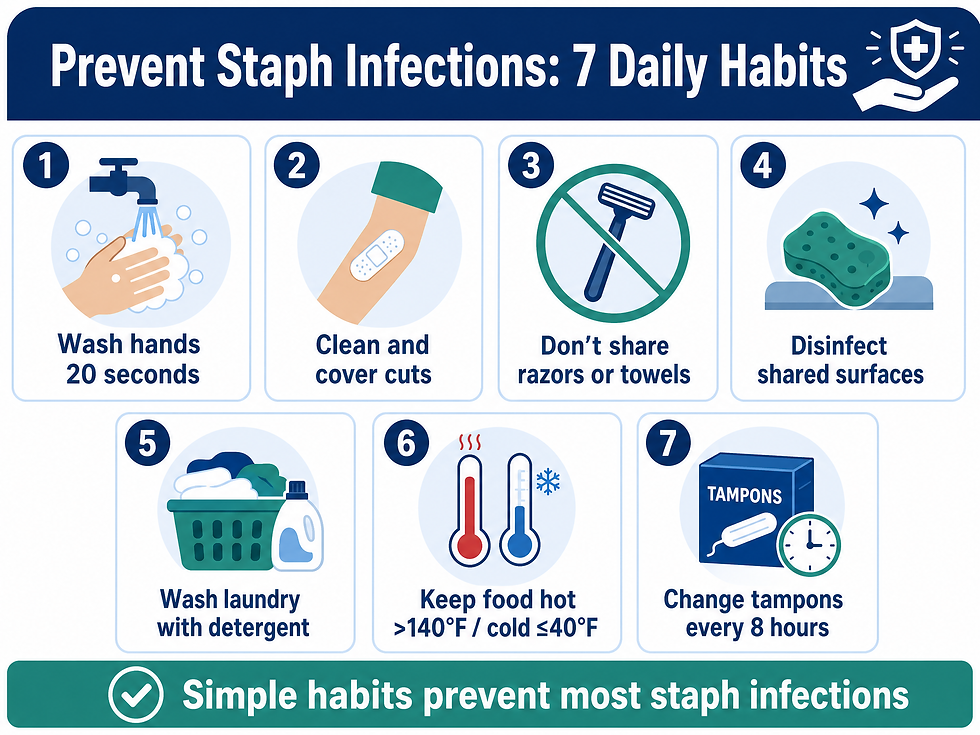
The Mayo Clinic recommends keeping the bacteria off your skin [1]:
Prevention habit | Specific guidance |
Handwashing | Soap and water for at least 20 seconds, or alcohol-based sanitizer with at least 60% alcohol — before/during/after food handling, before eating, after bathrooms, diapers, animal waste, and trash |
Wound care | Wash cuts with soap and water, cover with a clean dry bandage; keep healing wounds out of pools and natural bodies of water; don't pick or pop scabs |
Cleaning common items | Keyboards, remotes, light switches, gym equipment, lockers — with a disinfectant that kills staph |
Laundry | No bleach needed; regular detergent used as instructed is enough |
Not sharing | Razors, athletic equipment, and open or used skin products |
Tampon safety | Change at least every 8 hours; use the lowest absorbency; wash hands before and after placement (toxic shock is rare) |
Food safety | Hot foods above 140°F (60°C); cold foods at or below 40°F (4.4°C); refrigerate leftovers promptly; wash cutting boards and counters |
Preparing for your appointment
For a skin infection, you may see a general healthcare professional, a dermatologist, an infectious-disease specialist, or even a cardiologist for serious cases [2].
Bring a list that includes detailed symptom descriptions, key medical information and conditions, all medications and supplements you take, and questions [2]. Useful questions to ask [2]:
What might be causing my symptoms?
Do I need tests to confirm the infection?
Can I spread the infection to others?
How can I tell if my infection is getting better or worse?
What activities should I avoid for now?
Your healthcare team will likely ask when symptoms started, how severe they are, whether you have been around anyone with a staph infection, whether you have implanted devices, ongoing conditions, recent hospital stays, or play contact sports [2].
In the meantime, take steps not to spread the bacteria: wash your hands often, keep the area clean and covered, don't pop or touch the sore, and don't share anything that touches your skin [2].
Conclusion and what to do next
Most staph infections are small, treatable skin infections that resolve with antibiotics and proper care. The people who do well are those who act on three fronts: they treat wounds properly from day one, they finish every antibiotic course, and they escalate quickly when the danger signs appear. The numbers are sobering — nearly 120,000 bloodstream infections and 20,000 deaths in a single year — but sepsis deaths are preventable when care happens early.
Your next steps: wash your hands with soap and water for 20 seconds before food and after bathrooms; clean and cover any open cut today; stop sharing razors, towels, and sports equipment; and call emergency services immediately if fever, fast breathing, confusion, or a widespread rash appears. If a skin bump is red, swollen, warm, and painful, or a wound won't heal, schedule an appointment — a quick evaluation is the safest route.
Frequently asked questions
Can staph infections go away on their own?
Minor skin infections may improve with warm compresses and hygiene, but the Mayo Clinic recommends seeing a healthcare professional for any skin infections or wounds that don't get better, and treatment with antibiotics is the standard for confirmed infections [1] [2].
What does a staph infection look like on the skin?
It can appear as impetigo (face sores with a yellow crust), folliculitis (itchy pus-filled bumps around hair follicles), boils or furuncles (deep pus pockets under arms, groin, or buttocks), carbuncles (around the neck), or MRSA — small red bumps that quickly become deep, painful abscesses [1].
Is MRSA worse than a regular staph infection?
MRSA is a strain of staph that cannot be killed by standard antibiotics, so treatment requires different drugs such as IV vancomycin. It can cause the same infections as regular staph, but it is harder to treat [1] [2].
Is staph contagious?
Yes. Staph bacteria spread from person to person or from contaminated objects to your body when you touch it. Handwashing, covering wounds, and not sharing personal items reduce spread [1].
Why isn't staph food poisoning treated with antibiotics?
Staph food poisoning is caused by toxins the bacteria made in the food — not by an active bacterial infection in the body — so antibiotics don't help. Treatment focuses on fluids; most people recover within a day [1] [2].
How long does staph food poisoning last?
Symptoms begin within hours of eating contaminated food, and they usually disappear quickly, often lasting less than a day, typically without fever [1].
Can staph infections come back?
Yes — the bacteria commonly live on skin and in the nose, so reinfection is possible. Recurrent infections, especially in a household or team, warrant a conversation with a healthcare professional about prevention and possible testing [1].
How do I know if my staph infection is becoming an emergency?
Seek emergency care for signs of sepsis or septic shock: fever or chills, fast breathing, rapid heart rate, new confusion, cold or sweaty skin, severe pain, or a widespread rash [1].
Comments