
West Nile Virus: Symptoms, Transmission, and Prevention Strategies

Updated: 2 days ago
Medically reviewed by Dr. Baraa Alnahhal, MD · Last reviewed: October 2026
Quick Answer: What is West Nile virus and how can you prevent it?
West Nile virus is a mosquito-borne infection that does not spread between people. Most infected people never develop symptoms, about 1 in 5 get flu-like West Nile fever, and less than 1% develop severe illness such as encephalitis or meningitis. There is no vaccine or antiviral, so preventing mosquito bites with repellent and covered skin is the best defense. [1]
What the research says
Severe disease carries real risk, especially with chronic conditions. A systematic review and meta-analysis of 47 studies of West Nile neuroinvasive disease in the U.S. found pooled mortality of 9.2% and ICU admission in 42.1% of reported cases. Chronic kidney disease (odds ratio 5.99, 95% CI 2.71–13.23), hypertension (OR 4.01, 95% CI 2.39–6.72), and diabetes (OR 2.43, 95% CI 1.54–3.84) were associated with higher risk of death, and long-term fatigue (37–75%), memory concerns (11–57%), and depression (17–38%) were common at follow-up (Roberts et al., Annals of Neurology, 2025) [2].
DEET and picaridin protect similarly. A systematic review of 8 field studies and 3 laboratory studies found little difference between DEET and picaridin applied at the same dose, with some evidence of longer-lasting protection from picaridin; most studies were at high risk of bias (Goodyer & Schofield, Journal of Travel Medicine, 2018) [3].
How West Nile Virus Spreads
West Nile is an arbovirus — a virus you get from an arthropod, such as a mosquito. It is an RNA virus in the genus Flavivirus, the same group as the viruses that cause dengue fever, yellow fever, and Zika [1].
Infected mosquitoes transmit the virus. They usually get it by biting an infected bird, the virus multiplies inside the mosquito, and it is passed on when the mosquito bites you or another animal. The incubation period — the time before symptoms — is usually two to six days after a bite, but can be up to 14 days [1].
West Nile isn't contagious, so you can't catch it from another person. In a very few cases it has spread from a pregnant woman to the fetus, through breast milk, through a blood transfusion, or through an organ transplant [1].

Symptoms: From No Symptoms to Severe Disease
Severity | How often | Key symptoms |
|---|---|---|
No symptoms | About 80% of infections | No signs of illness |
West Nile fever | About 1 in 5 people | Fever, headache, muscle aches, nausea and vomiting, diarrhea, rash (usually on the chest and back), swollen lymph nodes, sore throat, pain behind the eyes |
Severe (neuroinvasive) disease | Less than 1% (about 1 in 150) | Intense headache, high fever (above 103°F/39.5°C), stiff neck, confusion, muscle weakness, tremors or convulsions, seizures, paralysis, coma |
Incubation period | — | Usually 2–6 days after a bite, up to 14 days |
Symptoms of West Nile fever are often mistaken for the flu or a cold. Mild symptoms usually fully resolve in a few weeks, though fatigue and muscle weakness can sometimes linger for months [1].
Severe infection can cause swelling in the brain and spinal cord (encephalitis or meningitis). Long-term effects can include memory loss, hearing loss, difficulty walking, muscle weakness, abnormal reflexes, and depression. West Nile is fatal in about 1 out of 10 people with nervous system infections [1].
Who Is at Higher Risk?
Mosquitoes can bite anyone, but you are at higher risk of severe illness if you [1]:
Are over the age of 60
Are an organ transplant recipient
Have cancer, diabetes, high blood pressure, or kidney disease

Diagnosis and Treatment
A provider can test your blood or cerebrospinal fluid (CSF) for antibodies or other signs of infection. These tests are usually done only if you are seriously ill. If there are signs of brain inflammation, a CT scan or MRI of the brain is used [1].
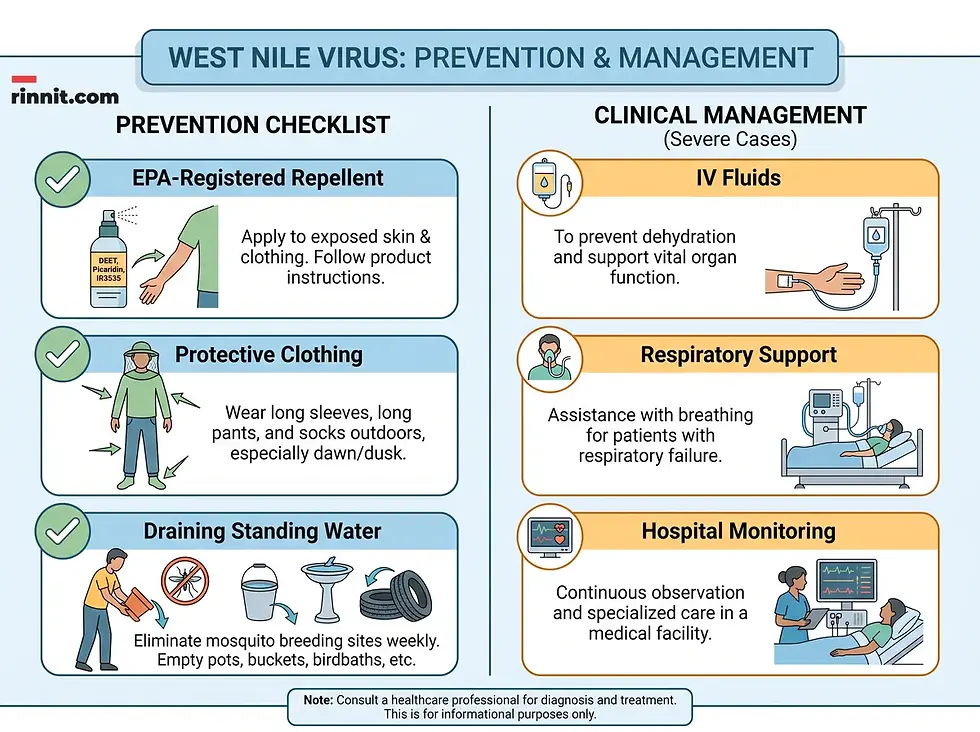
No antiviral medication treats West Nile virus. Mild symptoms can be treated at home with over-the-counter medications, like you would take for a cold or flu. If you have serious neurological symptoms, providers will monitor you in the hospital and may treat your symptoms or reduce brain swelling with [1]:
Antiseizure medicines if you are having seizures
Supplemental oxygen or mechanical ventilation to help you breathe
Intravenous (IV) fluids to keep you hydrated
Corticosteroids to reduce inflammation
Tube feeding if you can't feed yourself
Prevention and Home Safety
There is no vaccine, so the best way to reduce your risk is to protect yourself from mosquito bites [1]:
Avoid high-risk times: stay inside when mosquitoes are most active, especially early in the morning and around sunset.
Use insect repellent: spray EPA-registered repellent on exposed skin or clothes before going outdoors.
Cover your skin: wear lightweight long pants or a long-sleeved shirt outdoors.
Drain standing water: regularly empty and clean places that collect water, such as birdbaths and clogged rain gutters, where mosquitoes can breed.
Keep mosquitoes outside: keep doors and windows screened or closed.
Take precautions when traveling or sleeping outdoors: sleep with windows closed where possible, or use a mosquito net.
When to See a Healthcare Provider
If you think you could have West Nile virus, talk to a healthcare provider about whether you need testing, which symptoms of serious illness to watch for, how to care for yourself at home, and when to follow up. Go to the emergency room if you have symptoms of severe illness, including severe headache, high fever, stiff neck, confusion, muscle weakness or tremors, or seizures [1].
Conclusion
Most of the time, mosquitoes are just a nuisance, but they sometimes carry viruses that can make you sick. About 80% of people with West Nile never develop symptoms, and most people's risk of becoming seriously ill is very low. If you may be around mosquitoes, take steps to protect yourself from bites, and if you develop symptoms after a bite, see a healthcare provider [1].
Frequently Asked Questions
Can I get West Nile virus from another person?
No. West Nile isn't contagious, and you can't get it from another person who has it. In a very few cases it has spread from a pregnant woman to the fetus, through breast milk, through a blood transfusion, or through an organ transplant [1].
Is there a vaccine for West Nile virus?
No. There isn't a vaccine to prevent West Nile virus, and no antiviral medication treats it, so protecting yourself from mosquito bites is the best way to reduce your risk [1].
Do all mosquitoes carry West Nile virus?
No. Infected mosquitoes transmit the virus, and they usually get it by biting an infected bird. There is no evidence that humans get it directly from birds [1].
How long do symptoms last?
Mild symptoms usually fully resolve in a few weeks, though fatigue and muscle weakness can linger for months. After a nervous system infection, memory loss, hearing loss, balance or gait problems, and other neurological effects can be long-lasting or permanent [1].
What is the best insect repellent to use?
Use an insect repellent that is registered with the Environmental Protection Agency (EPA) for effectiveness, applied to exposed skin or clothes before going outdoors [1].
Can West Nile virus be fatal?
Yes, but rarely. It is fatal in about 1 out of 10 people with nervous system infections (about 1 in 1,500 people with West Nile overall) [1].
Should I be tested if I have a mosquito bite?
Most bites don't lead to infection. If you think you could have West Nile virus, talk to a healthcare provider, who can tell you whether you need testing and which serious symptoms to watch for. Go to the emergency room for severe headache, high fever, stiff neck, confusion, muscle weakness or tremors, or seizures [1].
Who is at higher risk of serious illness?
Mosquitoes can bite anyone, but you are at higher risk of getting severely ill if you are over 60, are an organ transplant recipient, or have cancer, diabetes, high blood pressure, or kidney disease [1].
How common is West Nile virus?
West Nile virus is found in many parts of the world, including North America, Europe, Africa, the Middle East, Australia, and Asia. It is the most common mosquito-transmitted virus in the U.S., with cases reported in 49 states [1].
What is the incubation period?
Symptoms usually appear two to six days after a bite, but can take up to 14 days [1].
Related Reading
Viral Meningitis: Symptoms, Causes, and Management explains viral infection of the brain lining, one form of severe West Nile illness.
Eastern Equine Encephalitis (EEE): Symptoms, Causes, Diagnosis, Treatment, Prevention and When to Seek Urgent Care — What You Need to Know covers another mosquito-borne virus that can inflame the brain.
Lumbar Puncture (Spinal Tap): Purpose, Procedure, Recovery and Results describes the spinal fluid test used to diagnose brain infections.
What Are Mosquito Bites? A Plain-Language Guide to the Itch, the Reaction, and How to Prevent Them explains mosquito bite reactions and how to prevent bites.
References
Source currency note: The Cleveland Clinic page was last updated on October 16, 2023, and the two studies were checked against PubMed. This article reflects the most current information available from those sources.
Cleveland Clinic. West Nile virus: symptoms, treatment & prevention. Cleveland Clinic. October 16, 2023. https://my.clevelandclinic.org/health/diseases/10939-west-nile-virus
Roberts JA, Kim CY, Hwang SA, et al. Clinical, prognostic, and longitudinal functional and neuropsychological features of West Nile virus neuroinvasive disease in the United States: a systematic review and meta-analysis. Annals of Neurology. 2025;98(1):93-106. PMID 40008684. https://doi.org/10.1002/ana.27220
Goodyer L, Schofield S. Mosquito repellents for the traveller: does picaridin provide longer protection than DEET? Journal of Travel Medicine. 2018;25(suppl_1):S10-S15. PMID 29718433. https://doi.org/10.1093/jtm/tay005
Medical disclaimer
Health information, not medical advice. This article is for general education and is not a substitute for professional diagnosis or treatment. Always consult a qualified healthcare provider about your own health, and seek emergency care for urgent symptoms.



Comments