Viral Meningitis: Symptoms, Causes, and Management

Updated: 3 days ago
Medically reviewed by Dr. Baraa Alnahhal, MD · Last reviewed: October 2026
Editorial note: This article is provided for educational purposes only. It is not medical advice. Always consult a qualified healthcare professional about your individual health situation.
Quick Answer: What Is Viral Meningitis?
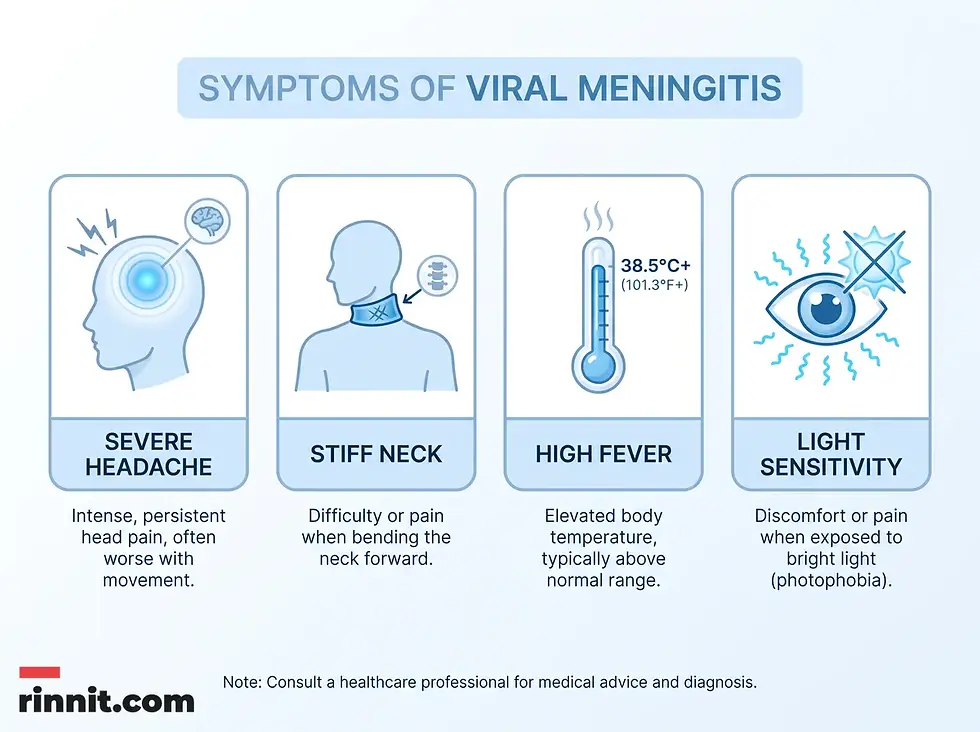
Viral meningitis is inflammation of the protective membranes of the brain and spine, typically triggered by enteroviruses or herpes simplex viruses. [1] [2] It causes sudden fever, neck stiffness and light sensitivity. [1] Unlike bacterial meningitis, it often resolves on its own with supportive care, though it can seriously affect young children. [1] Emergency medical attention is essential for any suspected case.
What the research says
Enteroviruses cause most cases, and the symptoms look much the same whatever the virus. A review of viral meningitis explains that enteroviruses are the underlying cause of most cases worldwide, and that with few exceptions the clinical features are similar across causes, which makes early diagnosis difficult (Kohil et al., Arch Virol, 2021 [2]).
Modern testing helps avoid unnecessary antibiotics and hospital time. A clinical review defines viral meningitis as acute meningeal symptoms with fever, white cells in the cerebrospinal fluid and no growth on routine bacterial culture. It reports that molecular diagnostics have improved pathogen detection, reducing unnecessary antibiotic use and length of hospitalization, and that most causes have no specific treatment other than supportive care (Wright et al., J Neurol Sci, 2019 [3]).
Viral meningitis is usually benign, but the bacterial form can be rapidly fatal. A neurology review describes viral meningitis as typically a benign, self-limited illness, in contrast to acute bacterial meningitis, which is rapidly fatal without early recognition and treatment. It adds that herpes simplex virus encephalitis requires prompt intravenous acyclovir (Bystritsky & Chow, Neurol Clin, 2022 [4]).
Emergency medical warning: Seek emergency medical attention right away if you or your child has sudden fever, severe headache, neck stiffness, light sensitivity or unusual drowsiness. Viral and bacterial meningitis often look identical, and only a professional evaluation can tell them apart.
Understanding Viral Meningitis
Viral meningitis, also referred to as aseptic meningitis, is a condition characterized by the inflammation of the meninges—the protective tissues surrounding the brain and spinal cord. This inflammation is specifically caused by a viral infection rather than bacteria or other infectious agents. [1] While the condition can affect individuals of all ages, it is notably more common in young children than in adults. [1]
Viral vs. Bacterial Meningitis
Distinguishing between viral and bacterial meningitis is critical because their outcomes differ significantly. Viral meningitis typically resolves without specialized intervention, whereas bacterial meningitis can be fatal if not treated immediately. [1] [4] Because the symptoms are often identical, there is no way to differentiate between the two without a professional medical evaluation. [1] Individuals experiencing symptoms of meningitis should seek emergency medical attention right away.
Symptoms and Warning Signs
The symptoms of viral meningitis often appear suddenly [1] and can escalate quickly. In some cases, systemic viral symptoms like a cough, runny nose, or rash may precede the onset of meningitis-specific signs. [1]
Signs in Infants and Young Children
Detecting meningitis in babies can be challenging as they cannot communicate their discomfort. Caregivers should monitor for irritability, sleepiness, or trouble waking up. [1] Physical signs include vomiting, a lack of energy (lethargy), eating less than usual, and a noticeable bulging of the "soft spot" (fontanelle) on the infant's head. [1]
Causes and Transmission
A wide variety of viruses can trigger meningitis. The specific virus responsible often dictates how the infection spreads and the likelihood of developing complications.
Common Viral Triggers
Enteroviruses: The most frequent cause, including those responsible for hand, foot, and mouth disease. [1] [2]
Herpes Viruses: Including herpes simplex, Epstein-Barr (mononucleosis), and varicella zoster (chickenpox and shingles). [1]
Respiratory & Other Viruses: Influenza, mumps, measles, and HIV. [1]
Arboviruses: Viruses spread by mosquitoes, such as West Nile and Zika. [1]
How the Infection Spreads
The viruses that cause meningitis are contagious and typically spread through person-to-person contact. This includes coughing, sneezing, sharing food or personal items, and touching contaminated surfaces. [1] While these viruses are common, most individuals who contract them will develop other illnesses (such as the flu or a rash) rather than meningitis. [1]

Diagnosis and Clinical Evaluation
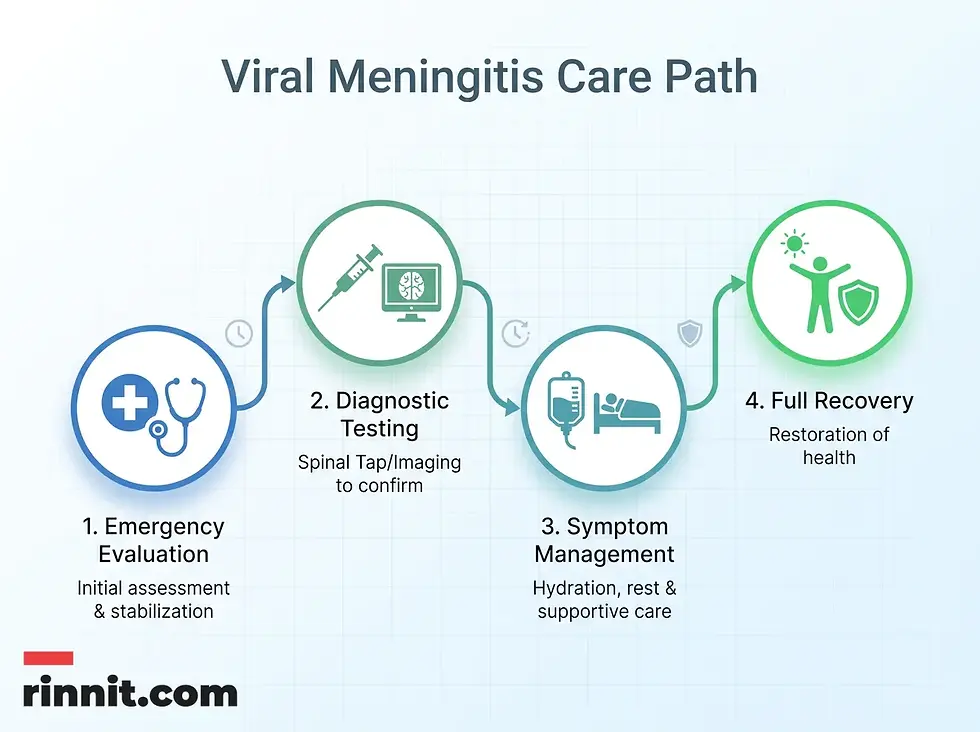
Healthcare providers diagnose viral meningitis through a combination of physical examinations and specialized testing. A neurological exam is typically the first step, followed by a lumbar puncture (spinal tap) to test the cerebrospinal fluid for infectious agents. [1] Other diagnostic tools may include blood tests, stool samples, nasal or throat swabs, and imaging such as CT scans or MRIs to look for brain inflammation. [1]
Management and Treatment Roadmap
Treatment for viral meningitis focuses primarily on managing symptoms and supporting the body's natural recovery process, as there is no specific cure for most viral causes. [1] [3]
Treatment Modality | Description |
Supportive Care | Managing pain, ensuring adequate hydration (sometimes via IV fluids), and rest. [1] |
Medications | Antivirals (like acyclovir) for specific triggers like herpes; corticosteroids are not routinely used for viral meningitis. [1] |
Diagnostic Precautions | Providers may start antibiotics initially until bacterial meningitis is ruled out. [1] |
Long-Term Outlook and Prevention
The prognosis for viral meningitis is generally positive, with most individuals recovering within one to two weeks. [1] However, serious complications can occur, [1] particularly in young children or those with weakened immune systems. Potential long-term effects include hearing or vision loss, memory difficulties, balance issues, and learning challenges. [1]
Prevention Strategies
Vaccination: Keeping up to date with vaccines for measles, mumps, chickenpox, and influenza. [1]
Hygiene: Frequent hand-washing, especially after using the bathroom or changing diapers and before eating. [1]
Environmental Safety: Cleaning and disinfecting frequently touched surfaces and avoiding close contact with individuals who are ill. [1]
Related reading: Enterovirus: Symptoms, Causes, Diseases, Diagnosis, Treatment, Prevention and When to Seek Emergency Care — What You Need to Know | Hand, Foot and Mouth Disease: What Parents Need to Know — From First Sores to Full Recovery | Mononucleosis Symptoms & Treatment: The Complete Recovery Guide
Sources: Cleveland Clinic — Viral Meningitis | Kohil et al., 2021 | Wright et al., 2019 | Bystritsky & Chow, 2022
Frequently Asked Questions
1. Is viral meningitis contagious?
The viruses that cause it are contagious, but most people who catch them do not develop meningitis.
2. How long does it take to recover?
Most people feel better within one to two weeks, though full recovery can sometimes take longer.
3. Can viral meningitis be fatal?
While generally less dangerous than the bacterial form, some severe cases can be fatal or cause permanent damage.
4. Do I need to stay in the hospital?
Depending on the severity, some patients are treated at home while others require hospitalization for a few days.
5. Is there a cure for viral meningitis?
There is no specific cure; treatment focuses on supporting the body while it clears the virus.
6. Can you get it twice?
Yes, because many different viruses can cause meningitis, it is possible to have it more than once.
7. What is the difference between viral and aseptic meningitis?
Viruses are the most common cause of aseptic meningitis, which means meningitis with no bacteria found on routine tests; it can also have other causes, such as some medicines.
8. Why do doctors give antibiotics for a virus?
Doctors may start antibiotics as a precaution until tests confirm the infection is not bacterial.
9. Are there long-term effects?
Some people, especially children, may experience hearing loss, vision changes, or memory issues.
10. How do babies get it?
Babies usually catch the viruses through close contact with others or contaminated surfaces.
11. Can mosquitoes spread it?
Yes, certain arboviruses like West Nile can cause meningitis through mosquito bites.
12. Is a stiff neck always a sign?
A stiff neck is a hallmark symptom, but it may not be present in every case, especially in infants.
13. Can adults get viral meningitis?
Yes, while more common in children, adults—especially those in group settings—are also at risk.
14. What should I do if I suspect meningitis?
Seek emergency medical attention immediately at an ER.
15. How can I prevent it?
The best prevention is vaccination and practicing excellent hand hygiene.
References
Cleveland Clinic. Viral Meningitis. Cleveland Clinic. August 11, 2023. https://my.clevelandclinic.org/health/diseases/25188-viral-meningitis
Kohil A, Jemmieh S, Smatti MK, et al. Viral meningitis: an overview. Arch Virol. 2021;166(2):335-345. PMID 33392820. https://doi.org/10.1007/s00705-020-04891-1
Wright WF, Pinto CN, Palisoc K, et al. Viral (aseptic) meningitis: A review. J Neurol Sci. 2019;398:176-183. PMID 30731305. https://doi.org/10.1016/j.jns.2019.01.050
Bystritsky RJ, Chow FC. Infectious Meningitis and Encephalitis. Neurol Clin. 2022;40(1):77-91. PMID 34798976. https://doi.org/10.1016/j.ncl.2021.08.006
Medical disclaimer
The information provided in this article is for educational purposes only and should not be used as a substitute for professional medical advice, diagnosis, or treatment. Always seek the advice of your physician or other qualified health provider with any questions you may have regarding a medical condition. Never disregard professional medical advice or delay in seeking it because of something you have read here.



Comments