Understanding Vulvar Dermatitis: Causes, Symptoms, and Care Strategies

Updated: 3 days ago
Medically reviewed by Dr. Baraa Alnahhal, MD · Last reviewed: October 2026
TL;DR: Vulvar dermatitis is a common, non-infectious skin condition that causes itching, redness, and irritation of the vulva [1]. It is triggered by irritants such as soaps and synthetic fabrics, by allergic reactions, or by autoimmune factors [1]. Treatment focuses on finding and avoiding triggers, gentle vulvar care, and prescribed medicines to calm inflammation. See a healthcare provider for a correct diagnosis.
Quick Answer
Vulvar dermatitis is a common, non-infectious skin condition that causes an itchy, irritated, inflamed vulva when its delicate skin reacts to irritants or allergens such as soaps, dyes or synthetic fabrics; it can also be autoimmune [1]. Diagnosis may include patch testing [1]. Management centers on avoiding triggers, gentle care and prescribed anti-inflammatory ointments, after a provider confirms the diagnosis.
What the research says
Many everyday products can be allergens or irritants. A systematic review of allergic and irritant contact dermatitis of the vulva found allergens including metals, topical drugs, fragrances, preservatives, cosmetic constituents, and rubber components, concluded that patch testing is the primary tool for finding the cause, and found that testing with a standard series alone was insufficient (According to PubMed, Vandeweege et al., Contact Dermatitis, 2023) [2].
“Natural” products are not automatically safe for itchy vulvar skin. Among 66 patients with itching vulvar conditions, 42 (63.6%) used natural topical products on the vulva; 7 of those (16.7%) noticed adverse reactions, and 14 of all patients (21.2%) had at least one relevant positive patch-test reaction, mainly to allergens in topical products and cosmetics (According to PubMed, Corazza et al., Contact Dermatitis, 2016) [3].
Itching is often treated as a yeast infection when it is not. A review noted that vulvar itch is often treated empirically as a yeast infection, although atopic, irritant, and allergic contact dermatitis are extremely common non-infectious causes that are often underdiagnosed by non-dermatologists, and that missing them can prolong itching unnecessarily (According to PubMed, Pichardo-Geisinger, Obstet Gynecol Clin North Am, 2017) [4].
What Is Vulvar Dermatitis?
Vulvar dermatitis is a common inflammatory condition of the external female genitalia. The vulva includes the folds of skin that surround the vagina, and the skin there is fragile and more likely to be damaged than skin elsewhere on the body [1]. Vulvar dermatitis is not a sexually transmitted infection (STI) and is not contagious. It happens when noninfectious things in your environment, such as soaps or dyes, irritate the skin, and it can also be an allergic or autoimmune reaction [1].
Many other conditions cause the same symptoms, so it is important to see a healthcare provider for a correct diagnosis. The condition can be scarring or non-scarring. Scarring types, such as lichen sclerosus and lichen planus, are inflammatory conditions that can change the appearance of the vulva, sometimes permanently [1]. Non-scarring types include contact and irritant dermatitis and lichen simplex chronicus [1], which results from a chronic itch-scratch cycle.

Identifying Symptoms and Common Triggers
Vulvar itching (vulvitis) is the most common symptom and can range from mild to severe [1]. Other symptoms include skin that feels burning, stinging, or raw; patches that feel thicker, or look redder or darker, than the surrounding skin; a wet feeling from damaged skin with fluid seeping out; and pain with intercourse or when inserting a tampon [1]. Symptoms often get worse at night, during intercourse, during your period, and when you are hot or sweating [1].
Triggers are often found in everyday products. Irritant contact dermatitis happens when a substance damages the skin barrier, while allergic contact dermatitis involves a specific immune reaction.
Category | Common Triggers and Irritants |
Hygiene products | Soap, bubble bath, shampoo and conditioner, deodorant, perfume, douches, and talcum powder. |
Clothing and laundry | Synthetic underwear such as nylon, laundry detergent, and dryer balls. |
Personal care | Tea tree oil, spermicides, pads, panty liners, tampons, and some medications. |
Miscellaneous | Dyes, toilet paper, nickel, and food preservatives. |
Because of excessive itching, you can break open the skin, which makes it easier for bacteria to enter and cause a secondary infection [1].
Risk Factors and Diagnostic Pathway
Anyone can develop vulvar dermatitis, but you may be at higher risk if you have not gone through puberty, are postmenopausal, or have urinary or fecal incontinence [1]. Lower estrogen levels make vulvar skin drier and more fragile, and with incontinence, urine and stool rubbing against the skin irritate it [1].
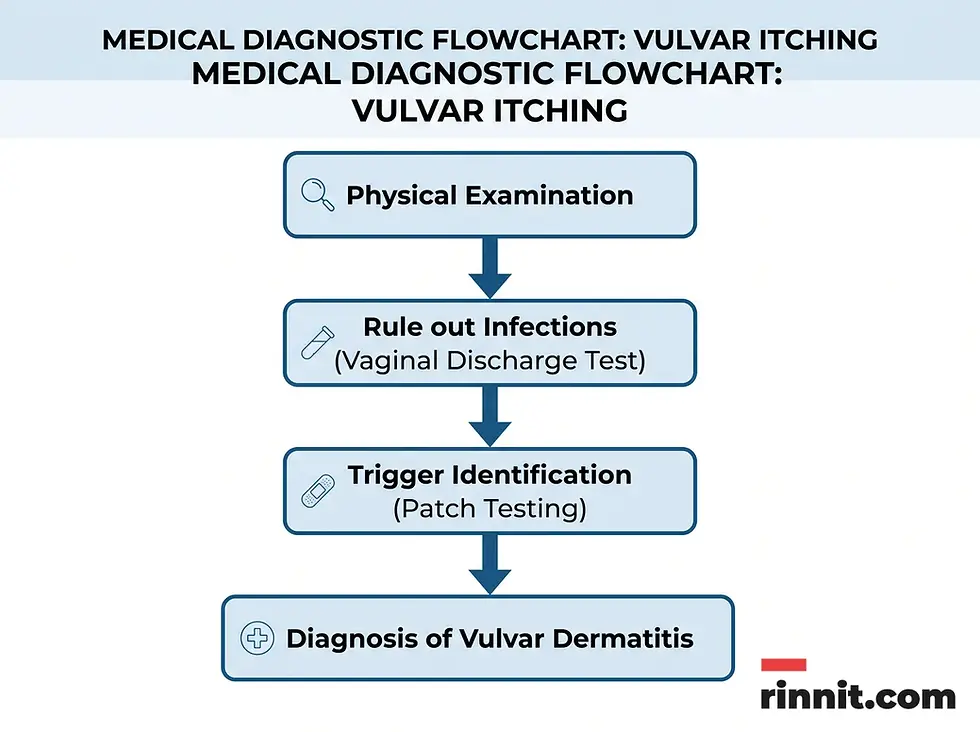
To diagnose vulvar dermatitis, your provider has to rule out other causes of your symptoms, such as infections [1]. The process may include:
Medical history: including any family history of skin conditions such as eczema, and when your symptoms happen and are most severe [1].
Physical exam: a visual look at the irritation [1].
Discharge testing: testing your vaginal discharge to rule out infections [1].
Patch testing: applying small amounts of possible allergens to the skin to see whether you react [1].
Biopsy: a small skin sample may be needed if the irritation gets worse despite treatment [1].
Management and Treatment Strategies
Often you can get rid of vulvar dermatitis by avoiding what irritates it and practicing better vulvar care, while medicines calm pain and itching as the skin clears [1]. Avoiding the trigger is the most important step [1]. Without it, medicines may only give temporary relief.
Medical Interventions
Corticosteroid ointments: prescribed to reduce itching and swelling, such as hydrocortisone, desonide, triamcinolone [1], or, for severe cases, clobetasol.
Anti-itch medicines that help you sleep: such as hydroxyzine or doxepin [1], which can help with nighttime itching.
Anti-itch emollients: to soothe raw skin and protect it from further irritation.
The Vulvar Care Regimen
A gentle, “less is more” approach to hygiene is essential for recovery. The routine below reflects common provider recommendations.
Action | Recommended Practice |
Washing | Use mild, unscented soap and warm water no more than once a day, and wash with your hands and fingers instead of a washcloth. |
Drying | Pat the area dry with a clean towel instead of rubbing. |
Clothing | Wear 100% cotton underwear or no underwear, and loose-fitting cotton clothing instead of tight underwear or jeans. |
Laundry | Use mild, unscented detergent. |
Products to avoid | Douching and scented feminine hygiene products. |
Barrier protection | Ask your provider whether a thin layer of plain petroleum jelly would help protect irritated skin. |

Long-Term Outlook
Vulvar dermatitis can be uncomfortable, but it is not harmful to your health [1]. How long it takes to improve depends on the cause. Contact dermatitis may take a couple of weeks, or up to a month, to go away once you remove the offending product, and having an infection at the same time can make recovery longer [1]. Scarring conditions such as lichen sclerosus and lichen planus need a provider's ongoing follow-up.
See a provider before self-treating: Schedule a visit before using any over-the-counter product to relieve itching. Vulvar itching is a symptom of many conditions that need different treatments, and a product that contains an irritant can make things worse. Itching “down there” is common, and your provider is there to help, not to judge.
Conclusion
Vulvar dermatitis is manageable and often improves with trigger avoidance and gentle care. Simplifying your hygiene routine and getting a professional diagnosis give you the best chance of lasting relief. If you have persistent itching, skin changes, or pain that does not improve with basic care, talk with a healthcare provider about a personalized treatment plan.
Related reading: Vulvitis · Genital itching · Dermatitis · Vulvar anatomy · Neurodermatitis · Menopause
Frequently Asked Questions
Is vulvar dermatitis contagious?
No. Vulvar dermatitis is not a sexually transmitted infection. It is caused by irritants, allergens, or autoimmune factors, so it cannot be passed to a partner.
Can laundry detergent cause vulvar itching?
Yes. Laundry detergent and dryer balls are among the products that can trigger vulvar dermatitis. Mild, unscented detergents are recommended.
Why does the itching get worse at night?
Symptoms often get worse at night, as well as during intercourse, during your period, and when you are hot or sweating. Scratching, including during sleep, can break the skin and make an infection more likely.
What is the difference between vulvar dermatitis and a yeast infection?
A yeast infection is an overgrowth of fungus, while vulvar dermatitis is a reaction to an irritant or allergen. Their symptoms can overlap, which is why a provider tests your vaginal discharge to rule out infection before diagnosing dermatitis.
Can I use anti-itch creams from the drugstore?
See a healthcare provider first. Vulvar itching has many causes that need different treatments, and without a diagnosis you might choose a product that contains the very irritant you need to avoid.
Is it safe to wear tight clothing if I have dermatitis?
It is better to avoid it. Choose loose-fitting cotton clothing and 100% cotton underwear, or no underwear, instead of tight underwear, tight jeans, or synthetic fabrics such as nylon.
How long does it take for the skin to heal?
It depends on the cause. Contact dermatitis may take a couple of weeks, or up to a month, to go away once the offending product is removed, and an infection can make recovery longer.
Can low estrogen cause vulvar irritation?
Yes. Lower estrogen levels, such as before puberty and after menopause, can make vulvar skin drier and more fragile, which raises the risk of irritation.
Should I stop using soap on my vulva?
Use only mild, unscented soap with warm water, no more than once a day, and wash with your hands instead of a washcloth. Avoid douching and scented feminine hygiene products.
What are the signs of a secondary infection?
Scratching can break the skin and let bacteria in. Increased pain, swelling, warmth, or yellow or green discharge can signal an infection, so contact a healthcare provider.
Related Reading
Vulvitis: Symptoms, Causes, and Management explains inflammation of the vulva and its common causes.
Contact Dermatitis: Symptoms, Causes, Diagnosis & Treatment — Complete Guide explains skin rashes caused by irritants and allergens.
Patch Test for Skin Allergies: How It Works, How to Prepare and What Results Mean describes how a patch test finds skin allergy triggers.
Neurodermatitis (Lichen Simplex Chronicus): Symptoms, Causes, Diagnosis & Treatment — Complete Guide explains how chronic scratching thickens itchy skin and how to stop it.
References
Cleveland Clinic. Vulvar Dermatitis: Causes, Symptoms & Treatment. Cleveland Clinic. Last updated 02/13/2026. https://my.clevelandclinic.org/health/diseases/24336-vulvar-dermatitis
Vandeweege S, Debaene B, Lapeere H, et al. A systematic review of allergic and irritant contact dermatitis of the vulva: the most important allergens/irritants and the role of patch testing. Contact Dermatitis. 2023;88(4):249-262. PMID 36458568. https://doi.org/10.1111/cod.14258
Corazza M, Virgili A, Toni G, et al. Level of use and safety of botanical products for itching vulvar dermatoses. Are patch tests useful? Contact Dermatitis. 2016;74(5):289-294. PMID 26928795. https://doi.org/10.1111/cod.12559
Pichardo-Geisinger R. Atopic and contact dermatitis of the vulva. Obstet Gynecol Clin North Am. 2017;44(3):371-378. PMID 28778637. https://doi.org/10.1016/j.ogc.2017.05.003
Medical disclaimer
This article is for educational purposes only and is not a substitute for professional medical advice, diagnosis, or treatment. Always seek the advice of your physician or other qualified health provider with any questions about a medical condition.



Comments