Understanding Vulvar Anatomy: Function, Health, and Care

Updated: 3 days ago
Medically reviewed by Dr. Baraa Alnahhal, MD · Last reviewed: October 2026
Quick Answer: What is the vulva?
The vulva is the external part of the female genitals, separate from the vagina, the internal canal. Vulvar anatomy includes the mons pubis, labia majora and minora, clitoris, and urethral and vaginal openings. The vulva protects internal reproductive organs and plays a central role in sexual pleasure, reproduction, menstruation and urination. [1] Gentle hygiene and avoiding irritants keep it healthy.
What the research says
The clitoris is very richly supplied with nerves. In a histology study of the dorsal nerves of the clitoris from 7 transmasculine patients having gender-affirming surgery (5 samples could be analyzed), each nerve contained a mean of 5,140 axons (SD 218.4). That put the approximate number of myelinated nerve fibers supplying the glans at 10,281 (SD 436.8), well above the often-quoted "8,000 nerve endings." The sample was small (Uloko et al., J Sex Med, 2023) [2].
"Normal" vulvar anatomy varies widely. A scoping review of 10 population-based studies found labial length ranging from 5 to 100 mm and width from 1 to 60 mm. Labia minora were wider before menopause than after, protruding labia minora were more common than not, and asymmetry between the left and right sides was common (Hayes and Temple-Smith, Aust N Z J Obstet Gynaecol, 2021) [3].
Defining the Vulva: More Than Just a Name
The word "vagina" is often used for the whole female genital area, but the vulva is the external part. "Vulva" comes from a Latin word meaning "covering," which reflects its protective role. [1] It is the area between the legs that allows you to menstruate, give birth, urinate, and experience sexual pleasure [1], and it is the gateway to the internal reproductive tract.
The vulva is not a single organ. It is a group of connected parts that work together: it shields the internal reproductive system, contains the nerve endings and erectile tissue involved in sexual pleasure, and includes the separate openings for the reproductive and urinary systems.
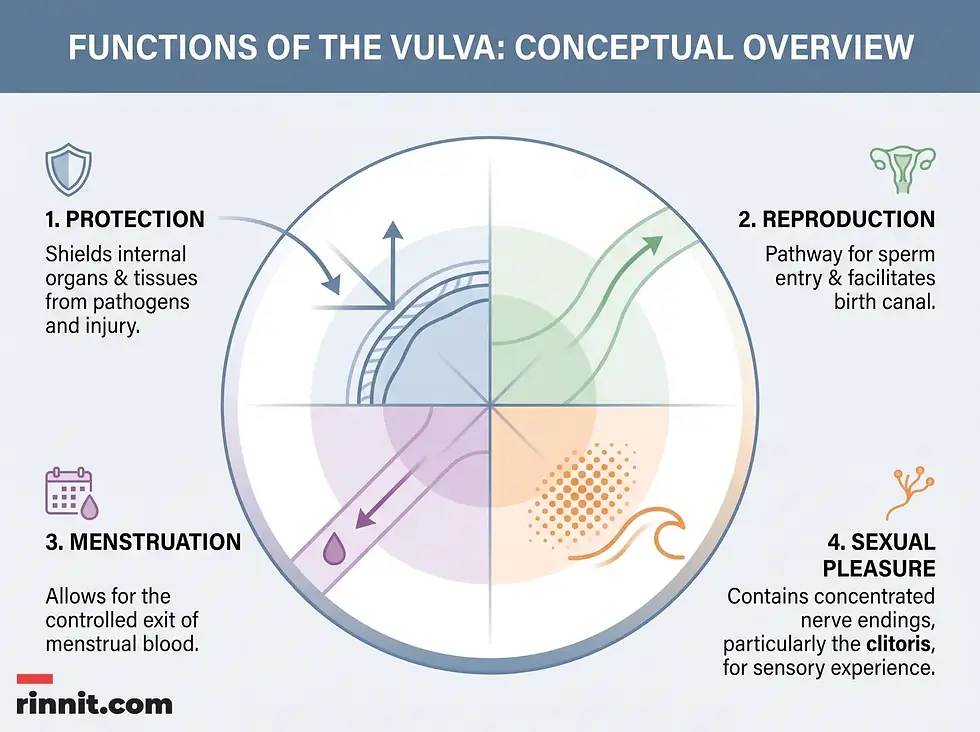
Primary Functions of the Vulva
The vulva supports several essential processes, from physical protection to sensation and the passage of fluids and life.
Function | Description |
Protection | Houses and shields the internal reproductive organs from injury. [1] |
Sexual pleasure | Contains organs, nerves, blood vessels, and erectile tissue for sexual response, especially in the clitoris. |
Reproduction | The vaginal opening, located within the vulva, is the entry point for sperm and the exit for a baby during childbirth. [1] |
Menstruation | Period blood leaves the body through the vaginal opening. [1] |
Urination | The urethral opening, where urine leaves the body, is part of the vulva. [1] |
Key Anatomical Structures
The vulva includes layers of skin, erectile tissue, glands, and sensitive organs. Each part has its own structure and purpose.
The External Folds and Mound
Mons pubis (pubic mound): A plump, V-shaped patch of skin and fatty tissue over the pelvic bone. After puberty it is covered with pubic hair. It cushions the area and absorbs impact, for example during penetration.
Labia majora (outer lips): These skin folds also grow pubic hair and enclose the innermost parts of the vulva. They contain erectile tissue that fills with blood during sexual arousal. [1]
Labia minora (inner lips): Hairless, highly sensitive folds inside the outer lips. They start above the clitoris and extend down toward the perineum, and they protect the clitoris and the vaginal opening. Their size, shape, and symmetry differ from person to person.

The Pleasure and Opening Centers
Clitoris: The primary center of sexual pleasure. The glans, roughly the size of a pea, sits under a protective clitoral hood, and the shaft extends into the body. Cleveland Clinic notes it contains more than 10,000 nerve endings, which is more than any other part of the body. [1]
Urethral opening: Just below the clitoris, this is where urine exits. Nearby are the Skene's glands, which release a lubricating fluid at the urethral opening and help protect against urinary tract infections. [1]
Vaginal opening: Below the urethral opening, it leads to the muscular vaginal canal. The Bartholin glands at its entrance release fluid that supports lubrication. A thin membrane called the hymen may partly cover the opening in some people. [1]
Common Conditions Affecting Vulvar Health
Because the vulva is sensitive and exposed to many environments, it can be affected by infections, skin irritation, and structural problems.
Category | Common examples |
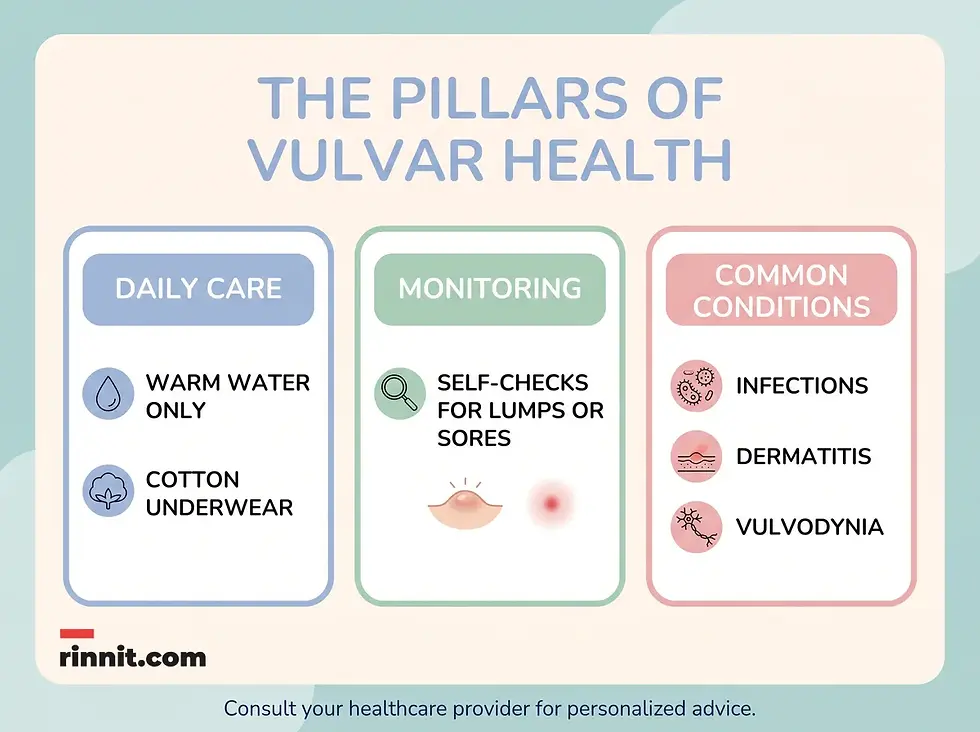
Infections | Bacterial vaginosis, yeast infections, and STIs such as chlamydia, herpes, or HPV [1] |
Skin irritation and inflammation | Contact dermatitis from soaps, detergents, or synthetic fabrics, and vulvitis |
Chronic conditions | Lichen sclerosus (inflamed, itchy, sometimes white patches), vulvodynia (vulvar pain with no clear cause) |
Structural issues | Bartholin gland cysts from blocked glands [1] |
Learn more in our guides to vulvitis and vulvar intraepithelial neoplasia (VIN), a precancerous skin condition of the vulva.
How the Vulva Changes Over Time
No two vulvas look exactly alike, and appearance can change with puberty, childbirth, and menopause. During menopause, falling estrogen can cause vaginal dryness, thinner pubic hair, less fatty tissue in the vulva, and pain with penetrative sex. [1] These changes are common, and there are treatments that can help.
Maintaining Vulvar Health and Hygiene
Caring for the vulva is straightforward but works best with consistency. Keep it clean, dry, and free of irritants. Wash with mild soap and warm water or with warm water alone, and do not overdo it, because over-washing can upset the balance of healthy bacteria and lead to infections. Avoid douching and scented soaps, sprays, deodorants, and tampons, as well as harsh laundry detergents and fabric softeners. [1]
Wear cotton underwear instead of nylon, which can trap heat and moisture. Change out of swimsuits and sweaty workout clothes soon after you finish. Do not leave a tampon in for more than eight hours, because of the risk of toxic shock syndrome. Protecting yourself from STIs is part of vulvar care too. [1]
Getting to know how your vulva normally looks, feels, and smells makes it easier to notice changes. A hand mirror can help you check regularly for new lumps, sores, or color changes, and any of these should be looked at by a healthcare provider.
Conclusion
The vulva is a complex and essential part of human anatomy that deserves attention and understanding. Knowing what each part does, from the protective labia to the highly sensitive clitoris, helps you look after your reproductive and sexual health. A gentle hygiene routine and staying alert to changes are the most effective ways to protect long-term comfort.
Next Steps
If you have persistent itching, unusual discharge, a new lump or sore, or pain during urination or sex, do not ignore it. Schedule a visit with a healthcare professional or gynecologist for an evaluation. Early care keeps minor irritation from becoming a bigger problem.
Frequently Asked Questions
1. What is the difference between the vulva and the vagina?
The vulva is the external genital area, while the vagina is the internal muscular canal.
2. Is it normal for the labia to be asymmetrical?
Yes. It is normal for the inner and outer lips to vary in size, shape, and symmetry.
3. How should I wash my vulva?
Use mild, unscented soap and warm water, or warm water alone. Avoid scented soaps, douches, and feminine hygiene sprays, and do not over-wash.
4. What are the symptoms of a vulvar infection?
Common signs include itching, redness, unusual discharge, odor, and burning when you urinate.
5. What is the mons pubis?
The mons pubis is the fatty, V-shaped mound of tissue over the pelvic bone, usually covered in pubic hair after puberty.
6. Where is the clitoris located?
The glans is at the top of the vulva, where the inner lips meet, usually under a protective hood.
7. What do the Bartholin glands do?
The Bartholin glands sit at the vaginal entrance and release fluid that helps with lubrication.
8. Can tight clothing affect vulvar health?
Yes. Tight, non-breathable fabrics can trap moisture and heat, which raises the risk of irritation and yeast infections.
9. What is vulvodynia?
Vulvodynia is a chronic pain condition of the vulva with no clearly identifiable cause.
10. What is a Bartholin cyst?
A Bartholin cyst is a fluid-filled lump that forms when a Bartholin gland becomes blocked.
11. How often should I check my vulva?
There is no single schedule. Checking regularly with a mirror, for example once a month, helps you learn what is normal and notice new lumps, sores, or color changes.
12. What is the function of the labia majora?
The labia majora are the outer lips that enclose and protect the more sensitive parts of the vulva.
13. Are Skene's glands important?
Yes. They release a lubricating fluid at the urethral opening that helps protect against urinary tract infections.
14. What causes vulvar dermatitis?
Vulvar dermatitis is often an allergic reaction or irritation from soaps, detergents, period products, or certain fabrics.
15. When should I see a doctor about vulvar changes?
See a provider if you notice new lumps, sores, persistent itching, unusual discharge or odor, or unexplained pain.
Related Reading
Clitoral Hood Reduction: Procedure, Recovery, Risks and Benefits explains how extra skin over the clitoris is trimmed, what recovery looks like and the risks to discuss with a surgeon.
Vestibulectomy: Purpose, Procedure, Risks & Recovery explains how painful tissue is removed from the vulvar vestibule to treat vestibulodynia, who it helps and what recovery looks like.
Trusted External Resources
References
Cleveland Clinic. Vulva. Cleveland Clinic. Last updated November 9, 2023. https://my.clevelandclinic.org/health/body/vulva
Uloko M, Isabey EP, Peters BR. How many nerve fibers innervate the human glans clitoris: a histomorphometric evaluation of the dorsal nerve of the clitoris. J Sex Med. 2023;20(3):247-252. PMID 36763957. https://doi.org/10.1093/jsxmed/qdac027
Hayes JA, Temple-Smith MJ. What is the anatomical basis of labiaplasty? A review of normative datasets for female genital anatomy. Aust N Z J Obstet Gynaecol. 2021;61(3):331-338. PMID 33382090. https://doi.org/10.1111/ajo.13298
Medical Disclaimer
This article is for educational purposes only and does not replace professional medical advice, diagnosis, or treatment. Always seek the advice of your physician or other qualified health provider with any questions you may have regarding a medical condition. Never disregard professional medical advice or delay in seeking it because of something you have read here.



Comments