Vestibulectomy: Purpose, Procedure, Risks & Recovery

Updated: 2 days ago
Written and medically reviewed by Dr. Baraa Alnahhal, MD · Last reviewed: November 2026 · How we review
Quick Answer
A vestibulectomy is surgery that removes the painful tissue of the vulvar vestibule, the area around the vaginal opening. It treats vestibulodynia, a condition where touch or pressure at the vaginal opening causes pain. Doctors offer it only after gentler treatments haven't helped. It takes 30 to 60 minutes, and most people recover fully within 6 to 12 weeks.
What the research says
A 2024 systematic review of 29 studies found that surgery for provoked vulvodynia reduced pain during sex in 52% to 93% of patients, with satisfaction rates of 79% to 93% (Saçıntı et al., Journal of Lower Genital Tract Disease, 2024) [2].
In a long-term follow-up 12 to 24 years after vestibulectomy, average pain with penetration dropped from 9.1 to 0.5 on a 0–10 scale, and 97% of women could have intercourse (David & Bornstein, Journal of Lower Genital Tract Disease, 2020) [3].
The most common complication reported across studies was a Bartholin cyst, seen in up to 9% of cases [2].
Key takeaways
Vestibulectomy treats vestibulodynia, not every type of vulvar pain.
It's usually a last step after creams, pelvic floor therapy and other treatments.
The surgery is outpatient and takes about 30 to 60 minutes.
Most people return to sex and tampon use after several weeks, once their doctor clears them.
About 3 in 4 people have significant improvement in pain [1].
What is a vestibulectomy?
The vulvar vestibule is the ring of tissue just inside the inner lips (labia minora) that surrounds the vaginal opening. In vestibulodynia, the nerves in this tissue become oversensitive. Even light pressure, like from a tampon, a pelvic exam or sex, can cause burning or sharp pain [1].
During a vestibulectomy, a surgeon removes the painful tissue. There are two main types [1]:
Type | What's removed | Best for |
Partial vestibulectomy | Only the painful part of the vestibule, often the lower (back) section | Pain limited to one area |
Complete vestibulectomy | Tissue around the whole vaginal opening | Pain all around the vestibule |
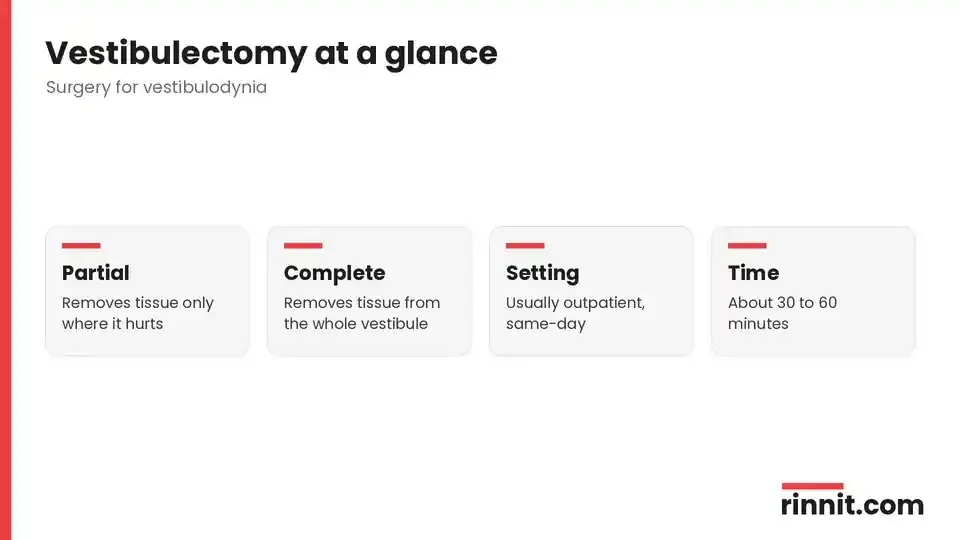
Your surgeon chooses partial or complete vestibulectomy based on where your pain is.
Who might need a vestibulectomy?
Vestibulectomy is for people with vestibulodynia whose pain hasn't improved with less invasive treatments. These first-line options often include [1]:
Topical numbing creams or hormone creams
Pelvic floor physical therapy
Medicines that calm nerve pain
Counseling or sex therapy
Avoiding irritants like scented soaps
It isn't a treatment for all vulvar pain. Pain that's spread across the vulva, or pain that happens without touch (generalized vulvodynia), usually doesn't respond to this surgery. Your doctor will confirm where your pain is, often with a gentle cotton swab test, before recommending it. Learn more about the condition in our guide to vestibulodynia.
How to prepare
Before surgery, you'll meet with your surgeon to review your health history and medicines. You may need to stop blood thinners or certain supplements for a short time. Ask what type of anesthesia you'll have, arrange a ride home, and stock up on ice packs, loose cotton underwear and pain relievers [1].
How is vestibulectomy done?
The procedure usually follows these steps [1]:
Anesthesia: You receive local, regional (spinal) or general anesthesia so you don't feel pain.
Incisions: The surgeon makes cuts on one or both sides of the vestibule, depending on the type.
Tissue removal: The painful vestibule tissue is removed.
Closure: In many cases, healthy vaginal tissue is moved down to cover the area. Dissolvable stitches close the incisions.
Going home: Most people go home the same day.
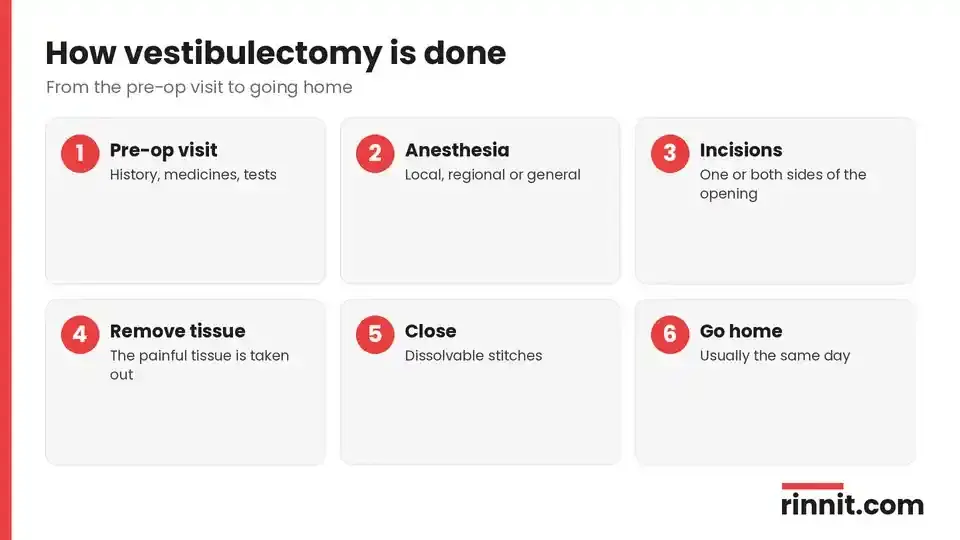
Vestibulectomy is usually done as an outpatient procedure in about 30 to 60 minutes.
Recovery after vestibulectomy
It's normal to have soreness and swelling for days to weeks after surgery. Ice packs and over-the-counter pain relievers help. Follow your surgeon's instructions on cleaning the incision and bathing [1].
Time after surgery | What to expect |
First 1–2 weeks | Soreness, swelling, light spotting; rest and use ice packs |
Within 4 weeks | Follow-up visit to check healing |
Several weeks | Sex and tampons often allowed once your doctor clears you |
6–12 weeks | Full recovery for most people |
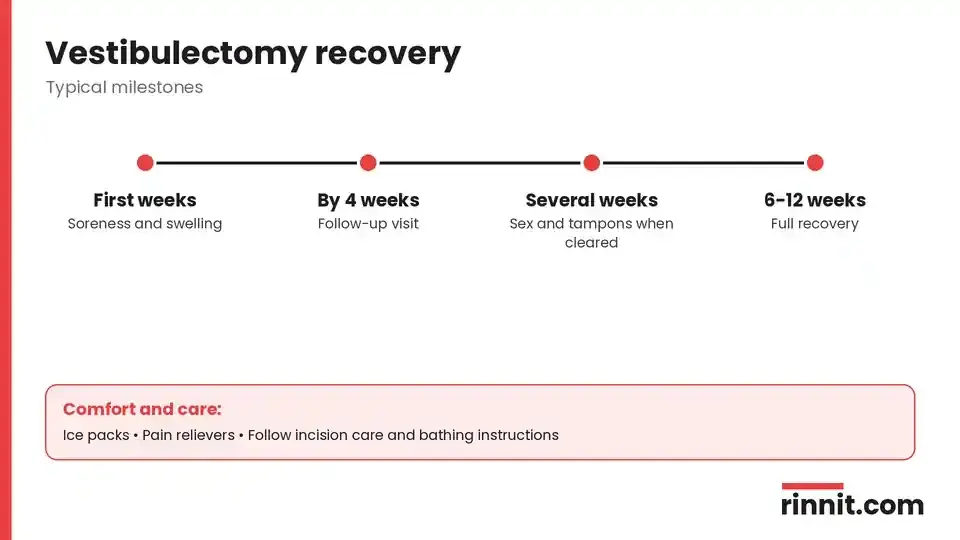
Recovery time varies. Don't resume sex or tampons until your doctor says it's safe.
Many people work with a pelvic floor physical therapist after healing. This can ease muscle tension and make returning to sex more comfortable.
Benefits
For the right patient, vestibulectomy can offer [1]:
Less pain with sex, tampons and exams
Better sexual satisfaction
Improved emotional well-being and quality of life
Research supports long-lasting results. In one study, 94% of women were highly satisfied, and 97% said they would have the surgery again [3].
Risks and complications
Like any surgery, vestibulectomy has risks. Possible risks include bleeding and infection, and in studies the most often reported complication was a Bartholin cyst [1]. Others include:
Pain that continues or returns
Changes in sensation or lubrication
Bartholin cyst formation
Dissatisfaction with how the area looks
When to call your doctor
Call your care team if you have a fever, heavy bleeding, pus or a bad smell from the incision, pain that gets worse instead of better, or trouble peeing.
Conclusion
Vestibulectomy is a well-studied option for vestibulodynia when other treatments haven't worked. Most people see major improvement in pain and can return to comfortable sex after recovery. If pain during sex is affecting your life, talk to a gynecologist or vulvar pain specialist about your options. You can also read about painful intercourse (dyspareunia) and vulvar anatomy on Rinnit.
FAQ
What is a vestibulectomy?
It's surgery to remove painful tissue from the vulvar vestibule, the area around the vaginal opening, to treat vestibulodynia [1].
Is vestibulectomy a major surgery?
It's usually an outpatient procedure that takes 30 to 60 minutes, and most people go home the same day [1].
How successful is vestibulectomy?
Studies report pain relief in 52% to 93% of patients, and about 3 in 4 people have significant improvement [1][2].
How long is recovery after vestibulectomy?
Most people recover fully within 6 to 12 weeks. Soreness and swelling are common in the first weeks [1].
When can I have sex after vestibulectomy?
Usually after several weeks, once your doctor confirms you've healed. Ask before resuming sex or tampons [1].
Is vestibulectomy painful?
Anesthesia prevents pain during surgery. Afterward, soreness is managed with ice packs and pain relievers [1].
What's the difference between partial and complete vestibulectomy?
A partial one removes only the painful section, while a complete one removes tissue around the whole vaginal opening [1].
What are the risks of vestibulectomy?
Bleeding and infection can occur, and Bartholin cysts were the most often reported complication in studies. Others include ongoing pain and sensation changes [1][2].
Who is a good candidate for vestibulectomy?
People with vestibulodynia whose pain hasn't improved with creams, pelvic floor therapy or other treatments [1].
Does vestibulectomy work long term?
Long-term studies show lasting relief, with 97% of women able to have intercourse 12 to 24 years later [3].
How do I prepare for vestibulectomy?
At a pre-operative visit, you discuss your medical history, allergies and current medicines, and you may need a physical exam or tests such as a complete blood count or a pregnancy test. Your provider will explain when to stop eating or drinking before surgery, which depends on the anesthesia used [1].
Related Reading
Learn more in our guide to Vestibulodynia.
Learn more in our guide to Painful Intercourse (Dyspareunia).
Learn more in our guide to Vulvar Anatomy.
References
Cleveland Clinic. Vestibulectomy: Purpose, Procedure, Risks & Recovery. Cleveland Clinic. Last updated June 3, 2024. https://my.clevelandclinic.org/health/procedures/vestibulectomy
Saçıntı KG, Razeghian H, Bornstein J. Surgical Treatment for Provoked Vulvodynia: A Systematic Review. J Low Genit Tract Dis. 2024;28(4):379-390. PMID 39105455. https://doi.org/10.1097/LGT.0000000000000834
David A, Bornstein J. Evaluation of Long-Term Surgical Success and Satisfaction of Patients After Vestibulectomy. J Low Genit Tract Dis. 2020;24(4):399-404. PMID 32569021. https://doi.org/10.1097/LGT.0000000000000552
Medical disclaimer
This article is for general education only and does not replace advice from a qualified healthcare professional. Talk to your doctor about your own diagnosis and treatment, and seek emergency care right away for severe or sudden symptoms.



Comments