Vulvar Intraepithelial Neoplasia (VIN): Symptoms, Types, and Care

Updated: 3 days ago
Medically reviewed by Dr. Baraa Alnahhal, MD · Last reviewed: October 2026
Quick Answer
Vulvar intraepithelial neoplasia is a precancerous condition in which atypical skin cells grow on the vulva; it is not cancer, but untreated cells can become vulvar cancer. [1] The two main types are usually linked to high-risk HPV or lichen sclerosus. [1] Some people have itching or skin changes, others none. [1] Removing or destroying the abnormal cells can prevent cancer. [1]
What the research says
Topical imiquimod can clear usual-type VIN in many women, while surgery often recurs. A Cochrane review of 6 randomized trials (327 women) and 5 non-randomized studies (648 women) found that in three trials (104 women), a complete response at 5 to 6 months occurred in 58% (36 of 62) of women using imiquimod and 0% (0 of 42) on placebo (risk ratio 14.40; 95% CI 2.97 to 69.80). In the best surgical study (70 women), VIN returned in 51% at a median of 14 months, more often with multifocal lesions (66%) than single lesions (34%), and vulvar cancer developed in 15.1% (11 women) at a median of 71.5 months (Lawrie et al., Cochrane Database Syst Rev, 2016) [2].
Lichen sclerosus raises vulvar cancer risk, and treatment may lower it. A systematic review of 14 studies including 14,030 women with vulvar lichen sclerosus and no earlier vulvar neoplasia found vulvar cancer in 2.2% (314 women) and differentiated VIN in 1.2% (50 of 4,175). The risk was highest in the first 1 to 3 years after a lichen sclerosus biopsy and with advancing age, and it fell significantly with ultrapotent topical steroid use (Vieira-Baptista et al., J Low Genit Tract Dis, 2022) [3].
What Is Vulvar Intraepithelial Neoplasia?
Vulvar intraepithelial neoplasia (VIN), also called vulvar dysplasia or squamous intraepithelial lesion (SIL), means there are atypical, precancerous cells on the surface of the vulva. [1] It is important to distinguish VIN from cancer: the cells are abnormal, but they have not invaded deeper tissue. Without treatment and monitoring, however, they can transform into vulvar cancer over time.
Types of VIN
Providers classify VIN by its underlying cause and behavior. Knowing the type guides treatment and the follow-up schedule.
VIN type | Primary association | Typical age at diagnosis | Time to progress to cancer |
Usual type (uVIN) | High-risk HPV (types 16, 18, 33) [1] | 40s | About 6 to 7 years [1] |
Differentiated type (dVIN) | Lichen sclerosus | 60 and older | About 2 to 3 years [1] |
Low-grade SIL (LSIL) | Low-risk HPV (the kind linked to genital warts) | Varies | Rarely becomes cancer; often goes away without treatment [1] |
Usual type VIN, also called high-grade squamous intraepithelial lesion (HSIL), accounts for most diagnoses. [1] Differentiated VIN is less common, about 5% of cases, but it tends to progress to cancer more quickly than the HPV-related type. [1]

Symptoms and Visual Changes
Not everyone with VIN has symptoms. [1] When symptoms do occur they can look like other common skin conditions, which is why regular professional exams matter.
Common Symptoms
Persistent vulvar itching
Burning, soreness, or tingling in the vulva
Pain during intercourse
Visible skin changes, such as new growths or discoloration
What to Look For
VIN can appear as raised or flat growths, or as patches of skin that are white, red, pink, gray, brown, or black. [1] The changes may be limited to one area or appear in several places on the vulva.
Causes and Risk Factors
Experts have not found a single cause of VIN. Most people diagnosed with VIN also have a high-risk form of HPV, a sexually transmitted infection that spreads through skin-to-skin contact, not only through intercourse. [1] People with VIN who do not have HPV usually have lichen sclerosus [1], a condition that causes inflammation and scaly patches on the vulva.
Key Risk Factors
HPV infection: Types 16, 18, and 33 are the high-risk strains linked to VIN, and HPV-16 is the most common.
Compromised immune system: A weakened immune system raises the risk of precancerous changes. [1]
Chronic irritation: Long-term irritation of the vulvar skin.
Smoking: Tobacco use is a risk factor and also makes VIN more likely to return after treatment. [1]

Diagnosis and Treatment
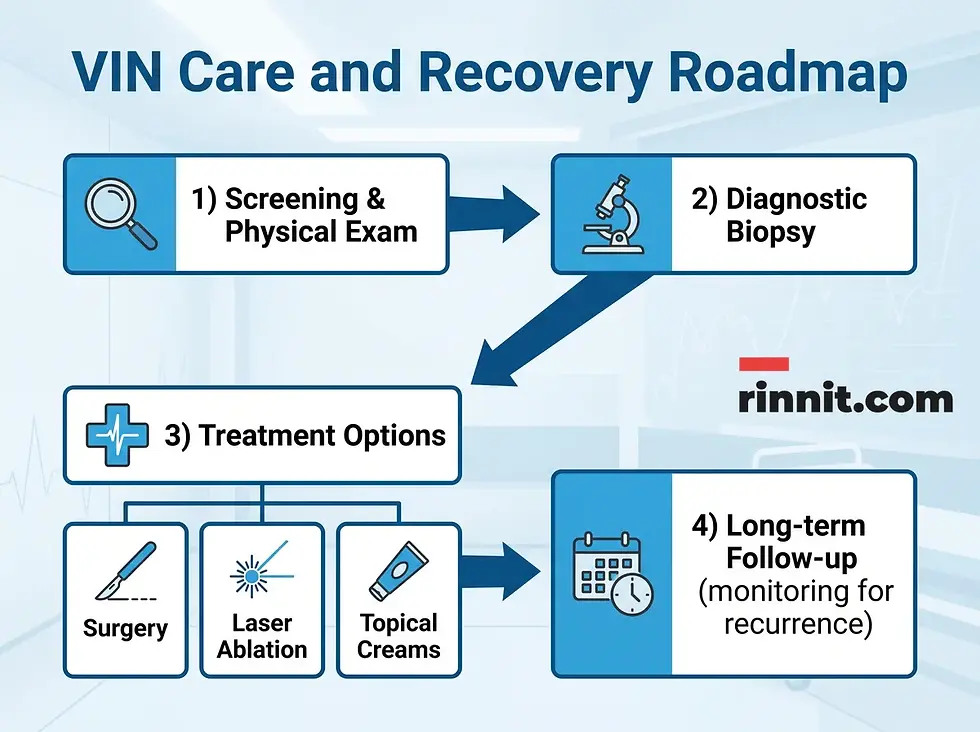
Early diagnosis is the most effective way to keep VIN from becoming cancer. It usually begins with a physical exam and may include tools that give a closer look.
Diagnostic Steps
Physical examination: Your provider checks the vulva for suspicious growths or discoloration.
Colposcopy: A lighted, magnifying instrument (a colposcope) gives a closer view of the vulva. [1]
Biopsy: This is the only way to know for sure. [1] A small sample of tissue is removed and tested in a lab for precancerous cells.
Treatment Options
The goal is to remove or destroy the precancerous cells while preserving the feeling and function of the vulva.
Treatment method | Description |
Surgery | Cutting out the abnormal tissue along with a small margin of healthy skin. [1] |
Laser ablation | Using a heated laser to remove or destroy the atypical cells, again with a small margin of healthy tissue. [1] |
Topical cream | Applying a medicine such as imiquimod directly to the skin to destroy abnormal cells. [1] |
Skinning vulvectomy | Rarely, removal of the vulvar skin when precancerous cells are widespread. [1] |
VIN can sometimes go away on its own, but this is uncommon. [1] Because the cells may stay precancerous or progress to cancer, providers usually recommend treatment.
Outlook, Follow-Up, and Prevention
The outlook with treatment is excellent, and most people never develop vulvar cancer. [1] VIN can return, though, and recurrence is more likely if you smoke. Many people return for follow-up visits twice a year for five years after treatment, and if there are no signs of VIN they may move to annual visits. [1] Your provider will set the schedule based on your diagnosis and response.
There is no foolproof way to prevent VIN, but you can lower your risk:
Get the HPV vaccine: It is the best way to reduce your risk because it protects against high-risk HPV strains that can lead to vulvar and cervical cancer. [1]
Practice safer sex: Condoms and dental dams do not fully prevent HPV, but they can reduce your risk. [1]
Treat lichen sclerosus: See a provider at the first signs, such as white, raised, itchy or sore spots, so symptoms are managed early.
Get regular Pap tests: Providers often add an HPV test, which helps catch suspicious changes while they are treatable.
Quit smoking: It lowers the chance of recurrence.
Conclusion
Vulvar intraepithelial neoplasia is serious but very manageable. A VIN diagnosis means abnormal changes were found early enough to stop them from becoming cancer. With prompt treatment, quitting smoking, and consistent follow-up, the long-term outlook is excellent.
Next Steps
If you notice unusual skin changes, persistent itching, or new growths in the genital area, schedule an appointment with a healthcare provider for an evaluation. Useful questions to ask include which type of VIN you have, what treatment is recommended, which side effects to expect, what signs would mean VIN has returned, and how often you will need follow-up visits.
Frequently Asked Questions
1. Is VIN a form of cancer?
No. VIN is a precancerous condition. It means there are atypical cells that could become cancer if not treated, but they are not yet cancer.
2. What is the main cause of VIN?
Most cases are linked to high-risk strains of human papillomavirus (HPV), particularly type 16.
3. Can VIN be caused by something other than HPV?
Yes. Differentiated VIN (dVIN) is typically associated with lichen sclerosus, an inflammatory skin condition.
4. What does VIN look like?
VIN can appear as raised or flat growths, or as patches of skin that are white, red, pink, gray, brown, or black.
5. Does everyone with VIN have symptoms?
No. Some people have none, which is why regular gynecologic exams are important.
6. How is VIN diagnosed?
A biopsy is the only way to confirm VIN.
7. What is a colposcopy?
A colposcopy is a procedure in which a provider uses a lighted, magnifying instrument to look closely at the vulvar skin.
8. Can VIN go away on its own?
VIN can, but this is not common. Most providers recommend treatment because of the risk of progression to cancer.
9. What are the most common treatments for VIN?
Treatment options include surgery to remove the cells, laser ablation, and topical medicated creams such as imiquimod.
10. How long does it take for VIN to become cancer?
HPV-related usual type VIN usually takes about 6 to 7 years, while differentiated VIN usually takes about 2 to 3 years.
11. Can VIN return after treatment?
Yes. There is always a chance of recurrence, which is why long-term monitoring is needed.
12. Does smoking affect VIN?
Yes. Smoking is a risk factor for VIN and makes it more likely to come back after treatment.
13. Can the HPV vaccine prevent VIN?
The vaccine protects against the high-risk HPV strains that cause most VIN, and it is the best way to reduce your risk. It does not remove the need for regular screening.
14. How often is follow-up needed after treatment?
Many people return twice a year for five years, then yearly if no new abnormal cells appear. Your provider will tailor the schedule.
15. Is VIN contagious?
VIN itself is not contagious, but the HPV that often causes it spreads through skin-to-skin sexual contact.
Related Reading
Trusted External Resources
References
Cleveland Clinic. Vulvar Intraepithelial Neoplasia. Cleveland Clinic. Last updated December 6, 2023. https://my.clevelandclinic.org/health/diseases/vulvar-intraepithelial-neoplasia
Lawrie TA, Nordin A, Chakrabarti M, et al. Medical and surgical interventions for the treatment of usual-type vulval intraepithelial neoplasia. Cochrane Database Syst Rev. 2016;2016(1):CD011837. PMID 26728940. https://doi.org/10.1002/14651858.CD011837.pub2
Vieira-Baptista P, Pérez-López FR, López-Baena MT, et al. Risk of development of vulvar cancer in women with lichen sclerosus or lichen planus: a systematic review. J Low Genit Tract Dis. 2022;26(3):250-257. PMID 35285455. https://doi.org/10.1097/LGT.0000000000000673
Medical Disclaimer
This article is for informational purposes only and does not constitute medical advice. Always seek the advice of your physician or other qualified health provider with any questions you may have regarding a medical condition. Never disregard professional medical advice or delay in seeking it because of something you have read here.



Comments