Vision Therapy: Exercises for Eye Alignment and Focus

Updated: 3 days ago
Medically reviewed by Dr. Baraa Alnahhal, MD · Last reviewed: October 2026
TL;DR: Vision therapy is a form of training that aims to improve how the eyes work together. It is often described as physical therapy for the eyes and combines monitored in-office sessions with exercises at home. Research supports it for convergence insufficiency and a related focusing problem called accommodative dysfunction. For most other uses, including dyslexia and learning difficulties, the evidence is lacking and major medical organizations advise against it [1].
Quick Answer
Vision therapy is a supervised program of eye exercises and training tools used to improve eye alignment, focusing, and coordination. Research supports it mainly for convergence insufficiency (trouble turning the eyes inward for close work) and accommodative dysfunction. Treatment usually lasts weeks to months and combines in-office visits with home practice, sometimes with prisms, patches, and special lenses [1].
What the research says
Office-based therapy with home practice works best for children. A Cochrane network meta-analysis of 12 trials (1,289 participants) found high-certainty evidence that, in children with convergence insufficiency, office-based vergence/accommodative therapy with home reinforcement raised the chance of treatment success versus home-based pencil push-ups (RR 2.86, 95% CI 1.82–4.35) and versus placebo (RR 3.04, 95% CI 2.32–3.98); evidence in adults was less clear (According to PubMed, Scheiman et al., Cochrane Database Syst Rev, 2020) [2].
Symptom relief is less certain than improvements in eye measurements. An American Academy of Ophthalmology review of 12 studies found that office-based therapy improved motor outcomes in children with symptomatic convergence insufficiency but gave inconsistent symptom relief, was not superior to placebo for symptoms in young adults, and left the value of home-based therapy unclear (According to PubMed, Chang et al., Ophthalmology, 2021) [3].
It should not be offered as a way to improve attention. In a randomized trial of 310 children aged 9 to 14, vergence/accommodative therapy was no better than placebo therapy for attention (SWAN inattention effect size d = 0.036, 95% CI −0.21 to 0.28) (According to PubMed, CITT-ART Investigator Group, Optom Vis Sci, 2021) [4].
What Is Vision Therapy?
Vision therapy is a term some optometrists and occupational therapists use for treatments that aim to improve vision through training. It generally includes monitored in-office and at-home eye exercises over weeks to months [1]. Unlike surgery or glasses, which address the physical structure or focusing power of the eye, vision therapy focuses on how well the eyes and brain coordinate. The pediatric eye community does not universally agree on what counts as vision therapy, but treatments that fall under the term include:
Therapy Type | Primary Focus | Common Tools |
Orthoptic | Eye movement and alignment, usually guided weekly in an eye specialist's office. | Prisms, Brock strings, flippers. |
Amblyopia | Strengthening the weaker eye (“lazy eye”) by covering or blurring the stronger one. Many, but not all, forms are based on strong scientific evidence. | Eye patches, blurring lenses. |
Behavioral | Exercises meant to improve visual processing and understanding. Experts recommend against it for conditions other than convergence insufficiency. | Electronic devices, specialized charts. |
Myopia (nearsightedness) | Aims to avoid or delay the onset or worsening of nearsightedness. | Training glasses, specific exercises. |
The core aim is to train the eyes and brain to work together more efficiently, which matters for reading, close work, and depth perception that rely on binocular vision.

Evidence-Based Applications
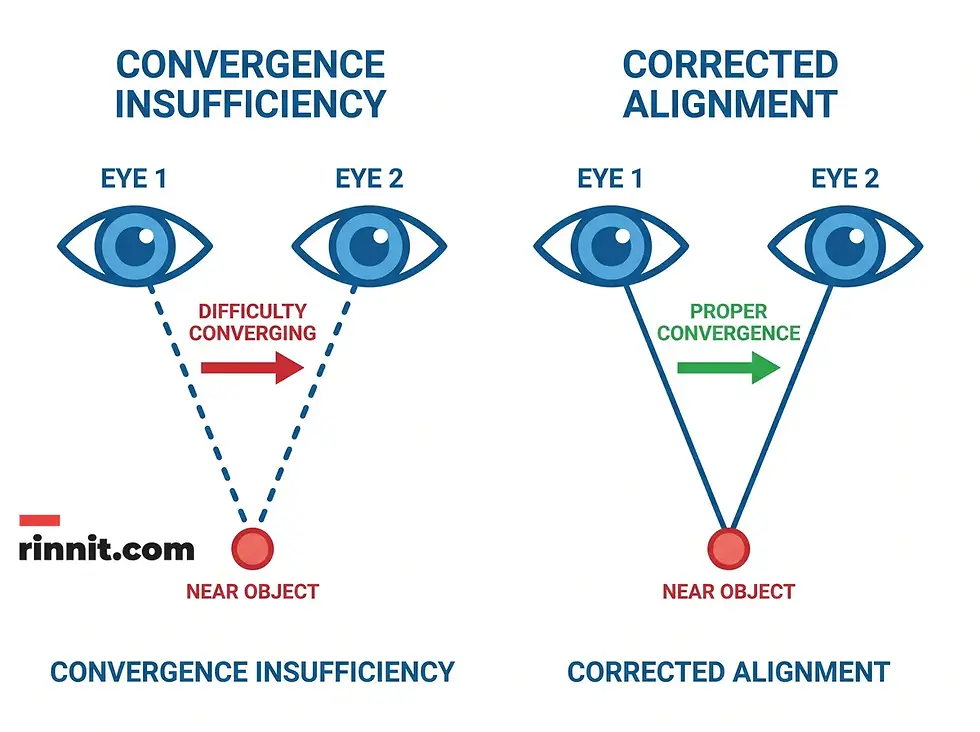
Research supports vision therapy for convergence insufficiency and accommodative dysfunction, which are forms of binocular vision dysfunction. In convergence insufficiency, the eyes have difficulty turning inward to see close objects, which can cause eye strain and blurred or double vision during reading or computer work. In accommodative dysfunction, the eyes struggle to focus, and this can occur together with convergence problems [1].
For these conditions, an eye specialist teaches orthoptic exercises, explains how often to do them, and oversees progress while you practice at home [1]. Studies in children show that supervised in-office therapy with home reinforcement works better than home exercises alone [2], and therapy can reduce symptoms such as blur, eye strain, and double vision [1].
The Therapy Process and Tools
Vision therapy starts with an in-office evaluation to find out whether you or your child has a problem with how the eyes align and work together. If therapy is recommended, the plan is tailored to the results and can run for weeks or months. Orthoptic sessions usually take place weekly, and you are given exercises to do at home, which are important for reinforcing what you learn in the office [1].
Specialists use a range of tools to challenge and train the visual system. Training glasses and light-bending prisms change how light enters the eyes. Eye patches temporarily cover the stronger eye so the weaker eye is encouraged to work harder [1]. Electronic devices and computer programs can help track progress and keep younger patients engaged.

Controversies and Considerations
Most vision therapy is controversial among eye care specialists, and research does not support its use for conditions other than convergence insufficiency and accommodative dysfunction. The American Academy of Pediatrics, the American Academy of Ophthalmology, the American Association for Pediatric Ophthalmology and Strabismus, and the American Association of Certified Orthoptists all recommend against behavioral vision therapy for other conditions [1].
Dyslexia is a clear example. It is not an eye condition. It happens because the brain processes what the eyes see differently, and behavioral vision therapy and eye exercises are not effective for treating it. The same is true of other learning disabilities. Some forms of vision therapy, such as syntonics (light exposure therapy), are widely regarded as pseudoscience [1].
Because there is no strong evidence that vision therapy treats other eye conditions, vision and medical insurance plans do not usually cover it, so families often pay out of pocket [1]. In some cases, trying the wrong type of vision therapy can delay treatments that would work and lead to permanent vision problems [1].
If your child is struggling in school: Learning difficulties often have more than one cause. A pediatric eye doctor can check for problems such as amblyopia, strabismus, or refractive errors with a full dilated eye exam, and your pediatrician can recommend specialists for dyslexia or other learning disorders.
Conclusion
Vision therapy is a useful, non-invasive option for people with convergence insufficiency or accommodative dysfunction, especially when supervised in-office therapy is combined with dedicated home practice. It is not a treatment for dyslexia, learning disabilities, or most other eye conditions. Before starting, ask a pediatric ophthalmologist or optometrist for a full evaluation and make sure the plan is evidence-based and matches your diagnosis.
Related reading: Convergence insufficiency · Eye strain · Double vision · Dyslexia · Anisometropia
Frequently Asked Questions
What is the primary goal of vision therapy?
The goal is to improve eye alignment, eye coordination, and visual skills through supervised exercises and training tools.
How long does a typical course of vision therapy last?
Treatment usually takes place over weeks to months and combines monitored in-office sessions with exercises you do at home. Your eye specialist will set the schedule.
Is vision therapy effective for dyslexia?
No. Dyslexia is not an eye condition. It happens because the brain processes what the eyes see differently, and behavioral vision therapy and eye exercises are not effective for treating it.
Can vision therapy replace the need for glasses?
No. Vision therapy trains how the eyes work together, while glasses correct refractive errors such as nearsightedness, farsightedness, and astigmatism.
What are common signs that a child might need an eye evaluation?
Frequent eye strain, headaches during reading, blurry or double vision, and trouble keeping focus on near tasks are common signs. A full eye exam can find out whether an alignment or focusing problem is the cause.
Is vision therapy covered by insurance?
Usually not. There is no strong evidence that vision therapy treats conditions other than convergence insufficiency and accommodative dysfunction, so vision and medical insurance plans do not usually cover it, and many people pay out of pocket.
Who provides vision therapy?
Vision therapy is typically provided or overseen by optometrists, pediatric ophthalmologists, orthoptists, and some occupational therapists.
What is convergence insufficiency?
Convergence insufficiency is a condition in which the eyes struggle to point inward to see close objects, such as a book or a screen, which can cause eye strain, blurred vision, and double vision.
Are there any risks associated with vision therapy?
The main risk is using the wrong kind of vision therapy for the wrong condition. It might not help, and it can delay other treatments that would work, which in some cases can lead to permanent vision problems.
Can adults benefit from vision therapy?
Possibly, but the evidence is less clear than in children. Reviews have found that office-based therapy was not clearly better than placebo for relieving symptoms in young adults, so ask an eye specialist whether it suits your situation.
References
Cleveland Clinic. Vision Therapy: What It Is & How It Works. Cleveland Clinic. Last updated 02/19/2025. https://my.clevelandclinic.org/health/treatments/vision-therapy
Scheiman M, Kulp MT, Cotter SA, et al. Interventions for convergence insufficiency: a network meta-analysis. Cochrane Database Syst Rev. 2020;12(12):CD006768. PMID 33263359. https://doi.org/10.1002/14651858.CD006768.pub3
Chang MY, Morrison DG, Binenbaum G, et al. Home- and office-based vergence and accommodative therapies for treatment of convergence insufficiency in children and young adults: a report by the American Academy of Ophthalmology. Ophthalmology. 2021;128(12):1756-1765. PMID 34172337. https://doi.org/10.1016/j.ophtha.2021.05.017
CITT-ART Investigator Group. Effect of vergence/accommodative therapy on attention in children with convergence insufficiency: a randomized clinical trial. Optom Vis Sci. 2021;98(3):222-233. PMID 33771952. https://doi.org/10.1097/OPX.0000000000001659
Medical disclaimer
This article is for educational purposes only and is not a substitute for professional medical advice, diagnosis, or treatment. Always seek the advice of your physician or other qualified health provider with any questions about a medical condition.



Comments