Convergence Insufficiency: What It Is, Symptoms, Causes, and Treatment

Updated: 3 days ago
Medically reviewed by Dr. Baraa Alnahhal, MD · Last reviewed: October 2026
Quick Answer
Convergence insufficiency is a binocular vision disorder in which the eyes fail to turn inward together for near objects, causing double or blurred vision, headaches and reading discomfort [1]. It often starts in childhood, and a routine eye exam cannot detect it [1]. Treatment relies on eye movement exercises, sometimes prism glasses, and most people improve permanently [1].
What the research says
Office-based vision therapy works better than home exercises alone in children. A Cochrane network meta-analysis of 12 trials (1,289 participants) found high-certainty evidence that office-based vergence/accommodative therapy with home reinforcement was more likely to succeed in children than home-based pencil push-ups (risk ratio 2.86; 95% CI 1.82 to 4.35), home-based computer therapy (RR 1.96; 95% CI 1.32 to 2.94), or placebo therapy (RR 3.04; 95% CI 2.32 to 3.98). Prism reading glasses showed no difference from placebo glasses in children, and evidence for adults was less clear (PubMed: Scheiman et al., Cochrane Database Syst Rev, 2020 [2]).
The ADHD link depends on how convergence insufficiency is defined. In a case-control study of 30 children with ADHD and 30 without, the prevalence of convergence insufficiency was similar in both groups when three diagnostic signs were required (p = 0.34), but significantly higher in the ADHD group when only two signs were used (p < 0.01). The authors concluded that vision problems are more common in ADHD but that the direction of the link is unclear. The sample was small (PubMed: Clavé and Torrents, Ophthalmic Physiol Opt, 2025 [3]).
Unusual cases deserve a fuller work-up. A clinical review notes that randomized trials and the Cochrane review support formal office-based vision therapy for convergence insufficiency in children, and that atypical presentations should prompt a comprehensive evaluation, including neuroimaging, because some vergence disorders point to neurologic disease. It recommends starting with the least invasive treatment, though some patients may need surgery (PubMed: Brune and Eggenberger, Curr Treat Options Neurol, 2018 [4]).
What Is Convergence Insufficiency?
Convergence insufficiency is a vision disorder involving binocular vision, which is the ability to use both eyes together as a team [1]. "Convergence" describes the way your eyes move together and point inward when you look at nearby objects, such as books, tablets, or smartphone screens [1]. With convergence insufficiency, an eye coordination problem takes over: instead of turning inward, the eyes drift outward as you look at close-up objects [1].
This drifting can cause double or blurred vision and make near tasks like reading uncomfortable [1]. The condition typically starts in childhood, but it frequently goes undiagnosed [1]. Providers who do diagnose it often identify it when children are learning to read [1]. In adults, convergence insufficiency can also occur after a brain injury, such as a concussion.
Key Facts at a Glance
Quick fact | Detail |
Type of condition | Binocular vision disorder (eye coordination problem) [1] |
What happens | Eyes drift outward instead of turning inward at close range [1] |
When it starts | Typically childhood; can follow brain injury in adults [1] |
Estimated prevalence | 2% to 13% of people in the U.S. [1] |
Detected by a 20/20 chart? | No; a specialized convergence test is required [1] |
First-line treatment | Eye movement exercises [1] |

How Common Is Convergence Insufficiency?
Convergence insufficiency occurs in an estimated 2% to 13% of people in the U.S [1]. That wide range reflects how often the condition goes undetected. Because it begins in childhood and its symptoms mimic reading difficulty or poor concentration, many people live with it for years without a diagnosis. It can also affect adults, particularly after head trauma [1].
Population | Relationship to convergence insufficiency |
Children learning to read | Often first diagnosed at this stage [1] |
General U.S. population | Affects an estimated 2% to 13% [1] |
Adults after brain injury | Can develop the condition, for example after a concussion [1] |
Children with ADHD | See the section below on the ADHD link |
How is convergence insufficiency connected to ADHD?
Because the symptoms of convergence insufficiency overlap with those of attention-deficit/hyperactivity disorder (ADHD), particularly trouble concentrating during focused reading, children being evaluated for ADHD frequently have an eye exam as part of that process [1].
A 2005 study cited by Cleveland Clinic evaluated the link between the two conditions and concluded that all children with an ADHD diagnosis should also be examined for convergence insufficiency, because the condition occurred three times as often in children with ADHD as in the general U.S. population [1]. More recent research suggests that the measured rate depends on the diagnostic criteria used [3], as described in the research box above.
What Are the Symptoms of Convergence Insufficiency?
People with convergence insufficiency may experience several symptoms when reading or looking at close-up objects like books or smartphones [1]. The symptoms appear during near-vision tasks, not distance vision.
Symptom | Why it happens |
Headache [1] | Eye strain from the effort of coordinating the eyes |
Double vision (diplopia) [1] | Eyes fail to point at the same close target |
Tired or sore eyes [1] | Extra muscle effort during near work |
Blurry vision [1] | Eyes cannot hold steady focus up close |
Difficulty concentrating [1] | Visual discomfort competes with the reading task |
Squinting, closing, or rubbing an eye [1] | Unconscious attempt to restore single vision |
Dizziness [1] | Conflicting signals between the two eyes |
What Causes Convergence Insufficiency?
A lack of communication between your nerves and the muscles that control your eye movements causes convergence insufficiency [1]. The eye muscles themselves are healthy, but the nerves that control them are not sending the proper message for the eyes to turn inward enough to aim at a close object [1]. Instead of coming together to focus on near objects, one or both eyes remain pointing away from the target.
Cause factor | What it means |
Nerve-muscle miscommunication | The primary driver: healthy muscles, faulty signals [1] |
Brain injury | Can trigger the condition, such as after a concussion [1] |
Neurodegenerative disease | Conditions like Parkinson's disease can cause it in some cases [1] |
Other risk factors | None identified beyond brain injury [1] |
What Are the Complications of Convergence Insufficiency?
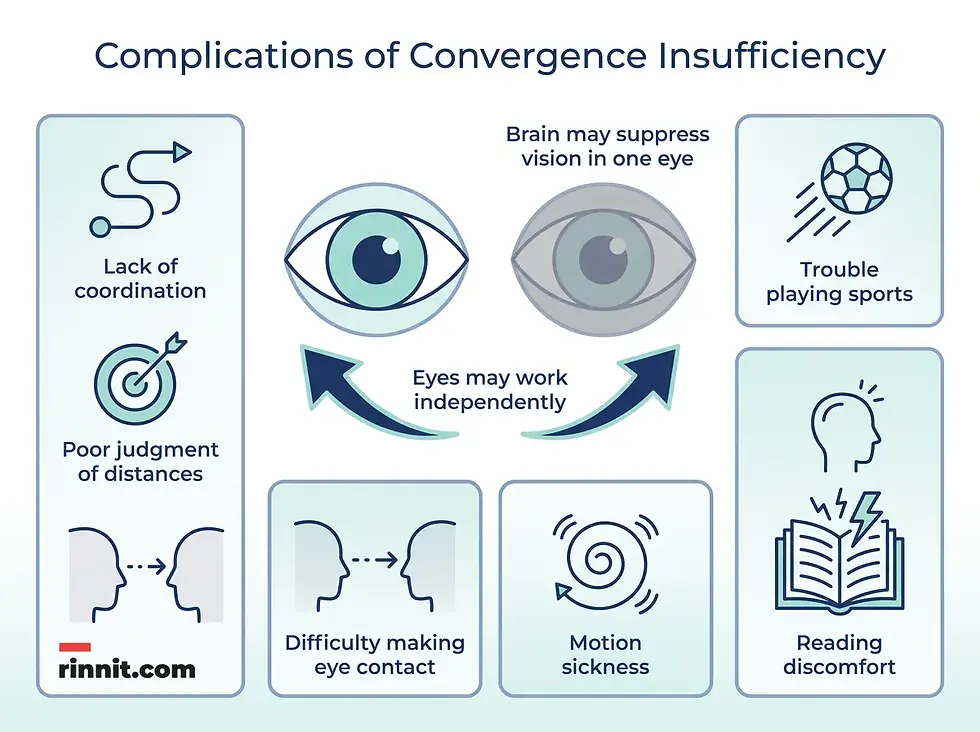
Most complications relate to the discomfort the condition creates and its interference with activities that require near vision [1]. In some people, the brain responds by suppressing (shutting down) vision in one eye to avoid experiencing double vision [1]. This is the brain's way of coping with eyes that will not work as a team. Alternatively, the eyes may drift farther apart and begin working independently instead of together [1]. When that happens, problems can extend beyond discomfort.
Complication | Impact |
Suppressed vision in one eye [1] | The brain shuts down input to avoid double vision |
Eyes working independently [1] | Loss of teamwork between the two eyes |
Lack of coordination [1] | Affects body coordination beyond vision |
Poor judgment of distances [1] | Depth perception suffers |
Trouble playing sports [1] | Distance judgment and coordination interfere with play |
Difficulty making eye contact [1] | Eye drift affects social visual cues |
Motion sickness [1] | Can become more frequent |
How Is Convergence Insufficiency Diagnosed?
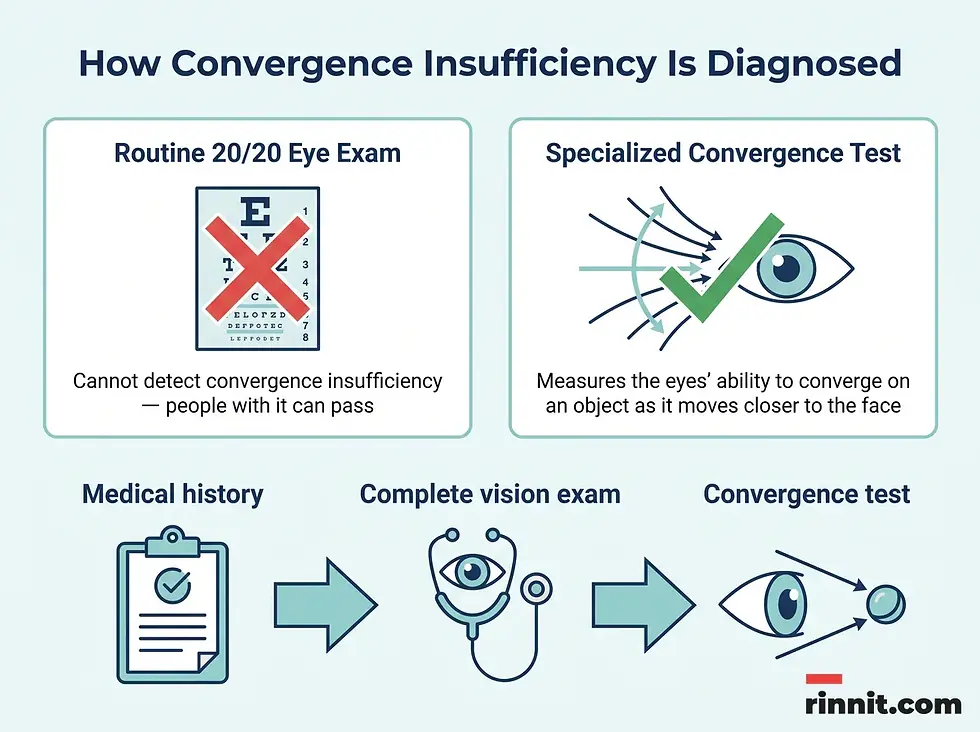
Eye specialists called optometrists or ophthalmologists diagnose convergence insufficiency [1]. They take your medical history and perform a complete vision exam [1]. Here is the most important point for anyone seeking a diagnosis: a routine eye exam with the familiar 20/20 eye chart does not diagnose convergence insufficiency [1]. People can pass the standard eye exam even if they have the condition [1].
Diagnostic step | What it involves |
Medical history | Review of symptoms and near-vision difficulties |
Complete vision exam | Full assessment by an optometrist or ophthalmologist |
Specialized convergence test | Measures the eyes' ability to converge on an object as it moves closer to the face [1] |
Standard 20/20 chart | Cannot detect the condition; people with convergence insufficiency can pass it [1] |
How Is Convergence Insufficiency Treated?
Treatment involves eye movement exercises that retrain your nerves to aim your eyes properly [1]. These exercises improve the eyes' ability to move inward together by focusing on objects at different distances [1]. They may be performed with a specialized optometrist or a therapist in your provider's office and then repeated at home [1] [2].
Treatment | When it is used | How it works |
Eye movement exercises | First-line treatment for most people [1] | Retrain nerves to aim the eyes inward together at varying distances |
Prism glasses | Occasionally required [1] | Redirect the light entering your eyes, doing the work the nerves cannot [1] |
Surgery | Makes the eye muscles stronger [1] | |
Regular eyeglasses | Not a treatment | Usually do not improve the condition [1] |
Eye patches | Not a treatment | Usually do not improve the condition [1] |
How Soon After Treatment Will You Feel Better?
You may not notice an improvement right away. It can take three months or more to notice a change in your vision [1]. Typically, the results are permanent, but symptoms may return after not getting enough sleep, being sick, or doing a lot of close-up activities [1].
What is the outlook for convergence insufficiency?
Most people who undergo eye exercise treatment for convergence insufficiency experience fewer symptoms and improved vision [1]. There is no threat to overall health or life expectancy from this condition. People with convergence insufficiency can return to their normal activities immediately [1], and with treatment, close-up activities such as reading and studying become more comfortable [1].
Can Convergence Insufficiency Be Prevented?
Because healthcare providers do not know what causes the poor muscle coordination behind convergence insufficiency, you cannot prevent it [1]. The best step is to seek testing when symptoms appear during near-vision tasks, since the symptoms mimic reading or concentration problems and are often missed.
How can people live well with convergence insufficiency?
Living with convergence insufficiency means keeping vision therapy sessions, repeating exercises at home, prioritizing sleep, pacing close-up work and watching for symptoms to return.
When to See Your Provider
Contact your child's healthcare provider if they experience symptoms of convergence insufficiency when doing up-close work like reading.
Keep scheduled vision therapy sessions and repeat the exercises at home, since office sessions alone are not the full treatment.
Prioritize sleep. Lack of sleep can trigger symptom return [1].
Pace close-up activity. Heavy near work can bring symptoms back [1].
Watch for symptom return, especially after sickness or poor sleep.
Questions to Ask Your Provider
Have you performed the necessary test to diagnose the condition?
Can you refer me to someone who can administer the exercise treatments?
How long will treatment take?
Can the condition return?
How can I prevent it from returning in the future?
Conclusion
Convergence insufficiency is a common but frequently missed binocular vision disorder in which the eyes drift outward instead of turning inward at close range. It typically begins in childhood, affects an estimated 2% to 13% of people in the U.S. [1], and cannot be detected by a routine 20/20 eye exam [1]. The good news is that treatment, centered on eye movement exercises that retrain the eyes to work together, helps most people achieve fewer symptoms and more comfortable reading, with results that are usually permanent [1].
If you or your child struggle with headaches, double vision, or losing focus while reading, talk to an eye care professional about a convergence test. Our related guides cover ADHD and concussion recovery. Explore them to understand the full picture and the questions worth asking your care team.
Frequently Asked Questions
1. What is convergence insufficiency in simple terms?
Convergence insufficiency is a vision disorder where the eyes drift outward instead of turning inward together when looking at close objects like books or screens. It involves binocular vision, affects an estimated 2% to 13% of people in the U.S., and causes double or blurred vision, headaches, and reading discomfort.
2. What are the main symptoms of convergence insufficiency?
Symptoms appear during near tasks and include headache, double vision (diplopia), tired or sore eyes, blurry vision, difficulty concentrating, squinting or rubbing an eye, and dizziness when reading or using close-up devices.
3. Why can't a routine 20/20 eye exam detect convergence insufficiency?
A standard eye chart test does not measure how the two eyes coordinate at close range. People can pass the routine exam even while having convergence insufficiency. A specialized convergence test, performed by an optometrist or ophthalmologist, is required.
4. What causes convergence insufficiency?
The cause is a lack of communication between the nerves and the muscles that control eye movements. The eye muscles are healthy, but the nerves fail to signal the eyes to turn inward enough. In some cases, brain injury or neurodegenerative diseases like Parkinson's disease can cause it.
5. Is convergence insufficiency related to ADHD?
Yes, the symptoms overlap, particularly difficulty concentrating while reading. A 2005 study cited by Cleveland Clinic recommends that all children diagnosed with ADHD also be examined for convergence insufficiency, because it occurred three times as often in children with ADHD as in the general U.S. population. More recent research suggests the exact rate depends on the diagnostic criteria used.
6. How is convergence insufficiency treated?
The main treatment is eye movement exercises that retrain the nerves to aim the eyes inward together at varying distances, done in the office and repeated at home. Occasionally, prism glasses are used, and rarely, surgery. Regular eyeglasses and eye patches usually do not help.
7. How long does treatment take to work?
Improvement is not immediate. It can take three months or more to notice a change in vision. Results are typically permanent, though symptoms can return after poor sleep, illness, or heavy close-up activity.
8. Can convergence insufficiency come back after treatment?
Convergence insufficiency can. Even though results are usually permanent, symptoms may return after not getting enough sleep, being sick, or doing a lot of close-up activities. Follow up with your eye care provider if this happens.
9. Can adults develop convergence insufficiency?
Yes. While it typically starts in childhood and is often diagnosed when children learn to read, adults can develop it after a brain injury such as a concussion, or in connection with neurodegenerative disease.
10. Can convergence insufficiency be prevented?
No. Because providers do not know what causes the poor muscle coordination behind the condition, it cannot be prevented. Seeking testing when symptoms appear during near work is the best step.
11. What complications can convergence insufficiency cause?
Most complications involve discomfort and interference with near-vision activities. In some people, the brain suppresses vision in one eye to avoid double vision, or the eyes drift apart and work independently, leading to poor coordination, poor distance judgment, trouble with sports, difficulty making eye contact, and motion sickness.
Related Reading
What Is Binocular Vision Dysfunction (BVD)? Symptoms, Causes, Diagnosis, and Treatment Explained explains how poor eye teaming causes strain, headaches and blurry vision.
Vision Therapy: Exercises for Eye Alignment and Focus describes eye exercises used to improve focusing and eye coordination.
Diplopia (Double Vision): What Causes It, How It's Classified, and When It's an Emergency covers the causes of double vision and when it is an emergency.
Eye Strain: The Complete Guide to Symptoms, Causes, Treatment and the 20-20-20 Rule explains eye strain and simple habits that ease tired eyes.
References
Cleveland Clinic. Convergence Insufficiency. Cleveland Clinic. June 13, 2023. https://my.clevelandclinic.org/health/diseases/17895-convergence-insufficiency
Scheiman M, Kulp MT, Cotter SA, Lawrenson JG, Wang L, Li T. Interventions for convergence insufficiency: a network meta-analysis. Cochrane Database Syst Rev. 2020;12(12):CD006768. doi:10.1002/14651858.CD006768.pub3. PMID: 33263359.
Clavé L, Torrents A. Convergence insufficiency prevalence in attention deficit and hyperactivity disorder children depends on the diagnosis criteria. Ophthalmic Physiol Opt. 2025;45(1):23-30. doi:10.1111/opo.13411. PMID: 39462237.
Brune AJ, Eggenberger ER. Disorders of vergence eye movements. Curr Treat Options Neurol. 2018;20(10):42. doi:10.1007/s11940-018-0528-z. PMID: 30136159.
Medical Disclaimer
This article is for informational purposes only and does not constitute medical advice. Always seek the advice of your physician or other qualified health provider with any questions you may have regarding a medical condition. Never disregard professional medical advice or delay in seeking it because of something you have read here.



Comments