Vesicovaginal Fistula: Causes, Symptoms, and Recovery

Updated: 2 days ago
Medically reviewed by Dr. Baraa Alnahhal, MD · Last reviewed: October 2026
TL;DR: A vesicovaginal fistula (VVF) is an abnormal opening between the bladder and the vagina that lets urine leak through the vaginal canal. [1] It most often develops after pelvic surgery or complicated childbirth, and it can cause significant physical discomfort and emotional distress. A few small, very new fistulas may close with continuous catheter drainage, but most need surgery. [1] At centers that perform these repairs often, about 85% to 95% of people have no leakage after one surgery, and recovery takes about six to eight weeks. [1]
Quick Answer
A vesicovaginal fistula is a small hole connecting the bladder to the vaginal wall, causing involuntary urine leakage. It usually occurs when tissue between these organs is damaged, often after a hysterectomy, bladder surgery or prolonged labor. [1] Symptoms include constant wetness and foul-smelling discharge. [1] Treatment usually requires surgery to close the opening, followed by six to eight weeks of recovery. [1]
What the research says
The surgical route matters less than you might expect. A systematic review of 46 studies found that the route of surgery (vaginal versus abdominal) was chosen mainly by surgeon preference and showed no difference in successful repair; quality-of-life scores improved after surgery regardless of route, but high-quality evidence to guide treatment is lacking (According to PubMed, Thompson et al., Obstet Gynecol, 2024) [2].
Less invasive approaches were linked to shorter hospital stays. In a US database of 449 women (252 transvaginal, 148 transabdominal, 49 laparoscopic/robotic), abdominal repair had a longer median hospital stay (3 days vs 1 day) and more major complications (4.7% vs 0.8% transvaginal and 0.0% laparoscopic/robotic) (According to PubMed, Jefferson et al., Urogynecology, 2024) [3].
Obstetric fistula affects nearly two million women worldwide, and outcomes go beyond closing the hole. A scoping review of 57 studies from low- and middle-income countries grouped outcomes into early ones (incontinence, surgical-site infection, urine retention, hemorrhage, retained catheter) and late ones (recurrence, residual incontinence, quality of life, reproductive and mental health), and noted that most study designs were poor (According to PubMed, Zeleke et al., Int J Gynaecol Obstet, 2024) [4].
What Is a Vesicovaginal Fistula?
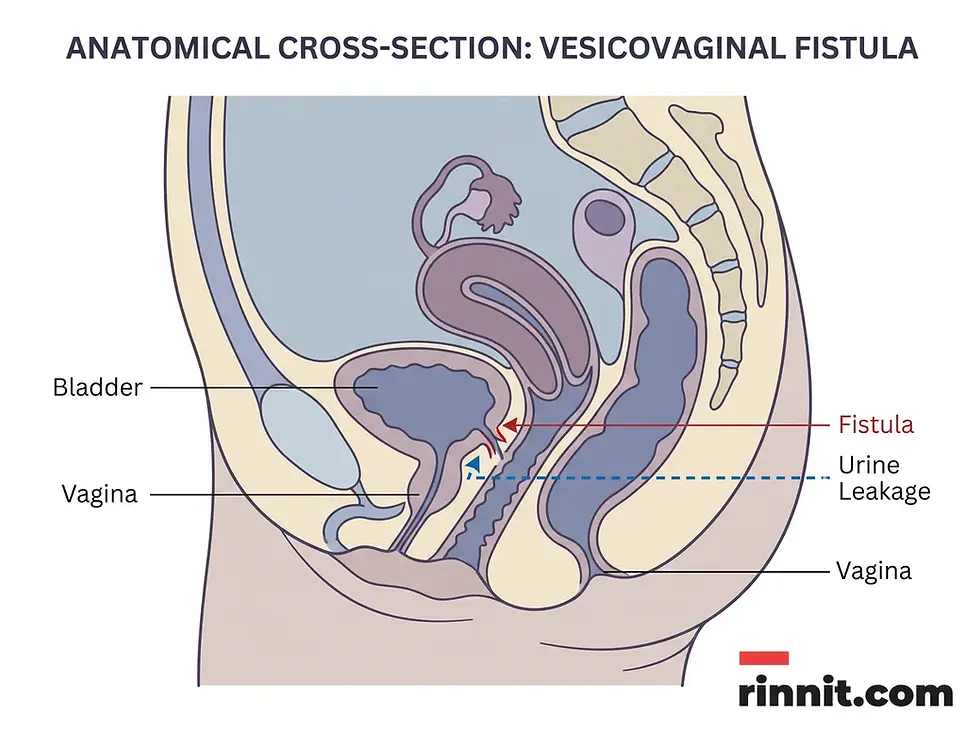
A vesicovaginal fistula (VVF) is an abnormal connection, or “shortcut,” between the bladder and the vagina. Normally, a wall of tissue separates these two organs. When that tissue is damaged to the point that it dies (necrosis), a hole forms and lets urine bypass the urethra and leak into the vagina. [1] You still pass urine through the urethra [1], but some of it takes the shortcut.
VVF is a physical health problem, but it often causes emotional distress and social isolation because of its symptoms. The good news is that VVFs are treatable, usually with surgery [1], and your healthcare team can help you find the treatment and support you need.
Identifying the Symptoms
Symptoms vary with the size of the opening and other factors. [1] The most common sign is leaking urine from the vagina, which can range from a light dribble to a steady stream.
Symptom | Description |
Urinary leakage | Leaking urine from the vagina, often mistaken for severe urinary incontinence. |
Constant wetness | A feeling of wetness in your underwear that persists even right after you use the bathroom. |
Vaginal discharge | Thin, watery, or foul-smelling discharge. |
Physical irritation | Irritation or soreness in the vagina or vulva. |
Painful intercourse | Pain or discomfort during sex (dyspareunia). [1] |
When to seek care: Tell a healthcare provider as soon as possible if you notice these symptoms, especially if leaking begins one to two weeks after pelvic surgery. [1]
Without treatment, a VVF can lead to complications such as an abscess or infection that could become life-threatening, recurrent urinary tract infections, and vaginal infections. [1] Living with a VVF can also affect your mental health and quality of life, so it is important to see a mental health specialist if it is causing distress or social isolation. [1]
Common Causes and Global Context
The most common cause of VVF depends on the medical resources available in a region. In the United States and other high-resource settings, it is most often accidental tissue damage during pelvic surgery, such as a hysterectomy or bladder surgery. [1]
In many parts of the world with fewer resources, the most common cause is obstructed childbirth. [1] During a long, difficult labor, pressure from the baby's head against the mother's pelvic bones can cut off blood flow to the surrounding tissue, which then dies and forms a fistula. Less commonly, bladder cancer, cervical cancer, or radiation treatment can lead to a VVF. [1]

Diagnostic Procedures
Diagnosis starts with a medical history, a physical exam, and a pelvic exam. [1] Your provider will also check that the leak is not coming from a ureter (the tube that carries urine from the kidney to the bladder), because a ureter leak needs a different treatment plan. [1] Tests that can confirm a fistula and help plan surgery include:
Dye test: the bladder is filled with blue fluid while a tampon is placed in the vagina. A tampon that turns blue suggests a bladder-to-vagina fistula. [1] You may also be given medicine that turns urine orange; orange without blue suggests a ureter-to-vagina fistula. [1]
Cystoscopy: a urologist uses a thin, lighted device to look inside the bladder.
CT urogram: an imaging test with contrast dye that shows detailed images of the bladder and the rest of the urinary system.
Other tests: a pelvic MRI or a speculum exam under anesthesia can help map a complex fistula.
Treatment and Surgical Recovery
A few small, very new fistulas may close with continuous bladder drainage through a Foley catheter for several weeks, but most need surgery. [1] The goal of surgery is to close the opening between the bladder and the vagina.
Your surgeon may operate through the vagina or the abdomen, sometimes using laparoscopic or robotic techniques, and you will decide together which approach is best for you. [1] After surgery, you will need a Foley catheter for two to three weeks to drain urine, and your provider will want to confirm that the fistula has healed before removing it. [1]

Recovery Guidelines
Recovery from fistula surgery takes about six to eight weeks, and you will need follow-up visits to make sure the fistula is healing. [1] Your provider will give you specific instructions. In general, you may be asked to avoid the following for six to eight weeks so the repair has time to heal:
Sexual intercourse.
Strenuous physical activity or exercise.
Heavy lifting of any kind.
Outlook
At centers that perform these repairs often, about 85% to 95% of people have no leakage after one surgery, and some need a second operation. [1] Your outlook depends on the size and severity of the fistula, its cause, your overall health, and the type of surgery. [1] Complex fistulas are generally harder to treat than simple ones. [1]
Conclusion
Vesicovaginal fistula is a challenging condition that affects both physical health and emotional well-being. With modern diagnostic tools and surgical techniques, most people can be treated successfully. Seeing a provider early, especially if leaking starts after pelvic surgery, is one of the most important steps toward a successful repair. By following your surgeon's recovery instructions and seeking support from healthcare professionals, you can work toward regaining control and getting back to your daily life.
Related reading: Urinary incontinence · Fistulas · Hysterectomy · Urinary tract infection · Foley catheter · Painful intercourse
Frequently Asked Questions
Can a vesicovaginal fistula heal on its own?
Only a few small, very new fistulas may close with continuous bladder drainage through a Foley catheter for several weeks. Most need surgery to close the opening.
Is surgery for VVF always successful?
At centers that perform these repairs often, about 85% to 95% of people have no leakage after one surgery. Some people need a second surgery, and complex fistulas are harder to treat than simple ones.
How soon after surgery can I return to work?
It depends on your job and on your surgeon's instructions. Recovery from fistula surgery can take six to eight weeks, and strenuous activity and heavy lifting are usually avoided during that time, so physically demanding jobs may need a longer break.
Will I still be able to have children after VVF repair?
In many cases, yes. Talk about your future pregnancy plans with your surgeon, who may recommend a Cesarean delivery to protect the repair.
Does the surgery leave a visible scar?
A repair through the vagina leaves no visible external scar. Laparoscopic or robotic surgery leaves a few small scars, and an open abdominal repair leaves a larger incision scar.
Can VVF cause infections?
Yes. A vesicovaginal fistula can lead to recurrent urinary tract infections (UTIs) and vaginal infections.
Is VVF a life-threatening condition?
The fistula itself is not usually life-threatening, but complications such as an abscess or infection could become life-threatening if left untreated.
What should I do if I notice leaking after a hysterectomy?
Contact your surgeon or a urologist as soon as possible. Leaking that starts one to two weeks after pelvic surgery is a possible sign of a vesicovaginal fistula.
How long do I need a catheter after surgery?
Most people need a Foley catheter for two to three weeks after surgery to drain the urine. Your provider will want to confirm that the fistula has healed before removing it.
Is emotional support available for people with VVF?
Yes. VVF can cause emotional distress and social isolation. Your healthcare team can connect you with resources, and a mental health specialist can help if the condition is affecting your well-being.
References
Cleveland Clinic. Vesicovaginal Fistula (VVF): Symptoms, Causes & Treatment. Cleveland Clinic. Last updated 10/16/2025. https://my.clevelandclinic.org/health/diseases/16442-vesicovaginal-fistula
Thompson JC, Halder GE, Jeppson PC, et al. Repair of vesicovaginal fistulae: a systematic review. Obstet Gynecol. 2024;143(2):229-241. PMID 38033311. https://doi.org/10.1097/AOG.0000000000005468
Jefferson FA, Hanson KT, Robinson MO, et al. Perioperative outcomes of vesicovaginal fistula repair by surgical approach. Urogynecology (Phila). 2024;30(2):114-122. PMID 37493226. https://doi.org/10.1097/SPV.0000000000001394
Zeleke LB, Welsh A, Abeje G, et al. Treatment outcomes of obstetrical fistula surgical repair in low- and middle-income countries: a scoping review. Int J Gynaecol Obstet. 2024;167(2):491-500. PMID 38881203. https://doi.org/10.1002/ijgo.15724
Medical disclaimer
This article is for educational purposes only and is not a substitute for professional medical advice, diagnosis, or treatment. Always seek the advice of your physician or other qualified health provider with any questions about a medical condition.



Comments