Vascular Ehlers-Danlos Syndrome: Understanding vEDS Risks and Care

Updated: 2 days ago
Medically reviewed by Dr. Baraa Alnahhal, MD · Last reviewed: October 2026
Vascular Ehlers-Danlos Syndrome (vEDS) is a rare and severe genetic disorder that compromises the strength of connective tissues, particularly in the arteries and internal organs. Caused by a mutation affecting collagen III, it places individuals at high risk for spontaneous arterial ruptures and organ injuries [1]. While no cure exists, proactive medical monitoring, genetic counseling, and lifestyle adjustments are essential for managing complications and improving long-term outcomes.
Quick Answer
Vascular Ehlers-Danlos syndrome (vEDS) is a life-threatening genetic condition caused by a mutation in the gene for collagen III, leading to extremely fragile arteries and organs [1]. Signs include thin, translucent skin, easy bruising and distinctive facial features. Genetic testing confirms it [1]. Management focuses on monitoring for aneurysms and avoiding high-risk activities such as contact sports.
What the research says
Pregnancy carries substantial risk. A systematic review of 6 publications covering 412 pregnancies in women with vEDS found a miscarriage rate of 13.8% (57/412), 8.8% of live births were premature, and the maternal mortality rate was 5.7% per pregnancy; the authors note the peripartum period carries the highest risk and recommend a caesarean section scheduled at 37 weeks to avoid expulsive efforts (Haem et al., BJOG, 2024) [2].
Emergency care is deliberately cautious, and prevention rests on celiprolol. A 2026 multidisciplinary clinical review reports a median survival near 51 years, advises avoiding catheter angiography, elective endoscopy and unnecessary surgery in emergencies, and notes that first randomized evidence in 2025 supports irbesartan added to background celiprolol; it concludes that earlier recognition and avoiding iatrogenic harm offer the largest near-term gains (Corrao et al., J Intern Med, 2026) [3].
What is Vascular Ehlers-Danlos Syndrome?
Ehlers-Danlos syndrome (EDS) encompasses a group of 13 distinct genetic disorders that primarily affect the body's connective tissues, such as ligaments, tendons, and cartilage [1]. Vascular EDS, clinically classified as Type IV, is among the rarest and most severe forms of the condition. It is characterized by extreme fragility in the circulatory system and internal organs, which can lead to life-threatening complications without warning.
Statistically, vEDS is exceptionally rare, affecting approximately 1 in every 200,000 to 250,000 individuals globally [1]. Because it impacts the fundamental structural integrity of the body, those with the condition are prone to severe internal bleeding and injuries from relatively minor physical stress.

Figure 1: Anatomical illustration of vascular Ehlers-Danlos syndrome, highlighting fragile arterial structures and affected internal organs.
Genetic Causes and Inheritance Patterns
The underlying cause of vascular EDS is a mutation in the gene that provides instructions for producing collagen III. This protein is a vital building block that ensures various tissues and structures throughout the body remain strong and durable. When this gene is mutated, the body either produces insufficient amounts of collagen III or creates flawed versions that cannot properly support facial tissues, arteries, and organs [1].
Vascular EDS follows an autosomal dominant inheritance pattern. This means that a person only needs to inherit one copy of the mutated gene from one parent to develop the disorder. A parent with vEDS has a 50% chance of passing the mutation to each of their children [1]. In some cases, the mutation occurs spontaneously (de novo) in individuals with no family history of the condition [1].
Identifying Symptoms and Physical Markers
The symptoms of vascular EDS are diverse, affecting the skin, facial structure, and internal systems. Many of these physical markers are present from birth or early childhood, though the internal risks often become more acute as the individual reaches adulthood.
Skin and Facial Characteristics
Individuals with vEDS often have thin, translucent skin that appears delicate, making underlying veins highly visible [1]. Premature aging of the skin on the hands and feet is also common [1]. Distinctive facial features frequently include unusually thin lips and a narrow nose, a small chin, and eyes that are large and set far apart. Small or absent earlobes and ears that stick out are also clinical indicators [1].
Circulatory and Systemic Issues
Circulatory problems are a hallmark of the condition, including easy bruising and the development of varicose veins at an unusually young age [1]. High blood pressure (hypertension) and heart valve issues, such as mitral valve prolapse, occur frequently. The most dangerous symptoms involve arterial injuries, such as dissections (tearing of the artery wall), which can lead to aneurysms or sudden ruptures [1].

Figure 2: Clinical symptoms of vEDS, including skin translucency, facial features, and internal vascular risks.
Diagnostic Procedures and Testing
Diagnosis often begins with a thorough review of a patient's medical and family history, followed by a physical examination to identify characteristic markers. Because vEDS is so rare, healthcare providers may first perform tests like echocardiograms or CT scans to rule out other blood or connective tissue disorders [1].
However, the only definitive way to confirm a diagnosis of vascular Ehlers-Danlos syndrome is through genetic testing [1]. This identifies the specific mutations associated with collagen III production. Early diagnosis is critical for establishing a long-term monitoring plan and educating the patient and their family on emergency protocols.
Management and Lifestyle Adjustments
Vascular EDS is a lifelong, incurable condition [1]. Therefore, the focus of medical care is on minimizing the impact of symptoms and preventing catastrophic complications through rigorous monitoring.
Medical Monitoring
Patients require regular screenings to detect the formation of aneurysms before they rupture [1]. While surgery may be necessary to repair internal injuries or aneurysms, it carries a high risk because the tissues are so fragile, making recovery more difficult [1]. Specialized care is especially important during pregnancy, which carries a high risk of life-threatening complications such as uterine rupture or severe bleeding [1].
Daily Management Strategies
Activity Restrictions: Avoid contact sports, heavy lifting, or any activity with a high risk of physical injury [1].
Blood Pressure Control: Maintaining healthy blood pressure levels is essential to reduce strain on fragile arteries.
Emergency Preparation: Patients should have clear protocols for seeking immediate care if they experience unexplained severe pain.
Genetic Counseling: Essential for families to understand inheritance risks and plan for future generations.
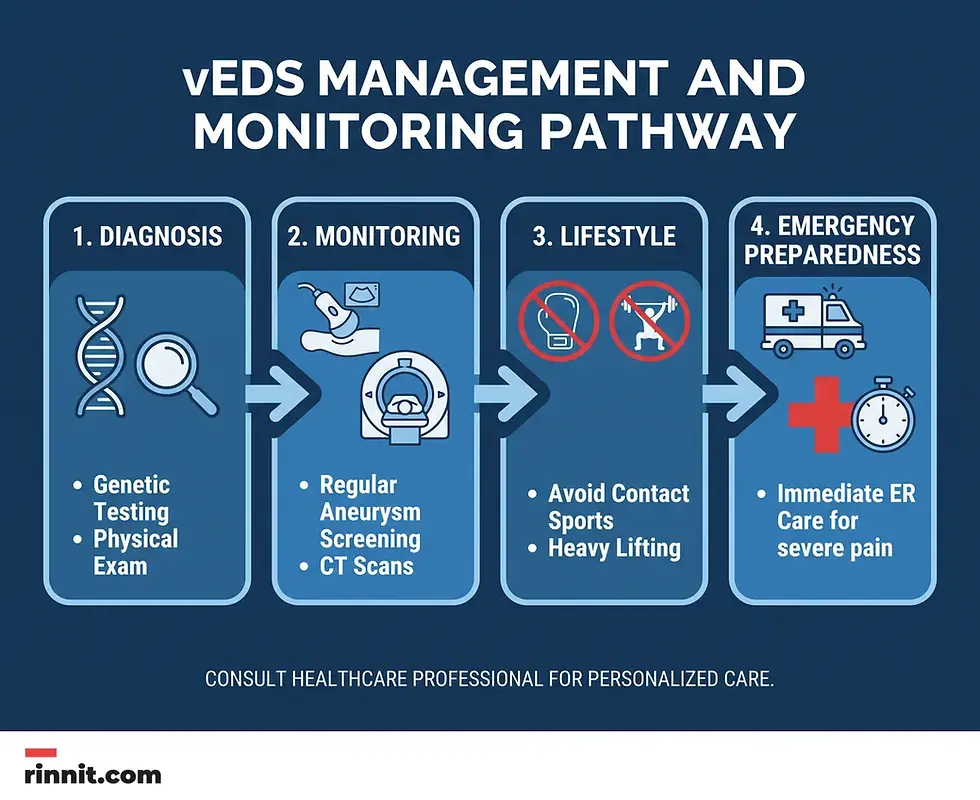
Figure 3: Recommended management pathway for vEDS, focusing on monitoring, lifestyle adjustments, and emergency care.
Prognosis and Long-Term Outlook
The outlook for individuals with vascular EDS is shaped by the high risk of internal complications. Statistically, about 1 in 4 people with the condition will have a first major complication by age 20, and the risk of a life-threatening event increases to 80% by age 40 [1].
Despite these risks, advancements in medical understanding and surgical techniques mean that outcomes are improving. Half of the people diagnosed with vEDS now live to at least about age 48 to 51 [1]. Close collaboration with a multidisciplinary medical team is the most effective way to manage the condition and improve quality of life.
Conclusion
Vascular Ehlers-Danlos syndrome is a complex and high-risk genetic condition that requires a lifelong commitment to specialized medical care. By understanding the underlying genetic causes and identifying physical symptoms early, patients can implement vital management strategies to mitigate risks. Through regular monitoring for aneurysms, lifestyle modifications to avoid injury, and emergency preparedness, individuals with vEDS can work toward better outcomes.
Clinical Urgency: Seek immediate emergency medical attention if you experience sudden, unexplained severe pain in your chest or abdomen, as these can be signs of a life-threatening arterial or organ rupture.
Frequently Asked Questions
Is vascular Ehlers-Danlos syndrome curable?
No. As a genetic condition, vEDS is a lifelong disorder. Current medical care focuses on managing symptoms and preventing complications rather than providing a cure.
How is vEDS different from other types of EDS?
While all EDS types affect connective tissue, vEDS (Type IV) specifically targets the structural integrity of the vascular system and internal organs, making it the most life-threatening form.
Can vEDS be prevented?
Because it is genetic, there is no way to prevent the development of vEDS. However, genetic counseling can help families understand the risks before having children.
What should I do in an emergency?
If you have vEDS and experience unexplained, severe pain in the chest or abdomen, or have a wound with heavy bleeding, seek emergency medical attention immediately.
Why is surgery risky for vEDS patients?
The extreme fragility of the tissues makes it difficult for surgeons to perform repairs, and the risk of severe bleeding during and after the procedure is significantly higher than in the general population.
Are there specific facial features associated with vEDS?
Yes. Common features include thin lips, a narrow nose, large eyes, a small chin, and ears that may lack lobes or stick out prominently.
Can people with vEDS have children?
Yes, but pregnancy is considered extremely high-risk due to the potential for uterine rupture and severe internal bleeding. Specialized maternal-fetal medicine is required.
Is vEDS always inherited?
Not always. While many people inherit the mutation from a parent, it can also occur spontaneously in individuals with no family history of the disorder.
What activities should be avoided?
High-impact activities, contact sports (like football or wrestling), and heavy weightlifting should be avoided to minimize the risk of arterial or organ injury.
How common is vEDS?
Vascular Ehlers-Danlos syndrome (vEDS) is extremely rare, affecting only about 1 in 200,000 to 250,000 people.
Related Reading
Ehlers-Danlos Syndrome: Symptoms, Causes, and Treatment explains the full group of Ehlers-Danlos syndromes and their care.
Aortic Dissection: Emergency Warning Signs, Types, Diagnosis & Treatment explains a tear in the aorta and its emergency warning signs.
Understanding Loeys-Dietz Syndrome: A Comprehensive Guide to Connective Tissue Health covers another genetic condition that weakens blood vessel walls.
Marfan Syndrome: Symptoms, Causes, and Management Strategies explains a related connective tissue disorder that affects the aorta.
References
Cleveland Clinic. Vascular Ehlers-Danlos Syndrome. Cleveland Clinic. Accessed October 11, 2026. https://my.clevelandclinic.org/health/diseases/22696-vascular-ehlers-danlos-syndrome
Haem T, Benson B, Dernoncourt A, et al. Vascular Ehlers-Danlos syndrome and pregnancy: A systematic review. BJOG. 2024;131(12):1620-1629. PMID 38926786. https://doi.org/10.1111/1471-0528.17893
Corrao S, Ruggeri MI, Benedetto AD, et al. Vascular Ehlers-Danlos syndrome: A multidisciplinary clinical framework for early suspicion, emergency-safe management and lifelong care. J Intern Med. 2026. PMID 42798186. https://doi.org/10.1111/joim.70165
Medical disclaimer
The information provided in this article is for educational purposes only and should not be used as a substitute for professional medical advice, diagnosis, or treatment. Always seek the advice of your physician or other qualified health provider with any questions you may have regarding a medical condition.



Comments