Understanding Your Deltoid Muscles: Anatomy, Function, and Care

Updated: 1 day ago
Medically reviewed by Dr. Baraa Alnahhal, MD · Last reviewed: October 2026
The deltoid muscles are essential skeletal muscles that crown the shoulder, enabling a wide range of arm movements. Composed of three distinct "heads"—anterior, lateral, and posterior [1]—they facilitate lifting, rotating, and stabilizing the shoulder joint. While common in athletes and overhead workers, deltoid injuries like strains or tendonitis [1] can affect anyone, causing pain and restricted mobility. Understanding their anatomy is key to effective treatment and long-term shoulder health.
Quick Answer: What are the deltoid muscles?
The deltoid muscles are the large, triangular muscles covering the top of the shoulder joint, divided into anterior, lateral and posterior heads that each move the arm in a different direction [1]. They power movements like reaching overhead or pitching a ball and stabilize the shoulder to help prevent dislocations [1]. Healthy deltoids are vital for upper-body mobility and strength.
What the research says
Shoulder pain is common. A systematic review of 61 studies found a median community prevalence of shoulder pain of 16% (range 0.67–55.2%) and an incidence of 7.7 to 62 per 1,000 persons per year, with estimates generally higher in women than in men (Lucas et al., BMC Musculoskelet Disord, 2022) [2].
Exercise improves shoulder pain, function and range of motion. In 21 randomized trials with 1,152 middle-aged and older adults with rotator cuff-related shoulder pain, exercise programs significantly improved pain, function and range of motion, while the gain in strength was not statistically significant; results varied widely between studies (Vico-Rodríguez et al., BMC Musculoskelet Disord, 2026) [3].
Physical therapy outperformed hyaluronic acid injections for tendon-related shoulder pain. A network meta-analysis of 14 studies in adults with chronic shoulder pain found that physical therapy gave greater pain control than injected hyaluronic acid in shoulder tendinopathy (at rest, at night and during activity, at both 3 and 6 months), and the authors called for further high-quality studies (Marra et al., Arch Phys Med Rehabil, 2026) [4].
Decompression surgery for shoulder pain did no better than placebo surgery. In a UK trial of 313 people with long-lasting subacromial shoulder pain, decompression surgery gave similar shoulder scores to a placebo keyhole operation at 6 months (32.7 vs 34.2 points out of 48). Both did slightly better than no treatment, but not by a clinically important amount (Beard et al., Lancet, 2018) [5].
Decompression surgery gave no benefit over placebo surgery at 2 years. In a Finnish trial of 210 people with shoulder impingement, decompression surgery gave no benefit over diagnostic (placebo) arthroscopy at 2 years. Differences compared with exercise therapy were below the threshold that patients would notice as meaningful (Paavola et al., BMJ, 2018) [6].
Anatomy and Structure of the Deltoids
The deltoid muscle gets its name from its resemblance to an upside-down triangle (the Greek letter Delta). It is a superficial muscle, meaning it sits just beneath the skin [1] and provides the rounded contour of the shoulder. The muscle is attached to the collarbone (clavicle) and shoulder blade (scapula) at its base, while its point connects to the upper arm bone (humerus) [1].
The deltoid is uniquely structured with three separate sections, or heads, each performing a specialized role in arm movement. These heads work together to ensure the shoulder joint remains stable while carrying weight or performing complex motions.
Deltoid Head | Location | Primary Movement |
Anterior | Front of shoulder | Moving arm forward (flexion) |
Lateral | Side of shoulder | Raising arm to the side (abduction) |
Posterior | Back of shoulder | Moving arm backward (extension) |
Vital Functions of the Deltoid Muscles
The primary purpose of the deltoid muscles is to move the arms in multiple directions while protecting the delicate ball-and-socket joint of the shoulder. They work in tandem with the rotator cuff muscles [1] to provide both power and precision during physical activity.
Beyond movement, the deltoids are critical for joint stabilization. They help keep the humerus securely in the shoulder socket, especially when lifting heavy objects or carrying weight at your sides [1]. If a rotator cuff injury occurs, the deltoids often compensate by providing additional strength to maintain arm function [1].

Figure 1: The anterior, lateral, and posterior deltoid heads work together to move the arm in multiple directions at the shoulder.
Common Conditions and Injuries
Deltoid injuries are frequent among individuals who perform repetitive overhead movements, such as swimmers, pitchers, and weightlifters [1]. A common issue is a deltoid strain, which occurs when the muscle fibers are overstretched or torn. This can happen suddenly during heavy lifting or develop gradually through overuse.
Other conditions like frozen shoulder (adhesive capsulitis) and bursitis can cause significant stiffness and inflammation around the deltoid [1]. Additionally, axillary nerve palsy can lead to weakness or numbness in the shoulder if the nerve supplying the deltoid is compressed or damaged.

Figure 2: Pain, swelling, and a limited range of motion are key indicators of deltoid muscle conditions.
Diagnosis and Recovery
To diagnose a deltoid issue, healthcare providers typically perform a physical exam to test the muscle's strength and range of motion [1]. In some cases, imaging tests like MRIs or ultrasounds are used to identify tissue tears or inflammation. Most deltoid injuries respond well to nonsurgical treatments [1], such as physical therapy, rest, and ice.
For severe tears, surgical intervention may be necessary. Procedures like arthroscopic shoulder surgery allow doctors to repair damaged tissue with minimal invasiveness [1]. Consistent shoulder exercises and proper warm-ups are the best ways to prevent future injuries and maintain deltoid flexibility.
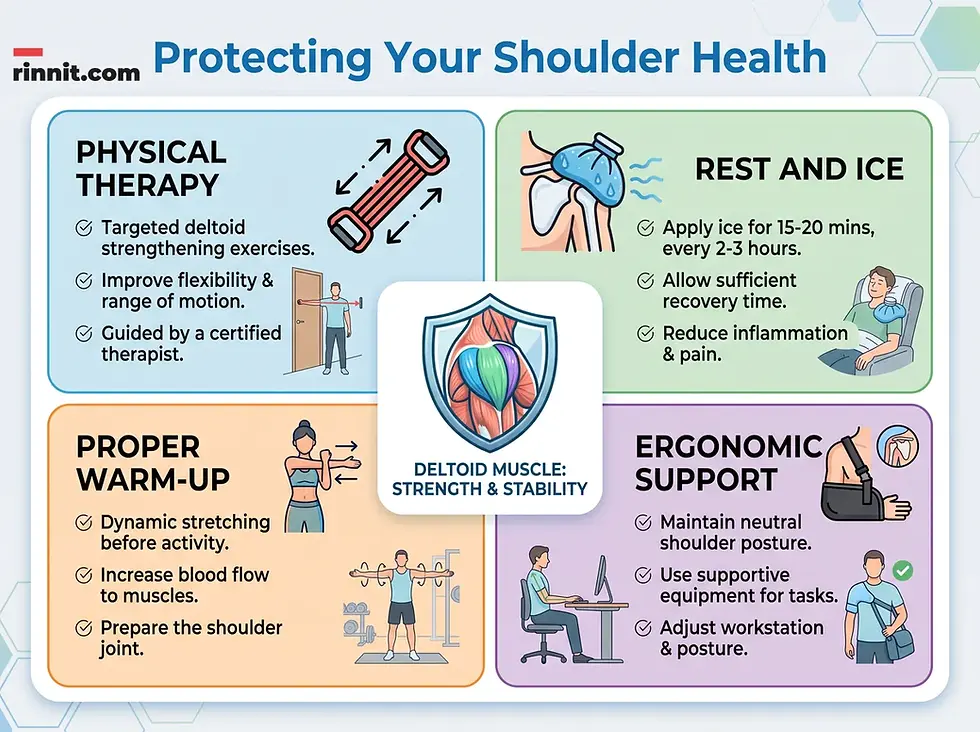
Figure 3: Stretching, strengthening exercises, and proper rest are essential for maintaining deltoid health.
Conclusion
The deltoid muscles are the cornerstones of shoulder mobility, providing the strength needed for everything from daily reaching to professional sports. By understanding the anatomy of the three deltoid heads and recognizing the signs of injury, you can take proactive steps to protect your shoulders. Maintaining strong, flexible deltoids is a key component of lifelong physical health and upper-body performance.
If you are experiencing persistent shoulder pain or find it difficult to lift your arm, consult an orthopaedic specialist. A personalized physical therapy plan can help you regain strength and prevent minor strains from becoming chronic issues.
Frequently Asked Questions
What are the deltoid muscles?
The deltoids are the three-headed muscles that cover the top of the shoulder joint and power arm movement.
Where are the deltoids located?
The deltoids crown the shoulder, connecting the collarbone and shoulder blade to the upper arm bone.
What is the function of the anterior deltoid?
The anterior (front) deltoid is primarily responsible for moving your arm forward, such as when reaching for an object.
Can a deltoid injury cause numbness?
Yes, if the axillary nerve is affected, you may experience numbness or tingling around the deltoid muscle.
What is a deltoid strain?
A strain occurs when the muscle fibers in the deltoid are overstretched or torn due to sudden impact or overuse.
How do doctors diagnose deltoid issues?
Providers use physical exams, movement tests, and imaging like MRIs or ultrasounds to diagnose injuries.
What is frozen shoulder?
Also known as adhesive capsulitis, it is a condition where the shoulder joint capsule becomes thick and stiff, causing pain.
Who is most at risk for deltoid injuries?
Athletes who perform repetitive overhead motions, such as swimmers and pitchers, are at higher risk.
What is the best treatment for a minor delt strain?
Most minor strains heal with rest, ice, and physical therapy to restore strength and mobility.
Does the deltoid help stabilize the shoulder?
Yes, it works to keep the arm bone securely in the shoulder socket, preventing dislocations.
Related Reading
Shoulder Joint: Anatomy, Function, and Common Conditions explains how the shoulder joint works and its common problems.
Rotator Cuff Tear: Symptoms, Causes, and Recovery Guide covers rotator cuff tear symptoms, treatment and recovery time.
Frozen Shoulder (Adhesive Capsulitis): Symptoms, Causes & Treatment — Complete Guide explains why the shoulder stiffens and how frozen shoulder is treated.
Dislocated Shoulder: Symptoms, First Aid, Treatment & Recovery — Complete Guide covers first aid, treatment and rehab after a shoulder dislocation.
References
Cleveland Clinic. Deltoid Muscles. Cleveland Clinic. Last updated September 24, 2021. https://my.clevelandclinic.org/health/body/21875-deltoid-muscles
Lucas J, van Doorn P, Hegedus E, Lewis J, van der Windt D. A systematic review of the global prevalence and incidence of shoulder pain. BMC Musculoskelet Disord. 2022;23(1):1073. PMID 36476476. https://doi.org/10.1186/s12891-022-05973-8
Vico-Rodríguez P, Aibar-Almazán A, Hita-Contreras F, et al. Exercise interventions for rotator cuff-related shoulder pain in middle-aged and older adults: a systematic review and meta-analysis. BMC Musculoskelet Disord. 2026;27(1). PMID 42260441. https://doi.org/10.1186/s12891-026-10035-4
Marra A, de Siena AU, Iacovazzo C, et al. Comparison of the efficacy of hyaluronic acid versus corticosteroids, platelet-rich plasma, and physical therapy in chronic shoulder pain: a systematic review and a frequentist network meta-analysis. Arch Phys Med Rehabil. 2026;107(10):2991-3001. PMID 42069289. https://doi.org/10.1016/j.apmr.2026.04.026
Beard DJ, Rees JL, Cook JA, et al. Arthroscopic subacromial decompression for subacromial shoulder pain (CSAW): a multicentre, pragmatic, parallel group, placebo-controlled, three-group, randomised surgical trial. Lancet. 2018;391(10118):329-338. PMID 29169668. https://doi.org/10.1016/S0140-6736(17)32457-1
Paavola M, Malmivaara A, Taimela S, et al. Subacromial decompression versus diagnostic arthroscopy for shoulder impingement: randomised, placebo surgery controlled clinical trial. BMJ. 2018;362:k2860. PMID 30026230. https://doi.org/10.1136/bmj.k2860
Medical disclaimer
The information provided in this article is for educational purposes only and should not be used as a substitute for professional medical advice, diagnosis, or treatment. Always seek the advice of your physician or other qualified health provider with any questions you may have regarding a medical condition.



Comments