Understanding Vellus Hair (Peach Fuzz)

Updated: 2 days ago
Medically reviewed by Dr. Baraa Alnahhal, MD · Last reviewed: October 2026
Vellus hair, commonly called "peach fuzz," is the thin, fine, short hair that grows on most of the body. It helps regulate body temperature and protects the skin [1], and its amount and appearance depend on genetics, age and hormone levels [1]. Excess vellus hair can sometimes point to a health condition such as Cushing syndrome [1]. If you do not like how it looks, several safe removal methods exist.
Quick Answer
Vellus hair is thin, light hair that grows on most of the body, including the face, arms, legs and trunk, but not the palms, soles, lips or eyelids [1]. It insulates, wicks sweat, protects the skin and helps sense light touch [1]. At puberty, androgens turn some into terminal hair [1]. A noticeable increase is worth discussing with a provider.
What the research says
Hypertrichosis and hirsutism are different. A review of inherited hypertrichosis explains that hypertrichosis is excess hair in amount and thickness on any part of the body, localized or generalized and congenital or acquired, whereas hirsutism is excess hair growth in androgen-dependent areas such as the upper lip, chin, chest, thigh and armpit (Buch and Ranganath, Indian Journal of Dermatology, Venereology and Leprology, 2021) [2].
Cushing syndrome is rare but easy to miss in young women with excess hair. A review reports an incidence of 0.7-2.4 per million people per year and notes that Cushing syndrome is remarkably prevalent among young females, who can present with menstrual irregularities or signs of hyperandrogenism such as hirsutism (Ferraù et al., Journal of Endocrinological Investigation, 2025) [3].
Dihydrotestosterone (DHT) drives follicle shrinkage in androgenic hair loss. A systematic umbrella review of 43 articles found that dermal papilla cells consistently express high levels of androgen receptor and 5α-reductase type II, and that DHT activation in these cells leads to hair follicle miniaturization (Yu et al., Cell Transplantation, 2026) [4].
What Is Vellus Hair?
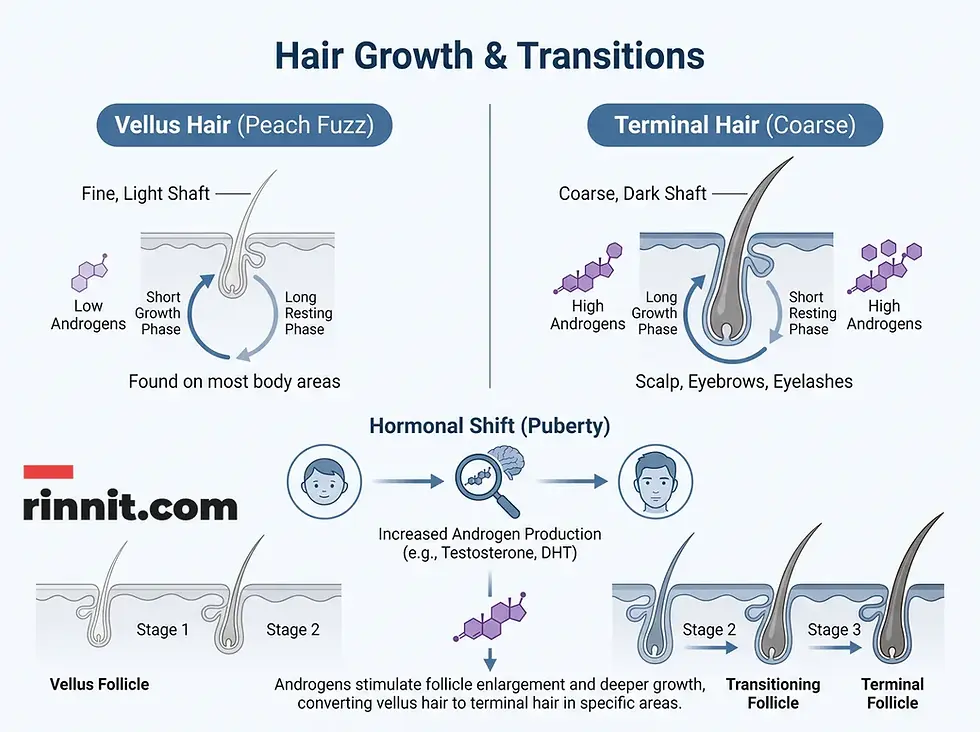
Vellus hair is thin, fine hair that grows on most of your body. It is different from the thicker, longer hair on your scalp, which healthcare providers call terminal hair [1]. For most people, vellus hair is thin, fine and wispy, shorter and lighter than terminal hair, ranging in color from light blonde to dark brown. Its length, thickness and color vary from person to person [1].
Area | Where Vellus Hair Usually Appears |
Arms, shoulders, legs | Arms, shoulders, legs, hips and buttocks [1] |
Face | Face, forehead, nose and earlobes [1] |
Trunk | Neck, chest, breasts, back, stomach and torso [1] |
Hands and feet | Tops of the knuckles on fingers and toes [1] |
Where it does not grow | Soles of the feet, palms of the hands, lips and eyelids [1] |
Functions of Vellus Hair
These tiny hairs do important work all over the body:
Function | Description |
Thermoregulation | Provides insulation to keep the skin warm and helps wick away sweat, which cools you off and helps you avoid heat illness |
Protection | Helps protect your skin as a minor barrier [1] |
Sensory perception | Helps you feel light objects against your skin [1] |
Goosebumps | Allows you to feel goosebumps when you get them [1] |

Vellus Hair vs. Terminal Hair
The hair on your scalp is terminal hair. It is thicker and coarser than vellus hair, grows longer and is usually darker [1]. After puberty, terminal hair also tends to grow on the armpits, the pubic area and, in males and some females, the face [1].
Development and Transitions
Puberty and Hormones
During puberty, your endocrine system produces more of a type of hormone called androgens. This increase causes vellus hair on some parts of the body to change to terminal hair [1]. In the pubic area and armpits it becomes darker and coarser [1]. In males, and some females, vellus hair on the upper lip and beard area darkens and thickens, and hair on the upper back, chest, knuckles, arms and legs grows longer [1].
Aging and Genetics
The appearance of vellus hair and the amount you have depend on your genetics, age and hormone levels [1]. Vellus hairs usually shorten or fall out as you age, so children and young adults have more vellus hair than older adults [1].
Conditions Associated With Abnormal Vellus Hair
In some cases, the amount and appearance of vellus hair can be a sign of a health condition. Conditions associated with abnormal vellus hair growth include:
Cushing syndrome, which causes excessive vellus hair growth on the face, neck, chest, belly, breasts and legs [1]
Hypertrichosis, which causes excessive vellus hair growth all over the body and can result from a range of disorders and medications [1]
Hirsutism, which causes coarse terminal hair to grow on parts of the body that usually have peach fuzz [1]
Eruptive vellus hair cysts, which result from a rare abnormality of vellus hair follicles and appear as red or brown bumps, usually on the chest, forearms and trunk, more often in adolescents and young adults [1]
Male pattern baldness, in which dihydrotestosterone (DHT) damages hair follicles so that terminal hair turns into vellus hair, leading to thinning and loss [1]. Hair loss in women can also result from hormone changes [1]
Some medications, including chemotherapy drugs, which can cause terminal hair to fall out or change to vellus hair [1]. It may be possible for vellus hair to change back when the medication is stopped [1]
Lanugo vs. Vellus Hair
People with eating disorders such as anorexia nervosa and bulimia nervosa may grow a type of hair called lanugo on skin all over the body, which results from lack of nutrition [1]. Lanugo is slightly thicker and more fur-like than vellus hair [1]. It also grows on babies in the uterus as part of fetal development and falls out shortly after birth [1].

When to See a Healthcare Provider
If you notice an increase in vellus hair, see your healthcare provider, because excessive vellus hair growth can be a sign of a medical condition [1].
Removal and Care
There is no medical reason to remove normal vellus hair, but you can remove it if you do not like the way it looks. Several methods are effective [1], and you can talk to your healthcare provider about the best option for you:
Depilatory creams and shaving remove hair at the skin's surface. For facial peach fuzz, use depilatory creams made for the face, because creams for body hair are too strong and can cause damage [1]
Dermaplaning is a procedure that removes the skin's top layer [1]
Electrolysis removes hair permanently [1]
Threading uses fine threads to pluck several vellus hairs out at the root [1]
Waxing uses hot, sticky wax and a cloth to pull hairs from their follicles [1]
Never bleach vellus hair. Bleaching can damage your skin and cause permanent changes in skin tone [1].
Peach fuzz does not grow back thicker after you remove it. New hairs can seem thicker because the top part of each new hair has to push through the skin's surface as it grows back, but they feel softer as they grow [1].
Conclusion
Vellus hair is a normal part of the skin that helps regulate temperature, protect the skin and sense the world around you. Its amount changes with age and hormones, and in most people it is entirely harmless. Whether you keep it for its functions or remove it for cosmetic reasons, pay attention to sudden increases in vellus hair, because they can be a sign of a hormonal or other medical condition worth checking with your provider.
Frequently Asked Questions
What is vellus hair?
Vellus hair, often called peach fuzz, is the thin, fine, short hair that grows on most of the body. It is usually lighter and shorter than terminal hair.
Does vellus hair grow back thicker after shaving?
No. New vellus hairs can seem thicker after shaving or removal because the top part of the new hair has to push through the skin's surface as it grows back, but they are not thicker and feel softer as they grow.
Where does vellus hair not grow?
Vellus hair does not grow on the soles of the feet, the palms of the hands, the lips or the eyelids.
What is the difference between vellus and terminal hair?
Vellus hair is thin, fine and usually lighter and shorter. Terminal hair, such as the hair on your scalp, is thicker, coarser, longer and usually darker.
Why do I have more peach fuzz than others?
The amount and appearance of vellus hair depend on your genetics, age and hormone levels. Children and young adults have more vellus hair than older adults.
Can vellus hair turn into terminal hair?
Yes. During puberty, rising androgen hormone levels change vellus hair in areas such as the pubic area and armpits into darker, coarser terminal hair.
Is excessive vellus hair a sign of a health problem?
Excessive vellus hair can be. Excess vellus hair can be a sign of conditions such as Cushing syndrome or hypertrichosis, so see your healthcare provider if you notice an increase in vellus hair.
What is lanugo?
Lanugo is a fine, fur-like hair slightly thicker than vellus hair. It grows on babies in the uterus and falls out shortly after birth, and it can grow on people with eating disorders because of a lack of nutrition.
Is dermaplaning a good way to remove peach fuzz?
Dermaplaning removes the skin's top layer along with the hair and is one of several effective options. Talk to your healthcare provider about which method is best for you.
Should I bleach my peach fuzz?
No. Never try to bleach vellus hair, because bleaching can damage your skin and cause permanent changes in skin tone.
Related Reading
Hirsutism: Causes, Symptoms, and the Treatment Options That Work explains excess coarse hair growth in women and its hormonal causes.
Hypertrichosis: A Comprehensive Guide to Causes, Symptoms, and Management covers abnormal extra hair growth anywhere on the body and its management.
Lanugo: The Protective Fine Hair of Fetal Development describes the fine fetal hair and why it can appear in adults.
Hair Loss in Women: What It Is, Why It Happens, and How It's Treated explains common causes of hair thinning in women and treatment options.
References
Cleveland Clinic. Vellus Hair (Peach Fuzz). Cleveland Clinic. Last updated May 24, 2022. https://my.clevelandclinic.org/health/body/23098-vellus-hair-peach-fuzz
Buch J, Ranganath P. Approach to inherited hypertrichosis: A brief review. Indian Journal of Dermatology, Venereology and Leprology. 2021;88(1):11-21. PMID 34379956. https://doi.org/10.25259/IJDVL_629_20
Ferraù F, Alessi Y, Nista F, et al. "Who and how to screen for endogenous hypercortisolism among young women presenting with clinical hyperandrogenism and/or menstrual abnormalities". Journal of Endocrinological Investigation. 2025;48(Suppl 1):83-89. PMID 39982685. https://doi.org/10.1007/s40618-025-02537-0
Yu S, Ji J, Wu Y, et al. The central role of fibroblasts in androgenic alopecia: A systematic umbrella review. Cell Transplantation. 2026;35:9636897261468231. PMID 42439449. https://doi.org/10.1177/09636897261468231
Medical disclaimer
The information provided in this article is for educational purposes only and should not be used as a substitute for professional medical advice, diagnosis, or treatment. Always seek the advice of your physician or other qualified health provider with any questions you may have regarding a medical condition.



Comments