Hypertrichosis: A Comprehensive Guide to Causes, Symptoms, and Management

Updated: 2 days ago
Medically reviewed by Dr. Baraa Alnahhal, MD · Last reviewed: October 2026
Quick Answer
Hypertrichosis, sometimes called werewolf syndrome, is excessive hair growth on the body or face, regardless of age or gender. It may be congenital or acquired later and is caused by genetics, certain medications or underlying health conditions. Diagnosis involves a physical exam, family history, blood tests and genetic testing. Management includes laser hair removal, electrolysis, medications and treating causes. [1]
What the research says
Hypertrichosis must be told apart from hirsutism, and treatment is tailored. A review of inherited hypertrichosis stresses distinguishing it from hirsutism (excess hair in androgen-dependent areas), customizing treatment to the area, amount and age of the patient, and using multidisciplinary care when it is part of a syndrome. (Buch & Ranganath, Indian Journal of Dermatology, Venereology and Leprology, 2021)
Laser hair removal rarely makes hair worse. In a meta-analysis of 9,733 patients treated with lasers or intense pulsed light, paradoxical hypertrichosis occurred in about 3% (95% CI 1–6%), almost always on the face or neck, and in only 0.08% of non-facial and non-neck cases. (Snast et al., American Journal of Clinical Dermatology, 2021)
Medication-triggered hair growth can reverse when the exposure stops. In a case report, a 9-month-old girl exposed to her grandfather's 5% topical minoxidil developed generalized hypertrichosis, and her hair distribution returned to normal 4 months after the minoxidil was removed from her environment. (Farsani et al., Pediatric Dermatology, 2014)
What is hypertrichosis?
Hypertrichosis is a rare medical condition that causes an abnormal amount of hair growth over the body. Unlike common hair growth, this condition involves hair appearing in areas where it is not typically found or growing at an accelerated rate. It can affect individuals of any gender and age, and the hair can vary from fine, light "peach fuzz" (vellus hair) to thick, dark terminal hair. Because of its distinct appearance, it is sometimes colloquially referred to as "werewolf syndrome." [1]
It is important to distinguish hypertrichosis from hirsutism. While hypertrichosis can affect anyone and appear anywhere on the body, hirsutism specifically affects females and follows a male-pattern hair growth distribution, such as on the chin or chest, often due to hormonal imbalances. [1]
Classification and types of hypertrichosis

Healthcare providers categorize hypertrichosis based on its location, the time of onset, and the type of hair produced.
Category | Type | Description |
Location | Generalized | Hair growth occurs all over the body. |
Location | Localized | Extra hair is restricted to specific patches or areas. |
Onset | Congenital | The condition is present at the time of birth. |
Onset | Acquired | Excessive hair growth develops later in life. |
Hair type | Vellus | Soft, fine, and light-colored hair, often called "peach fuzz." |
Hair type | Terminal | Thicker, darker, and more prominent hair. |
Hair type | Lanugo | Fine hair normally found on fetuses that persists after birth. |
Recognizing the symptoms
The primary symptom is visible hair growth that exceeds what is considered normal for an individual's age, gender, or ethnic background.
Unusual locations: Thick or dark hair may appear on the face, back, arms, forehead, or even inside the ears and nose.
Rapid growth: Hair may grow significantly faster than scalp hair and may not fall out according to normal cycles.
Dense patches: Some individuals develop thick patches of hair on specific joints, such as the elbows or shoulders.
Congenital signs: In rare genetic cases, hypertrichosis may be accompanied by dental differences, such as thick gums, or structural bone changes like a curved spine. [1]
Common causes and risk factors
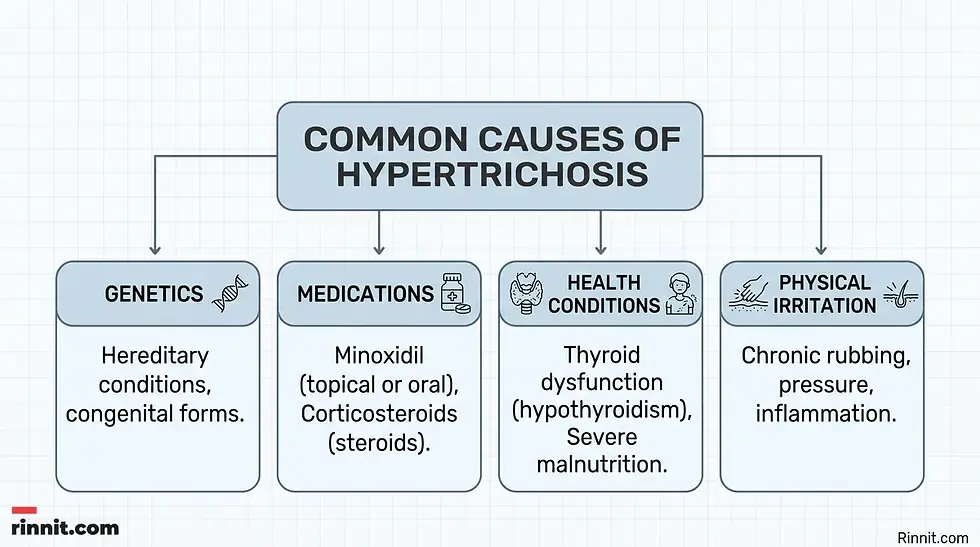
The causes of hypertrichosis are diverse, ranging from inherited genetic traits to external environmental triggers.
Genetic factors: Congenital cases are often the result of rare genetic mutations inherited from a parent or occurring spontaneously during fetal development.
Medication side effects: Several drugs are known to trigger hair growth, including minoxidil (for hair loss), phenytoin (for seizures), and certain steroids or antibiotics.
Underlying conditions: Health issues such as thyroid disorders, malnutrition, eating disorders, or advanced infections like HIV can lead to acquired hypertrichosis.
Cancer link: In rare instances, a sudden growth of fine hair (acquired hypertrichosis lanuginosa) can be an early warning sign of cancers, including lung or breast cancer.
Physical irritation: Localized hair growth can sometimes occur due to repeated friction or pressure, such as from wearing a heavy bag or a medical cast. [1]
Management and treatment options

While there is no permanent cure for genetic hypertrichosis, several methods exist to manage the hair and improve the patient's comfort and self-esteem.
Medication adjustment: If a specific drug is causing the growth, a physician may recommend switching to an alternative medication.
Temporary removal: Common methods include shaving, waxing, and the use of depilatory creams. These require regular maintenance as the hair will grow back.
Long-term solutions: Laser hair removal and electrolysis offer more durable results by targeting the hair follicles, though they typically require multiple sessions.
Prescription treatments: Specialized creams or oral medications can be prescribed to slow down the rate of hair production.
Emotional support: Because the condition can be socially challenging, many individuals benefit from counseling or support groups to manage the psychological impact of the condition. [1]
Learn more at Rinnit.com.
Frequently Asked Questions
Is hypertrichosis dangerous?
Generally, no. Hypertrichosis itself is not a dangerous condition, but it can sometimes be a symptom of a more serious underlying health issue, such as cancer or a hormonal disorder.
Can "werewolf syndrome" be cured?
Congenital (genetic) hypertrichosis has no known cure, and management is a lifelong process. However, acquired hypertrichosis often resolves once the underlying cause is addressed.
How common is hypertrichosis?
Hypertrichosis is extremely rare. While exact numbers are difficult to track, it is considered one of the rarest dermatological conditions globally.
Does shaving make the hair grow back thicker?
No, this is a common myth. Shaving cuts the hair at the skin's surface, which may make the regrowth feel coarse, but it does not change the actual thickness or rate of growth.
Is laser hair removal effective for hypertrichosis?
Yes, laser hair removal is one of the most effective long-term management strategies, though results vary depending on hair color and skin type.
Can hypertrichosis affect infants?
Yes, congenital hypertrichosis is present at birth, and babies may be born with significant body hair or fine lanugo hair that does not fall out.
What is the difference between vellus and terminal hair?
Vellus hair is the fine, light "peach fuzz" found on most of the body, while terminal hair is the thick, dark hair found on the scalp and eyebrows.
Can stress cause hypertrichosis?
While stress does not directly cause hypertrichosis, some conditions triggered by extreme malnutrition or eating disorders (which can be stress-related) may lead to extra hair growth.
Is hypertrichosis only a cosmetic concern?
While it is primarily a cosmetic and psychological concern, it can lead to skin irritation from frequent hair removal and may signal internal health problems.
Can medications for hair loss cause hypertrichosis?
Yes, medications like minoxidil, which are designed to treat scalp hair loss, can sometimes cause unwanted hair growth on other parts of the body.
Are there any natural remedies for hypertrichosis?
There are no proven natural remedies to stop the hair growth, though some people use natural waxes or sugaring for temporary removal.
How is hypertrichosis diagnosed?
Diagnosis usually involves a physical examination by a dermatologist, a review of medical history, and sometimes blood or genetic tests to find the cause.
Can hypertrichosis be localized to just the ears or nose?
Yes, localized hypertrichosis can appear in very specific areas, including the ears, nose, or elbows.
Is hypertrichosis more common in certain ethnicities?
There is no strong evidence suggesting it is more common in any specific ethnic group; it appears to affect all populations equally.
What should I do if I notice sudden new hair growth?
You should consult a healthcare provider or dermatologist to rule out underlying health conditions or medication side effects.
Related Reading
References
Cleveland Clinic. Hypertrichosis (Werewolf Syndrome): What It Is & Treatment. Cleveland Clinic. Last updated June 25, 2026. https://my.clevelandclinic.org/health/diseases/hypertrichosis
Buch J, Ranganath P. Approach to inherited hypertrichosis: A brief review. Indian J Dermatol Venereol Leprol. 2021;88(1):11-21. PMID 34379956. https://doi.org/10.25259/IJDVL_629_20
Snast I, Kaftory R, Lapidoth M, et al. Paradoxical Hypertrichosis Associated with Laser and Light Therapy for Hair Removal: A Systematic Review and Meta-analysis. Am J Clin Dermatol. 2021;22(5):615-624. PMID 34057666. https://doi.org/10.1007/s40257-021-00611-w
Farsani TT, Kane MJ, Kane KS. Piggyback-acquired hypertrichosis. Pediatr Dermatol. 2014;31(4):520-2. PMID 24915767. https://doi.org/10.1111/pde.12329
Medical disclaimer
The information provided in this article is for educational purposes only and should not be considered medical advice. If you notice sudden or unusual hair growth, consult a dermatologist or healthcare provider immediately.



Comments