Understanding Retinitis Pigmentosa (RP): Causes, Symptoms, and Management

Updated: 2 days ago
Medically reviewed by Dr. Baraa Alnahhal, MD · Last reviewed: October 2026
Retinitis pigmentosa (RP) is a group of inherited genetic disorders that cause the light-sensing cells in the retina to gradually fail. [1] Beginning typically in childhood, the condition leads to progressive night blindness and loss of peripheral vision. [1] While there is no current cure, management focuses on low vision rehabilitation, assistive devices, and emerging therapies to preserve quality of life. [1]
Quick Answer
Retinitis pigmentosa (RP) is an inherited eye condition in which photoreceptor cells in the retina progressively degenerate. [1] [3] Night blindness often begins in late childhood, progressing to tunnel vision and central vision loss. [1] [3] Diagnosis uses visual field testing, retinal imaging and genetic analysis. [1] Management centers on vision rehabilitation and assistive technology, as most people have substantial impairment by age 40. [1]
What the research says
High-dose vitamin A slowed retinal decline in a large trial. In a randomized, double-masked trial of 601 adults aged 18 to 49 followed for 4 to 6 years, people taking 15,000 IU/day of vitamin A lost retinal function more slowly; among the 354 patients with higher starting cone electroretinogram amplitudes, they were 32% less likely to have a drop of 50% or more in a given year. The trial also suggested that 400 IU/day of vitamin E may be harmful, so supplements should only be taken under a doctor's guidance (Berson et al., Archives of Ophthalmology, 1993 [2]).
Gene therapy improved functional vision in one genetic form of the disease. In a phase 3 randomized trial of 31 people with RPE65-mediated inherited retinal dystrophy, the treated group improved by 1.8 light levels on a mobility test versus 0.2 in the control group (difference 1.6; 95% CI 0.72 to 2.41), and 13 of 20 treated participants, but none of the controls, passed the test at the lowest light level (Russell et al., The Lancet, 2017 [4]).
RP is genetically diverse, and many causes are still unknown. A clinical review reports that more than 45 genes for RP have been identified, yet they explain only about 60% of patients, with the rest carrying defects in genes not yet found (Hartong et al., The Lancet, 2006 [3]).
What is retinitis pigmentosa and how does the retina normally work?
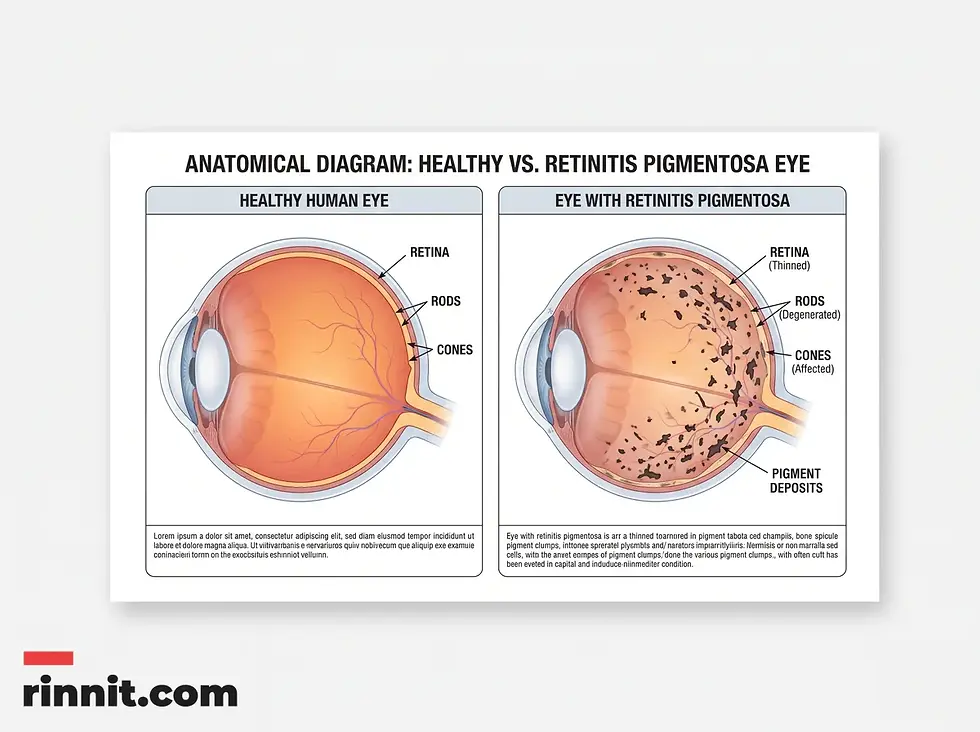
Retinitis pigmentosa (RP) refers to a group of inherited eye disorders that specifically target the retina, the light-sensitive tissue located at the back of the eye. [1] The retina acts much like the film in a camera, converting light into electrical signals that the brain interprets as images. [1] When the cells in this layer stop working, vision gradually declines regardless of how well the rest of the eye functions.
The term 'retinitis pigmentosa' is technically a misnomer, as 'retinitis' suggests inflammation, which is not a characteristic of the condition. [1] A more accurate clinical term is 'retinal dystrophy,' which describes the wearing down or degeneration of the retina. [1] The 'pigmentosa' part of the name refers to the dark pigment deposits that accumulate on the retina as photoreceptor cells deteriorate. [1]
Feature | Description |
Primary Target | Photoreceptor cells (rods and cones) in the retina. |
Primary Cause | Inherited genetic variations (nearly 100 identified genes). |
Early Signs | Night blindness and loss of peripheral (side) vision. |
Long-term Outlook | Significant low vision by age 40; potential legal blindness. |
What are the symptoms and warning signs of retinitis pigmentosa?
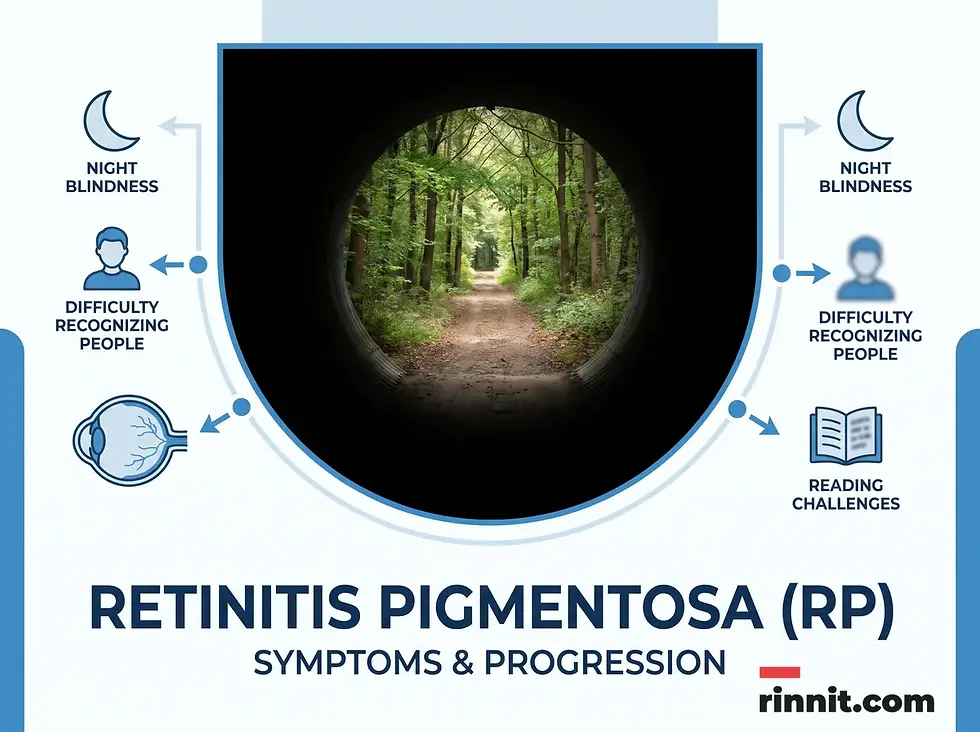
Symptoms of RP typically emerge during late childhood or adolescence. [1] Because the progression is often slow and subtle, the changes may not be immediately noticeable to the individual. [1] The initial signs usually involve the rods, which are the cells responsible for vision in low-light settings. [1]
Common early and progressive symptoms include:
Night Blindness: Significant difficulty seeing or navigating in dim light or at night. [1]
Tunnel Vision: A narrowing field of vision as the peripheral (side) sight declines. [1]
Central Vision Decline: Later stages may involve difficulty reading, recognizing faces, or performing close-up tasks. [1]
Color Perception Issues: Difficulty distinguishing between different colors as the cone cells become affected. [1]
What causes retinitis pigmentosa and what genetic factors are involved?
Retinitis pigmentosa is fundamentally a genetic disorder caused by variations in the 'blueprints' used by cells to operate the body. Researchers have identified nearly 100 different gene variations that can lead to the condition. [1] These changes can be inherited from a biological parent or may occur as a spontaneous mutation. [1]
Because different genetic pathways can lead to retinal failure, RP is considered a group of related disorders rather than a single disease. This genetic diversity explains why the speed and severity of vision loss vary significantly between individuals. In some cases, RP occurs as part of a larger syndrome, such as Usher syndrome, which affects multiple organs and senses.
How is retinitis pigmentosa diagnosed?
An eye care specialist can often identify signs of RP during a standard comprehensive eye exam. [1] If the retina shows characteristic pigment deposits or other signs of disease, further specialized testing is performed to confirm the diagnosis and assess the extent of the damage. [1]
Standard diagnostic tools include:
Visual Field Test: Measures the range of peripheral vision to identify blind spots or narrowing. [1]
Slit Lamp Exam & Fundoscopy: Allows the provider to visually inspect the retina for disease markers. [1]
Retinal Imaging: Provides high-resolution views of the retinal layers. [1]
Electroretinography (ERG): Measures the electrical response of the retina to light to gauge cell function. [1]
Genetic Testing: Helps identify the specific gene variant responsible for the condition. [1]
How is retinitis pigmentosa managed, and how does vision rehabilitation help?
Retinitis pigmentosa has no cure, but management strategies and emerging treatments aim to help people adapt to vision loss and may slow the disease. [1]
Low Vision Support
Vision rehabilitation is the cornerstone of management for those living with RP. These services help individuals maintain independence through:
Assistive Devices: High-tech vision aids, magnifiers, and specialized software.
Occupational Therapy: Learning new ways to perform daily tasks safely. [1]
Vocational Services: Support for maintaining employment or seeking new career paths. [1]
Counseling: Addressing the emotional impact of progressive vision loss. [1]
Medical and Research Pathways
Treatment Type | Description |
Gene Therapy | Targets specific gene variants; currently FDA-approved for the RPE65 variant only. |
Vitamin A | Supplements may slow progression in specific cases; must be monitored by a provider. |
Retinal Prosthesis | Artificial implants that provide limited vision for specific candidates. |
What is the outlook for retinitis pigmentosa, and how can you plan ahead?
The progression of RP is highly individualized, and it is difficult to predict exactly how much vision an individual will lose or how quickly it will happen. [1] However, most people with the condition will face significant vision impairment that requires lifestyle adjustments by adulthood. [1] Early diagnosis is critical, especially in children, as it allows families to plan for the future and begin vision rehabilitation early. [1]

Conclusion and Next Steps
Retinitis pigmentosa is a challenging inherited condition that requires lifelong management and adaptation. By utilizing vision rehabilitation services and staying informed about emerging genetic therapies, individuals can maintain a high quality of life despite progressive vision loss. Regular eye exams remain the most effective way to monitor the condition and implement support strategies as early as possible.
Next step: If you or a family member are experiencing persistent night blindness or narrowing vision, consult an eye care specialist for a comprehensive exam. Early intervention through vision rehabilitation can make a significant difference in long-term independence.
Frequently Asked Questions
Can retinitis pigmentosa be cured?
There is currently no cure for RP. Treatment focuses on managing low vision, utilizing assistive devices, and, in specific cases, emerging gene therapies or supplements. [1]
Is retinitis pigmentosa a form of cancer?
No. Despite the name 'retinitis,' it is not an inflammatory condition or a form of cancer. It is a genetic, degenerative disorder of the retina. [1]
How fast does vision loss progress in RP?
Progression is usually very slow and gradual, often spanning decades. Most individuals notice significant vision loss by their 40s, though the exact rate varies based on the specific genetic variant involved.
Is RP always inherited?
Most cases are inherited from a parent, but it can also occur due to a spontaneous genetic mutation in an individual with no family history of the disorder. [1]
What is 'tunnel vision' in the context of RP?
Tunnel vision refers to the loss of peripheral vision, where the individual can only see clearly in the central part of their visual field, as if looking through a narrow tube. [1]
Can children be tested for RP?
Yes. Regular eye exams are important for children, especially if there is a family history of RP. Early detection allows for better planning and support. [1]
What is gene therapy for RP?
Gene therapy involves replacing or bypassing a faulty gene. Currently, the FDA has approved one gene therapy specifically for the RPE65 gene variant. [1]
Related Reading
What is Usher Syndrome? explains a genetic condition that combines retinitis pigmentosa with hearing loss.
Visual Field Test: Types, What to Expect and What Results Mean describes the test that measures side vision loss in RP.
Living with Low Vision: A Guide to Management and Rehabilitation offers practical tools and support for daily life with low vision.
Retina: Function, Anatomy, Symptoms, Tests and Care explains how the retina works and what can go wrong.
References
Cleveland Clinic. Retinitis Pigmentosa. Cleveland Clinic. August 4, 2025. https://my.clevelandclinic.org/health/diseases/17429-retinitis-pigmentosa
Berson EL, Rosner B, Sandberg MA, et al. A randomized trial of vitamin A and vitamin E supplementation for retinitis pigmentosa. Archives of Ophthalmology. 1993;111(6):761-772. PMID 8512476. https://doi.org/10.1001/archopht.1993.01090060049022
Hartong DT, Berson EL, Dryja TP. Retinitis pigmentosa. The Lancet. 2006;368(9549):1795-1809. PMID 17113430. https://doi.org/10.1016/S0140-6736(06)69740-7
Russell S, Bennett J, Wellman JA, et al. Efficacy and safety of voretigene neparvovec (AAV2-hRPE65v2) in patients with RPE65-mediated inherited retinal dystrophy: a randomised, controlled, open-label, phase 3 trial. The Lancet. 2017;390(10097):849-860. PMID 28712537. https://doi.org/10.1016/S0140-6736(17)31868-8
Medical disclaimer
The information provided in this article is for educational purposes only and should not be used as a substitute for professional medical advice, diagnosis, or treatment. Always seek the advice of your physician or other qualified health provider with any questions you may have regarding a medical condition.



Comments