Understanding Pyruvate Kinase Deficiency: Causes and Care

Updated: 2 days ago
Medically reviewed by Dr. Baraa Alnahhal, MD · Last reviewed: October 2026
Definition: A rare genetic disorder in which red blood cells break down faster than the body can replace them.
Main effect: Lifelong hemolytic anemia, with symptoms such as fatigue and jaundice.
Cause: A mutation in the PKLR gene that prevents red blood cells from making the enzyme needed for energy production.
Management: Blood transfusions, specialized medications, and sometimes surgical intervention.
Quick Answer
Pyruvate kinase deficiency is a rare, lifelong genetic condition in which red blood cells break down too early, causing hemolytic anemia. It results from a mutation in the PKLR gene that prevents cells from making an enzyme needed for energy. Common symptoms include fatigue, jaundice and an enlarged spleen. Management often involves blood transfusions or medication. [1]
What the research says
Mitapivat raised hemoglobin in adults who were not on regular transfusions. In a phase 3, randomized, placebo-controlled trial of 80 adults with pyruvate kinase deficiency (40 per group), a hemoglobin response (a rise of at least 1.5 g/dL sustained at two or more assessments) occurred in 16 of 40 patients (40%) on mitapivat versus none of 40 on placebo over 24 weeks (adjusted difference 39.3 percentage points, 95% CI 24.1 to 54.6; P<0.001). Adverse events of grade 3 or higher occurred in 25% of the mitapivat group and 13% of the placebo group (Al-Samkari et al., N Engl J Med, 2022).
The benefit extends to adults who need regular transfusions. A review of the two phase 3 trials reports that, in the single-arm ACTIVATE-T trial of regularly transfused adults, mitapivat was associated with a reduction in red blood cell transfusion burden, along with improved markers of hemolysis and quality of life, and adverse events were generally mild to moderate (Zhuang-Yan and Shirley, Drugs, 2023).
What is Pyruvate Kinase Deficiency?
Pyruvate kinase (PK) deficiency is an inherited condition where red blood cells lack a vital enzyme needed for energy production. [1]
Without sufficient pyruvate kinase, red blood cells cannot produce enough adenosine triphosphate (ATP) to survive their normal lifespan. Consequently, these cells break down prematurely, leading to a state called hemolytic anemia. Because red blood cells are responsible for carrying oxygen throughout the body, a deficiency can result in significant systemic symptoms as other cells struggle to receive the oxygen they need to function correctly.
This condition is present from birth and requires lifelong management. While the disorder is permanent, the severity of symptoms can vary significantly between individuals. Some people may experience severe complications in infancy, while others may not notice significant issues until their bodies are stressed by external factors later in life.
What are the symptoms of pyruvate kinase deficiency and when do they start?
The symptoms of pyruvate kinase deficiency primarily stem from the resulting anemia and the buildup of waste products from destroyed red blood cells. Common indicators of anemia include persistent fatigue, a rapid heartbeat, and shortness of breath. Individuals may also appear pale or experience frequent dizziness and headaches. [1]
When red blood cells are destroyed, waste products like bilirubin can accumulate in the body. This often leads to visible signs such as jaundice, characterized by yellowing of the skin and the whites of the eyes. Other signs include an enlarged spleen and dark-colored urine. The timing of symptom onset depends on the condition's severity; newborns may require immediate treatment, whereas adults might only experience symptoms during pregnancy, infections, or injuries.
Symptom Category | Common Signs |
Anemia-Related | Fatigue, weakness, rapid heartbeat, shortness of breath, dizziness |
Waste Buildup | Jaundice (yellow skin/eyes), dark urine, enlarged spleen |
Physical Appearance | Pale skin (pallor), yellowing of eye whites |

What causes pyruvate kinase deficiency and how is it inherited?
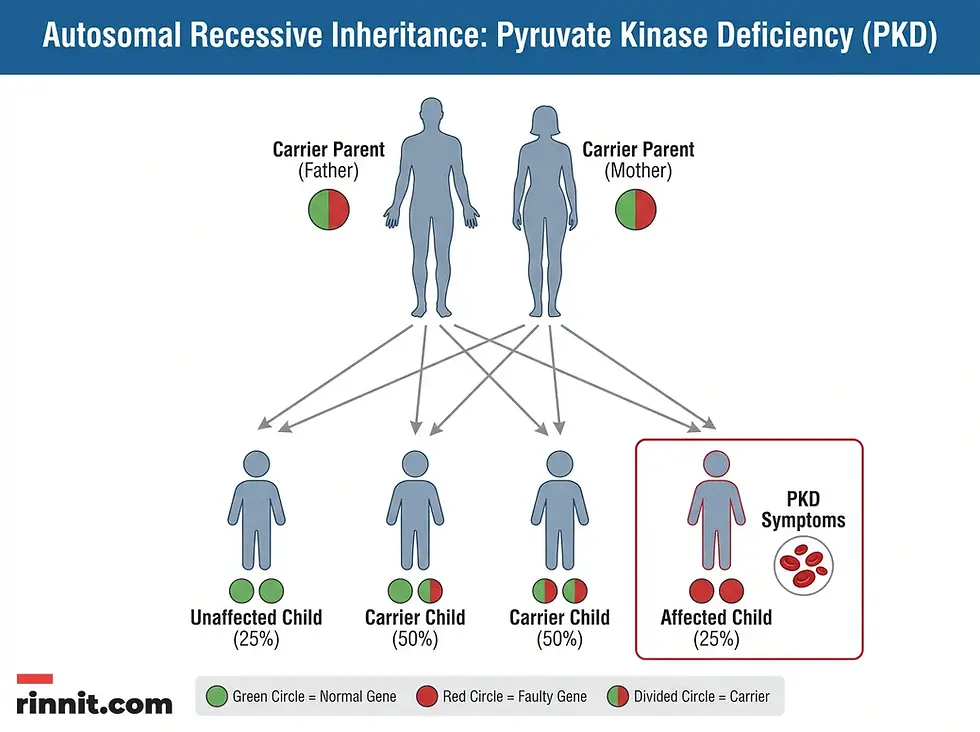
Pyruvate kinase deficiency is caused by a variation or error in the PKLR gene. This gene provides the instructions for red blood cells to produce the pyruvate kinase enzyme. When these instructions are faulty, cells cannot generate the energy required to thrive, causing them to rupture early. This genetic error is inherited in an autosomal recessive pattern, meaning an individual must receive one faulty gene from each biological parent to develop the disorder. [1]
Parents who carry only one faulty gene typically do not show symptoms and may be unaware of their carrier status without genetic testing. When both parents are carriers, there is a 25% chance with each pregnancy that the child will inherit both faulty genes and have the condition. The disorder is most commonly diagnosed in individuals of northern European descent and is notably prevalent in certain Amish communities.
What are the complications and risks of pyruvate kinase deficiency?
If left unmanaged, pyruvate kinase deficiency can lead to several long-term health complications. The constant destruction of red blood cells and subsequent treatments can cause a buildup of excess iron in the body, known as iron overload. Additionally, the condition increases the risk of developing gallstones and painful leg ulcers. [1]
Other risks include pulmonary hypertension and weakened bones, which may lead to osteoporosis or an increased frequency of fractures in older age. For pregnant individuals, the physical stress of pregnancy can intensify symptoms, potentially leading to complications such as preterm birth or miscarriage, though these outcomes are relatively rare when managed by a specialized medical team.
How is pyruvate kinase deficiency diagnosed and managed?
Diagnosis typically involves a combination of clinical observation and specialized laboratory testing. Healthcare providers use blood tests to confirm the presence of hemolytic anemia and measure the activity level of the pyruvate kinase enzyme. Molecular testing is also employed to identify specific mutations in the PKLR gene. In some cases, warning signs like fluid buildup in a fetus may be detected via prenatal ultrasound. [1]
Management strategies are tailored to the individual's age and symptom severity. For newborns, treatments may include phototherapy for jaundice or exchange transfusions in severe cases. For older children and adults, regular blood transfusions and folic acid supplements are common. In 2022, the FDA approved Mitapivat as a targeted medication for adults with the condition. It should not be stopped suddenly, because stopping it abruptly can trigger a sudden breakdown of red blood cells; any stop should be a gradual taper directed by your doctor. Other interventions include iron chelation therapy to remove excess iron and surgical procedures like spleen or gallbladder removal.

How can people live well with pyruvate kinase deficiency?
Managing a lifelong blood disorder requires consistent coordination with a hematologist. Regular monitoring is essential to track red blood cell levels and prevent complications like iron overload. While some individuals who require frequent transfusions as children may find their needs decrease in adulthood, others will need ongoing support to maintain their health and energy levels. [1]
Proactive health measures, such as maintaining general wellness and protecting bone health, can improve long-term outcomes. For those with a family history of the disorder, genetic counseling can provide valuable information regarding inheritance risks and testing options for future pregnancies.
Conclusion and Next Steps
Pyruvate kinase deficiency is a complex, lifelong genetic disorder that significantly impacts red blood cell survival. While the symptoms and complications can be challenging, advancements in diagnostic testing and the introduction of new targeted therapies have improved the outlook for many individuals. Through consistent medical care and personalized management plans, people living with this condition can effectively navigate its challenges and maintain a high quality of life.
If you or a family member are experiencing persistent fatigue, jaundice, or have a known family history of blood disorders, consult a healthcare professional. Early diagnosis and a tailored management plan from a hematologist are vital for preventing complications and ensuring long-term health.
Frequently Asked Questions
What is pyruvate kinase deficiency?
Pyruvate kinase deficiency is a rare genetic disorder where a lack of the pyruvate kinase enzyme causes red blood cells to break down prematurely, leading to anemia.
How is this condition inherited?
Pyruvate kinase deficiency follows an autosomal recessive pattern, meaning a child must inherit one faulty PKLR gene from each biological parent to have the disorder.
What are the primary symptoms?
Common symptoms include extreme fatigue, jaundice (yellowing of skin and eyes), rapid heartbeat, shortness of breath, and an enlarged spleen.
When do symptoms usually appear?
While present at birth, symptoms may be noticed in infancy or remain mild until triggered by stress, such as an infection or pregnancy, in adulthood.
What are the potential complications?
Possible complications include gallstones, iron overload, leg ulcers, pulmonary hypertension, and an increased risk of bone fractures or osteoporosis.
How do doctors diagnose the disorder?
Diagnosis is made through blood tests that check for anemia, measure enzyme activity, and identify specific mutations in the PKLR gene.
What is Mitapivat?
Mitapivat is an FDA-approved medication used to treat pyruvate kinase deficiency and hemolytic anemia in adults.
Is spleen removal a common treatment?
A splenectomy may be recommended if the spleen becomes significantly enlarged due to the accumulation of destroyed red blood cells.
Can the condition be cured?
A bone marrow transplant is a potential cure, but it is a high-risk procedure typically reserved for severe cases.
Does it affect pregnancy?
Pregnancy can intensify symptoms and increase the risk of complications like preterm birth, requiring close monitoring by a hematologist.
Related Reading
Hemolytic Anemia: Understanding Rapid Red Blood Cell Loss explains anemia from red blood cells breaking down too early.
Hereditary Spherocytosis: Understanding Inherited Hemolytic Anemia covers another inherited red blood cell disorder with similar symptoms.
G6PD Deficiency: Symptoms, Causes, Diagnosis, Treatment and Outlook — What You Need to Know explains the most common red cell enzyme deficiency.
Splenectomy: Procedure, Recovery, and Long-Term Care explains spleen removal surgery and life afterward.
References
Cleveland Clinic. Pyruvate Kinase Deficiency. Cleveland Clinic Health Library. Accessed October 11, 2026. https://my.clevelandclinic.org/health/diseases/23419-pyruvate-kinase-deficiency
Al-Samkari H, Galactéros F, Glenthøj A, et al. Mitapivat versus placebo for pyruvate kinase deficiency. N Engl J Med. 2022;386(15):1432-1442. PMID: 35417638. DOI: https://doi.org/10.1056/NEJMoa2116634
Zhuang-Yan A, Shirley M. Mitapivat: a review in pyruvate kinase deficiency in adults. Drugs. 2023;83(17):1613-1620. PMID: 37991635. DOI: https://doi.org/10.1007/s40265-023-01961-x
Medical disclaimer
This article is for informational purposes only and is not a substitute for professional medical advice, diagnosis, or treatment. Always seek the advice of your physician or other qualified health provider with any questions you may have about a medical condition.



Comments