Understanding Menarche: A Guide to the First Menstrual Cycle

Updated: 3 days ago
Medically reviewed by Dr. Baraa Alnahhal, MD · Last reviewed: October 2026
Editorial note: This article is provided for educational purposes only. It is not medical advice. Always consult a qualified healthcare professional about your individual health situation.
Quick Answer: What Is Menarche?
Menarche is the medical term for the first menstrual period, signaling the start of the reproductive years. [1] In the United States, the average age is 12, though it typically occurs between ages 9 and 15, usually about two years after breast development begins. [1] Common signs include light bleeding, cramping and mood swings, a natural part of puberty. [1]
What the research says
Puberty is starting earlier around the world. A systematic review and meta-analysis of 30 studies found that the age at breast development (thelarche), the first clinical sign of puberty in girls, fell by about 0.24 years (almost 3 months) per decade between 1977 and 2013 (Eckert-Lind et al., JAMA Pediatr, 2020 [2]).
The average age of the first period has also fallen in some countries. A systematic review and meta-analysis in Indonesia found that the average age at menarche dropped from 14.43 years to 13.63 years over the 40 years before 2010 (Wahab et al., Int J Adolesc Med Health, 2018 [4]).
Earlier menarche is linked with a higher later risk of type 2 diabetes. A meta-analysis of 28 observational studies of age at menarche in women (combined N = 1,228,306) found that early versus later menarche was associated with higher risk of type 2 diabetes or impaired glucose tolerance (RR 1.39, 95% CI 1.25-1.55). The link weakened but remained after adjusting for adiposity (RR 1.19, 95% CI 1.11-1.28) (Cheng et al., PLoS Med, 2020 [3]).
What is the biological function of menarche?
Menarche serves as a primary indicator that the female reproductive system is maturing. It marks the transition into the reproductive years, during which the body becomes biologically capable of pregnancy. [1] This process is governed by chemical messengers known as hormones, which coordinate the menstrual cycle to prepare the uterus for a potential fertilized egg each month. [1]
During a typical cycle, hormones stimulate the ovaries to release an egg while the uterine lining thickens. If fertilization does not occur, the body sheds this extra lining through the vagina, resulting in a period. [1] This monthly shedding continues until menopause, typically occurring in the late 40s or early 50s.
What are the signs and symptoms of menarche?
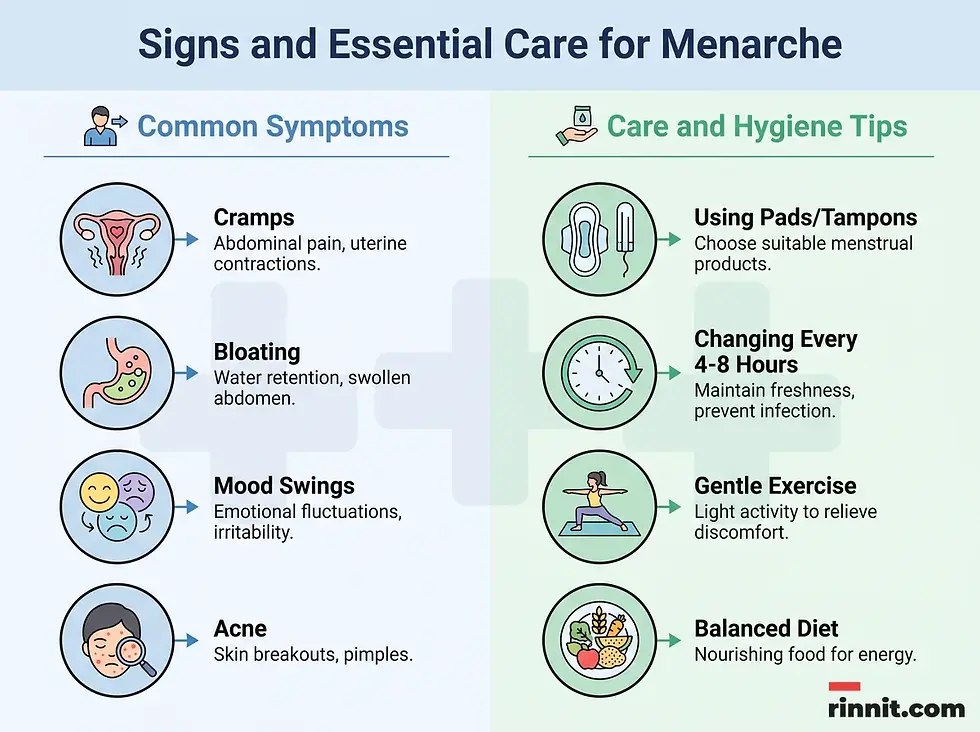
The arrival of a first period is often preceded by physical and emotional changes. Recognizing these signs can help individuals prepare for the transition. Symptoms may begin several days before bleeding starts and vary significantly between individuals. [1]
Category | Common Signs and Symptoms |
Physical | Abdominal cramping, lower back pain, bloating, tender breasts, acne, tiredness. |
Emotional | Mood swings, irritability, or increased sensitivity. |
Bleeding | Light spotting, red or brown blood, flow lasting two to seven days. |

When should you seek medical advice about menarche?
Menarche is a natural process, but a first period before age 9 or after 15, very heavy or prolonged bleeding, or severe cramps should be checked by a healthcare provider. [1] Identifying these issues early ensures proper management of reproductive health.
Precocious Puberty: Signs of puberty, such as breast growth, before age 8, or a first period before age 9. [1]
Primary Amenorrhea: The first period has not arrived by the age of 15. [1]
Abnormal Bleeding: Soaking through a pad or tampon every hour for two consecutive hours or bleeding that lasts longer than 7 days. [1]
Severe Symptoms: Cramping so intense that it prevents participation in normal daily activities or the presence of blood clots larger than a quarter. [1]

How can you care for yourself and manage menarche?
Managing the first period involves selecting appropriate products and addressing discomfort. There are several options for managing blood flow, and individuals may choose different methods based on comfort and activity levels. [1]
Product Type | Usage and Maintenance |
Pads/Liners | Worn in underwear; should be changed every four to eight hours. |
Tampons | Inserted internally; suitable for swimming; change every four to eight hours. Use the lowest absorbency you need and never leave one in longer than 8 hours, to lower the risk of toxic shock syndrome. |
Menstrual Cups | Silicone cups inserted internally; empty and wash every eight to 12 hours. |
Period Underwear | Specialized absorbent fabric; washable and reusable. |
For symptom relief, warm baths, gentle stretching, and heating pads can be effective. [1] Over-the-counter medications like ibuprofen or naproxen may help with cramps, but aspirin should be avoided for those under 18 unless directed by a doctor. [1]
Conclusion
Menarche is a natural and healthy milestone that signifies the body's progression toward adulthood. [1] While it introduces new responsibilities and physical changes, it does not have to limit daily activities. [1] Tracking cycles on a calendar can help individuals understand their unique patterns and identify any irregularities early. [1] Support from trusted adults and healthcare providers can make this transition a positive experience.
Take Action for Reproductive Health
Prepare a Kit: Carry a small bag with pads, spare underwear, and a sweatshirt to handle unexpected starts. [1]
Start Tracking: Use an app or calendar to note the first day of each period to learn your cycle length. [1]
Discuss Options: Talk to a healthcare provider about the best period products and pain management for your lifestyle.
Sources: Cleveland Clinic — Menarche | Eckert-Lind et al., 2020 | Cheng et al., 2020 | Wahab et al., 2018
Frequently Asked Questions
1. What is the average age for a first period?
The average age in the United States is 12, but it commonly occurs between 9 and 15.
2. How long does the first period usually last?
Bleeding typically lasts between two and seven days, though the first few periods may be irregular.
3. Can you get pregnant after your first period?
Yes, menarche signifies that the body is biologically capable of pregnancy.
4. Is it normal for the first period to be brown?
Yes, period blood can range in color from pink to red to dark brown.
5. What are common signs that a period is coming?
Signs include abdominal cramps, bloating, acne, breast tenderness, and mood swings.
6. Should I avoid exercise during my period?
No, gentle exercise and stretching can actually help relieve menstrual cramps.
7. How often should I change my pad or tampon?
Pads and tampons should generally be changed every four to eight hours.
8. What is precocious puberty?
Precocious puberty is the medical term used when signs of puberty, such as breast growth, begin before age 8 in girls.
9. When should I see a doctor about my period?
See a doctor if you soak through pads hourly, have severe pain, or haven't started by age 15.
10. Is it safe to use tampons for a first period?
Yes, tampons are safe to use, though some find pads easier to start with.
Related Reading
Puberty: Stages, Timing, Hormones and Support explains the body changes of puberty that lead up to a first period.
Precocious Puberty: Complete Guide to Signs, Causes, and Treatment describes when puberty starts too early and how it is managed.
Abnormal Menstruation: Understanding Irregular Periods explains irregular periods and when they need a doctor's visit.
Menstrual Cramps: Causes, Treatment & Relief covers why period cramps happen and ways to ease them.
References
Cleveland Clinic. Menarche. Cleveland Clinic. August 2, 2026. https://my.clevelandclinic.org/health/body/menarche
Eckert-Lind C, Busch AS, Petersen JH, et al. Worldwide secular trends in age at pubertal onset assessed by breast development among girls: a systematic review and meta-analysis. JAMA Pediatr. 2020;174(4):e195881. PMID 32040143. https://doi.org/10.1001/jamapediatrics.2019.5881
Cheng TS, Day FR, Lakshman R, et al. Association of puberty timing with type 2 diabetes: a systematic review and meta-analysis. PLoS Med. 2020;17(1):e1003017. PMID 31905226. https://doi.org/10.1371/journal.pmed.1003017
Wahab A, Wilopo SA, Hakimi M, et al. Declining age at menarche in Indonesia: a systematic review and meta-analysis. Int J Adolesc Med Health. 2018;32(6). PMID 30256760. https://doi.org/10.1515/ijamh-2018-0021
Medical disclaimer
The information provided in this article is for educational purposes only and should not be used as a substitute for professional medical advice, diagnosis, or treatment. Always seek the advice of your physician or other qualified health provider with any questions you may have regarding a medical condition. Never disregard professional medical advice or delay in seeking it because of something you have read here.



Comments