Menstrual Cramps: Causes, Treatment & Relief

Updated: 2 days ago
Medically reviewed by Dr. Baraa Alnahhal, MD · Last reviewed: September 2026
TL;DR
Menstrual cramps (dysmenorrhea) are throbbing or cramping pains in the lower abdomen that many women experience just before and during their periods. They are driven by prostaglandins, hormone-like substances that trigger the uterine contractions that shed the uterine lining — higher levels mean more-severe cramps. While some cramps are merely annoying, others disrupt everyday life, and five underlying conditions — endometriosis, uterine fibroids, adenomyosis, pelvic inflammatory disease, and cervical stenosis — can be responsible. Period-related cramps not caused by another condition tend to lessen with age and often improve after childbirth. Relief options range from heat, exercise, and stress reduction to over-the-counter pain relievers taken before the period starts, hormonal birth control, and, when a disorder is the cause, surgery.
Quick Answer
What are menstrual cramps? Throbbing or cramping pains in the lower abdomen (dysmenorrhea) that many women have just before and during their menstrual periods; for some they are merely annoying, for others severe enough to interfere with daily life.
What causes them? Prostaglandins — hormone-like substances involved in pain and inflammation — trigger the uterine muscle contractions that expel the uterine lining; higher levels are linked to more-severe cramps. Endometriosis, fibroids, adenomyosis, pelvic inflammatory disease, or cervical stenosis can also be responsible.
What does the pain feel like? A dull, continuous ache or intense throbbing that starts 1 to 3 days before a period, peaks 24 hours after the period begins, and subsides in 2 to 3 days; pain may radiate to the lower back and thighs.
When should you see a doctor? If cramps disrupt your life every month, your symptoms progressively worsen, or you start having severe cramps for the first time after age 25.
How are they treated? Heat, exercise, sleep, and stress reduction at home; OTC pain relievers (ibuprofen or naproxen) starting the day before your period; hormonal birth control in pill, patch, ring, implant, injection, or IUD form; and surgery if an underlying disorder is the cause.
What Are Menstrual Cramps?
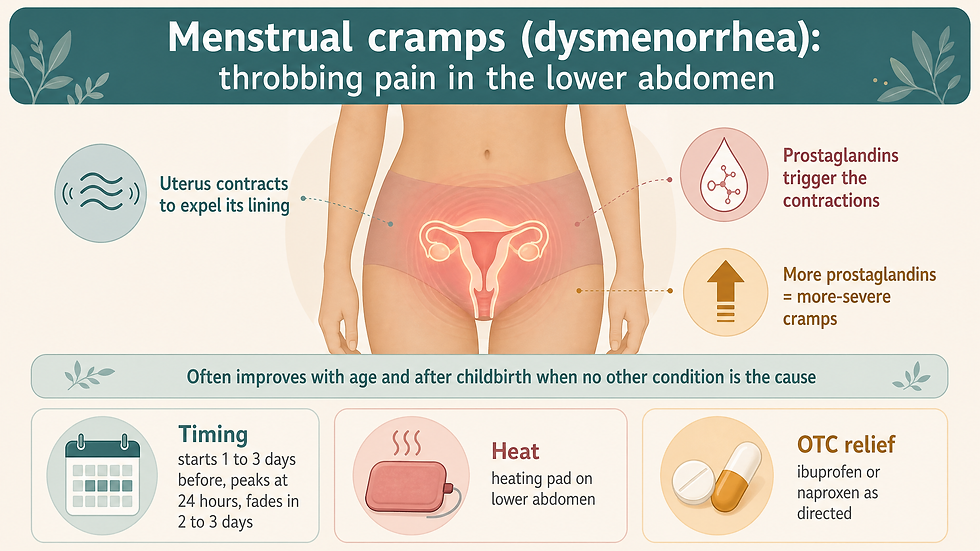
Menstrual cramps, medically known as dysmenorrhea, are throbbing or cramping pains in the lower abdomen. Many women have menstrual cramps just before and during their menstrual periods.
For some women, the discomfort is merely annoying. For others, menstrual cramps can be severe enough to interfere with everyday activities for a few days every month.
The encouraging news: menstrual cramps that are not caused by another condition tend to lessen with age and often improve after giving birth.
Menstrual Cramps Symptoms
Symptoms of menstrual cramps follow a recognizable pattern:
Throbbing or cramping pain in the lower abdomen that can be intense
Pain that starts 1 to 3 days before your period, peaks 24 hours after the onset of your period and subsides in 2 to 3 days
A dull, continuous ache
Pain that radiates to the lower back and thighs
Some women also experience:
Nausea
Loose stools
Headache
Dizziness
What Causes Menstrual Cramps?
During your menstrual period, your uterus contracts to help expel its lining. Hormone-like substances called prostaglandins — which are involved in pain and inflammation — trigger these uterine muscle contractions. Higher levels of prostaglandins are associated with more-severe menstrual cramps.
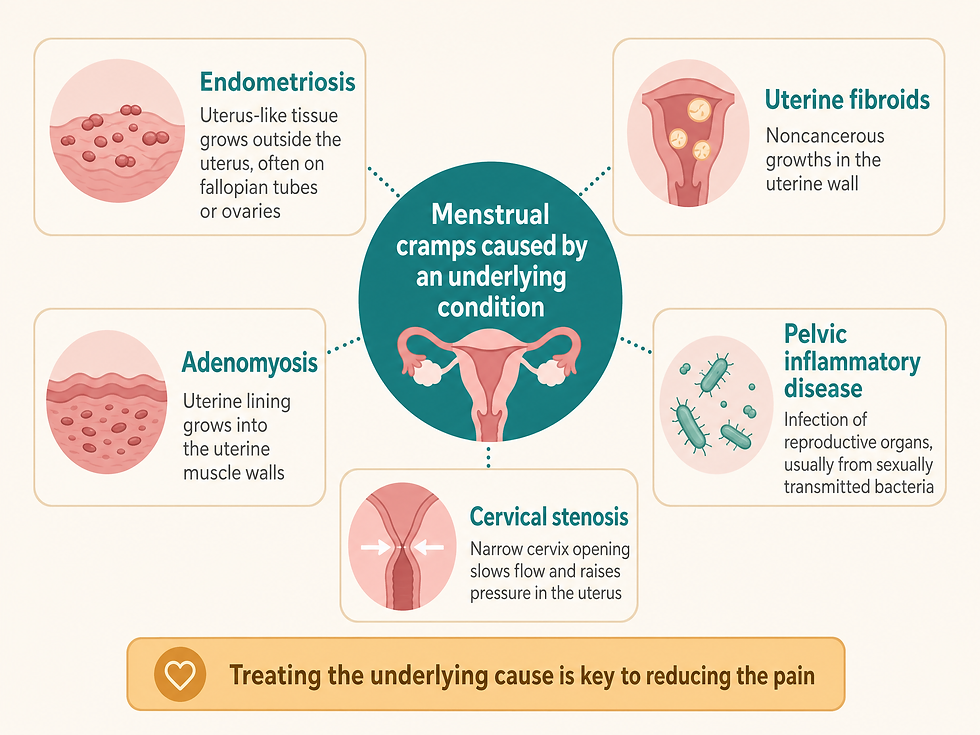
Beyond this primary mechanism, five medical conditions can cause or worsen menstrual cramps.
Underlying Condition | What Happens |
Endometriosis | Tissue that acts similar to the lining of the uterus grows outside of the uterus, most commonly on the fallopian tubes, ovaries or the tissue lining the pelvis |
Uterine fibroids | Noncancerous growths in the wall of the uterus that can cause pain |
Adenomyosis | The tissue that lines the uterus grows into the muscular walls of the uterus |
Pelvic inflammatory disease | An infection of the female reproductive organs, usually caused by sexually transmitted bacteria |
Cervical stenosis | The opening of the cervix is small enough to impede menstrual flow, causing a painful increase of pressure within the uterus |
Treating the underlying condition is key to reducing the pain — which is exactly why severe or changing cramps deserve a medical evaluation rather than just more pain relievers.
Risk Factors
You might be at higher risk of menstrual cramps if you:
Are younger than age 30
Started puberty early, at age 11 or younger
Bleed heavily during periods (menorrhagia)
Have irregular menstrual bleeding (metrorrhagia)
Have a family history of menstrual cramps (dysmenorrhea)
Smoke
Possible Complications
Menstrual cramps themselves do not cause other medical complications, but they can interfere with school, work and social activities.
Certain conditions associated with menstrual cramps can have complications, however. Endometriosis can cause fertility problems. Pelvic inflammatory disease can scar the fallopian tubes, increasing the risk of a fertilized egg implanting outside of the uterus — an ectopic pregnancy.
When to See a Doctor
See your healthcare provider if:
Menstrual cramps disrupt your life every month
Your symptoms progressively worsen
You just started having severe menstrual cramps after age 25
How Menstrual Cramps Are Diagnosed
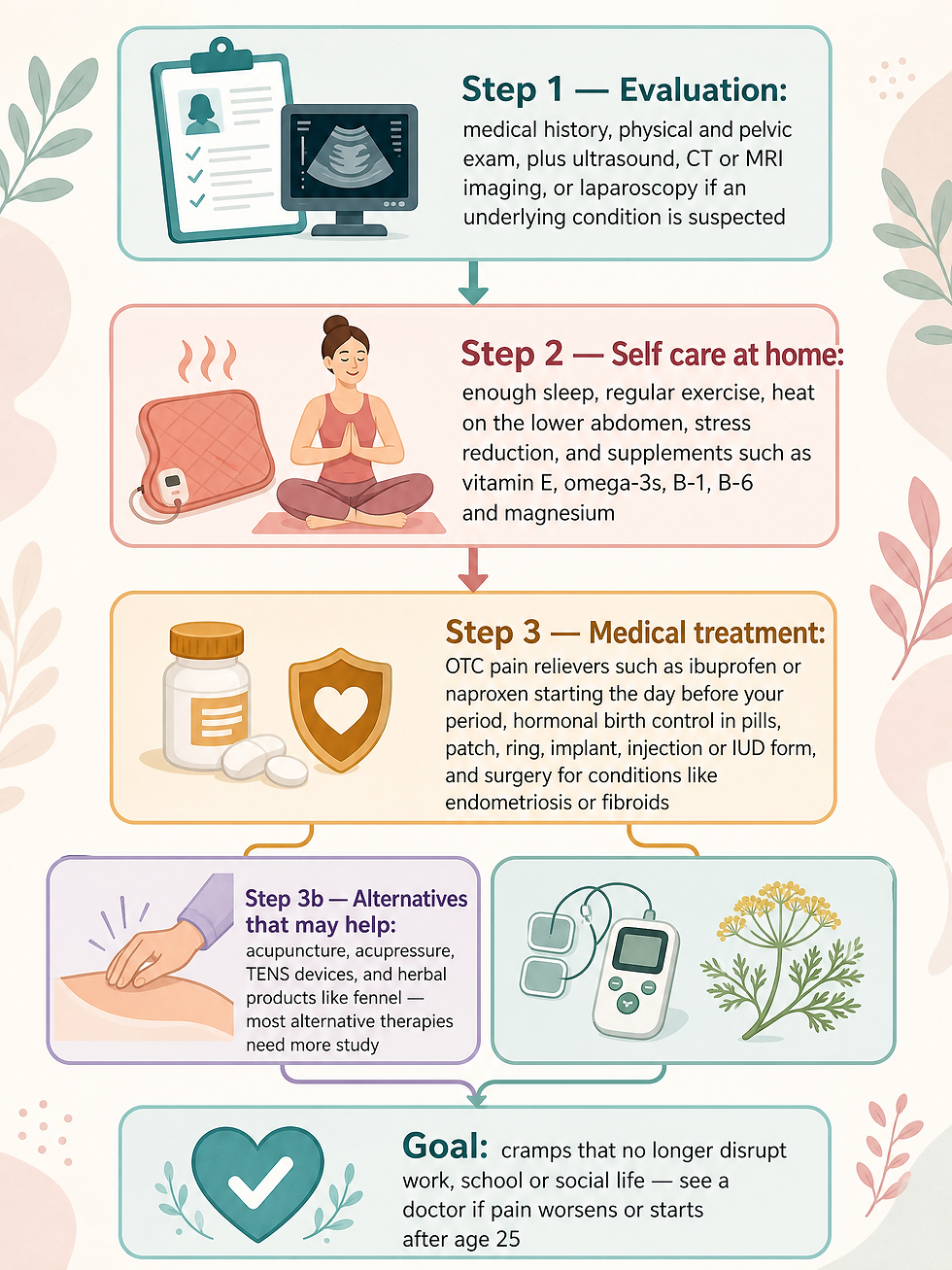
Your healthcare provider will review your medical history and perform a physical exam, including a pelvic exam to check for anything unusual with the reproductive organs and look for signs of infection. Additional tests may follow.
Test | What It Involves |
Ultrasound | Sound waves create an image of the uterus, cervix, fallopian tubes and ovaries |
CT or MRI | Imaging that provides more detail than an ultrasound and can help diagnose underlying conditions; both are noninvasive and painless |
Laparoscopy | An outpatient surgical procedure that can detect endometriosis, adhesions, fibroids, ovarian cysts and ectopic pregnancy; tiny incisions are made in the abdomen and a fiber-optic tube with a small camera lens is inserted — not usually necessary for menstrual cramps alone |
Treatment Options
To ease your menstrual cramps, your healthcare provider might recommend one or more of the following.
Pain relievers
Over-the-counter pain relievers, such as ibuprofen (Advil, Motrin IB, others) or naproxen sodium (Aleve), at regular doses starting the day before you expect your period to begin can help control the pain of cramps. Prescription nonsteroidal anti-inflammatory drugs are also available.
The key to effectiveness is timing: start taking the pain reliever at the beginning of your period, or as soon as you feel symptoms, and continue taking the medicine as directed for two to three days, or until your symptoms are gone.
Hormonal birth control
Oral birth control pills contain hormones that prevent ovulation and reduce the severity of menstrual cramps. These hormones can also be delivered in several other forms: an injection, a skin patch, an implant placed under the skin of the arm, a flexible ring inserted into the vagina, or an intrauterine device (IUD).
Surgery
If your menstrual cramps are caused by a disorder such as endometriosis or fibroids, surgery to correct the problem might help your symptoms. Surgical removal of the uterus (hysterectomy) also might be an option if other approaches fail to ease your symptoms and you are not planning to have children.
Self-Care and Lifestyle Steps
Besides getting enough sleep and rest, several things you can try at home make a genuine difference.
Exercise regularly. Physical activity, including sex, helps ease menstrual cramps for some women.
Use heat. Soaking in a hot bath or using a heating pad, hot water bottle or heat patch on your lower abdomen might ease menstrual cramps.
Try dietary supplements. A number of studies have indicated that vitamin E, omega-3 fatty acids, vitamin B-1 (thiamin), vitamin B-6 and magnesium supplements might reduce menstrual cramps.
Reduce stress. Psychological stress might increase your risk of menstrual cramps and their severity.
Alternative Medicine Options
Most alternative therapies for treating menstrual cramps have not been studied enough for experts to recommend them broadly. However, some alternative treatments might help.
Acupuncture involves inserting extremely thin needles through the skin at strategic points on the body, and some studies have found that it helps relieve menstrual cramps.
Transcutaneous electrical nerve stimulation (TENS) uses a device connected to the skin through adhesive patches with electrodes that deliver a varying level of electric current to stimulate nerves. TENS might work by raising the threshold for pain signals and stimulating the release of your body's natural painkillers (endorphins). In studies, TENS was more effective than a placebo in relieving menstrual cramp pain.
Herbal medicine. Some herbal products, such as pycnogenol, fennel or combination products, might provide some relief from menstrual cramps.
Acupressure stimulates certain points on the body with gentle pressure on the skin instead of needles. Although research on acupressure and menstrual cramps is limited, it appears that acupressure may be more effective than a placebo in easing menstrual cramps.
Preparing for Your Appointment
If you have bothersome menstrual cramps, make an appointment with either your primary physician or a doctor who specializes in the female reproductive system (gynecologist).
What you can do. Track your menstrual periods — when they begin and how severe your cramps are. Also make a list of medical problems you have had and recent major stresses in your life, all medications, vitamins or other supplements you take, and your questions for the doctor.
Useful questions include what the most likely cause of your symptoms is, whether symptoms are likely to change over time, whether you need any tests, and which treatments or home remedies might help.
What to expect from your doctor. The doctor is likely to ask how old you were when you began menstruating, how far apart your periods are and how long they last, how heavy your bleeding is and whether you ever bleed between periods, where the cramps hurt, whether you have other symptoms such as nausea, vomiting, diarrhea, back pain, dizziness or headaches, whether symptoms cause you to limit activities or stay home, whether intercourse is painful, which treatments you have tried, and whether women in your family have a history of similar symptoms.
In the meantime. When you have cramps, try a warm bath or applying a heating pad, hot water bottle or heat patch to your abdomen. Over-the-counter pain relievers, such as ibuprofen, also might help.
Bottom Line
Menstrual cramps exist on a spectrum — from a dull annoyance to several days of genuine disruption — and the difference usually comes down to one question: are these cramps a prostaglandin problem, or the symptom of a treatable condition?
Most period pain follows the natural rhythm of the cycle, driven by prostaglandins that make the uterus contract, and it responds well to well-timed pain relievers, heat, exercise, and hormonal birth control. But cramps that ruin your month, keep getting worse, or suddenly appear after age 25 are your body flagging something that needs attention — endometriosis, fibroids, adenomyosis, pelvic inflammatory disease, or cervical stenosis — and treating the underlying cause is what actually solves the pain.
Your next step: Start a simple period and pain diary this month — note when cramps begin, how severe they are, and whether they limit your activities — and bring it to an appointment with your primary physician or gynecologist. In the meantime, take heat to the lower abdomen, keep up your exercise routine, and if you use over-the-counter pain relievers, take them as directed starting the day before you expect your period.
Frequently Asked Questions
Why do I get cramps every month?
During your menstrual period, your uterus contracts to expel its lining, and hormone-like substances called prostaglandins — involved in pain and inflammation — trigger these contractions. Higher levels of prostaglandins are associated with more-severe menstrual cramps. Conditions such as endometriosis, uterine fibroids, adenomyosis, pelvic inflammatory disease, or cervical stenosis can also cause or worsen cramps.
What does period pain normally feel like?
Typical menstrual cramps are a dull, continuous ache or intense throbbing in the lower abdomen. The pain usually starts 1 to 3 days before your period, peaks 24 hours after your period begins, and subsides within 2 to 3 days, and it may radiate to the lower back and thighs. Some women also have nausea, loose stools, headache, or dizziness.
When should I see a doctor for menstrual cramps?
See your healthcare provider if menstrual cramps disrupt your life every month, your symptoms progressively worsen, or you just started having severe menstrual cramps after age 25. Cramps beginning or worsening later in life can signal an underlying condition such as endometriosis or fibroids that deserves diagnosis.
What is the best over-the-counter medicine for cramps?
Over-the-counter pain relievers such as ibuprofen or naproxen sodium, taken at regular doses starting the day before you expect your period, can help control cramp pain. Start at the beginning of your period or as soon as you feel symptoms, and continue as directed for two to three days, or until symptoms are gone. Prescription nonsteroidal anti-inflammatory drugs are also available.
Does hormonal birth control really help period pain?
Yes. Birth control pills contain hormones that prevent ovulation and reduce the severity of menstrual cramps, and the same hormones can be delivered through an injection, skin patch, arm implant, vaginal ring, or intrauterine device (IUD). For cramps caused by a disorder such as endometriosis or fibroids, surgery to correct the problem might also help.
What can I do at home to ease cramps?
Get enough sleep and rest, exercise regularly, apply heat to your lower abdomen (hot bath, heating pad, hot water bottle, or heat patch), reduce psychological stress, and consider supplements that studies link to reduced cramps — vitamin E, omega-3 fatty acids, vitamin B-1 (thiamin), vitamin B-6, and magnesium. Acupuncture, acupressure, and TENS devices have also shown promise in studies.
References
Menstrual cramps — Symptoms and causes (Mayo Clinic)
Menstrual cramps — Diagnosis and treatment (Mayo Clinic)
Rinnit.com provides general health information for educational purposes. This content does not replace professional medical advice — always consult a qualified healthcare provider for diagnosis and treatment.
Health information, not medical advice. This article is for general education and is not a substitute for professional diagnosis or treatment. Always consult a qualified healthcare provider about your own health, and seek emergency care for urgent symptoms.
Comments