Understanding Melorheostosis: Symptoms, Causes, and Management

Updated: 3 days ago
Medically reviewed by Dr. Baraa Alnahhal, MD · Last reviewed: October 2026
Melorheostosis is a very rare bone disorder in which new bone grows on top of healthy bone and can look like "dripping candle wax" on an X-ray. It usually affects one arm or leg and can cause pain, stiff joints, and skin changes. There is no cure, but treatment can help you manage symptoms[1].
Quick Answer: What is melorheostosis?
Melorheostosis is a rare, noncancerous bone condition in which new bone grows on top of healthy bones, making them irregularly thick. It mostly affects one arm or leg and often causes chronic pain, limited joint movement and thickened skin. It does not spread or affect life expectancy. Management relieves symptoms through therapy, medication or surgery. [1]
What the research says
Pain is the most common problem. In a chart review of 24 patients with melorheostosis at the Mayo Clinic, pain was the most common presenting concern (83.3%), followed by deformity (54.1%), limited movement (45.8%), numbness (37.5%), and weakness (25.0%). The lower limb was most often affected (66.6%), and the female-to-male ratio was 4:1 (Smith et al., PM R, 2017 [2]).
Nerve and skin changes are common, so care often needs a team. In a study of 30 adults with melorheostosis, about 77% had sensory deficits, all reported pain, and 53% had skin changes over the affected bone. The authors suggest that patients may benefit from a multidisciplinary team (Jha et al., JBMR Plus, 2019 [3]).
Most cases are linked to acquired (somatic) mutations. A 2024 review reports that the majority of cases are due to somatic activating mutations in bone, and that different somatic mutations underlie different clinical and radiographic presentations (Bhattacharyya, JBMR Plus, 2025 [4]).
What Is Melorheostosis?
Melorheostosis, also known as Leri disease, is a very rare type of skeletal dysplasia. It causes new bone tissue to grow on the existing outer layers of bone (cortical bone), leading to an overly thick or wide bone. It usually affects only one arm or leg, but it can also involve other bones, such as the pelvis, ribs, or breastbone (sternum). Experts estimate that it affects about 1 in 1 million people worldwide[1].
The name comes from three Greek words: melos (limb), rheos (flow), and ostosis (bone formation)[1].
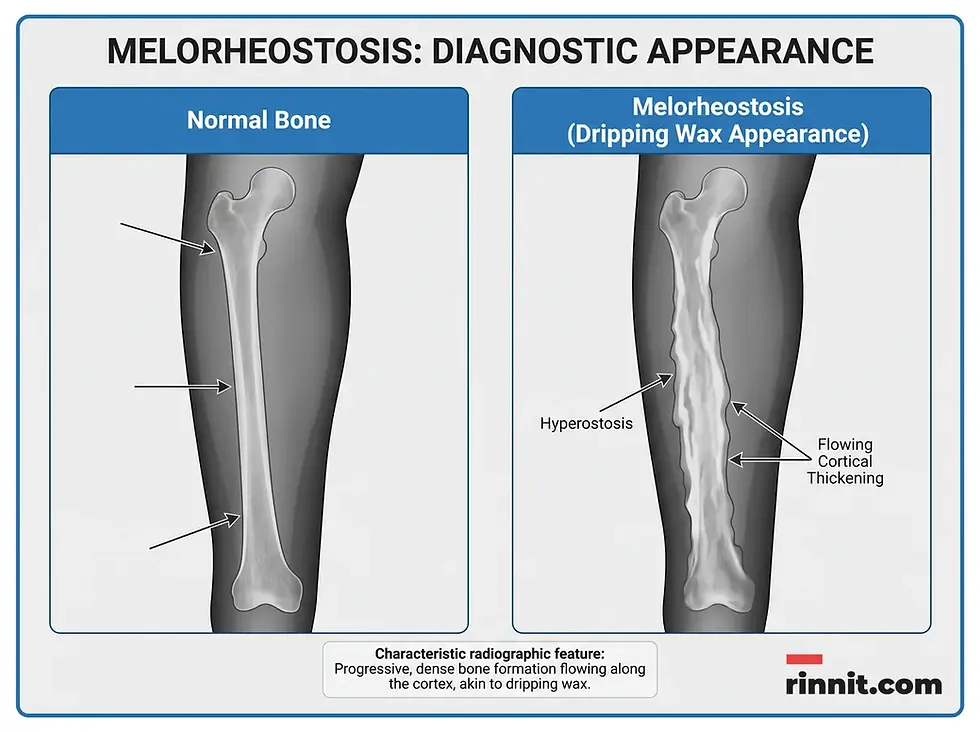
On an X-ray, melorheostosis can make the outer layer of the bone look like dripping candle wax.
The most distinctive feature is this appearance on imaging. The condition may worsen over time and can limit movement, but it is not cancerous, it does not spread from one bone to another, and it does not affect life expectancy[1].
What are the symptoms of melorheostosis?
About half of people with melorheostosis have symptoms by age 20. Symptoms usually develop in childhood, sometimes within the first few days of life, and they may get more severe over time. They usually affect only the arm or leg involved[1].
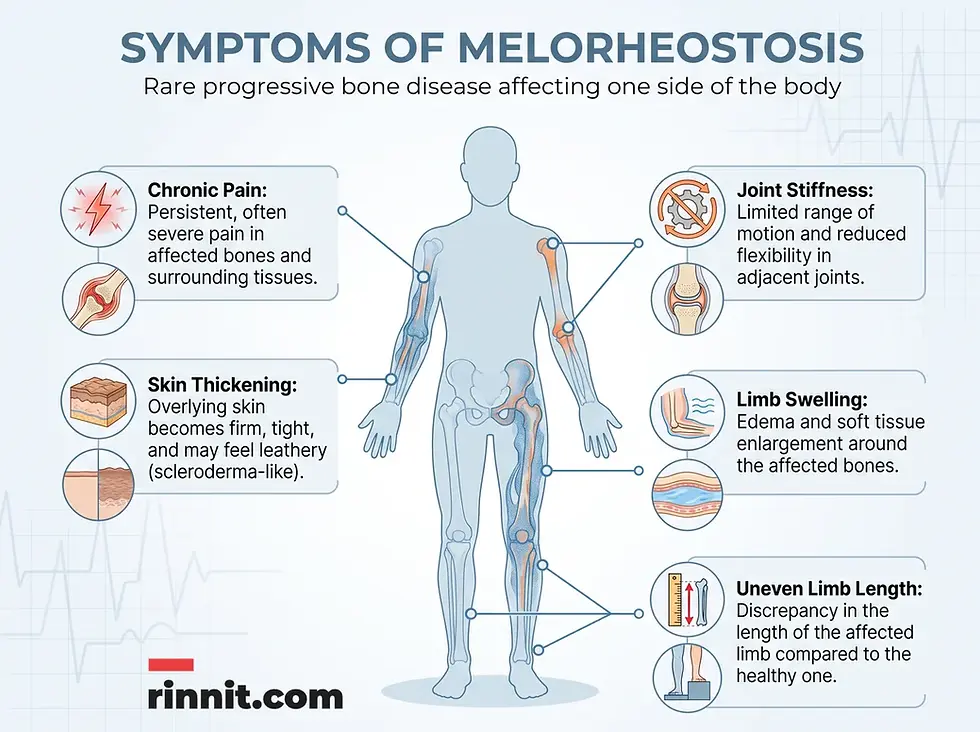
Chronic pain, joint stiffness, skin thickening, limb swelling, and uneven limb length are common features.
Symptom category | Common clinical signs |
Physical appearance | Irregularly thick or wide bones; hardened or shiny skin. |
Mobility | Chronic pain, limited range of motion, and joint deformities (contractures). |
Limb differences | Uneven arm or leg lengths and muscle wasting (atrophy) in the affected limb. |
Swelling | Fluid buildup in the limb (edema or lymphedema). |
What causes melorheostosis to develop?
In about 1 in 2 cases, melorheostosis occurs because of a change (mutation) in the MAP2K1 gene, which makes a protein that controls how bone cells grow. The change happens randomly (sporadically) and is not passed down from your parents. In the other half of people, the cause is not known[1][4].
Because melorheostosis happens randomly, there is no way to prevent it[1].
How is melorheostosis diagnosed?
Providers use imaging tests to diagnose melorheostosis. X-rays are often the most useful because the "dripping wax" pattern is so distinctive. A bone scan, which uses a small injected dose of radioactive material, can also be used. Your provider may also recommend genetic testing of a sample of the affected bone, because the gene change is usually found only in the affected tissue and not in blood[1].
Several other conditions can look similar, so your provider may need to rule them out. These include Buschke-Ollendorff syndrome, desmoid tumor, hemangioma, osteopathia, osteopoikilosis, and scleroderma[1].
How is melorheostosis treated and managed?
Melorheostosis has no cure, but physical and occupational therapy, medication and sometimes surgery can help manage symptoms and improve function. The right plan depends on how severe the symptoms are and where the bone growth is[1][3]:
Physical therapy: builds strength and increases range of motion in affected joints.
Occupational therapy: improves fine motor skills and helps with daily activities such as bathing or getting dressed.
Medication: nonsteroidal anti-inflammatory drugs (NSAIDs) or bisphosphonates to help reduce bone pain.
Surgery: to remove excess bone growth or reshape bones when growth limits movement or causes deformity.
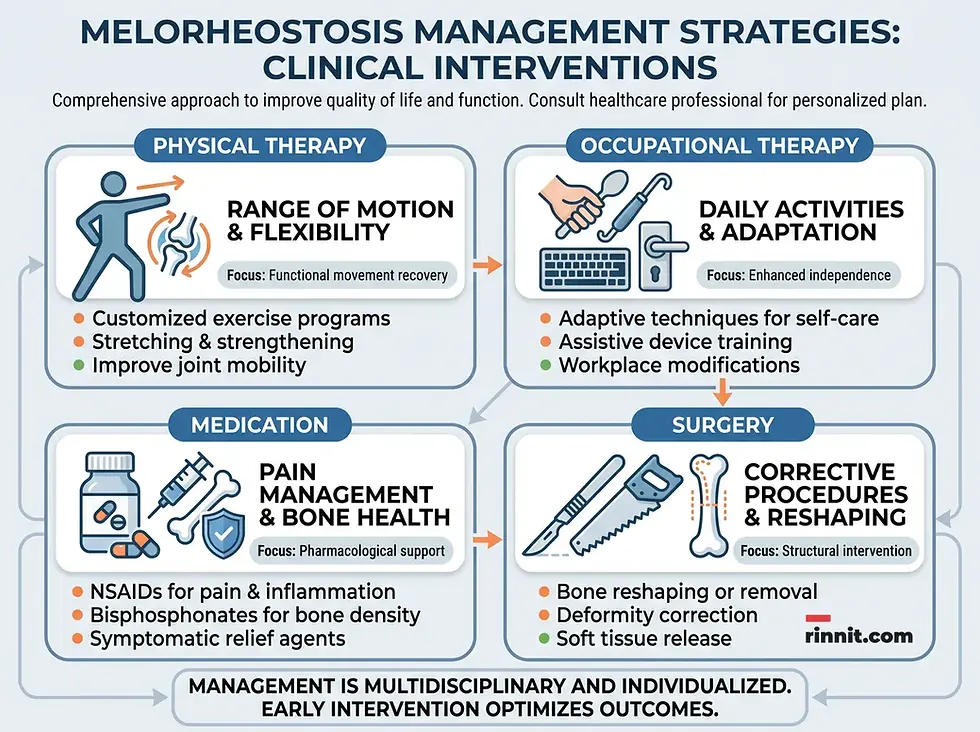
Management is individualized and often combines therapy, medication, and surgery.
What is the bottom line on melorheostosis?
Melorheostosis is a lifelong condition that needs a personalized plan to manage pain and mobility. Although it is rare and can be hard to diagnose, X-rays and genetic testing provide clear ways to identify it. If you or your child has unexplained limb pain, joint stiffness, or unusual skin changes, talk to a healthcare professional. The right combination of therapy, medication, and, when needed, surgery can improve quality of life[1].
Frequently Asked Questions
What is melorheostosis?
Melorheostosis is a rare bone disorder in which new bone tissue grows on top of existing bone, making it thick or wide.
How rare is melorheostosis?
Melorheostosis is very rare, affecting about 1 in 1 million people worldwide.
What does melorheostosis look like on an X-ray?
The new bone looks like dripping or flowing candle wax along the side of the affected bone.
Is melorheostosis hereditary?
No. The gene change linked to the condition happens randomly and is not passed down from parents.
At what age do symptoms usually start?
Symptoms usually appear in childhood or adolescence, and about half of people have symptoms by age 20.
Can melorheostosis spread to other bones?
No. It does not spread from bone to bone, although the growth on the affected bone can worsen over time.
What are the main symptoms?
Common symptoms include chronic pain, limited joint movement, hardened or shiny skin, limb swelling, and uneven limb lengths.
How is melorheostosis treated?
Treatment focuses on managing symptoms with physical and occupational therapy, pain medication or bisphosphonates, and sometimes surgery.
Does melorheostosis affect life expectancy?
No. It is not cancerous and does not affect life expectancy, but it can limit movement and function.
Can melorheostosis be cured?
There is no cure, but treatment can help manage symptoms and improve quality of life.
Related Reading
Osteopoikilosis: Symptoms, Causes, Diagnosis, Treatment, and Outlook — What You Need to Know describes a related bone condition that sometimes occurs with melorheostosis.
Bone Scan: What It Shows, How It's Done, Results and Risks explains an imaging test used to map areas of abnormal bone.
Contracture: Symptoms, Causes, Diagnosis, Treatment and Prevention — What You Need to Know covers stiff, tightened joints and how they are treated.
Fibrous Dysplasia: Understanding Bone Weakness and Fibrous Tissue Replacement explains another rare condition where abnormal tissue replaces normal bone.
References
Cleveland Clinic. Melorheostosis. Cleveland Clinic. June 7, 2022. https://my.clevelandclinic.org/health/diseases/23447-melorheostosis
Smith GC, Pingree MJ, Freeman LA, et al. Melorheostosis: a retrospective clinical analysis of 24 patients at the Mayo Clinic. PM R. 2017;9(3):283-288. PMID 27485676. https://doi.org/10.1016/j.pmrj.2016.07.530
Jha S, Cowen EW, Lehky TJ, et al. Clinical evaluation of melorheostosis in the context of a natural history clinical study. JBMR Plus. 2019;3(8):e10214. PMID 31485554. https://doi.org/10.1002/jbm4.10214
Bhattacharyya T. Unraveling melorheostosis: insights into clinical features, diagnosis, and treatment. JBMR Plus. 2025;9(2):ziae163. PMID 39776616. https://doi.org/10.1093/jbmrpl/ziae163
Medical disclaimer
This article is for informational purposes only and is not a substitute for professional medical advice, diagnosis, or treatment. The clinical information in this guide reflects source material last reviewed in June 2022.



Comments