Osteopoikilosis: Symptoms, Causes, Diagnosis, Treatment, and Outlook — What You Need to Know

Updated: 2 days ago
Medically reviewed by Dr. Baraa Alnahhal, MD · Last reviewed: September 2026
TL;DR (Too Long; Didn't Read)
Osteopoikilosis (OPK) is a rare, inherited skeletal condition characterized by the development of small, round, dense spots of bone, typically near the joints. Often referred to as "spotted bone disease" due to its distinct appearance on X-rays, it is caused by a mutation in the LEMD3 gene. While the condition can be startling when discovered accidentally during imaging for other issues, it is benign, does not weaken the bones, and rarely requires treatment. Most individuals remain asymptomatic throughout their lives, though a small percentage may experience mild joint pain or swelling.
Quick Answer: What is Osteopoikilosis?
Osteopoikilosis is a rare genetic condition where specific areas of bone tissue become overly dense, appearing as bright white spots on diagnostic imaging. These spots usually form during childhood and stop developing once skeletal maturity is reached in adulthood. The condition affects approximately 1 in 50,000 people and is typically inherited in an autosomal dominant pattern, meaning a child has a 50% chance of inheriting the gene if one parent has it.
Despite the "spotted" appearance on X-rays, the bones remain structurally sound and are not more prone to fractures. In most cases, the condition is discovered by chance during X-rays for unrelated injuries. While 80% of people have no symptoms, about 20% may experience joint inflammation or pain similar to mild arthritis. Because it is noncancerous and does not progress into bone cancer, medical intervention is rarely necessary unless pain management is required.
Understanding the Basics of Osteopoikilosis
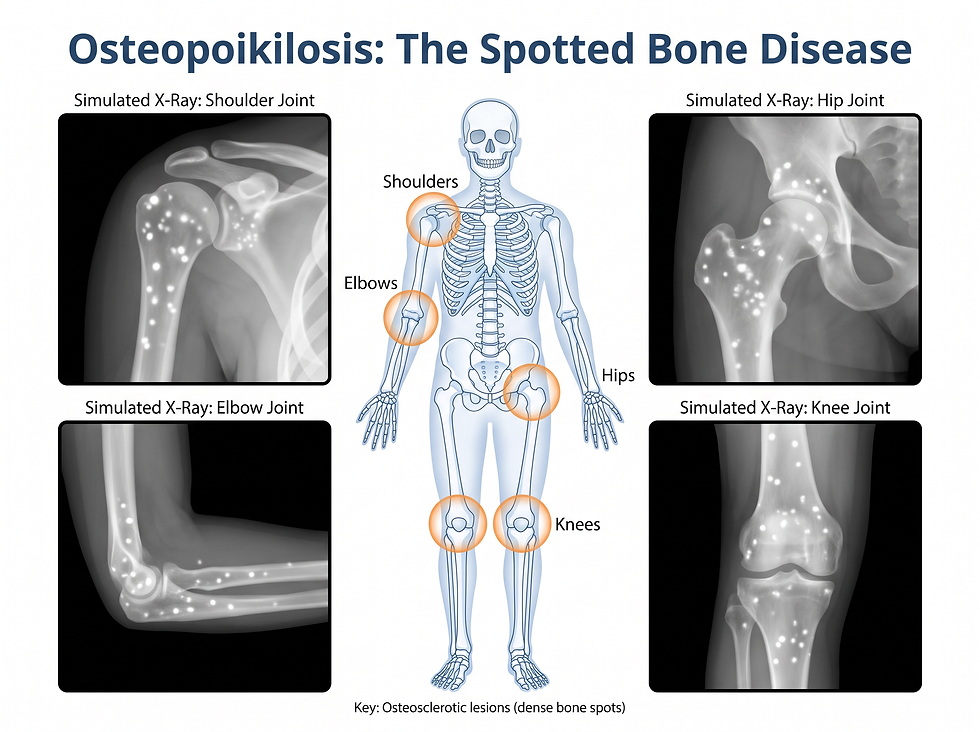
Osteopoikilosis primarily affects the musculoskeletal system, specifically the ends of long bones in the arms and legs, as well as the hands, feet, and pelvis. The term itself is derived from the Greek words for "spotted bone."
Feature | Description |
Prevalence | Approximately 1 in 50,000 individuals |
Typical Discovery Age | Most commonly found between ages 15 and 60 |
Primary Risk Factor | Family history (autosomal dominant inheritance) |
Bone Strength | Unaffected; bones are as strong as normal bone tissue |
Malignancy Risk | Benign; no increased risk of bone cancer |
"Osteopoikilosis is a noncancerous condition that rarely causes problems. Most people are surprised to find out they have it. You inherit a mutated gene from a parent that causes your bones or joints to become extra dense." [1]
Symptoms and Clinical Signs
For the vast majority of patients, osteopoikilosis presents no outward signs. However, clinical manifestations can occur in a minority of cases, often mimicking other rheumatological conditions.
Asymptomatic Nature
Most individuals live their entire lives without knowing they have the condition. The dense spots do not interfere with mobility, growth, or general health.
Joint and Bone Pain
Approximately 20% of individuals with the condition report joint pain or inflammation. This pain is often described as similar to the discomfort found in osteoarthritis or rheumatoid arthritis.
Symptom | Frequency | Clinical Note |
No Symptoms | ~80% | Discovered incidentally on X-ray |
Joint Pain | ~20% | May affect joints near dense bone spots |
Joint Swelling | Rare | Often associated with activity or related syndromes |
Bone Fractures | Not increased | Bone structural integrity remains normal |
Causes and Genetic Inheritance
The primary driver of osteopoikilosis is a genetic mutation affecting bone formation proteins.
The LEMD3 Mutation
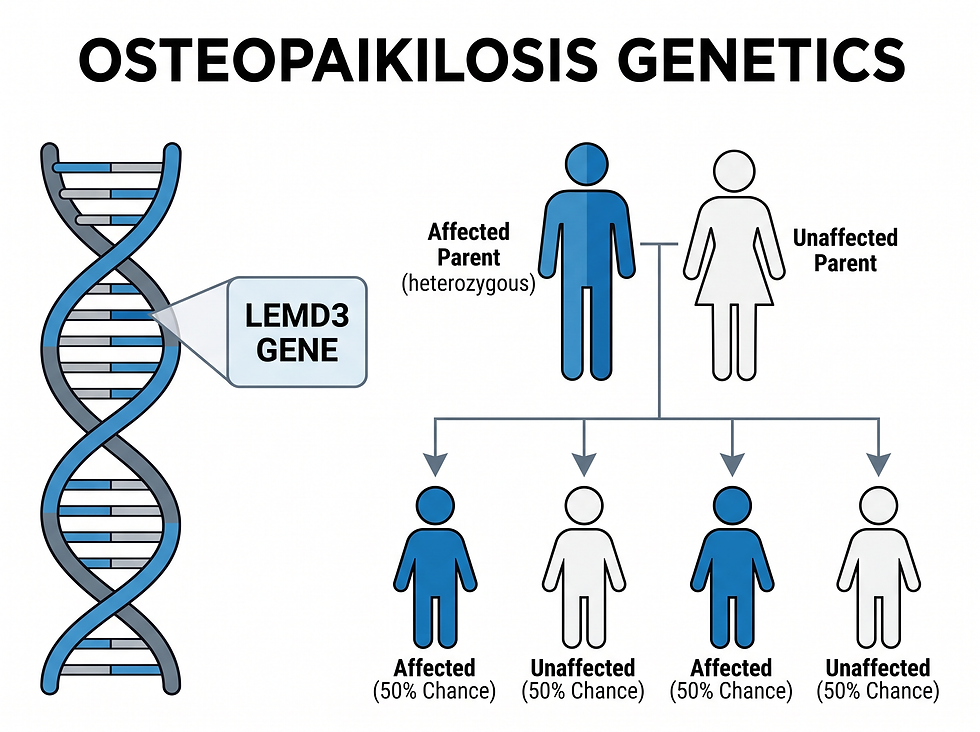
Research indicates that a change in the LEMD3 gene is responsible for the condition. This gene is responsible for producing a protein that regulates bone formation. When the gene is mutated, there is insufficient protein production, leading to an over-accumulation of dense bone tissue in specific clusters.
Inheritance Patterns
Osteopoikilosis follows an autosomal dominant inheritance pattern. This means:
If one parent has the mutated gene, each child has a 50% chance of inheriting it.
A person who inherits the gene also has a 50% chance of passing it to their own children.
Spontaneous mutations can occur in individuals with no family history of the disease.
Related Conditions and Syndromes
Osteopoikilosis sometimes appears as part of a broader clinical picture involving other connective tissue or bone disorders.
Associated Condition | Characteristics |
Buschke-Ollendorff Syndrome | Connective tissue disease affecting skin and bone formation |
Mixed Sclerosing Bone Dysplasia | Condition involving multiple types of bone diseases simultaneously |
Melorheostosis | Rare condition causing excess bone growth, often compared to "dripping candle wax" |
Osteopathia Striata | Also known as Voorhoeve disease; characterized by hard, thick bones |
Diagnosis and Diagnostic Imaging
Because it is often asymptomatic, the diagnosis of osteopoikilosis is frequently an "accidental finding" during the evaluation of other medical issues.
Imaging Techniques
X-rays: The primary diagnostic tool. Dense bone spots appear as small, round, bright white areas.
MRI and CT Scans: Used to rule out other conditions or to investigate related skeletal abnormalities.
Genetic Testing: A blood test can confirm the presence of the LEMD3 gene mutation.
Differential Diagnosis
Orthopedists must distinguish osteopoikilosis from other conditions that cause bone spots, such as bone metastases (cancer that has spread). The symmetrical and benign appearance of OPK spots typically helps in making the distinction.
Management and Treatment Strategies
In most cases, no treatment is necessary. The focus is on monitoring and managing symptoms if they arise.
Pain Management
For the minority of patients who experience joint pain or inflammation, standard pain relief protocols are used:
Analgesics: Over-the-counter pain relievers.
NSAIDs: Nonsteroidal anti-inflammatory drugs to reduce swelling and discomfort.
Activity and Lifestyle
There are no specific activity restrictions for individuals with osteopoikilosis. Since bone strength is not compromised, patients can participate in sports and physical activities as they normally would.

Outlook and Long-Term Prognosis
The long-term outlook for individuals with osteopoikilosis is excellent. It is a stable, non-progressive condition that does not affect life expectancy or general quality of life.
Key Prognostic Facts
Non-Progressive: Spots typically stop forming once the skeleton matures.
Benign: There is no documented increase in the risk of bone cancer or other malignancies.
Stable: Bone strength remains within normal ranges.
When to See a Doctor
While the condition is benign, you should consult a healthcare provider if you experience:
Persistent or unexplained joint pain.
Visible inflammation or swelling around joints.
Unexplained bone pain that interferes with daily activities.
FAQ: Frequently Asked Questions
1. Is osteopoikilosis a form of cancer?
No, it is a benign (noncancerous) condition and does not increase your risk of developing bone cancer.
2. Does the "spotted bone" appearance mean my bones are weak?
No. Despite the appearance on X-rays, the bones are as strong as those in individuals without the condition.
3. Can I prevent osteopoikilosis?
Because it is a genetic condition, there is no way to prevent it if you have inherited the mutated gene.
4. How common is this condition?
It is rare, affecting approximately 1 in 50,000 people.
5. Why are the spots called "bright" on an X-ray?
Dense bone tissue absorbs more X-ray radiation, causing those areas to appear whiter or "brighter" than the surrounding bone.
6. Do the spots grow over time?
They typically form during childhood and stop developing once you reach skeletal maturity in adulthood.
7. Is there a specific test for osteopoikilosis?
It is usually diagnosed via X-ray, but genetic blood tests can confirm the LEMD3 mutation.
8. Can osteopoikilosis affect my skin?
Yes, if it is part of Buschke-Ollendorff syndrome, it can be associated with skin lesions.
9. Does it affect men and women differently?
It affects both sexes, though males may have a slightly higher risk.
10. Will I need surgery for this?
Surgery is not a standard treatment for osteopoikilosis as the condition is benign and rarely causes structural issues.
11. Can I pass this to my children?
Yes, if you have the condition, there is a 50% chance of passing the gene to each of your children.
12. What parts of the body are most affected?
The ends of long bones in the arms and legs, as well as the pelvis, hands, and feet.
13. Does it cause arthritis?
It does not cause arthritis, but the joint pain some people experience can feel very similar to it.
14. Are there any restrictions on exercise?
No, most people can engage in all forms of physical activity without restriction.
15. Should my family members be tested?
If you are diagnosed, your provider may suggest testing for family members to understand the inheritance pattern.
References
Cleveland Clinic. Osteopoikilosis. https://my.clevelandclinic.org/health/diseases/24277-osteopoikilosis. Accessed August 22, 2026.
Genetic and Rare Diseases (GARD) Information Center. Osteopoikilosis. https://rarediseases.info.nih.gov/diseases/4158/osteopoikilosis.
National Library of Medicine. Buschke-Ollendorff Syndrome. https://medlineplus.gov/genetics/condition/buschke-ollendorff-syndrome/.
Medical Disclaimer: The information provided in this article is for educational purposes only and should not be used for diagnosing or treating a health problem or disease. Always seek the advice of your physician or other qualified health provider with any questions you may have regarding a medical condition.
Comments