Fibrous Dysplasia: Understanding Bone Weakness and Fibrous Tissue Replacement

Updated: 3 days ago
Medically reviewed by Dr. Baraa Alnahhal, MD · Last reviewed: October 2026
Source currency note: This guide reflects medical information reviewed in May 2025. Always confirm current guidance with your healthcare professional.
Quick Answer
Fibrous dysplasia is a rare, benign bone condition in which abnormal scar-like fibrous tissue replaces healthy bone, weakening it and causing pain, fractures or bone shape changes, though some people have no symptoms. It results from a random, non-hereditary GNAS1 gene change. There is no cure; treatment ranges from observation to medicine, bracing and surgery. [4]
What the research says
Most cases trace to a GNAS mutation. A meta-analysis of 878 patients found GNAS mutations in 74% of people with fibrous dysplasia (95% CI 64% to 83%), and mutation testing was highly specific for diagnosis (sensitivity 0.83, specificity 0.99) (Zhang et al., Frontiers in Genetics, 2024 [1]).
Bone-strengthening drugs can ease pain. A meta-analysis of 21 studies and 374 patients, mostly treated with pamidronate or denosumab, found pain fell by 32.7% after 6 to 12 months of antiresorptive treatment and by 44.5% after a mean of about 41 months (Bertin et al., Reviews in Endocrine & Metabolic Disorders, 2023 [2]).
Observation suits many people, but follow-up matters. A systematic review of 193 articles on craniofacial fibrous dysplasia found that diagnosis is often incidental and based on CT, that asymptomatic patients are suitable for observation, and that follow-up is encouraged for everyone to watch for lesion reactivation, late complications, and, rarely, malignant transformation (Tuompo et al., Bone, 2024 [3]).
What is fibrous dysplasia?
Fibrous dysplasia (FD) is a chronic bone condition in which abnormal, scar-like fibrous tissue replaces normal bone and marrow. This tissue is weaker than healthy bone, so the bone is more likely to fail under stress. FD is benign, meaning it is not cancerous and will not spread to other bones [4].
Classification | Description |
Monostotic | Affects only a single bone (the most common form) |
Polyostotic | Affects several bones throughout the body |
Common sites | Femur (thigh), tibia (shin), ribs, skull, and humerus |
Associated condition | McCune-Albright syndrome (polyostotic FD with skin and hormone problems) |
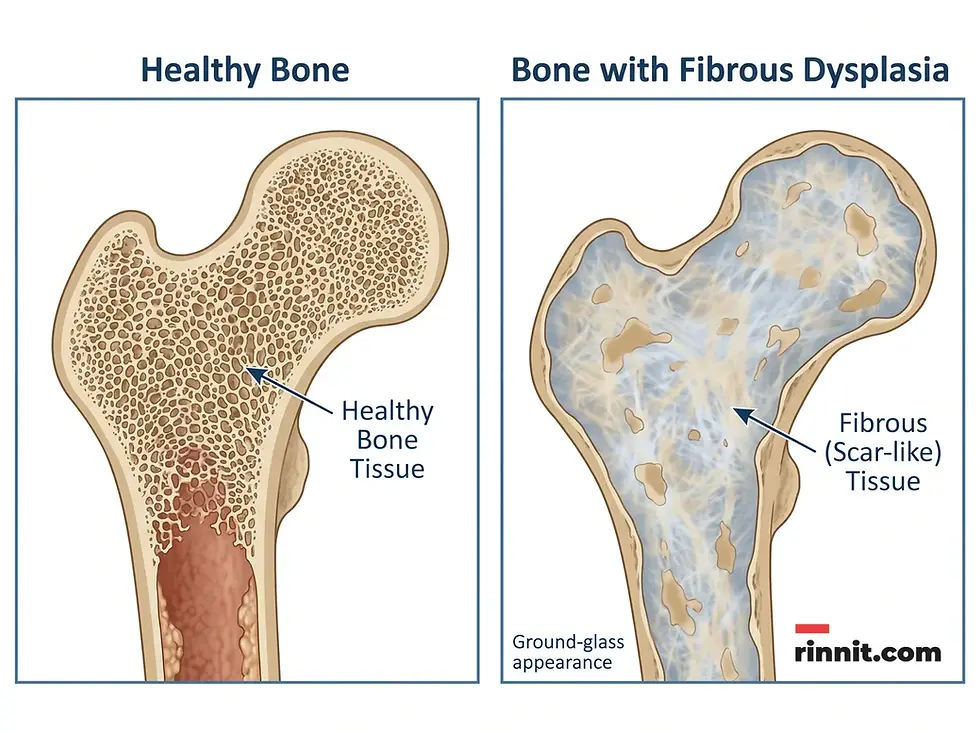
The condition varies widely in severity. Some people have a single affected bone and no symptoms, while others with several affected bones face significant physical challenges [4].
What are the symptoms and warning signs of fibrous dysplasia?
Symptoms depend on how many bones are affected and where. In many people the condition is “silent” and is only discovered when imaging is done for an unrelated problem [4].
Physical indicators
Bone pain: Persistent, dull aching in the affected area.
Frequent fractures: Breaking bones more easily than expected from minor impacts.
Deformities: Visible changes in bone shape, such as curvature of the spine (scoliosis) or bowed legs, or a painless swollen area on the ribs.
Facial changes: If the skull is affected, bulging eyes, jaw misalignment, misaligned teeth, or nasal congestion.
Complications
The most common complication is a higher chance of breaking a bone. If FD affects bones around the eyes or ears, it can also cause vision or hearing problems [4].
Symptom category | Common signs |
Skeletal | Bone pain, fractures, swollen ribs, scoliosis |
Facial and skull | Bulging eyes, misaligned teeth, jaw issues, nasal congestion |
Sensory | Possible hearing or vision problems (when bones around the eyes or ears are involved) |
Asymptomatic | No visible signs; found incidentally on an X-ray |
What causes fibrous dysplasia?
Fibrous dysplasia is not inherited from parents. It happens when the GNAS1 gene changes after conception, and experts do not know what triggers the change [4].
The role of osteoblasts
The gene change affects osteoblasts, the cells that build and maintain bone. Instead of producing mature, healthy bone, the affected cells produce the weaker fibrous tissue that defines the disorder [4].
Because the change occurs after conception (a “somatic” change), it affects only some cells and some parts of the body, which helps explain why some people have one affected bone while others have several. Because it is not present in reproductive cells, people with fibrous dysplasia cannot pass it on to their children [4].

How is fibrous dysplasia diagnosed?
Diagnosis starts with a physical exam and a review of the medical history. If fibrous dysplasia is suspected, a provider combines lab tests and imaging to confirm it [4].
Diagnostic tools
Imaging: X-rays are the most common tool and typically show a “ground glass” appearance of fibrous tissue in the bone. CT scans and MRI give more detailed views of how far it extends.
Lab tests: Blood or urine tests can check for high enzyme levels that may point to fibrous tissue growth.
Biopsy: In some cases, a small sample of tissue is removed and examined under a microscope to rule out other conditions.
Test type | Purpose |
X-ray | Detecting fractures and fibrous tissue patterns |
CT or MRI | Mapping the exact extent of bone involvement |
Blood or urine tests | Checking enzyme levels that may signal fibrous tissue growth |
Biopsy | Confirming the diagnosis and ruling out other conditions |
How is fibrous dysplasia managed and treated?
Fibrous dysplasia has no cure, so treatment aims to manage pain, strengthen the bones and prevent or treat fractures. The plan is individualized based on symptoms [4].
Non-surgical approaches
If there are no symptoms, observation with regular follow-up visits may be all that is needed. When treatment is needed, it often includes:
Medication: Drugs that strengthen bone and help prevent fractures.
Bracing: External supports that help bones grow correctly and prevent deformities.
Surgical intervention
Surgery may be needed to treat broken bones. Surgeons may use bone grafts, and may use metal rods or plates to provide internal stability [4].

What is the outlook and long-term care for fibrous dysplasia?
Fibrous dysplasia is a chronic condition, so living with it means ongoing medical follow-up and staying alert for new bone pain or signs of weakness. It affects people in different ways, and many manage their symptoms well [4].
Injury prevention: Take extra care to avoid falls and high-impact activities that could lead to fractures.
Immediate care: Go to the emergency room right away after a fall or a hit to a known affected bone.
Regular monitoring: Attend all scheduled follow-up imaging and exams so changes are caught early.
If you have persistent bone pain or notice changes in the shape of your bones, talk to a healthcare professional. Early diagnosis and a proactive management plan are key to protecting skeletal health and preventing complications.
Frequently Asked Questions
Is fibrous dysplasia a type of bone cancer?
No. Fibrous dysplasia is a benign (non-cancerous) disorder. While it involves abnormal tissue growth, it does not spread to other bones and is not life-threatening in the way cancer is.
Can I pass fibrous dysplasia to my children?
No. The condition is caused by a random genetic change that occurs after conception. It is not hereditary, so it is not passed down from parents and cannot be passed on to your children.
What bones are most commonly affected?
The most commonly affected bones include the femur (thigh bone), tibia (shin bone), ribs, skull, and humerus (upper arm bone). However, it can occur in any bone.
How is fibrous dysplasia diagnosed?
Fibrous dysplasia is typically diagnosed with imaging tests like X-rays, which show a characteristic “ground glass” appearance. CT scans, MRIs, and sometimes a biopsy are used for confirmation.
Can the fibrous tissue be completely removed?
While surgery can remove some fibrous tissue and replace it with bone grafts, the underlying condition is chronic. Surgery is usually reserved for stabilizing bones or treating fractures rather than “curing” the disease.
Does fibrous dysplasia cause pain?
Yes, many people experience a persistent, dull ache in the affected bone. However, some people have no symptoms and feel no pain at all.
What is McCune-Albright syndrome?
McCune-Albright syndrome is a rare disorder that combines polyostotic fibrous dysplasia with skin pigmentation (café-au-lait spots) and endocrine system problems, such as early puberty.
What are the main complications of fibrous dysplasia?
The most common complication is frequent bone fractures. Other issues include bone deformities, scoliosis, and possible vision or hearing problems if the bones around the eyes or ears are involved.
Is there a cure for fibrous dysplasia?
Currently, there is no cure for fibrous dysplasia. Treatment focuses on managing symptoms, strengthening the bones, and preventing injuries.
When should I see a doctor?
See a doctor if you have bone pain that does not go away, notice a change in the shape of a bone, or have a fracture from a minor impact. If you fall or take a hit to a known affected bone, go to the emergency room right away.
References
Zhang AB, Zhang JY, Xue J, et al. The prevalence, diagnostic accuracy and genotype-phenotype correlation of GNAS mutations in fibrous dysplasia: a meta-analysis. Frontiers in Genetics. 2024;15:1377716. PMID 39135681. https://doi.org/10.3389/fgene.2024.1377716
Bertin H, Moussa MS, Komarova S. Efficacy of antiresorptive agents in fibrous dysplasia and McCune Albright syndrome, a systematic review and meta-analysis. Reviews in Endocrine & Metabolic Disorders. 2023;24(6):1103-1119. PMID 37632645. https://doi.org/10.1007/s11154-023-09832-2
Tuompo S, Mäkitie RE, Nieminen MT. Craniofacial fibrous dysplasia: a review of current literature. Bone. 2024;192:117377. PMID 39681203. https://doi.org/10.1016/j.bone.2024.117377
Cleveland Clinic. Fibrous dysplasia. Cleveland Clinic. Medically reviewed May 14, 2025. https://my.clevelandclinic.org/health/diseases/17902-fibrous-dysplasia
Medical disclaimer
This article was prepared for general information only and is not a substitute for professional medical advice.



Comments