Tympanosclerosis: Understanding Eardrum Scarring and Hearing Health

Updated: 2 days ago
Medically reviewed by Dr. Baraa Alnahhal, MD | Last reviewed: October 7, 2026
Quick Answer
Tympanosclerosis is scarring of the eardrum, in which calcium deposits make the membrane thicken and harden [1]. Often triggered by previous infections or injuries, it shows up as bright white lesions visible during an ear exam [1]. While many cases require no intervention, people with conductive hearing loss may benefit from surgical procedures like tympanoplasty or from hearing aids [1].
What the research says
Ear tubes raise the risk of tympanosclerosis, which is usually cosmetic. A meta-analysis of tympanostomy tube sequelae drawn from 134 articles found tympanosclerosis in 32% of ears after tube extrusion, and tube placement increased the relative risk of tympanosclerosis 3.5-fold (95% CI 2.6–4.9) compared with non-intubated ears (baseline rate 10%); the authors described it as generally cosmetic (Kay et al., Otolaryngology–Head and Neck Surgery, 2001) [2].
Tympanosclerosis predicts poorer hearing after eardrum repair. A systematic review of 93 articles covering 6,685 patients found that adhesions and tympanosclerosis were prognostic factors for poorer hearing after tympanoplasty, while smoking and tympanosclerosis may predict anatomic failure, although results were mixed and limited by heterogeneity and the lack of controls (Gutierrez et al., Annals of Otology, Rhinology & Laryngology, 2023) [3].
How does tympanosclerosis cause eardrum scarring?
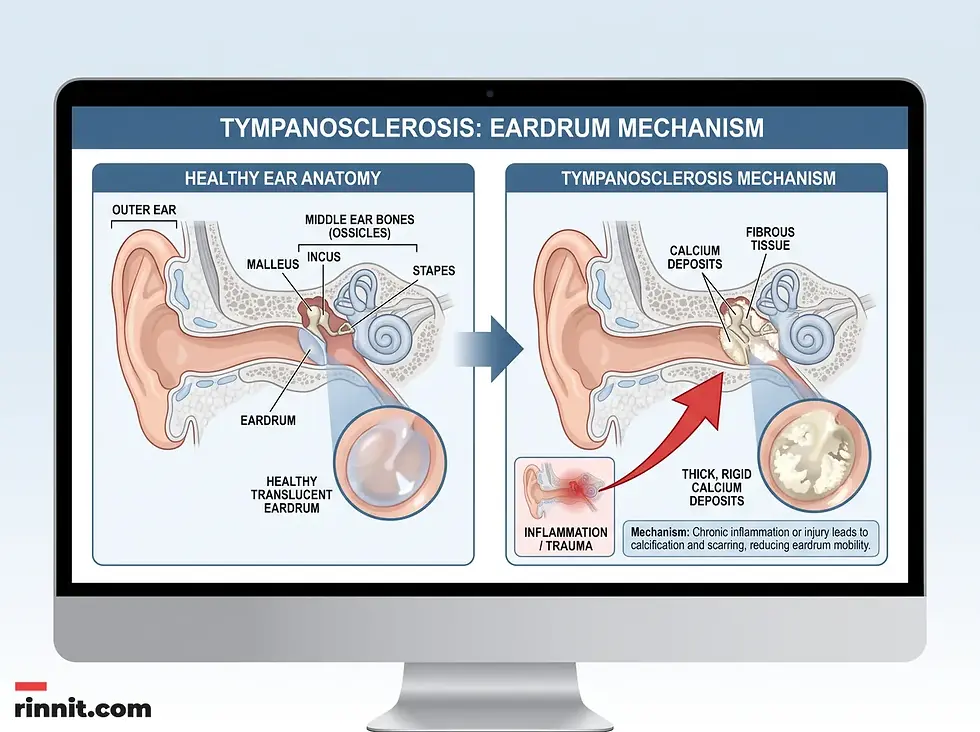
The eardrum, or tympanic membrane, is a delicate, translucent barrier that vibrates in response to sound waves. Tympanosclerosis occurs when this membrane sustains damage, typically from chronic infections, ruptures or surgical procedures [1], and undergoes an abnormal healing response. During this process, calcium deposits build up within the tissue [1], causing the once-flexible membrane to become thick, rigid and less responsive to sound vibrations.
Clinically, healthcare providers distinguish between myringosclerosis and tympanosclerosis. While both involve calcium deposits, myringosclerosis is limited strictly to the eardrum itself. In contrast, tympanosclerosis is more extensive, involving the eardrum as well as the tiny bones of the middle ear (ossicles) [1]. When these structures become rigid, they can no longer effectively conduct sound to the inner ear, leading to a specific type of auditory impairment known as conductive hearing loss [1].
Feature | Myringosclerosis | Tympanosclerosis |
Primary location | Limited to the eardrum (tympanic membrane) | Affects the eardrum and middle ear structures |
Structural impact | Thickening of the membrane only | Rigidness of both the membrane and the ossicles |
Visual sign | Chalky white spots on the eardrum | Chalky white spots and potential bone damage |
Hearing risk | Often asymptomatic | Higher risk of conductive hearing loss |
What are the symptoms and common causes of tympanosclerosis?
For many people, tympanosclerosis is a “silent” condition that is only discovered during a routine physical examination. The most prominent visual sign is the presence of bright, chalky white lesions on the eardrum, which an otolaryngologist can identify using a specialized light called an otoscope [1]. If the scarring is severe enough to impede the movement of the eardrum or middle ear bones, the primary symptom is a noticeable decrease in hearing clarity or volume.
The development of these calcium deposits is usually a long-term consequence of prior ear health challenges. Chronic ear infections, particularly those involving fluid buildup (glue ear), are significant contributors [1]. Additionally, a history of ruptured eardrums or the placement of ear tubes (tympanostomy) can trigger the scarring process [1]. While the condition itself is not contagious, the underlying bacterial or viral infections that lead to it can be transmitted between people [1].
Symptom or cause category | Clinical details |
Primary visual sign | Bright, chalky white spots or lesions on the eardrum [1] |
Auditory symptom | Conductive hearing loss (mild to severe) [1] |
Infection history | Acute or chronic middle ear infections and glue ear [1] |
Physical trauma | Ruptured eardrums or a history of ear surgery [1] |
How is tympanosclerosis treated, and what is recovery like?
If tympanosclerosis does not interfere with a person’s ability to hear, medical intervention is generally not required [1]. However, when conductive hearing loss occurs, healthcare providers focus on restoring the mechanical function of the ear. The most common treatment is surgery, such as myringoplasty to repair the eardrum or tympanoplasty to address both the membrane and the middle ear bones. During these procedures, surgeons remove the hardened scar tissue and may use grafts to reconstruct damaged areas [1].
For those who are not candidates for surgery or whose hearing is not fully restored after a procedure, hearing aids are a highly effective alternative. These devices amplify sound to compensate for the rigidity of the middle ear structures. Recovery from surgical intervention typically takes one to two weeks [1], during which patients are advised to avoid heavy lifting and ensure the ear canal remains dry to prevent post-operative infections.
Essential Management Strategies
Surgical repair: tympanoplasty or myringoplasty to remove scar tissue and repair structures
Auditory support: fitting for hearing aids if surgery is not an option or is partially successful
Infection prevention: prompt treatment of new ear infections [1] to prevent further scarring
Ear protection: avoiding the use of cotton swabs and wearing earplugs in loud environments [1]

Conclusion
Tympanosclerosis is a manageable condition that reflects the ear’s complex healing process. While the appearance of white spots on the eardrum may seem concerning, the majority of cases do not lead to significant health issues. By monitoring hearing health and seeking professional care when changes occur, people with eardrum scarring can maintain excellent auditory function and overall ear health.
Next Steps
If you or your child have a history of frequent ear infections and notice a change in hearing quality, schedule an evaluation with an ear, nose and throat (ENT) specialist. A simple ear exam can determine whether tympanosclerosis is present and help you decide on the best course of action for your hearing health.
Frequently Asked Questions
What is tympanosclerosis?
Tympanosclerosis is the medical term for scarring and calcium deposits on the eardrum.
What does it look like?
Tympanosclerosis appears as bright, chalky white spots or lesions on the thin membrane of the eardrum.
Is tympanosclerosis the same as myringosclerosis?
Tympanosclerosis and myringosclerosis are similar, but tympanosclerosis also involves the middle ear bones, while myringosclerosis is limited to the eardrum.
Does it always cause hearing loss?
No. Many people have scarring without any impact on their ability to hear.
What kind of hearing loss does it cause?
Tympanosclerosis causes conductive hearing loss, in which sound is blocked from reaching the inner ear because of structural rigidity.
Can ear infections cause this?
Yes. Both acute and chronic ear infections are primary causes of eardrum scarring.
Is the condition contagious?
No. You cannot pass tympanosclerosis to another person.
Can ear tubes cause scarring?
Yes. The placement of pressure-equalizing (PE) tubes can sometimes lead to localized scarring.
How is it diagnosed?
A doctor uses an otoscope or endoscope to look for white spots during a physical exam.
Do I need surgery for white spots on my eardrum?
Only if the scarring is causing significant hearing loss or other complications.
What is a tympanoplasty?
A tympanoplasty is a surgical procedure to repair the eardrum and the tiny bones in the middle ear.
How long is the recovery from ear surgery?
Most people recover within one to two weeks.
Can hearing aids help with tympanosclerosis?
Yes. They are an excellent option for people with hearing loss who do not wish to undergo surgery.
Can I prevent tympanosclerosis?
While not always preventable, prompt treatment of ear infections and avoiding ear trauma can reduce the risk.
Does the scar tissue ever go away on its own?
No. Once the calcium deposits form, they do not disappear without surgical removal.
Related Reading
Tympanoplasty: Eardrum Repair Surgery, Recovery, and Results explains the surgery used to repair a damaged eardrum.
What Is Conductive Hearing Loss? Symptoms, Causes, Diagnosis & Treatment Explained covers hearing loss caused by problems in the outer or middle ear.
Ear Infections: Symptoms, Causes, and Treatment explains the middle ear infections that often lead to eardrum scarring.
Ear Tubes (Tympanostomy): Why They're Placed, What Happens, and How Recovery Goes describes ear tube surgery, a common cause of eardrum scarring.
Sources
Cleveland Clinic. Tympanosclerosis. Cleveland Clinic. Last updated October 5, 2022. https://my.clevelandclinic.org/health/diseases/24265-tympanosclerosis
Kay DJ, Nelson M, Rosenfeld RM. Meta-analysis of tympanostomy tube sequelae. Otolaryngol Head Neck Surg. 2001;124(4):374-380. PMID 11283489. https://doi.org/10.1067/mhn.2001.113941
Gutierrez JA, Cabrera CI, Stout A, et al. Tympanoplasty in the setting of complex middle ear pathology: a systematic review. Ann Otol Rhinol Laryngol. 2023;132(11):1453-1466. PMID 36951041. https://doi.org/10.1177/00034894231159000
Medical disclaimer
This information is for educational purposes only and does not constitute medical advice. Always consult a qualified healthcare provider about any ear symptoms or hearing changes.



Comments