Topical Antibiotics: What They Treat, How to Use Them, and When to Get Help

Updated: 6 days ago
Written and medically reviewed by Dr. Baraa Alnahhal, MD · Last reviewed: October 2026 · How we review
Quick Answer: What are topical antibiotics?
Topical antibiotics are antibacterial medicines applied to the skin, eyes, or ears to kill bacteria or stop them from multiplying at the infection site. They come as ointments, creams, gels, eye drops, and ear drops, and they treat only bacterial infections. Finish the full course, and seek emergency care for signs of spreading infection or sepsis. [1]
What the research says
Plain petroleum jelly protected wounds about as well as an antibiotic ointment. In a randomized trial of 922 people after skin surgery, infection rates were 2.0% with white petrolatum and 0.9% with bacitracin, a difference that was not statistically significant. Four people (0.9%) in the bacitracin group developed allergic contact dermatitis, versus none with petrolatum. (Smack et al., JAMA, 1996) [2]
An antibiotic ointment gave no healing advantage and caused more burning. In a double-blind study of 30 people, each with two small skin wounds, a petrolatum-based ointment healed wounds as well as a combination antibiotic ointment. The antibiotic side caused more burning in week 1, and one person developed allergic contact dermatitis. (Draelos et al., J Am Acad Dermatol, 2011) [3]
On stitched surgical wounds, topical antibiotics probably lower infection risk. A meta-analysis of 14 randomized trials (6,466 participants) found topical antibiotics probably reduced surgical-site infection compared with no topical antibiotic (8 trials, 5,427 participants; risk ratio 0.61), about 20 fewer infections per 1,000 patients. Whether they raise allergy risk remained unclear. (Heal et al., Br J Surg, 2017) [4]
Key takeaways
Topical antibiotics treat bacterial infections only, not viral or other infections. [1]
They mostly stay at the infection site, so they cause fewer whole-body side effects than antibiotic pills. [1]
Over-the-counter (OTC) products are weaker than prescription ones and can irritate the skin. [1]
Petroleum jelly is often recommended instead of OTC antibiotic ointments for minor wounds. [1][2][3]
Always finish a prescribed course, and never use a product in a body area it wasn't made for. [1]
What are topical antibiotics and how do they work?
Topical antibiotics are antibacterial medicines you put on the outside of your body instead of swallowing or injecting them. [1]
They work in one of two ways: they kill bacteria, or they stop bacteria from multiplying. [1]
Some are sold over the counter. Most are prescription-only. [1]
Unlike antibiotic pills, injections, or IV drips, topical forms mainly stay where you apply them. They don't travel through your whole body. [1]
Remember: Topical antibiotics only work on bacterial infections. They won't help a viral infection. [1]
For a broader look at how all antibiotics work, see this overview of antibiotics.
What types of topical antibiotics are there?
Topical antibiotics come in three types, grouped by the body area they treat: skin (dermal), eye (ophthalmic), and ear (otic). [1]
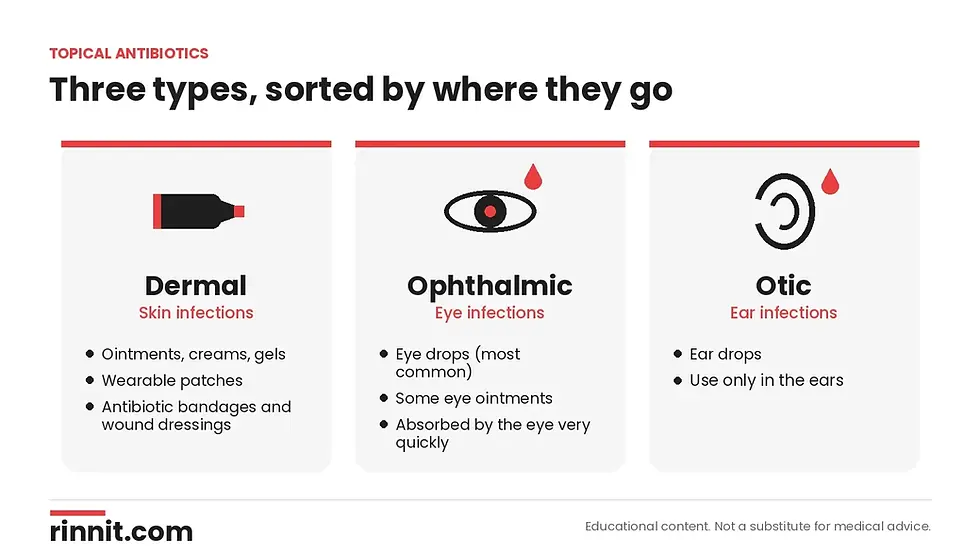
Type | Body area | Common forms | Good to know |
Dermal | Skin | Ointments, creams, gels, wearable patches, antibiotic bandages and wound dressings | The most familiar form for cuts and skin infections |
Ophthalmic | Eyes | Mostly eye drops; some eye ointments | The eyes absorb these medicines very quickly |
Otic | Ears | Ear drops | Made only for use in the ear |
Source: [1]
What are the benefits of topical antibiotics?
The main benefit of topical antibiotics is that they deliver medicine directly to the infection. [1]
That direct delivery brings three advantages:
What are the drawbacks of topical antibiotics?
The main drawbacks of topical antibiotics are limited strength in OTC products and a risk of skin reactions. [1]

Over-the-counter (OTC) | Prescription | |
Strength | Often not effective against many common bacteria | Usually much stronger |
Common ingredients | Bacitracin, neomycin, polymyxin B | Chosen by your provider for the infection |
Reaction risk | Irritation and allergic-type reactions are possible | Discuss side effects with your provider |
Source: [1]
Irritation and allergic-type reactions can happen, especially with OTC products. [1]
Is petroleum jelly better than an antibiotic ointment?
Petroleum jelly (petrolatum) is often recommended by healthcare providers instead of OTC antibiotic ointments for minor wounds. [1]
It works about as well as those OTC products, with a lower risk of reactions. [1]
Research supports this. In one large trial, wounds treated with plain petrolatum had infection rates similar to those treated with bacitracin, and no allergic reactions. [2] A smaller study found the same healing results, with less burning. [3]
Using antibiotics only when needed also helps slow antimicrobial resistance, when bacteria stop responding to the drugs meant to kill them.
How do you use topical antibiotics safely?
To use topical antibiotics safely, follow your prescription exactly and finish the full course, even if you feel better. [1]

Finish the full course. Stopping early can let the infection come back and raises the risk of antibiotic resistance. [1]
Don't stop without asking. Talk to your provider before stopping a prescribed medicine partway through. [1]
Keep each product in its place. Use eye drops only in the eyes, ear drops only in the ears, and skin products only on the skin. [1]
Ask about alternatives. For minor wounds, ask whether petroleum jelly could work instead of an OTC antibiotic. [1]
For closing small cuts, see our guide to Steri-Strips and butterfly bandages.
When should you call a doctor about a topical antibiotic?
You should call a healthcare provider if a topical antibiotic isn't helping or the infection is getting worse. [1]
Situation | What to do |
Treatment isn't working, or the infection is worsening | Call your healthcare provider [1] |
Side effects are bothersome or make treatment hard to continue | Call your healthcare provider [1] |
The infection returns after you finish treatment | Call your healthcare provider [1] |
Signs of a spreading infection or sepsis | Emergency: call your local emergency number now [1] |
Emergency warning: Sepsis is a medical emergency. If you notice signs of a spreading infection or sepsis, call your local emergency number right away. [1] For what to do while waiting for help, see our shock first-aid guide.
Topical antibiotics at a glance
Question | Short answer |
What do they treat? | Bacterial infections of the skin, eyes, or ears [1] |
Do they treat viruses? | No [1] |
OTC or prescription? | Both exist; most are prescription [1] |
Main advantage | Medicine goes straight to the infection with fewer side effects [1] |
Main risk | Irritation or allergic-type reactions, mainly with OTC products [1] |
Can I stop early? | Not without talking to your provider [1] |
Conclusion
Topical antibiotics are a targeted way to treat bacterial infections of the skin, eyes, and ears. They put medicine right where it's needed and avoid many side effects of antibiotic pills.
They aren't always the right choice, though. OTC ointments are often weaker than people expect, and for minor wounds, plain petroleum jelly may work just as well with fewer reactions.
Use each product only where it's meant to go, finish the full course, and get emergency help fast if an infection spreads.
Have a skin, eye, or ear infection that isn't improving? Bring this guide to your next appointment and ask your provider which option fits you best. Then explore our health library for more clear, research-backed guides like this one.
FAQ
What are topical antibiotics?
Topical antibiotics are antibacterial medicines applied to the outside of the body, such as the skin, eyes, or ears. They kill bacteria or stop them from multiplying where the infection is. [1]
Do topical antibiotics work on viral infections?
Topical antibiotics do not work on viral infections. They only treat infections caused by bacteria. [1]
Are over-the-counter antibiotic ointments effective?
Over-the-counter antibiotic ointments are often not effective against many common bacteria. Prescription topical antibiotics are usually much stronger. [1]
Can I use petroleum jelly instead of an antibiotic ointment?
Petroleum jelly is often recommended by healthcare providers instead of over-the-counter antibiotic ointments. It works about as well, with a lower risk of reactions. [1][2]
What are the side effects of topical antibiotics?
The side effects of topical antibiotics can include skin irritation and allergic-type reactions, especially with over-the-counter products. They largely avoid the stomach upset and diarrhea common with antibiotic pills. [1]
Can I stop using a topical antibiotic when I feel better?
You should not stop a prescribed topical antibiotic early without talking to your provider. Stopping early can let the infection return and raises the risk of antibiotic resistance. [1]
Can I use eye drops in my ears?
Eye drops should be used only in the eyes, and ear drops only in the ears. Skin products should be used only on the skin. [1]
When is an infection an emergency?
An infection is an emergency when it shows signs of spreading or of sepsis. Call your local emergency number right away. [1]
Can topical antibiotics cause an allergic reaction?
Yes. Some people get an itchy, red rash, especially from neomycin. Stop the product and talk to a provider if a rash appears, and call 911 for face swelling or trouble breathing.
Are topical antibiotics safe for children?
Many over-the-counter antibiotic ointments are safe for minor cuts in children when used as directed. Ask a pediatrician or pharmacist before using one on an infant or on a large area of skin.
Related Reading
Antibiotics: Types, Uses, Side Effects and Resistance explains how antibiotics work and how to use them safely.
References
Cleveland Clinic. What Are Topical Antibiotics? Cleveland Clinic. Last updated January 9, 2025. https://my.clevelandclinic.org/health/treatments/topical-antibiotics
Smack DP, Harrington AC, Dunn C, et al. Infection and allergy incidence in ambulatory surgery patients using white petrolatum vs bacitracin ointment. A randomized controlled trial. JAMA. 1996;276(12):972-977. PMID 8805732. https://pubmed.ncbi.nlm.nih.gov/8805732/
Draelos ZD, Rizer RL, Trookman NS. A comparison of postprocedural wound care treatments: do antibiotic-based ointments improve outcomes? J Am Acad Dermatol. 2011;64(3 Suppl):S23-S29. PMID 21247662. https://doi.org/10.1016/j.jaad.2010.11.010
Heal CF, Banks JL, Lepper P, et al. Meta-analysis of randomized and quasi-randomized clinical trials of topical antibiotics after primary closure for the prevention of surgical-site infection. Br J Surg. 2017;104(9):1123-1130. PMID 28656693. https://doi.org/10.1002/bjs.10588
Medical disclaimer
This article is for educational purposes only and is not a substitute for professional medical advice, diagnosis, or treatment. Always talk to a qualified healthcare provider about your health and before starting or stopping any medicine. In an emergency, call your local emergency number.



Comments