Tattoo Removal: How It Works, Sessions, Aftercare and Risks

Updated: 6 days ago
Written and medically reviewed by Dr. Baraa Alnahhal, MD · Last reviewed: October 2026 · How we review
Quick Answer: What is tattoo removal?
Tattoo removal is a medical procedure that removes permanent tattoo ink from the skin, most often with lasers that break ink into tiny particles the immune system clears. Surgery, dermabrasion and chemical peels are other options. Laser removal often takes six to 12 sessions. Possible risks include scarring and infection, so removal belongs with a qualified provider, not at home. [1]
What the research says
Picosecond lasers clear most black and blue tattoos well. A systematic review of six human trials (160 participants) found that 69% to 100% of tattoos reached more than 70% pigment clearance after 1 to 10 laser treatments, with mostly minor side effects (Reiter et al., Lasers in Medical Science, 2016). [2]
The number of sessions can be estimated before treatment starts. In a review of 100 patients, a six-factor score (skin type, location, color, amount of ink, scarring and layering) tracked closely with the sessions each person actually needed (correlation 0.757) (Kirby et al., Journal of Clinical and Aesthetic Dermatology, 2009). [3]
Newer short-pulse lasers have a low rate of side effects. A systematic review of picosecond lasers in dermatology, including tattoo removal, screened 41 articles and included 27; most studies showed safe and effective treatment with a low incidence of adverse effects (Torbeck et al., Dermatologic Surgery, 2019). [4]
Key takeaways
Tattoo ink stays in the skin because the particles are too large for the immune system to remove. [1]
Laser removal is the most common method; it breaks ink into smaller pieces the body can clear. [1]
Laser treatment usually takes six to 12 sessions, sometimes more. [1]
Surgery, dermabrasion and chemical peels remove the inked skin itself and usually leave a scar. [1]
Do not try to remove a tattoo at home; salt rubs and removal creams can damage skin or cause infection. [1]
Get care right away for severe pain or swelling after a removal session. [1]
How does tattoo removal work?
Tattoo removal works either by breaking ink into particles small enough for the immune system to clear, or by removing the layers of skin that hold the ink. [1]
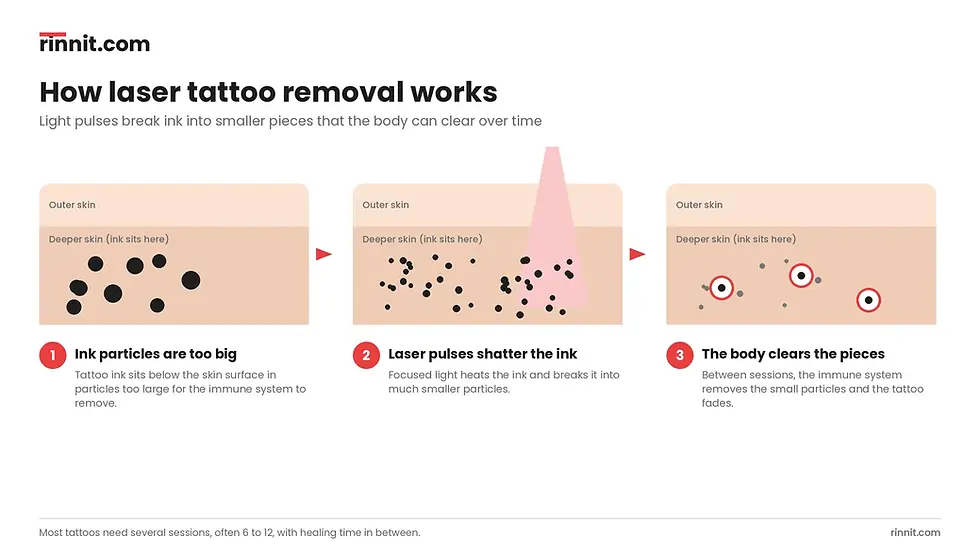
A tattoo is made by injecting inks and pigments into the skin. Your immune system normally clears foreign particles, but tattoo ink particles are too big for it to remove, which is why tattoos are permanent. [1]
Laser treatment and removal creams aim to shrink the ink particles so the body can carry them away, with a lower risk of scarring. Dermabrasion, chemical peels and surgical excision take away the inked skin instead, so the skin heals over the area. These methods usually cause scarring. [1]
Because professional tattoo ink sits below the skin's surface, removal can be a complex process that takes several sessions. [1]
What are the types of tattoo removal?
The main types of tattoo removal are laser treatment, dermabrasion, chemical peels, surgical excision and tattoo removal creams. [1]
Method | How it works | Scarring | Good to know |
Laser tattoo removal | Focused light heats ink and breaks it into smaller particles | Lower risk | Most common method; needs several sessions |
Surgical excision | The tattooed skin is cut out and the skin is stitched together | Usually | Works for small tattoos, not large ones |
Dermabrasion | A special tool removes the outer skin layers that hold ink | Usually | Needs local or general anesthesia; leaves an open wound to heal |
Chemical peel | A chemical such as trichloroacetic acid makes the outer layers peel | Usually | Applied by a provider |
Removal creams | Acids rubbed on the skin at home | Irritation and skin damage possible | Less effective; may take months to show results |
Source for table: [1]

You can read more about two of these procedures in our guides to dermabrasion and chemical peels.
How does laser tattoo removal work?
Laser tattoo removal uses focused beams of light that heat the ink particles in your skin and break them into smaller pieces your immune system can remove. [1]
What happens during a laser session?
A laser session starts with a skin test and then repeated light pulses over the tattoo while you wear eye protection. [1]
Consultation. A trained physician checks your skin and asks when you got the tattoo, whether you have had removal before, and whether it was done by a professional or an amateur. [1]
Planning. The provider measures the tattoo, may photograph it to track results, and builds a plan around the ink type, ink color and how deep the pigment sits. [1]
Eye protection. You wear protective eye shields. [1]
Test spot. Your skin's reaction to the laser is tested to find the most effective energy level. [1]
Treatment. The provider holds a hand piece against your skin and pulses the laser across the tattoo. Smaller tattoos need fewer pulses; larger ones need more. [1]
Aftercare. You get instructions on caring for the treated skin. [1]
Laser removal is related to other light-based skin treatments, which we cover in our guide to laser skin resurfacing.
How many sessions does laser tattoo removal take?
Laser tattoo removal often takes six to 12 sessions, and sometimes more, before you see final results. [1]
The exact number depends on the size of the tattoo and the color of the ink. A laser session can take just a few minutes, while surgical excision can take a few hours. [1]
More than one session is needed for three reasons: [1]
Tattoo artists apply ink in layers.
After the laser breaks up the pigment, your body needs time to flush out the particles.
Your skin needs time to heal between treatments.
The tattoo should look lighter after each treatment. Ask your provider how many sessions your tattoo is likely to need. [1]
Does tattoo removal hurt?
Tattoo removal can be uncomfortable, and the level of pain depends on the method used. [1]
Some people say laser removal feels like getting a tattoo, while others compare it to a rubber band snapping against the skin. Your skin may be sore afterward. For more painful procedures, a dermatologist may apply a numbing cream or inject a local anesthetic, or a surgeon may use general anesthesia. [1]
Will laser tattoo removal remove the whole tattoo?
Laser tattoo removal does not always remove a tattoo completely, although some treatments do. [1]
Results vary from person to person. Some ink colors resist removal, and some pigment sits too deep for the laser to reach. Blue and black inks respond well because they absorb light better. [1]
Who is a good candidate for tattoo removal?
A good candidate for tattoo removal is a person in good health who wants a tattoo removed and has realistic expectations. [1]
You may be a candidate if you: [1]
Have a tattoo you want removed
Are in good health
Don't smoke
Have realistic expectations for the results
Understand the risks and possible side effects
Common reasons people remove tattoos include no longer liking the design, a job that doesn't allow visible tattoos, or a tattoo linked to a painful memory or person. [1]
Is it safe to remove a tattoo at home?
Removing a tattoo at home is not safe, because home methods can damage your skin or cause an infection. [1]
At best, home removal doesn't work. At worst, it can harm your health. Removal at a tattoo parlor or spa may be safer than home remedies but still carries risks. A trained dermatologist can weigh your overall health and guide you to the safest plan. [1]
What are the risks of tattoo removal?
The main risks of tattoo removal are scarring, infection, skin discoloration, skin irritation or rash, and pain. [1]
Laser treatment can also cause swelling, blistering and temporary changes in skin color. Less often, it leaves superficial scarring or permanent discoloration. [1]
Tattoo removal is safe when a licensed or certified provider who specializes in it does the procedure. Newer laser systems have made treatment more effective, with a lower risk of scarring. [1]
Infection is one of these risks; our guide to tattoo infection explains how it is recognized and treated.
Does tattoo removal leave scars?
Some types of tattoo removal can leave scars, especially surgery, dermabrasion and chemical peels. [1]
You can lower your risk by caring for your skin after each session and following your provider's aftercare instructions. [1] If a raised scar does form, our guides to hypertrophic scars and scar revision cover the treatment options.
How should you care for your skin after tattoo removal?
After tattoo removal, you should cool the area, keep it covered and protected, avoid scrubbing, use sunscreen outdoors and avoid picking at the skin. [1]

When | What to do |
Right after treatment | Apply an ice pack to soothe the area |
Same day | Use the antibiotic cream or ointment your provider gives you, and cover the area with a bandage |
Next day | Shower as normal, but don't scrub the treated skin |
Whenever you go outside | Cover the treated area with sunscreen |
Throughout healing | Don't pick at the skin, because picking can lead to scarring |
Source for table: [1]
How do you find a doctor for tattoo removal?
To find a doctor for tattoo removal, start with your primary care provider, who can refer you to a dermatologist or surgeon who specializes in it. [1]
Because there are several removal options, you may want consultations with both a dermatologist and a surgeon to compare their advice on the best method for your tattoo. [1] For background reading, see the consumer overview of tattoo removal options and results and this patient guide to laser therapy for unwanted tattoos.
When should you see a doctor after tattoo removal?
You should see a doctor or go to the emergency room right away if you have severe pain or swelling after tattoo removal. [1]
Also book a visit with a healthcare provider before starting any removal, so they can check your skin and recommend the right method. [1]
Tattoo removal at a glance
Question | Short answer |
Most common method | Laser tattoo removal |
Typical laser sessions | 6 to 12, sometimes more |
Inks that respond best | Blue and black |
Methods that usually scar | Surgical excision, dermabrasion, chemical peels |
Home removal | Not recommended |
Urgent warning signs | Severe pain or swelling |
Source for table: [1]
Conclusion
Tattoos are designed to last, so removing one takes time, planning and the right provider. Laser removal is the most common choice and carries a lower scarring risk than cutting or peeling away skin, but it usually needs six to 12 sessions and may not erase every color. Surgery, dermabrasion and chemical peels can work in specific cases, while home creams and salt rubs put your skin at risk. With careful aftercare and a qualified provider, you can safely work toward fading or removing an unwanted tattoo. [1]
Considering tattoo removal? Save or print this guide and bring it to your consultation with a dermatologist or surgeon. For more plain-language skin guides, explore our articles on laser skin resurfacing, scar revision and tattoo infection, and follow us on Instagram and YouTube for new health explainers.
FAQ
What is the most common way to remove a tattoo?
Laser tattoo removal is the most common method for removing tattoos. It breaks ink into small particles the body clears, with a lower scarring risk than surgery or dermabrasion. [1]
How many laser sessions does it take to remove a tattoo?
Laser tattoo removal often takes six to 12 sessions, and sometimes more. The number depends on the tattoo's size and ink color, and your skin needs time to heal between sessions. [1]
Does laser tattoo removal hurt?
Laser tattoo removal can hurt, and many people compare it to getting a tattoo or to a rubber band snapping against the skin. A numbing cream or local anesthetic may be used, and the skin can feel sore afterward. [1]
Can a tattoo be removed completely?
A tattoo can sometimes be removed completely, but it is common for some ink to remain. Some colors resist removal and some pigment sits too deep for the laser, while blue and black inks respond best. [1]
Does tattoo removal leave a scar?
Tattoo removal can leave a scar, especially after surgical excision, dermabrasion or chemical peels. Laser removal has a lower scarring risk, and following aftercare instructions lowers it further. [1]
Is it safe to use tattoo removal cream at home?
Tattoo removal cream is not recommended, because its strong acids can irritate or damage the skin. Creams are less effective than other methods and may take months to show any results. [1]
How do I take care of my skin after tattoo removal?
After tattoo removal, apply an ice pack, use the antibiotic ointment you're given and cover the area with a bandage. Shower the next day without scrubbing, use sunscreen outdoors and don't pick at the skin. [1]
When should I see a doctor after tattoo removal?
See a doctor or go to the emergency room right away if you have severe pain or swelling after tattoo removal. These signs need prompt medical attention. [1]
Which tattoo colors are hardest to remove?
Black and blue inks usually respond best to laser treatment. Some other colors resist removal and may fade only partly, even after many sessions.
Why do laser tattoo removal sessions need to be spaced apart?
Your skin needs time to heal, and your body needs time to clear the broken-up ink between treatments. Your provider will set a schedule based on your skin and your tattoo.
Related Reading
Dermabrasion: Uses, Procedure, Recovery, Risks and Results explains how dermabrasion removes outer skin layers and what recovery involves.
Chemical Peels: Types, Recovery, Risks and What to Expect covers the types of chemical peels, their risks and recovery.
Tattoo Infection: Signs, Causes, Treatment and Prevention explains how to spot and treat an infected tattoo.
Laser Skin Resurfacing: Types, Benefits, Risks, Recovery and Results describes how laser resurfacing works and what to expect afterward.
References
Cleveland Clinic. Tattoo Removal: How It Works, Process, Healing & Scarring. Cleveland Clinic. Last updated December 9, 2022. https://my.clevelandclinic.org/health/treatments/8313-tattoo-removal
Reiter O, Atzmony L, Akerman L, et al. Picosecond lasers for tattoo removal: a systematic review. Lasers Med Sci. 2016;31(7):1397-1405. PMID 27311768. https://doi.org/10.1007/s10103-016-2001-0
Kirby W, Desai A, Desai T, et al. The Kirby-Desai Scale: A Proposed Scale to Assess Tattoo-removal Treatments. J Clin Aesthet Dermatol. 2009;2(3):32-37. PMID 20729941. https://pubmed.ncbi.nlm.nih.gov/20729941/
Torbeck RL, Schilling L, Khorasani H, et al. Evolution of the Picosecond Laser: A Review of Literature. Dermatol Surg. 2019;45(2):183-194. PMID 30702447. https://doi.org/10.1097/DSS.0000000000001697
U.S. Food and Drug Administration. Tattoo Removal: Options and Results. FDA Consumer Updates. Content current as of August 3, 2023. https://www.fda.gov/consumers/consumer-updates/tattoo-removal-options-and-results
American Society for Dermatologic Surgery. Laser Therapy for Unwanted Tattoo. American Society for Dermatologic Surgery. Accessed October 31, 2026. https://www.asds.net/skin-experts/skin-treatments/laser-light-therapy/laser-therapy-for-unwanted-tattoo
Medical disclaimer
This article is for general education only and is not a substitute for professional medical advice, diagnosis or treatment. Talk to a qualified healthcare provider about your own skin and the right tattoo removal option for you. If you have severe pain or swelling after a removal procedure, seek medical care right away.



Comments