Understanding Swyer Syndrome: Causes, Symptoms, and Management

Updated: 2 days ago
Medically reviewed by Dr. Baraa Alnahhal, MD · Last reviewed: October 2026
Quick Answer
Swyer syndrome is a difference of sex development in which a person has XY chromosomes but female anatomy, including a vagina, uterus and fallopian tubes. It occurs in approximately 1 in 80,000 people and is usually found in adolescence when puberty does not begin. [1] Treatment combines hormone replacement therapy with surgical removal of undeveloped gonadal tissue to prevent tumors.

What the research says
Streak gonads carry a real tumor risk, which is why surgery is advised. A review of familial 46,XY gonadal dysgenesis notes that dysgenetic gonads in people with Y chromosome material can develop gonadoblastoma or germinoma, and that management is preventive removal of the gonads plus long-term hormone replacement. The tumor risk was reported as 15–45% in sporadic cases and was higher (66.6%) in familial cases (Rudnicka et al., J Clin Med, 2024) [2].
New virilization should prompt a tumor check. A case report of a 16-year-old with Swyer syndrome describes progressive virilization caused by a dysgerminoma and gonadoblastoma, and highlights the need to consider early preventive gonadectomy (Alam et al., BMJ Case Rep, 2020) [3]. This is a single case, so it illustrates the risk rather than measuring it.
Estrogen therapy supports puberty and bones. A case report of two patients with 46,XY differences of sex development describes preventive gonadectomy followed by estrogen replacement to promote secondary sexual characteristics and menstruation and to prevent osteoporosis, with no tumor recurrence at follow-up (Yu & Liu, Medicine (Baltimore), 2024) [4]. Again, this is a small case report.
What Is Swyer Syndrome?
Swyer syndrome is a type of difference of sex development (DSD), sometimes described as an intersex variation. In typical development, XY chromosomes trigger the formation of male reproductive organs. In Swyer syndrome this process is disrupted, and the person develops a vulva, vagina, uterus, and fallopian tubes. Despite these female structures, the gonads do not become functioning ovaries or testes. Instead, they remain as non-functioning scar-like tissue called streak gonads. [1]
Streak gonads cannot make the sex hormones needed for physical maturation, so puberty does not occur naturally. The condition is present from birth, but it is often not identified until the teenage years, when expected signs of puberty such as menstruation do not appear.
What are the symptoms of Swyer syndrome?
Most people with Swyer syndrome have no noticeable health problems in childhood. The condition usually becomes apparent in adolescence. Without functioning gonads, the body does not receive the hormonal signals needed for breast development or the start of the menstrual cycle.
Symptom Category | Common Signs and Observations |
|---|---|
Delayed puberty | No menstrual periods (primary amenorrhea) and underdeveloped breasts. |
Physical growth | Often taller than peers. |
Secondary sex characteristics | Little or no pubic or underarm (axillary) hair. |
Internal anatomy | A uterus and fallopian tubes are present, but the gonads are non-functioning streak gonads. |
What causes Swyer syndrome, and which genetic factors are involved?
The main cause is a disruption in the genes that direct sex differentiation. This process is complex, and a change in any of the genes that guide testis development can lead to the condition. In many people the exact cause is never found.
Variants in the SRY (sex-determining region Y) gene are found in about 15% of people with Swyer syndrome (per MedlinePlus Genetics). [1] The SRY gene normally switches on testis development in the fetus; when it is altered or missing, the gonads remain undeveloped. Variants in other genes, including MAP3K1, DHH, and NR5A1, have also been linked to the condition. [1] Most cases are not inherited and occur in people with no family history [1], although some gene changes can be passed on.
How is Swyer syndrome diagnosed?
Diagnosis often begins when a teenager or their parents see a healthcare provider about delayed puberty. The evaluation combines a physical exam, imaging, and specialized laboratory tests.
Karyotype testing: analyzes the chromosomes and confirms XY chromosomes.
Genetic testing: detailed DNA analysis may identify specific variants in genes such as SRY.
Imaging studies: pelvic ultrasound or MRI shows the internal reproductive organs, confirming a uterus and the absence of functioning ovaries.
How is Swyer syndrome managed over the long term?
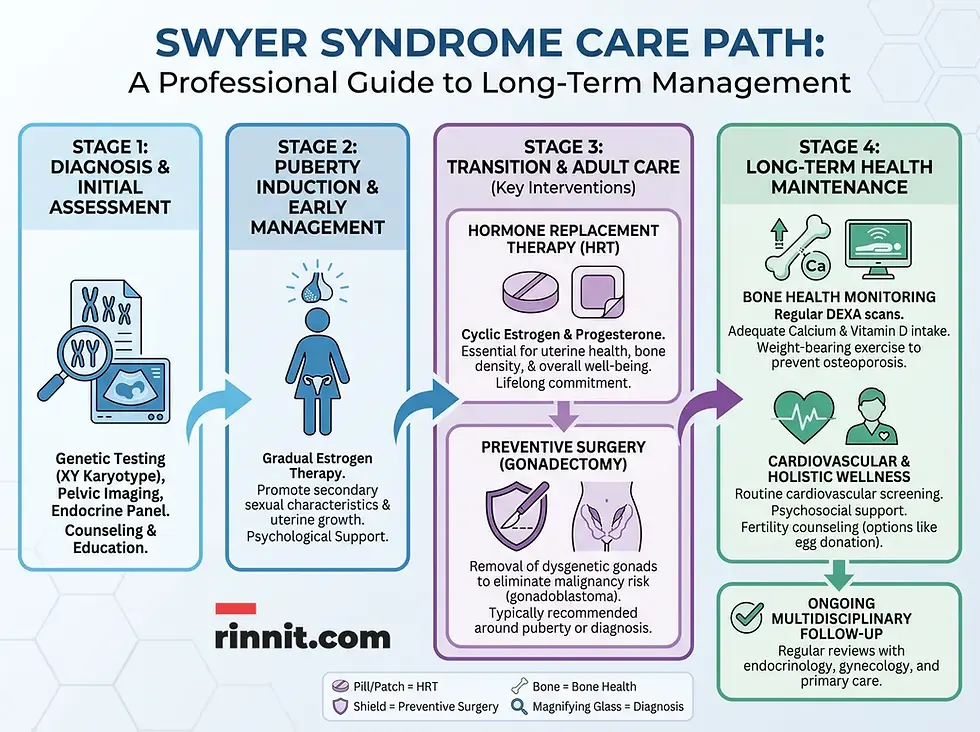
Swyer syndrome has no cure but is very manageable, with hormone replacement therapy and surgical removal of the streak gonads as key parts of care. Treatment aims to bring about the physical changes of puberty, maintain overall health, and prevent complications.
Hormone Replacement Therapy (HRT)
HRT is a cornerstone of care. By supplying the hormones the body cannot make, HRT induces breast development and regular menstrual cycles. [1] [4] These hormones are also vital for bone health: without them, there is a much higher risk of osteoporosis later in life. [1] [4]
Surgical Intervention
Doctors strongly recommend surgical removal of the streak gonads as a preventive measure, because they can develop tumors such as gonadoblastoma. [2] Reported tumor rates range from about 15% to 45% in sporadic cases and are higher in familial cases. [2] Gonadoblastomas are often initially benign, but they can become cancerous or occur alongside cancers such as dysgerminoma if the gonads are left in place.
Management Goal | Primary Action | Expected Outcome |
|---|---|---|
Pubertal development | Hormone replacement therapy | Breast growth and start of menstruation. |
Bone protection | Consistent HRT use | Prevention of bone thinning and osteoporosis. |
Cancer prevention | Surgical removal of streak gonads | Removes the risk of gonadal tumors. |
Family planning | Egg donation and assisted reproduction | Possibility of carrying a pregnancy and giving birth. |
What is the outlook for Swyer syndrome, and how can people live well?
With regular medical care, the outlook for people with Swyer syndrome is generally good. Natural conception is not possible because there are no eggs, but many people become pregnant and give birth using donated eggs and assisted reproductive technology. [1]
Receiving a diagnosis of a difference of sex development can be emotionally hard for teenagers and their families. Open communication and professional counseling and peer support are often recommended to help people process their feelings and thrive.
What are the next steps after a Swyer syndrome diagnosis?
If you or your child has a significant delay in puberty or concerns about sexual development, schedule a consultation with a healthcare professional. Early diagnosis and a personalized management plan are essential for long-term health and well-being.
Frequently Asked Questions
1. What is the difference between Swyer syndrome and typical development?
In typical development, XY chromosomes lead to male organs. In Swyer syndrome they result in female anatomy with non-functioning gonads.
2. Is Swyer syndrome common?
No. It is rare, affecting approximately 1 in 80,000 people.
3. Can people with Swyer syndrome have children?
People with Swyer syndrome cannot conceive naturally, but they can carry a pregnancy using donated eggs and assisted reproduction.
4. Why does Swyer syndrome cause tall stature?
Without sex hormones during the usual pubertal years, bones can keep growing for longer before the growth plates close.
5. What are streak gonads?
Streak gonads are non-functioning bands of tissue that form where ovaries or testes would normally develop.
6. Is surgery always necessary?
Surgery to remove streak gonads is strongly recommended in almost all cases because of the risk of tumors. Your care team will advise on timing.
7. When is Swyer syndrome usually diagnosed?
Most cases are diagnosed in adolescence, when puberty fails to start.
8. Does Swyer syndrome affect intelligence?
No. The condition affects sexual development and related hormone functions, not intelligence.
9. Can Swyer syndrome be prevented?
No. It is a genetic condition that occurs spontaneously or through inheritance.
10. What is the most common gene change involved?
Variants in the SRY gene are found in about 15% of cases, but in many people the cause is unknown.
11. What happens if HRT is not started?
Without HRT, puberty will not occur, and there is a higher risk of osteoporosis.
12. Is Swyer syndrome a type of intersex condition?
Swyer syndrome is classified as a difference (disorder) of sex development (DSD), which some people describe as an intersex variation.
13. Are there other names for this condition?
Swyer syndrome is also known as XY gonadal dysgenesis or 46,XY complete gonadal dysgenesis.
14. Do individuals with Swyer syndrome have a uterus?
Yes. They typically have a uterus, vagina, and fallopian tubes.
15. What is the risk of cancer?
Reported rates of gonadal tumors range from about 15% to 45% in sporadic cases and are higher in familial cases, which is why the streak gonads are removed.
Trusted External Resources
Related Reading
Turner Syndrome: A Comprehensive Guide to Symptoms and Care explains another chromosome condition that affects ovary development.
Androgen Insensitivity Syndrome: What It Is, How It Develops, and How It Is Treated covers a related XY condition with a different cause and care plan.
Karyotype Test: What It Shows, Sample Types, Results and Limits describes the chromosome test used to diagnose Swyer syndrome.
Amenorrhea: Symptoms, Causes, Treatment & Complete Guide explains missing periods, often the first sign of Swyer syndrome.
References
MedlinePlus Genetics. Swyer syndrome. National Library of Medicine. Accessed October 7, 2026. https://medlineplus.gov/genetics/condition/swyer-syndrome/
Rudnicka E, Jaroń A, Kruszewska J, et al. A risk of gonadoblastoma in familial Swyer syndrome: a case report and literature review. J Clin Med. 2024;13(3):785. PMID 38337479. https://doi.org/10.3390/jcm13030785
Alam S, Boro H, Goyal A, et al. 46,XY complete gonadal dysgenesis with pubertal virilisation due to dysgerminoma/gonadoblastoma. BMJ Case Rep. 2020;13(7):e235501. PMID 32641439. https://doi.org/10.1136/bcr-2020-235501
Yu T, Liu L. Pure 46,XY gonadal dysgenesis and 46,XY complete androgen insensitivity syndrome: a case report. Medicine (Baltimore). 2024;103(25):e38297. PMID 38905377. https://doi.org/10.1097/MD.0000000000038297
Medical Disclaimer
This article is for informational purposes only and does not constitute medical advice. Always seek the advice of your physician or other qualified health provider with any questions you may have regarding a medical condition. Never disregard professional medical advice or delay in seeking it because of something you have read in this article.



Comments