Androgen Insensitivity Syndrome: What It Is, How It Develops, and How It Is Treated

Updated: 2 days ago
Medically reviewed by Dr. Baraa Alnahhal, MD · Last reviewed: September 2026
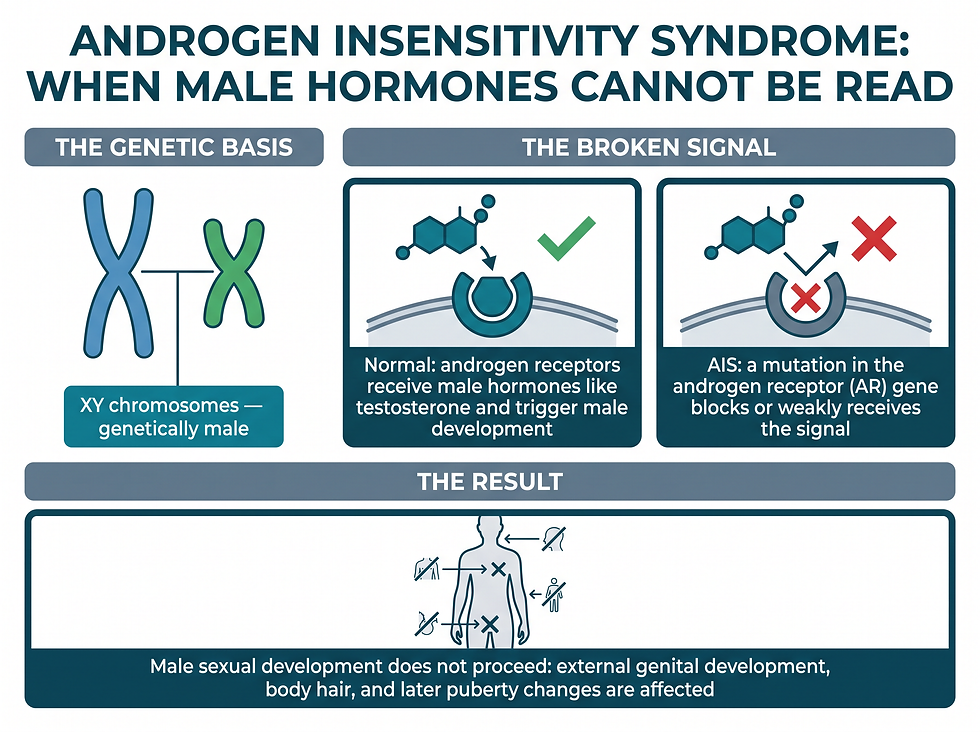
Androgen insensitivity syndrome (AIS) is a rare, inherited sexual development disorder in which a person is genetically male — with one X and one Y chromosome — but their body cannot respond to male sex hormones called androgens. The condition results from a mutation in the androgen receptor (AR) gene and affects development before birth and again during puberty. There are three forms: complete AIS (about 1 in 20,000 genetically male infants), partial AIS (about 1 in 99,000), and mild AIS. AIS is not life-threatening and life expectancy is unaffected, but it almost always results in infertility, and treatment focuses on surgery, hormone therapy, and psychological support.
Quick Answer
What it is: A rare inherited condition where a genetically male (XY) body cannot respond to androgens, so male external genitals do not develop.
How common: Complete AIS affects about 1 in 20,000 genetically male infants; partial AIS affects about 1 in 99,000.
How it is inherited: Passed from mother to child through a mutation in the AR gene; males who inherit the abnormal gene have a 1 in 4 chance of developing AIS.
Long-term outlook: Not life-threatening — life expectancy is unaffected — but almost all cases cause infertility.
What Is Androgen Insensitivity Syndrome?
Androgen insensitivity syndrome (AIS) is a rare condition that affects sexual development. It occurs when someone is genetically male, but their body does not respond to male sex hormones called androgens. This results in a person having male sex chromosomes — one X and one Y chromosome — but not having male genitals. AIS affects males during fetal development and during puberty. The condition was previously called testicular feminization syndrome.
AIS happens due to genetic mutations, which are changes to genes that affect how they function. With AIS, the gene mutation prevents male genitals from developing in people who are genetically male. AIS almost always results in infertility.
Receiving an AIS diagnosis for yourself or your child can be difficult. The condition is not life-threatening, but people with AIS may struggle with gender identity or have concerns about their body image. A supportive network of healthcare providers, family, and friends matters, and surgery can help people with AIS have genitals that match their gender identity.
Key Fact | Detail |
Definition | Rare, inherited sexual development disorder — an XY body cannot respond to androgens |
Former name | Testicular feminization syndrome |
Genetic basis | Mutation in the androgen receptor (AR) gene |
When it acts | Fetal development and puberty |
Life expectancy | Not affected — the condition is not life-threatening |
Fertility | Almost always results in infertility |
What Are the Types of AIS?
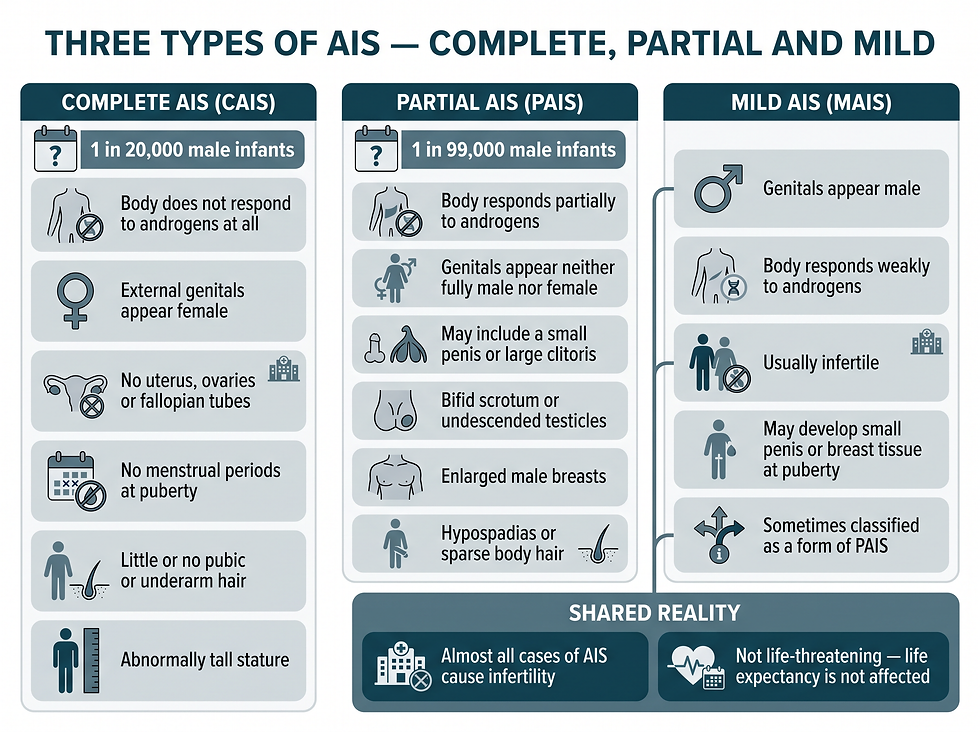
The different types of AIS vary in how completely the body fails to respond to androgens.
Complete androgen insensitivity syndrome (CAIS) means your body does not respond to androgens at all. Your external genitals appear female, but you do not have female sex organs — no ovaries, fallopian tubes, or uterus. People with CAIS are often raised as girls with a female gender identity. Approximately 1 in 20,000 genetically male infants are born with complete androgen insensitivity syndrome.
Partial androgen insensitivity syndrome (PAIS) means your body may respond partially to androgens. Your external genitals appear neither male nor female, or a little of both. People with PAIS can be raised as boys or girls and have either a female or male identity (or both). About 1 in 99,000 genetically male infants are born with partial androgen insensitivity syndrome.
Mild androgen insensitivity syndrome (MAIS) means a person's genitals appear male, but they are usually infertile. Some experts consider MAIS a type of PAIS.
Type | Androgen Response | Typical Genital Appearance | Prevalence |
Complete AIS (CAIS) | None at all | Appears female; no internal female organs | ~1 in 20,000 genetically male infants |
Partial AIS (PAIS) | Partial | Neither fully male nor female | ~1 in 99,000 genetically male infants |
Mild AIS (MAIS) | Weak | Appears male | Not stated; some experts classify it as PAIS |
What Are the Symptoms of Androgen Insensitivity Syndrome?
The most common symptom across all forms of AIS is infertility. People with CAIS cannot get pregnant or make their partners pregnant. They have genitals that appear female, but they do not have female reproductive organs. It is very rare for people with PAIS to make their partners pregnant — even if they have a very small penis, sperm production is usually low or nonexistent.
Other signs and symptoms of complete androgen insensitivity syndrome (CAIS) include abnormally tall stature for a female during puberty, no menstrual periods, little or no pubic hair or underarm hair during puberty, a narrow or short vagina, and undescended testicles.
Other signs and symptoms of partial androgen insensitivity syndrome (PAIS) can include a bifid scrotum (scrotum splits in two), a large clitoris, enlarged male breasts, hypospadias, sealed-shut labia (labial adhesions), an abnormally small penis, partially undescended testicles, and sparse body hair.
Form | Signs and Symptoms |
CAIS | Female-appearing genitals without female reproductive organs; infertility; abnormally tall stature at puberty; no menstrual periods; little or no pubic/underarm hair; narrow or short vagina; undescended testicles |
PAIS | Bifid scrotum; large clitoris; enlarged male breasts; hypospadias; sealed labia; abnormally small penis; partially undescended testicles; sparse body hair; near-zero sperm production |
MAIS | Male-appearing genitals; usually infertile; may develop a very small penis or breast tissue at puberty |
What Causes Androgen Insensitivity Syndrome?
Androgen insensitivity syndrome is a hereditary condition, meaning it is passed down from the mother to the child. It happens when there is a defect or abnormality in the androgen receptor (AR) gene. Androgen receptors are the cells that allow your body to respond to androgens like testosterone.
Androgens play a major role in male sexual development, supporting the development of sex organs and regulating hair growth and sex drive. The abnormal gene either blocks or partially blocks androgens. This causes a person who is genetically male to not have male genitals or other sexual traits that are typical for males.
Males who inherit the abnormal AR gene have a 1 in 4 chance of developing AIS. Females can also inherit and carry the gene, but they will not develop AIS.
Inheritance Fact | Detail |
Transmission | Hereditary — passed from mother to child |
Gene involved | Androgen receptor (AR) gene |
Mechanism | The abnormal gene blocks or partially blocks androgens |
Risk for sons | Males who inherit the abnormal gene have a 1 in 4 chance of developing AIS |
Carriers | Females can inherit and carry the gene without developing AIS |
What Are the Complications of AIS?
Androgen insensitivity syndrome is not life-threatening. Still, there are possible complications.
Infertility affects almost all cases of AIS due to undeveloped reproductive organs. Testicular tumor risk rises if testicles do not descend into the scrotum, so most healthcare providers recommend removing the testicles. Psychological conditions are also a consideration: living with an AIS diagnosis can be emotionally and mentally difficult, and people with AIS may struggle with gender dysphoria or feel like their physical appearance does not match the gender they want to be.
Complication | Why It Happens | Typical Management |
Infertility | Undeveloped reproductive organs in almost all cases | Counseling on family planning; genetic testing for carriers |
Testicular tumors | Higher risk when testicles do not descend into the scrotum | Most providers recommend removing the testicles |
Psychological conditions | Gender dysphoria; appearance does not match desired gender identity | Counseling, support groups, family and provider support |
How Is Androgen Insensitivity Syndrome Diagnosed?
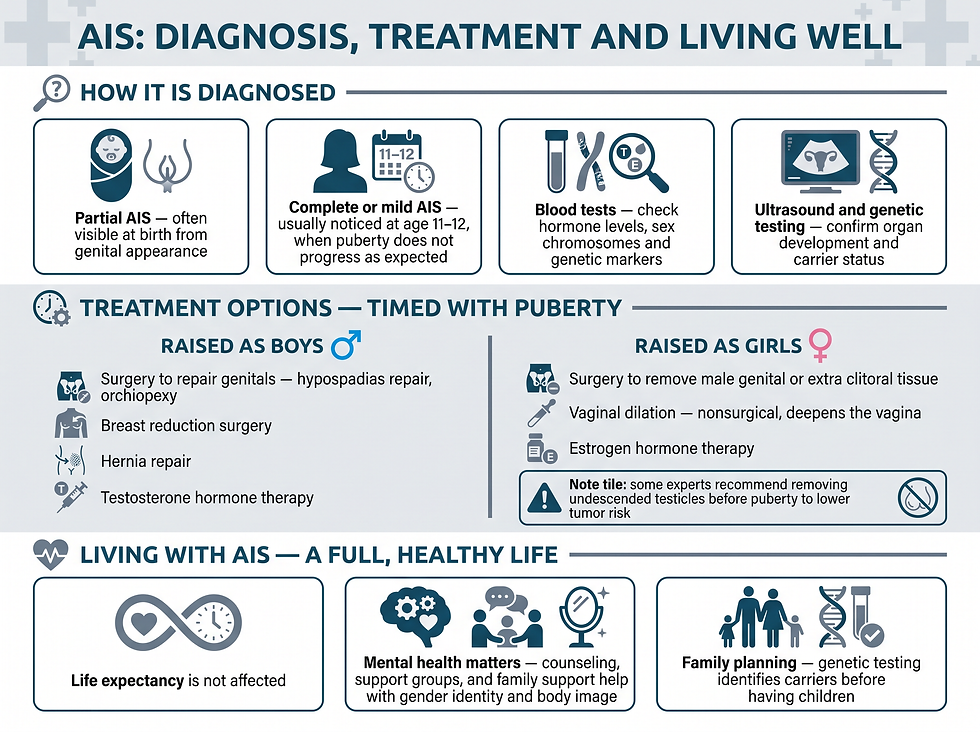
A healthcare provider can often diagnose PAIS right after birth by looking at a baby’s genitals and noticing both male and female sexual characteristics. But CAIS or MAIS might not be evident until the age of 11 or 12, when puberty begins. A child with CAIS may not have menstrual periods or may have no pubic hair. A child with mild AIS might have a very small penis or develop breasts at puberty. Puberty is also when undescended testicles can bulge through an opening in the abdominal wall, and providers sometimes discover undescended testicles when a child has surgery for an inguinal hernia.
To confirm a diagnosis, providers use blood tests that check hormone levels, sex chromosomes, and genetic abnormalities. Imaging exams such as ultrasound can confirm the absence of female reproductive organs. If you have a biological family history of AIS, you may choose genetic testing if you are considering having children — these tests can tell you whether you are a carrier of the abnormal gene.
Diagnostic Step | What It Reveals |
Physical exam at birth | PAIS often visible from genital appearance |
Puberty observation (ages 11–12) | No periods or pubic hair (CAIS); small penis or breast development (MAIS) |
Blood tests | Hormone levels, sex chromosomes, genetic abnormalities |
Ultrasound | Confirms absence of female reproductive organs |
Genetic testing | Identifies carriers in families with AIS history |
How Is Androgen Insensitivity Syndrome Treated?
Most treatments take place after puberty. This gives the child’s body time to go through developmental changes and allows the child to play a more active role in treatment decisions. But some health experts believe certain treatments, such as removal of the testicles, should happen before puberty to reduce the risk of developing tumors in undescended testicles.
Children raised as boys may choose surgery to repair their male genitals, such as hypospadias repair or orchiopexy (surgery to move undescended testicles to the scrotum), breast reduction surgery to remove excess breast tissue, hernia repair to close open or weakened abdominal wall tissue, and hormone therapy with testosterone.
Children raised as girls may choose surgery to remove male genitals or extra clitoral tissue, nonsurgical vaginal dilation to make the vagina deeper, and hormone therapy with estrogen.
Parents and healthcare providers may decide not to assign a gender at birth. Sometimes they wait until puberty to choose one, or parents might want the child to choose their own.
Raising Direction | Treatment Options |
Raised as boys | Hypospadias repair, orchiopexy, breast reduction surgery, hernia repair, testosterone therapy |
Raised as girls | Genital or clitoral tissue removal, nonsurgical vaginal dilation, estrogen therapy |
Either (before puberty) | Some experts recommend testicle removal to lower tumor risk in undescended testicles |
What Is the Prognosis (Outlook)?
People with AIS can lead full, healthy lives, and most respond well to treatments like hormone therapy and surgery. But AIS usually results in infertility, which can be difficult for many people, and it can also have profound psychological effects on children and young adults.
AIS does not affect life expectancy in any way. You may be more at risk for certain conditions, but providers manage or treat these, and this typically does not affect lifespan.
Can AIS Be Prevented?
There is no way to prevent AIS. If you have a biological family history of the disease and worry about passing the abnormal gene to your child, genetic testing can help you find out if you are a carrier.
Living With AIS: Support and Coping
Caring for your child’s psychological health is a huge part of managing AIS. A strong support system of healthcare providers, friends, and family members who understand their condition is important, and support groups can help your child share experiences with others going through similar challenges. It is important to talk with your child about their AIS around the time of puberty — that is when they will notice they are not developing like their peers.
AIS presents many challenges for adults. You may struggle to have a normal sex life or find a partner who understands and accepts your condition, and infertility can have a profound emotional effect. Some older children or adults may develop gender dysphoria and choose to transition from one gender to another, which is a complex physical and emotional process. Talking with a counselor or therapist about your experiences helps, and support groups can connect you with others who have AIS.
Is AIS the Same as Morris Syndrome?
No, but both are genetic conditions that affect sexual development.
Conclusion
Androgen insensitivity syndrome illustrates a fundamental truth of development: having male chromosomes and male hormones is not enough — the body must also be able to read the hormonal signal. A mutation in the androgen receptor gene silences that signal during fetal development and again at puberty, producing a spectrum of conditions from complete AIS (about 1 in 20,000 male births) to partial and mild forms.
The reassuring facts are just as important as the challenges. AIS is not life-threatening, life expectancy is unaffected, and most people respond well to hormone therapy and surgery, leading full, healthy lives. The hard reality is that infertility affects almost all cases, and gender identity and body image can weigh heavily on children and adults. That is why psychological support, family communication around puberty, and careful, individualized medical decisions — including the timing of surgery — sit at the heart of good care.
CTA: If you have a family history of AIS, consider genetic testing before planning a pregnancy — carriers are identifiable, and sons who inherit the gene have a 1 in 4 chance of developing the condition. If your child’s puberty is not progressing as expected (no periods, no pubic hair, or unusual breast development), talk with a healthcare provider about evaluation. And for anyone living with AIS, counseling and support groups are worth pursuing early — emotional health is a core part of managing this condition.
FAQ
What is androgen insensitivity syndrome (AIS)?
AIS is a rare, inherited sexual development disorder. A person with AIS is genetically male (one X and one Y chromosome) but their body does not respond to male sex hormones called androgens, so male external genitals do not develop. The condition affects fetal development and puberty, and almost always results in infertility.
How common is androgen insensitivity syndrome?
Complete AIS affects approximately 1 in 20,000 genetically male infants, and partial AIS affects about 1 in 99,000. AIS as a whole is considered a rare condition.
What are the three types of AIS?
Complete AIS (CAIS) means the body does not respond to androgens at all — external genitals appear female, but there are no ovaries, fallopian tubes, or uterus. Partial AIS (PAIS) means a partial response — genitals appear neither fully male nor fully female. Mild AIS (MAIS) means genitals appear male but the person is usually infertile; some experts classify MAIS as a form of PAIS.
How is AIS inherited?
AIS is hereditary and passed from mother to child through a defect in the androgen receptor (AR) gene. Males who inherit the abnormal AR gene have a 1 in 4 chance of developing AIS. Females can inherit and carry the gene but will not develop the condition.
Can people with AIS have children?
No. AIS typically results in being unable to have children. Almost all cases cause infertility due to undeveloped reproductive organs.
Does AIS affect life expectancy?
No. AIS does not affect life expectancy in any way. People with AIS are at higher risk for certain conditions — such as tumors in undescended testicles — but providers manage or treat these, and lifespan is typically unaffected.
How is AIS diagnosed?
PAIS can often be noticed at birth from genital appearance. Complete or mild AIS may not be evident until ages 11–12, when puberty does not progress as expected. Confirmation involves blood tests (hormone levels, chromosomes, genetics), ultrasound (to confirm the absence of female reproductive organs), and genetic testing to identify carriers in families with AIS.
What treatments are available for AIS?
Most treatment happens after puberty so the child can help decide. Options for those raised as boys include genital repair surgery (hypospadias repair, orchiopexy), breast reduction, hernia repair, and testosterone therapy. Options for those raised as girls include removal of male genital or extra clitoral tissue, nonsurgical vaginal dilation, and estrogen therapy. Some experts recommend removing undescended testicles before puberty to reduce tumor risk.
References
Disclaimer: This article is for general educational purposes only and is not a substitute for professional medical advice, diagnosis, or treatment. Always consult a qualified healthcare provider for guidance specific to your situation.
Comments