SVT Ablation: How It Works, Success Rate, Risks, and Recovery

Updated: 6 days ago
Written and medically reviewed by Dr. Baraa Alnahhal, MD · Last reviewed: October 2026 · How we review
Quick Answer: What is SVT ablation?
SVT ablation is a procedure that treats supraventricular tachycardia (SVT) by guiding a thin catheter from the groin to the heart and heating or freezing the cells sending faulty signals. The tiny scar it leaves stops those signals. It works in 90% to 95% of people with most types of SVT, and most return to normal activities the next day. [1]
What the research says
Ablation works on the first try for most people. A meta-analysis of 39 studies with 7,693 adults found a single procedure stopped SVT in 93.2% of patients, rising to 94.6% with repeat procedures. Complications were reported in 2.9% of patients. (Spector et al., Am J Cardiol, 2009) [3]
Heat lasts longer; cold is gentler on the heart's wiring. Pooling 14 studies of 2,340 patients with the most common SVT type, SVT stayed away in 96.5% after heat (radiofrequency) ablation vs 90.9% after freezing (cryoablation). Permanent heart block happened in 0.87% of heat cases and in no freezing cases. (Santangeli et al., J Interv Card Electrophysiol, 2014) [4]
Freezing may suit children and young adults. A review of 14 trials with 5,617 patients found SVT returned more often after freezing, but permanent heart block occurred in 0.75% after heat ablation and in none of 1,066 patients treated with cold. (Hanninen et al., J Cardiovasc Electrophysiol, 2013) [5]
Key takeaways
SVT ablation creates a tiny scar that blocks a faulty "short circuit" in the heart's upper chambers.
You're usually awake but relaxed with sedation. The energy itself doesn't hurt.
Success rates are 90% to 95% for most types of SVT.
Most people resume normal activities the next day and strenuous activity after three days.
Serious complications are rare.
What is SVT ablation?
SVT ablation is a procedure that creates a tiny scar in the heart to break a faulty electrical loop that makes the heart race. [1]
Supraventricular tachycardia (SVT) is a fast heart rhythm that starts in the heart's upper chambers. It's one type of heart arrhythmia. [1]
Your heart has an electrical system made of living "wires," or fibers. These fibers carry signals that tell your heart when to beat. [1]
In some people, these fibers form a small loop. The loop acts like a short circuit. Signals race around it and push the heart to beat too fast. [1]
SVT ablation targets that loop. A doctor damages the problem cells on purpose, in a controlled way. The small scar that forms can't carry electrical signals, so the short circuit is broken. [1]

How SVT ablation works: a catheter finds the faulty loop and creates a tiny scar that blocks it.
Heat vs. cold: two ways to create the scar
Method | How it works | What it does |
Radiofrequency ablation | Uses radiofrequency energy to heat the tissue | Creates a small scar that blocks the loop |
Cryoablation | Uses an extremely cold gas to freeze the tissue | Also creates a small scar that blocks the loop |
[1]
How common is SVT, and who needs SVT ablation?
About 2 in every 1,000 people have SVT, and ablation is usually considered when medicine doesn't control symptoms. [1]
Medicines help 60% to 80% of people with SVT. People whose symptoms aren't controlled with medicine may consider ablation. [1]
A doctor may suggest SVT ablation when:
Medicine isn't controlling your heart rhythm
Medicine is causing side effects
Your symptoms are frequent or disruptive
Sometimes ablation is the first-choice treatment, before medicine is tried. The decision depends on: [1]
The exact type of arrhythmia you have
Other health conditions you have
How much your symptoms affect your daily life
Related conditions that may be treated with ablation include atrial tachycardia and Wolff-Parkinson-White syndrome. [2]
What happens before SVT ablation?
Before SVT ablation, you usually fast for 6 to 8 hours and review your medicines with your doctor. [1]
Fast for 6 to 8 hours. Don't eat or drink during this time.
Review your medicines. Your doctor may ask you to stop some medicines before the procedure.
Follow the exact instructions your care team gives you.
What happens during SVT ablation?
During SVT ablation, a doctor guides a catheter from your groin to your heart in a special room called an electrophysiology (EP) lab and treats the cells causing the fast rhythm. Here's what happens, step by step: [1]
Medicine through an IV. You get pain-relieving and calming medicine through a small tube in your arm.
Access in the groin. The doctor numbs the skin in your groin and places a catheter into a blood vessel.
Catheter to the heart. An electrode catheter is guided through the blood vessel up to your heart.
Finding the faulty cells. Signals sent through the catheter help the doctor locate the exact cells causing the problem.
Treating the cells. Energy is applied to those cells to create the small scar.
Are you awake during SVT ablation?
Usually, yes. Most people get conscious sedation. You're relaxed and drowsy but not fully asleep. [1]
In rare cases, general anesthesia is needed. Your doctor decides this case by case. [1]
Is SVT ablation painful?
The ablation energy itself does not hurt. [1]
You may feel a brief sting when the numbing medicine (lidocaine) is injected in your groin. After that, the area is numb while the catheter goes in. [1]
What happens right after SVT ablation?
Right after SVT ablation, the doctor removes the catheter and stops bleeding at the groin site using: [1]
Firm pressure by hand, or
A vascular closure device, which helps seal the blood vessel
You'll need to keep your leg straight for 6 to 8 hours. This protects the site while it seals. [1]

A typical SVT ablation timeline, from preparation to full activity.
How long does recovery from SVT ablation take?
Recovery from SVT ablation is quick: most people return to normal daily activities the day after going home. [1]
Time after going home | What you can usually do |
Day 1 (the next day) | Return to your normal daily activities |
Day 3 onward | Return to more physically demanding activities, like heavy lifting or intense exercise |
[1]
Always follow your own doctor's advice. It may differ based on your health and how the procedure went.
What is the success rate of SVT ablation?
SVT ablation succeeds in 90% to 95% of people with most types of SVT. [1] [3]
Measure | Result |
Success rate for most types of SVT | 90% to 95% |
Chance SVT returns after ablation | 2% to 11% |
[1]
If SVT does return, talk with your doctor about next steps. A repeat procedure is sometimes an option. [1]
What are the risks of SVT ablation?
Serious problems after SVT ablation are uncommon, and most risks come from the catheters used during the procedure. [1]
Risk | What it means |
Bleeding | Rare bleeding at the groin site |
Infection | Rare infection where the catheter entered |
Hematoma | Blood pooling under the skin |
Blood clots | A clot forming in a blood vessel |
Reaction to anesthesia | A response to the sedation or anesthesia medicine |
Fluid collecting around the heart and pressing on it | |
Damage to the normal electrical system | On rare occasions, healthy wiring is affected, which may require a pacemaker |
[1]
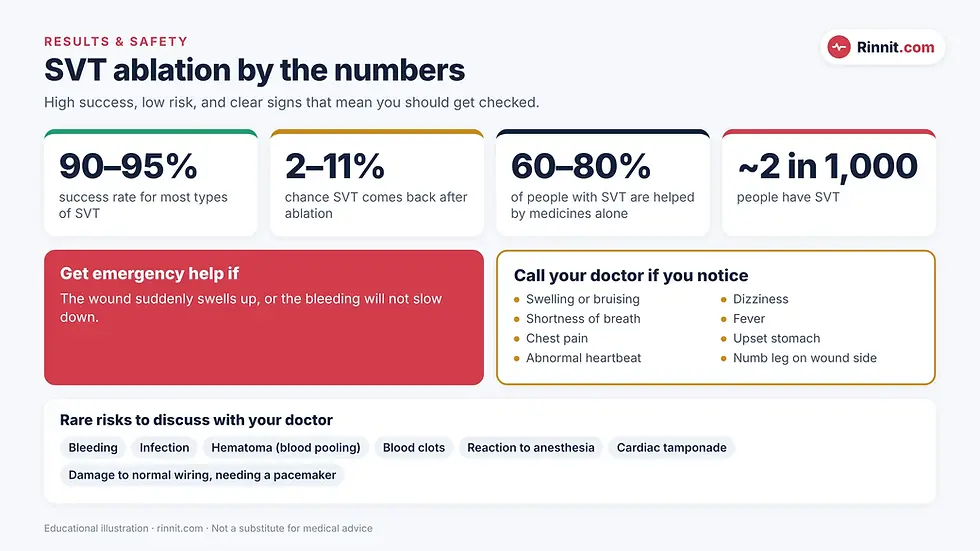
SVT ablation results, warning signs, and rare risks at a glance.
When should you call your doctor after SVT ablation?
Get emergency help if your wound suddenly swells, the bleeding won't slow down, or you have chest pain, trouble breathing or fainting, and call your doctor for symptoms such as fever. [1]
Get emergency help right away if:
Your wound suddenly swells up
The bleeding won't slow down
Contact your doctor if you have:
Swelling or bruising at the wound
Shortness of breath
Chest pain
A heartbeat that doesn't feel normal (see heart palpitations)
Dizziness
Fever
Upset stomach
Numbness in the leg on the wound side
Conclusion
An irregular, racing heartbeat can feel frightening. SVT ablation offers a way to fix the problem at its source rather than just managing it.
The procedure is short, you're usually awake but comfortable, and most people are back to their routine the next day. With success rates of 90% to 95%, it's one of the most effective treatments in heart rhythm care.
If you have SVT, ask your doctor whether ablation makes sense for your situation.
Next step: Learn more about how your heart's rhythm works in our complete guide to heart arrhythmia, and bookmark this page to bring your questions to your next appointment. For everyday ways to protect your heart, read our plain-language heart health guide.
FAQ
What is SVT ablation?
SVT ablation is a procedure that heats or freezes a small group of heart cells sending faulty signals. The tiny scar it creates stops those signals and helps your heart return to a normal rhythm.
Is SVT ablation painful?
The ablation energy doesn't hurt. You may feel a short sting from the numbing injection in your groin. Most people receive sedation that keeps them relaxed.
Are you awake during SVT ablation?
Usually, yes. Most people get conscious sedation, which keeps them calm and drowsy. General anesthesia is used only in rare cases.
How successful is SVT ablation?
SVT ablation succeeds in 90% to 95% of people with most types of SVT.
Can SVT come back after ablation?
Yes, but it's uncommon. SVT returns in about 2% to 11% of people after ablation.
How long is recovery after SVT ablation?
Most people return to normal activities the day after going home. Wait three days before strenuous activity.
How long do I need to lie flat after SVT ablation?
You'll need to keep your leg straight for 6 to 8 hours after the procedure so the blood vessel can seal.
Do I need to fast before SVT ablation?
Yes. You'll usually need to avoid eating and drinking for 6 to 8 hours beforehand.
What are the risks of SVT ablation?
Risks are rare. They include bleeding, infection, blood pooling, blood clots, reaction to anesthesia, fluid around the heart, and, rarely, damage to the heart's normal electrical system that may require a pacemaker.
Is ablation better than medicine for SVT?
It depends on your situation. Medicine helps 60% to 80% of people with SVT. Ablation is often chosen when medicine doesn't work or causes side effects, and sometimes it's the first-choice treatment.
Related articles on Rinnit.com
Related Reading
Valsalva Maneuver: How to Do It and When It's Used explains a breathing technique that can stop a fast heartbeat.
References
Cleveland Clinic. SVT Ablation: Procedure & Recovery. Cleveland Clinic. Last updated October 9, 2026. https://my.clevelandclinic.org/health/treatments/24605-svt-ablation
American Heart Association. Ablation for Arrhythmias. American Heart Association (heart.org). Last updated October 24, 2024. https://www.heart.org/en/health-topics/arrhythmia/prevention--treatment-of-arrhythmia/ablation-for-arrhythmias
Spector P, Reynolds MR, Calkins H, et al. Meta-analysis of ablation of atrial flutter and supraventricular tachycardia. Am J Cardiol. 2009;104(5):671-677. PMID 19699343. https://doi.org/10.1016/j.amjcard.2009.04.040
Santangeli P, Proietti R, Di Biase L, et al. Cryoablation versus radiofrequency ablation of atrioventricular nodal reentrant tachycardia. J Interv Card Electrophysiol. 2014;39(2):111-119. PMID 24293174. https://doi.org/10.1007/s10840-013-9842-2
Hanninen M, Yeung-Lai-Wah N, Massel D, et al. Cryoablation versus RF ablation for AVNRT: A meta-analysis and systematic review. J Cardiovasc Electrophysiol. 2013;24(12):1354-1360. PMID 24016223. https://doi.org/10.1111/jce.12247
Medical disclaimer
This article is for general education only and is not a substitute for professional medical advice, diagnosis or treatment. Always talk with your doctor or cardiologist about your own care.



Comments