Valsalva Maneuver: How to Do It and When It's Used

Updated: 2 days ago
Written and medically reviewed by Dr. Baraa Alnahhal, MD · Last reviewed: November 2026 · How we review
Quick Answer
The Valsalva maneuver is a breathing technique that can stop a fast heart rhythm called supraventricular tachycardia (SVT) without medicine. You close your mouth, pinch your nose and strain as if having a bowel movement for 15 to 20 seconds. The standard method works only 5% to 20% of the time; a modified version works much more often.
What the research says
Raising your legs makes it work better: in the REVERT trial of 428 adults with SVT in emergency departments, a modified Valsalva (strain, then lie flat with legs raised) restored a normal rhythm in 43% compared with 17% using the standard method, with no serious side effects (Appelboam A et al., Lancet, 2015) [2]
Results are lower in real emergencies: a Cochrane review of 3 trials with 316 people found the standard Valsalva stopped SVT in about half of lab-induced episodes but only about 19% of real emergency department episodes (Smith GD et al., Cochrane Database Syst Rev, 2015) [3]
Key takeaways
The Valsalva maneuver can stop SVT without medicine.
Breathe in, close your mouth and nose, and strain for 15 to 20 seconds.
The modified version with raised legs works better.
If it works, your heart rate slows within about a minute.
If it fails after three tries, you may need medicine or cardioversion.
What is the Valsalva maneuver?
Supraventricular tachycardia is a fast heart rhythm that starts above the heart's lower chambers. Straining against a closed airway changes the pressure in your chest and stimulates the vagus nerve, which can slow the heart's electrical signals and stop the abnormal rhythm. Your provider will confirm that your rhythm is one that responds to the maneuver. Sources: [1]
Why it's used

It's quick, safe and drug-free.
Stopping SVT and slowing a fast heart rate.
Helping classify a heart murmur.
Checking for signs of heart failure.
Helping diagnose venous disease, varicocele or autonomic nervous system problems.
Clearing pressure or blockages from the middle ear. Sources: [1]
Types of Valsalva maneuvers

The modified version works more often for SVT.
Type | How it's done |
Standard | Strain against a closed mouth and nose for 15 to 20 seconds |
Modified | Strain, then lie flat right away while someone raises your legs |
Reverse | While seated, breathe in for 10 seconds with your nose and mouth closed |
For testing, you may blow into a mouthpiece connected to a pressure gauge to reach a set pressure of 40 mm Hg. Sources: [1]
How to do it
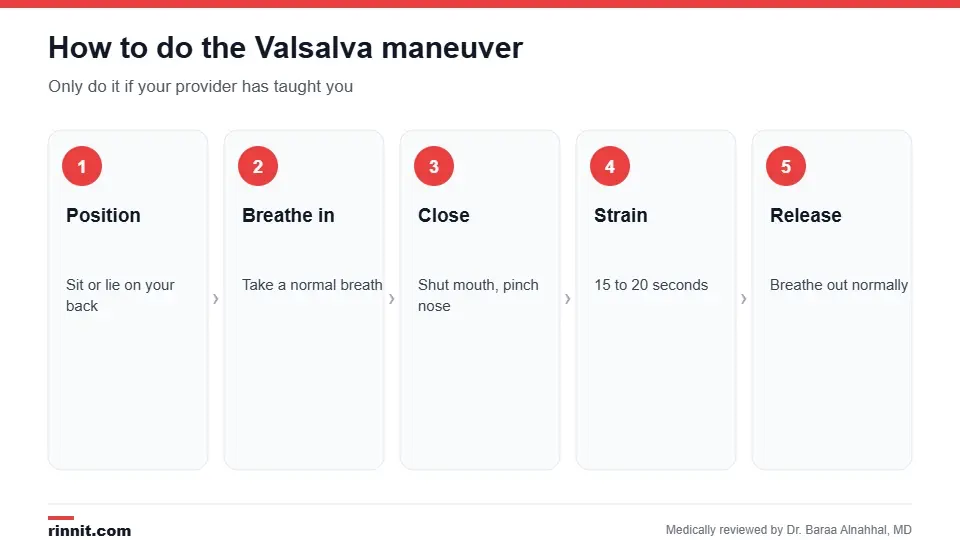
Only do it if your provider has taught you.
Sit or lie on your back.
Take a breath in.
Close your mouth and pinch your nose.
Strain as if you're having a bowel movement for 15 to 20 seconds.
Open your mouth and breathe out normally. Sources: [1]
If it works, your heart rate slows in about a minute. Only use the maneuver at home if your provider has taught you how. Sources: [1]
What happens in your body
Phase | What happens |
1 | Blood pressure rises briefly as you strain |
2 | Blood pressure falls and heart rate speeds up, then recovers |
3 | Blood pressure drops when you stop straining |
4 | Blood pressure rises and the heartbeat slows before returning to normal |
Sources: [1]
Risks
Most people do the Valsalva maneuver safely. Uncommon problems include chest pain, fainting, abnormal heart rhythms and, rarely, stroke. Avoid it if you have retinopathy or an artificial lens in your eye, and use caution with heart valve disease, coronary artery disease or congenital heart disease. Sources: [1]
How well it works
The standard method works about 5% to 20% of the time.
In the REVERT trial, the standard method worked for 17% of people and the modified method for 43%.
If it fails after three tries, don't press on your neck yourself. Get medical care; a provider may try carotid massage with heart monitoring, medicine or electrical cardioversion. Sources: [1, 2, 3]
When to call your provider
The maneuver didn't stop your fast heartbeat.
You have chest pain, fainting or trouble breathing; call 911. Sources: [1]
Conclusion
The Valsalva maneuver is a quick, drug-free first step to stop SVT, and the modified version works best. If it doesn't work, your provider has other safe and effective treatments.
Keep learning: read about tachycardia and SVT ablation.
Frequently asked questions
What is the Valsalva maneuver?
A breathing technique where you strain against a closed mouth and nose.
What does it treat?
A fast heart rhythm called supraventricular tachycardia (SVT).
How do I do it?
Breathe in, close your mouth and nose, and strain for 15 to 20 seconds.
How well does it work?
The standard method works 5% to 20% of the time; the modified method works more often.
What is the modified Valsalva maneuver?
Straining, then lying flat right away while your legs are raised.
How fast does it work?
If it works, your heart rate slows within about a minute.
Is it safe?
Usually. Rarely, it causes chest pain, fainting or abnormal rhythms.
Who shouldn't do it?
People with retinopathy or an artificial lens, and some with heart disease.
What if it doesn't work?
Your provider may use medicine or electrical cardioversion.
Can it help my ears?
Yes. It can help clear pressure in the middle ear.
Related Reading
What Is Tachycardia? A Plain-Language Guide to the Fast Heartbeat, Its Causes, and Its Treatment fast heart rhythms and their causes.
SVT Ablation: How It Works, Success Rate, Risks, and Recovery a procedure that can cure SVT.
Heart Arrhythmia: Symptoms, Types, Causes, Diagnosis & Treatment — Complete Guide abnormal heart rhythms explained.
What Is Supraventricular Tachycardia (SVT)? Symptoms, Causes, Tests, and Treatments Explained the fast heart rhythm this maneuver treats.
References
Cleveland Clinic. Valsalva Maneuvers: What They Are and How to Do Them. Cleveland Clinic. Last updated June 9, 2022. https://my.clevelandclinic.org/health/treatments/23209-valsalva-maneuver
Appelboam A, Reuben A, Mann C, et al. Postural modification to the standard Valsalva manoeuvre for emergency treatment of supraventricular tachycardias (REVERT): a randomised controlled trial. Lancet. 2015;386(10005):1747-1753. PMID 26314489. https://doi.org/10.1016/S0140-6736(15)61485-4
Smith GD, Fry MM, Taylor D, et al. Effectiveness of the Valsalva manoeuvre for reversion of supraventricular tachycardia. Cochrane Database Syst Rev. 2015;2015(2):CD009502. PMID 25922864. https://doi.org/10.1002/14651858.CD009502.pub3
Medical disclaimer
This article is for general education only and does not replace advice from a qualified healthcare professional. Talk to your doctor about your own diagnosis and treatment, and seek emergency care right away for severe or sudden symptoms.



Comments