Slipping Rib Syndrome: Causes, Symptoms, and Treatment Options

Updated: 2 days ago
Medically reviewed by Dr. Baraa Alnahhal, MD · Last reviewed: October 2026
Quick Answer: What is slipping rib syndrome?
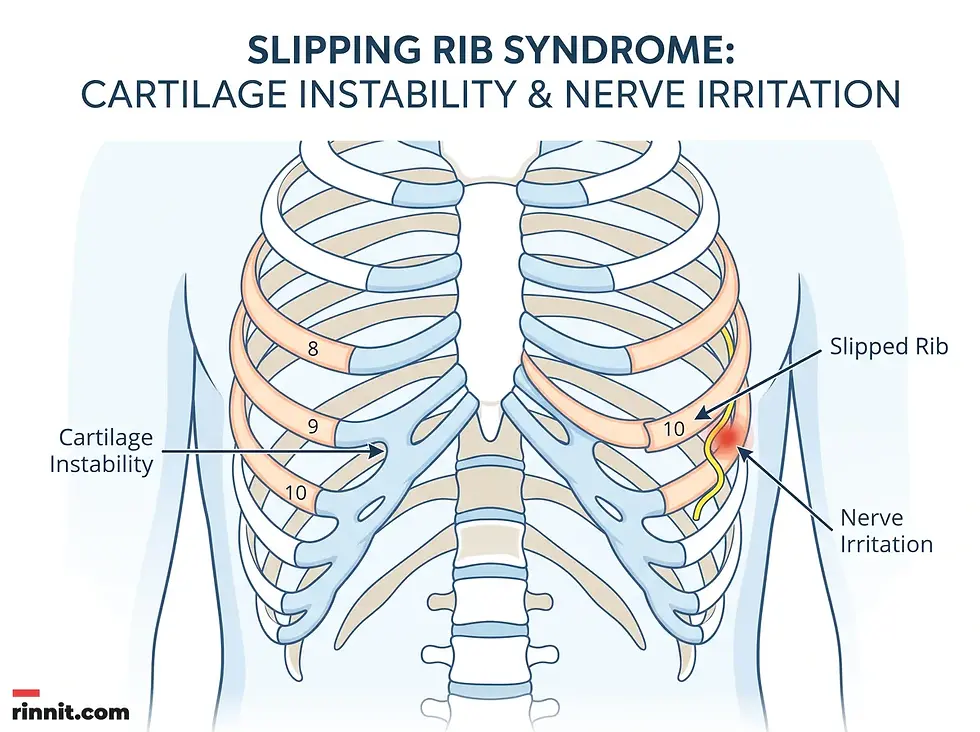
Slipping rib syndrome is a condition in which the cartilage at the tips of the lower ribs (ribs 8 to 10) loosens, so a rib slips and irritates a nearby nerve. [1] [6] It causes sharp, stabbing pain often triggered by coughing, twisting or reaching. [1] [2] A hooking maneuver test often diagnoses it. [1] [2] Treatment begins with rest and pain management.
When chest pain needs urgent care
Slipping rib syndrome does not damage the heart, lungs, or other internal organs, but chest pain can have serious causes. Call your local emergency number right away if you have chest pressure or tightness, pain spreading to the arm, jaw, or back with sweating or nausea, shortness of breath, fainting, or pain after a major injury. Slipping rib syndrome should only be considered once a clinician has ruled out urgent causes.
What the research says
Surgical repair can bring large, lasting pain relief. In a series of 449 patients treated at one referral center, 247 had costal margin reconstruction. Their average pain score fell from 7.5 out of 10 before surgery to 0.9 at 24 months, and regular opioid use dropped from 29% to 0% by 18 months. Of 241 patients who had the older sutured repair, 66 needed a revision (Hansen et al., JTCVS Open, 2024) [3].
Cartilage resection works for most people, but not all. Among 49 children and teens who underwent 67 operations, 11 needed a repeat operation for recurrence. Of 29 patients reached at a median of 4.5 years, 21 (72%) reported a complete cure (Fraser et al., Journal of Pediatric Surgery, 2021) [4].
Diagnosis is often delayed. In a Mayo Clinic series of 31 young patients, symptoms had lasted an average of 18.9 months and patients had seen an average of 4.7 specialists before the diagnosis was made (Polycarpou et al., Journal of Pediatric Surgery, 2024) [5].
What Is Slipping Rib Syndrome?
Slipping rib syndrome is a musculoskeletal condition that causes lower chest or upper abdominal pain when one of the lower ribs partially dislocates. It is known medically as interchondral subluxation. [1] [2] It happens when the cartilage that connects the lower ribs becomes loose or unstable, so the rib tip can glide over or under the rib above it. This can pinch or irritate the intercostal nerve that runs along the underside of each rib. [1] [6]
The condition is considered rare and is little known, even among many healthcare providers, so diagnosis is often delayed while the symptoms are mistaken for more common problems. [1] [6] It goes by several other names, including clicking rib syndrome, gliding rib syndrome, rib-tip syndrome, Cyriax syndrome, and displaced rib. [1] You may also see the term "floating rib syndrome," but this is a misnomer, because the floating ribs (ribs 11 and 12) are not the ribs involved. [1]
What are the symptoms of slipping rib syndrome, and which ribs are affected?
The pain is often described as sudden, sharp, and stabbing. Many people hear or feel a distinct click, pop, or slipping sensation when the rib moves. [1] [2] The acute pain may fade into a dull, lingering ache that spreads to the back, the side, or the upper abdomen. [1] Common triggers include coughing, sneezing, laughing, reaching overhead, leaning over, and even rolling over in bed. [1] [2] Most people have symptoms on one side, although both sides can be affected. [2]
The syndrome involves the "false ribs" (ribs 8, 9, and 10). Unlike the upper ribs, these do not attach directly to the breastbone (sternum). [1] [2] Each one is joined by cartilage to the rib above it, so when that connection weakens, the lower rib cage becomes less stable and a rib tip can slip.
Feature | What it means |
|---|---|
Ribs involved | Ribs 8, 9, and 10 (the "false ribs") |
How they attach | Cartilage joins each rib to the rib above, not directly to the sternum |
Nerve involvement | The intercostal nerve under the rib can be irritated or pinched |
Common pain triggers | Coughing, sneezing, twisting, reaching overhead, rolling over in bed |
Conditions that can look similar
Several conditions can cause pain in the same area, including costochondritis, a rib fracture, and problems in the stomach, esophagus, or gallbladder. This is one reason a careful physical examination matters.
What causes slipping rib syndrome, and who is at risk?
Slipping rib syndrome can develop suddenly after an injury or gradually over time, and trauma, repetitive motion, joint hypermobility and differences present from birth are linked to it. The exact cause is not always clear, and some cases occur with no obvious injury. Factors linked to slipping rib syndrome include:
Trauma: a fall, a direct blow to the chest, or a contact-sport injury (such as football, hockey, wrestling, or rugby). [1] [2]
Repetitive or forceful motion: rapid twisting, pushing, or lifting, and high-intensity athletic activity. [1] [2]
Joint hypermobility: an unusually wide range of joint motion may contribute to rib instability. [1]
Differences present from birth: some people have a structural variation in the rib cartilage, which may explain why the syndrome can appear in children and teenagers. [1]
Slipping rib syndrome can affect people of any age and fitness level, and it has been reported in both adults and adolescents. [2] [4]
How is slipping rib syndrome diagnosed?
Diagnosing slipping rib syndrome can be challenging because the rib usually slips only during movement, so X-rays and CT scans often look normal. [1] Diagnosis is mainly clinical, based on your history and a physical examination. [2] [6] Dynamic ultrasound, performed while you move or cough, can sometimes capture the rib slipping in real time. [1] [6]
One of the most useful tools is the hooking maneuver. The clinician hooks their fingers under the lower edge of the rib cage and gently pulls forward and upward. If this reproduces your pain or the click, it strongly suggests slipping rib syndrome. [1] [2] In uncertain cases, an intercostal nerve block can help confirm the diagnosis if the injection relieves the pain. You can read more about how they work in our guide to nerve blocks.
What are the treatment options for slipping rib syndrome?
Treatment usually begins with conservative care. Mild cases may settle with rest and by avoiding the movements that trigger the pain. [1] [2] Providers often recommend hot or cold therapy, over-the-counter non-steroidal anti-inflammatory drugs (NSAIDs) if they are safe for you, and physical therapy to strengthen the muscles around the chest wall. [1] [2]
If these measures are not enough, an intercostal nerve block (an injection of a local anesthetic, sometimes with a steroid, near the irritated nerve) can reduce pain and inflammation. [1] For severe, long-lasting pain, surgery may be considered. Options include removing the affected costal cartilage, stabilizing the rib with stitches, or rib plating and costal margin reconstruction. [1] [3] Recurrence of pain after surgery can happen, which is why surgical techniques are still being refined. [3] [4] [5]
Treatment level | Common interventions | Goal |
|---|---|---|
Conservative | Rest, activity changes, hot or cold therapy, NSAIDs, physical therapy | Pain relief and less inflammation |
Interventional | Intercostal nerve block | Targeted pain relief and diagnostic confirmation |
Surgical | Costal cartilage excision, suture fixation, rib plating, costal margin reconstruction | Stabilize the rib and correct the problem |

What is the outlook and long-term recovery for slipping rib syndrome?
Once the condition is correctly identified, the outlook is generally positive. Slipping rib syndrome is not life-threatening and does not cause long-term damage to internal organs. [1] [2] Some cases resolve on their own, many improve with rest and physical therapy, and surgery helps most people who need it, although some need a repeat procedure. [1] [4]
Long-term management involves paying attention to the movements that triggered the slipping. The graphic below summarizes general stability exercises and daily habits. Check with your clinician or physical therapist before starting any exercise program, especially during a flare-up.

Conclusion
Slipping rib syndrome is a little-known but real cause of sharp, intermittent pain in the lower chest and upper abdomen. Because imaging is often normal, it is easy to miss, and getting the right diagnosis is a large part of the battle. With rest, physical therapy, nerve blocks, and, when needed, surgery, most people can return to their normal activities.
What are the next steps for slipping rib syndrome?
If you have repeated sharp pain in your lower ribs with a clicking or popping feeling, see a healthcare provider and describe exactly which movements trigger it. Seek emergency care for any chest pain that could be heart-related.
Trusted resources: Cleveland Clinic: Slipping Rib Syndrome, UCSF Health: Slipping Rib Syndrome
Frequently Asked Questions
Is slipping rib syndrome dangerous?
No. It is not life-threatening and does not damage the heart, lungs, or other organs. The pain can be intense, though, and it can affect your quality of life.
Why didn't my X-ray show the slipping rib?
X-rays are still images, and a slipping rib usually moves out of place only during certain movements. A physical exam with the hooking maneuver or a dynamic ultrasound is more useful.
Can slipping rib syndrome cause abdominal pain?
Yes. The lower ribs sit next to the upper abdomen, and the irritated nerve can send pain to the upper abdomen or back, so it is sometimes mistaken for a digestive problem.
How long does it take for a slipping rib to heal?
It varies. Some cases settle on their own, and many people improve over weeks to months with rest, physical therapy, and anti-inflammatory treatment. If pain persists, other options can be discussed with your provider.
Can I exercise with slipping rib syndrome?
Rest and avoid triggering movements during flare-ups. Once the pain settles, a physical therapist can help you return to exercise gradually and safely.
What is the hooking maneuver?
It is a physical exam test in which the clinician hooks their fingers under the lower edge of your rib cage and pulls gently upward. If it reproduces your pain or the clicking, it supports the diagnosis.
Does slipping rib syndrome affect the lungs?
The condition itself does not affect the lungs, but the pain can make deep breaths and coughing uncomfortable.
Can children have slipping rib syndrome?
Yes. It has been reported in children and teenagers as well as adults, and studies of young patients describe symptoms lasting many months before diagnosis.
What is an intercostal nerve block?
It is an injection of local anesthetic, sometimes with a steroid, near the nerve running along the underside of a rib. It can reduce pain and inflammation and help confirm the diagnosis.
Is slipping rib syndrome the same as a broken rib?
No. A broken rib is a fracture of the bone, while slipping rib syndrome involves unstable cartilage connecting the lower ribs.
Can poor posture cause slipping rib syndrome?
Posture is not an established cause. Reported risk factors include trauma, high-intensity athletic activity, and joint hypermobility.
What are "false ribs"?
False ribs (ribs 8 to 10) do not attach directly to the sternum. Instead, they connect to the rib above through cartilage. Ribs 11 and 12 are called floating ribs.
Can slipping rib syndrome return after surgery?
Yes. Recurrence and repeat operations have been reported. In one long-term series of 49 children and teens, 11 needed another operation. Newer techniques aim to reduce recurrence.
Are there specific movements to avoid?
During recovery, many people avoid sudden twisting, heavy overhead lifting, and repetitive motions that trigger the pain. Your clinician can tailor advice to your situation.
Is slipping rib syndrome common?
It is considered rare and is probably underdiagnosed. Many people see several providers and have multiple tests before the diagnosis is made.
Related Reading
Costochondritis: What It Is, Why It Hurts, and How Long It Lasts explains rib cartilage inflammation, a common cause of chest wall pain.
Tietze Syndrome: Symptoms, Causes, Diagnosis and Treatment describes a related rib cartilage condition that causes swelling and pain.
Rib Fracture: Symptoms, Causes, and Recovery Guide covers broken ribs, their symptoms and how they heal.
Intercostal Nerve Block: Uses, Procedure and Side Effects explains the injection used to relieve rib and chest wall nerve pain.
References
Cleveland Clinic. Slipping Rib Syndrome. Cleveland Clinic. November 22, 2024. https://my.clevelandclinic.org/health/diseases/slipping-rib-syndrome
UCSF Health. Slipping rib syndrome. UCSF Health. Reviewed November 16, 2025. https://www.ucsfhealth.org/care/medical-tests/slipping-rib-syndrome
Hansen AJ, Hayanga J, Toker A, et al. Costal margin reconstruction for slipping rib syndrome: Outcomes of more than 500 cases and advancements beyond earlier sutured repair technique. JTCVS Open. 2024;19:347-354. PMID 39015462. https://doi.org/10.1016/j.xjon.2024.03.007
Fraser JA, Briggs KB, Svetanoff WJ, et al. Long-term outcomes and satisfaction rates after costal cartilage resection for slipping rib syndrome. J Pediatr Surg. 2021;56(12):2258-2262. PMID 33546899. https://doi.org/10.1016/j.jpedsurg.2021.01.034
Polycarpou A, Chopko TC, Glasgow AE, et al. One-year results of minimally invasive sutured fixation of the slipped ribs in the pediatric population. J Pediatr Surg. 2024;59(9):1703-1707. PMID 38522977. https://doi.org/10.1016/j.jpedsurg.2024.02.027
McMahon LE. Slipping rib syndrome: a review of evaluation, diagnosis and treatment. Semin Pediatr Surg. 2018;27(3):183-188. PMID 30078490. https://doi.org/10.1053/j.sempedsurg.2018.05.009
Medical Disclaimer
This article is for informational purposes only and does not constitute medical advice. Always seek the advice of a qualified healthcare professional with any questions you may have regarding chest pain or a musculoskeletal condition.



Comments