Tietze Syndrome: Symptoms, Causes, Diagnosis and Treatment

Updated: 2 days ago
Medically reviewed by Dr. Baraa Alnahhal, MD · Last reviewed: October 2026
Tietze syndrome is pain and swelling in the cartilage where one of your ribs meets your sternum, or breastbone. This junction is called a costochondral junction. Tietze syndrome is temporary for most people and is usually treated with rest and pain relievers, but chest pain should not be self-diagnosed. [1]
Quick safety note about chest pain
Tietze syndrome can resemble other conditions that cause chest pain. When someone seeks care for chest pain, healthcare providers first check that it is not a heart attack and then evaluate other possible causes. [1]
Seek urgent or emergency medical care for severe, sudden or worsening chest pain, trouble breathing, fainting, new weakness or other symptoms that feel dangerous. Do not assume that chest pain is Tietze syndrome without an evaluation.
Quick Answer: What is Tietze syndrome?
Tietze syndrome is pain and swelling in the cartilage at a costochondral junction, where a rib meets the sternum. It is a temporary condition for most people, but it can look like other causes of chest pain. A healthcare provider should assess new chest pain before attributing it to Tietze syndrome. [1]
What the research says
Serious heart causes of chest pain must be checked first. A clinical review reports that about 1% of primary care office visits are for chest pain, and 1.5% of those patients have unstable angina or an acute myocardial infarction. Chest-wall pain, described as localized pain reproducible by palpation, is among the other diagnoses considered when suspicion for heart ischemia is lower (McConaghy and Oza, Am Fam Physician, 2013). [2]
A painful chest swelling that keeps growing needs follow-up. Among 121 patients initially diagnosed with Tietze syndrome, 27 with normal first imaging had swellings that doubled in size over a mean of 8.5 months. Biopsy found primary chest wall tumors in 13 of them (5 malignant and 8 benign). The authors advised closer follow-up and considering early biopsy when swelling increases (Kaplan et al., Thorac Cardiovasc Surg, 2016). [3]

Where does Tietze syndrome occur?
Tietze syndrome affects cartilage in the rib cage at a costochondral junction. This is the point where a rib meets the sternum at the front of the chest. The condition is often felt in the upper and front part of the chest, usually on one side. [1]
The most commonly described swelling is near the second or third rib at the upper sternum. The swelling may look small and puffy or feel like a firm mass. [1]

What does Tietze syndrome feel like?
The most noticeable symptom is chest pain. It may begin suddenly or gradually. Some people describe a dull ache when they are still and a sharp or gripping sensation when they move or twist the upper body.
Coughing, sneezing and exercise can make the pain worse. Pain is usually in the front and top of the chest, often on one side, and may radiate to the arm, shoulder or neck. [1]
Common symptom pattern
Symptom | How it may appear |
Chest pain | May start suddenly or gradually; can feel dull at rest and sharp or gripping with movement |
Pain with movement | Moving or twisting the upper body can worsen pain |
Pain with coughing or sneezing | Coughing and sneezing can aggravate symptoms |
Pain with exercise | Exercise can make symptoms worse |
Pain location | Usually the front and top of the chest, often on one side |
Radiating pain | May spread to the arm, shoulder or neck |
Localized swelling | Often near the upper sternum, commonly around the second or third rib |
Swelling texture and appearance | May feel firm or mass-like, warm, red or discolored |
Why is swelling important?
Localized swelling is one of the major symptoms of Tietze syndrome. It may look like a small puffy area near the upper sternum or feel firm to the touch. The area may also feel warm or appear red or discolored, which are signs of inflammation. [1]
Swelling is a distinctive feature of Tietze syndrome and is often the last symptom to fade. Pain may improve before the visible or palpable swelling disappears. [1]
What causes Tietze syndrome?
The cartilage at the painful spot is irritated and inflamed, but healthcare providers do not know exactly what causes Tietze syndrome or why it produces characteristic swelling in particular upper ribs. [1]
Suggested causes include traumatic injury or microtrauma. A car accident, fall or sports injury affecting the upper rib cage may contribute. Repeated stress, such as frequent violent coughing or repeated blows to the chest, may also trigger an inflammatory reaction.
Risk factors and associated conditions
Several conditions or situations may make Tietze syndrome more likely or more persistent. These include rheumatic and autoimmune diseases, hereditary connective tissue diseases, degenerative or inflammatory arthritis, chronic chest infections, chronic coughing or vomiting, and recent surgery in the area. [1]
These are possible associations or alternative considerations, not a checklist for self-diagnosis.
How is Tietze syndrome diagnosed?
Diagnosis begins with a healthcare provider reviewing symptoms and examining the chest. With chest pain, the first priority is to make sure the symptoms are not caused by a heart attack. The provider then evaluates other possible causes. [1]
Providers may order imaging or other tests to look for inflammation and signs of injury inside the chest. Tietze syndrome is diagnosed after other possible causes have been ruled out. [1]
Test | Why it may be used |
Chest X-ray | To look for signs of injury or another cause inside the chest |
CT scan | To create detailed cross-sectional images of the chest |
MRI | To provide detailed images of soft tissues and structures |
Ultrasound | To examine tissues and the area of concern |
Electrocardiogram, or EKG | To evaluate the heart when chest pain is present |
Biopsy | To examine tissue when clinically appropriate |
How is Tietze syndrome treated?
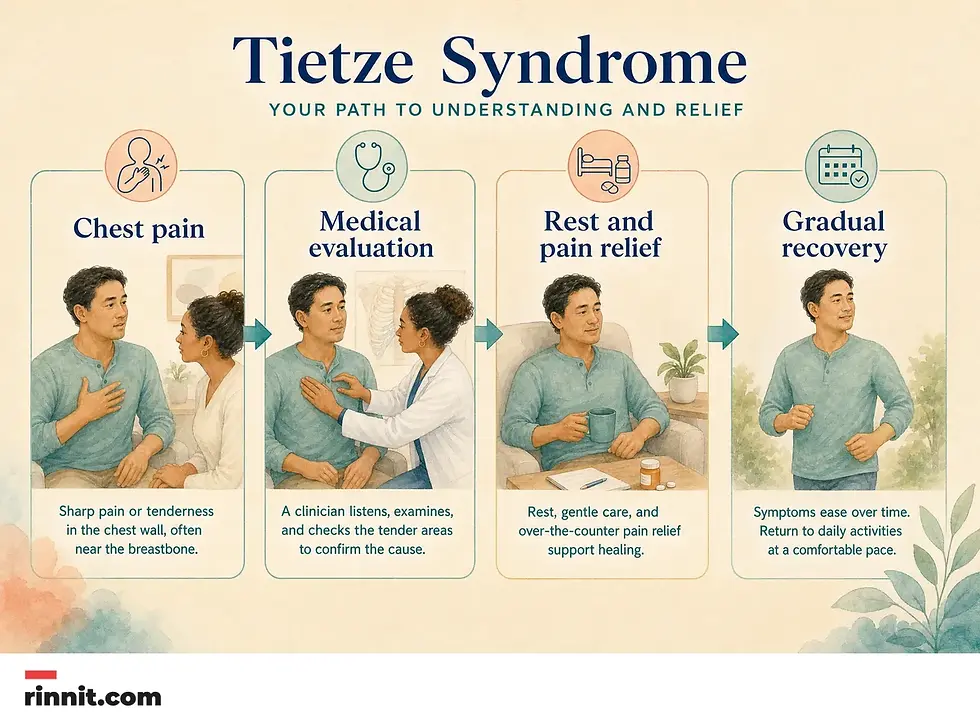
Inflamed soft tissues need time and rest to recover. Healthcare providers usually recommend rest and pain relief. People generally should not need to miss school or work, but they should take it easy and avoid vigorous activities while recovering. Activity can gradually increase as symptoms improve. [1]
Pain-relief options
Providers often recommend nonsteroidal anti-inflammatory drugs, or NSAIDs, to help relieve pain and swelling. If someone still feels they need NSAIDs after 10 days, they should consult their provider because taking them for too long can cause side effects. [1]
A provider may suggest switching to acetaminophen or may administer a cortisone injection at the site of inflammation. Medication choice depends on the individual’s health history and the provider’s assessment. [1]
Managing actions that worsen pain
Some people may need treatment to stop sneezing, coughing or vomiting before the chest can heal. These actions can put additional stress on the painful area. Keep in touch with the healthcare provider during recovery. [1]
What should you avoid during recovery?
Take it easy and avoid vigorous activities while recovering. As symptoms improve, activity can increase gradually. [1]
Do not use this article to decide when to resume strenuous activity or to choose medication without discussing your situation with a healthcare provider. Chest pain that changes, worsens or does not improve needs reassessment.
How long does Tietze syndrome last?
Tietze syndrome is temporary, and most people recover in a few weeks. Some bodies take longer. Swelling can remain for several months after the pain has gone away. [1]
Occasionally, Tietze syndrome returns after it appears to have resolved. Different causes and risk factors may make the condition more persistent in some cases. [1]
Recovery pattern | What to expect |
Pain | Often improves during recovery, usually within a few weeks for many people |
Swelling | May linger for several months after pain resolves |
Full recovery | Expected for a temporary condition, although the timeline varies |
Recurrence | Can occasionally return after seeming to go away |
Tietze syndrome vs. costochondritis
Tietze syndrome and costochondritis can both cause musculoskeletal chest pain. General inflammation of rib-cage cartilage is called costochondritis, while Tietze syndrome is more specific: it typically affects just one of the top four ribs and is distinctive for causing noticeable swelling. [1]
A person cannot reliably distinguish chest-pain conditions at home. A healthcare provider should assess symptoms and rule out more serious causes before confirming a diagnosis.
When should you contact a healthcare provider?
Contact a healthcare provider about new or persistent chest pain, especially when it occurs with localized swelling near the upper sternum. An evaluation is also important when pain is worsening, keeps returning or interferes with normal activity.
Seek emergency care for severe, sudden or worsening chest pain, trouble breathing, fainting or other symptoms that could signal a heart or lung emergency. If you are unsure whether your symptoms are urgent, seek immediate medical guidance rather than relying on an online description.
Conclusion: Tietze syndrome is treatable, but chest pain needs evaluation
Tietze syndrome causes pain and localized swelling where a rib meets the sternum. Pain may be dull at rest and sharp or gripping with movement, while coughing, sneezing and exercise can make it worse. [1]
The condition is temporary for most people. Rest, avoiding vigorous activity and provider-guided pain relief are the usual treatment approach. Most people recover in a few weeks, but swelling may take several months to disappear and symptoms can occasionally return. [1]
Because Tietze syndrome resembles other conditions, diagnosis involves evaluating chest pain and ruling out more serious causes. Rinnit.com helps make health information easier to understand, but this article cannot replace urgent assessment, testing or individualized medical advice. [1]
Frequently Asked Questions
Is Tietze syndrome dangerous?
Tietze syndrome is usually temporary and people can expect a full recovery, but chest pain can have other causes. Healthcare providers first check that chest pain is not from a heart attack and then rule out other possible conditions. Seek urgent care for severe, sudden or worsening chest pain or trouble breathing.
What is the main symptom of Tietze syndrome?
The main symptom is chest pain, often in the front and top of the chest and frequently on one side. Localized swelling near the upper sternum is another major and distinctive feature.
Where does Tietze syndrome swelling occur?
Swelling often occurs near the upper sternum, most commonly around the second or third rib. It may feel firm or mass-like and may be warm, red or discolored.
Can Tietze syndrome cause pain in the shoulder or arm?
Yes. Chest pain from Tietze syndrome may radiate to the arm, shoulder or neck.
Does coughing make Tietze syndrome worse?
Coughing can make the pain worse. Sneezing and exercise can also aggravate symptoms.
How is Tietze syndrome diagnosed?
A provider reviews symptoms, examines the chest and evaluates other possible causes. Tests may include a chest X-ray, CT scan, MRI, ultrasound, EKG or biopsy. The diagnosis is made after other causes have been ruled out.
Can Tietze syndrome be mistaken for a heart attack?
Chest pain from Tietze syndrome can resemble other conditions, so providers first check that it is not a heart attack. Do not assume that new chest pain is Tietze syndrome without medical evaluation.
How long does Tietze syndrome last?
Most people recover in a few weeks, although some take longer. Swelling can last several months after the pain goes away.
Can Tietze syndrome come back?
Yes. It can occasionally return after appearing to go away.
What is the treatment for Tietze syndrome?
Treatment usually includes rest and pain relievers. Providers often recommend NSAIDs, may suggest acetaminophen or may give a cortisone injection. Some people may need treatment to reduce sneezing, coughing or vomiting during recovery.
Should I exercise with Tietze syndrome?
Take it easy and avoid vigorous activities while recovering. You can gradually increase activity as symptoms improve, but a healthcare provider should guide your return to exercise.
How long can swelling last?
Swelling may linger for several months after pain resolves. It is often the last symptom to fade.
Is Tietze syndrome the same as costochondritis?
Tietze syndrome and costochondritis are not necessarily the same condition. Both can cause musculoskeletal chest pain, but localized swelling is emphasized as a distinctive feature of Tietze syndrome. A provider should evaluate chest pain and rule out other causes.
Can Tietze syndrome cause a firm lump?
The localized swelling may feel firm to the touch and may be described as mass-like. A new chest lump, or one that keeps growing, should be assessed by a healthcare provider rather than self-labeled as Tietze syndrome.
When should I go to the emergency room?
Go urgently for severe, sudden or worsening chest pain, trouble breathing, fainting or other symptoms that feel dangerous. Chest pain needs appropriate medical assessment because Tietze syndrome resembles other conditions.
References
Cleveland Clinic. Tietze Syndrome: Causes, Symptoms & Treatment. Cleveland Clinic. Last updated January 10, 2025. https://my.clevelandclinic.org/health/diseases/23565-tietze-syndrome
McConaghy JR, Oza RS. Outpatient diagnosis of acute chest pain in adults. Am Fam Physician. 2013;87(3):177-182. PMID 23418761. https://pubmed.ncbi.nlm.nih.gov/23418761/
Kaplan T, Gunal N, Gulbahar G, et al. Painful chest wall swellings: Tietze syndrome or chest wall tumor? Thorac Cardiovasc Surg. 2016;64(3):239-244. PMID 25742551. https://doi.org/10.1055/s-0035-1545261
Disclaimer
This article is for general educational purposes and is not a substitute for professional medical advice, diagnosis or treatment. Always seek the advice of a qualified healthcare professional with any questions about a medical condition or treatment.



Comments