Skin Graft: Types, Surgery and Recovery

Updated: 2 days ago
Written and medically reviewed by Dr. Baraa Alnahhal, MD · Last reviewed: November 2026 · How we review
Quick Answer
A skin graft is surgery that moves healthy skin from one part of the body to cover damaged or missing skin. It's used for burns, injuries, large or slow-healing wounds and after skin cancer surgery. Most grafts use your own skin. You may stay in the hospital up to two weeks. Most grafts take on the first try.
What the research says
Wound vacuum dressings cut graft infections: pooling 28 studies with 2,366 patients, negative pressure wound therapy over skin grafts lowered infection rates from 14.3% to 5.9% and improved graft take by about 7% (Shadid O et al., Journal of Plastic, Reconstructive & Aesthetic Surgery, 2025) [2]
Split-thickness grafts failed less often: in 13 studies with 712 patients whose forearm was closed after a radial forearm flap, full-thickness grafts failed more often than split-thickness grafts without better cosmetic results, while infection and pain were similar (Zhang C et al., American Journal of Otolaryngology, 2024) [3]
Key takeaways
A skin graft moves healthy skin to cover damaged or missing skin.
It treats burns, wounds, ulcers and areas left after skin cancer surgery.
Split-thickness grafts cover large areas; full-thickness grafts suit visible areas.
Avoid stretching the area for three to four weeks.
Most grafts succeed on the first attempt.
What is a skin graft?
Skin protects your body from infection and fluid loss. When a large area is lost, a graft replaces it. After placement, the graft forms new blood vessels and connects to the surrounding skin. Sources: [1]
Why it's done

Grafts restore the skin's protective barrier.
Injuries and large or slow-healing wounds.
Skin ulcers and bedsores.
Skin removed during skin cancer surgery, such as Mohs surgery.
Infections or diseases that damage skin. Sources: [1]
Types of skin grafts
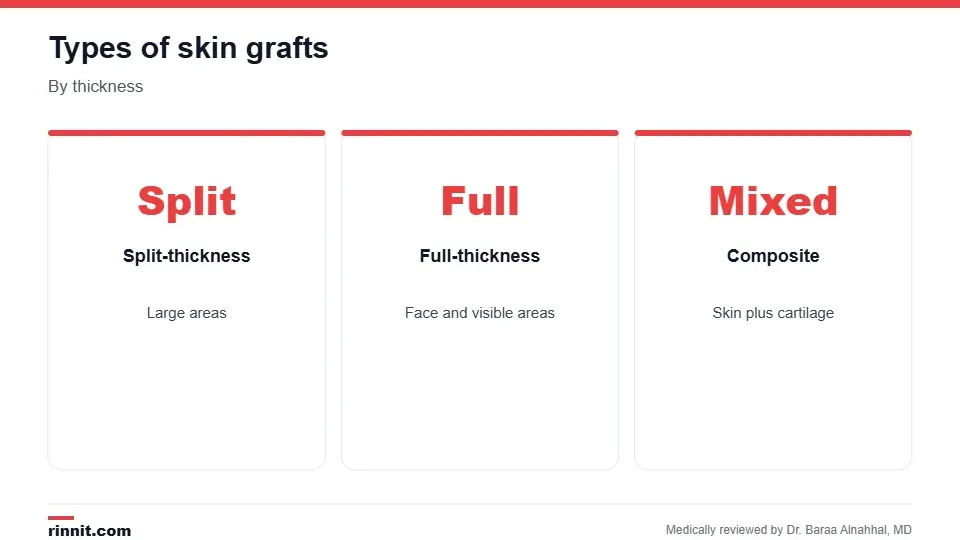
Your own skin is used most often.
Type | What it includes | Best for |
Split-thickness | Top layer plus part of the next | Large areas; donor site heals in 1 to 2 weeks |
Full-thickness | Top layer plus the entire next layer | Smaller, visible areas such as the face |
Composite | Skin plus cartilage or other tissue | Nose, ears and fingertips |
Source | Notes |
Autograft (your own skin) | Most common |
Allograft (donor skin) | Usually temporary |
Xenograft (animal, often pig) | Usually temporary |
Sources: [1]
What happens during surgery

Both the graft and donor sites are watched as they heal.
You get general anesthesia, or local anesthesia for small grafts.
The surgeon removes skin from a donor site, such as the thigh, buttock, belly, back, arm or groin.
The graft may be meshed with small cuts so it stretches and heals better.
It's placed over the wound and held with stitches or staples.
A dressing covers the area. Sources: [1]
Smokers should quit several weeks before surgery, and some medicines, such as blood thinners, may need to be stopped. Sources: [1]
Risks
Risk | Notes |
Graft failure | From fluid under the graft, infection, movement or poor blood flow; more common in smokers |
Bleeding and infection | Dressings help protect the area |
Contracture and scarring | Physical therapy can help |
Skin color or texture changes | Common |
Changes in feeling | Numbness or extra sensitivity |
Sources: [1, 2, 3]
Recovery
You may stay in the hospital up to two weeks.
Follow dressing instructions; your provider may suggest aloe vera or antibiotic ointment.
Avoid stretching the skin or hard exercise for three to four weeks.
Wait several weeks before driving or heavy lifting if advised.
Physical therapy can improve flexibility and reduce scarring.
Children may need more surgery later because grafted skin may not grow with them. Sources: [1]
When to call your provider
Bleeding or pus from the graft or donor site.
Severe pain or pain that medicine doesn't relieve.
A fever or other signs of infection. Sources: [1]
Conclusion
A skin graft can restore protection, function and appearance after serious skin loss. Careful wound care and patience while the graft settles give it the best chance to take.
Keep learning: read about burns and negative pressure wound therapy.
Frequently asked questions
What is a skin graft?
Surgery that moves healthy skin to cover damaged or missing skin.
What is a donor site?
The area where healthy skin is taken.
What's the difference between split- and full-thickness grafts?
Split-thickness takes less skin and covers large areas; full-thickness suits visible areas.
Where is skin usually taken from?
The thigh, buttock, belly, back, arm or groin.
How long does a skin graft take to heal?
The graft starts connecting in days; avoid stretching it for three to four weeks.
How long is the hospital stay?
Up to about two weeks.
Does a skin graft hurt?
You'll have pain afterward, managed with medicine.
Can a skin graft fail?
Yes, but most succeed on the first try.
Will I have a scar?
Yes, at both the graft and donor sites.
Can smoking affect a skin graft?
Yes. It raises the risk of graft failure.
Related Reading
Penectomy: Types, Surgery and Recovery explains penectomy for penile cancer.
Burns: Symptoms, Causes, Treatment, and Prevention in One Complete Guide a common reason for skin grafts.
Bedsores (Pressure Ulcers): Symptoms, Causes, and Treatment wounds that may need grafting.
Mohs Surgery: How It Works, Cure Rates, Risks, and Recovery skin cancer surgery that may need a graft.
Understanding Negative Pressure Wound Therapy: A Guide to Advanced Healing a wound dressing that helps grafts take.
Reconstructive Surgery: Restoring Form, Function, and Quality of Life an overview of reconstructive surgery.
References
Cleveland Clinic. Skin Graft: What Is It, Risks, Benefits & Recovery. Cleveland Clinic. Last updated July 21, 2021. https://my.clevelandclinic.org/health/treatments/21647-skin-graft
Shadid O, Novo J, Saini R, et al. Incidence of surgical site infections at skin graft recipient sites with negative pressure wound therapy: a meta-analysis. Journal of Plastic, Reconstructive & Aesthetic Surgery. 2025;110:306-321. PMID 40967918. https://doi.org/10.1016/j.bjps.2025.08.038
Zhang C, Pandya S, Alessandri Bonetti M, et al. Comparison of split thickness skin graft versus full thickness skin graft for radial forearm flap donor site closure: a systematic review and meta-analysis. American Journal of Otolaryngology. 2024;45(2):104156. PMID 38142610. https://doi.org/10.1016/j.amjoto.2023.104156
Medical disclaimer
This article is for general education only and does not replace advice from a qualified healthcare professional. Talk to your doctor about your own diagnosis and treatment, and seek emergency care right away for severe or sudden symptoms.



Comments