Bedsores (Pressure Ulcers): Symptoms, Causes, and Treatment

Updated: 3 days ago
Medically reviewed by Dr. Baraa Alnahhal, MD · Last reviewed: October 2026
Quick Answer
A bedsore is an injury to the skin and underlying tissue caused by sustained pressure that reduces blood flow, most often over bony areas such as the heels, hips and tailbone. Pressure, friction and shear cause them, and people with limited mobility face the highest risk. Treatment involves relieving pressure, wound care and preventing infection.
What the research says
Silicone foam dressings may lower the chance of pressure ulcers, but the evidence is weak. A Cochrane review of 51 randomized trials (13,303 participants) found that, in 18 trials with 5,903 participants, silicone foam dressings were associated with about half the pressure ulcer incidence of no dressing (risk ratio 0.50; 95% CI 0.33 to 0.77). The authors rated the evidence low or very low certainty, so it remains unclear whether any dressing or topical agent clearly makes a difference (Patton et al., Cochrane Database Syst Rev, 2024) [4].
Repositioning is standard care, yet high-quality evidence is thin. An overview of 17 systematic reviews covering 149 studies (5,856,293 participants) reported that frequent repositioning and certain nutritional interventions may reduce pressure injury incidence or wound surface area, but certainty was very low, and the authors called for better targeted research (Dewidar et al., Palliat Med, 2026) [5].
Combined approaches look most cost-effective. An umbrella review of 14 systematic reviews found that the most cost-effective prevention strategies were multifaceted, combining repositioning regimens, pressure-redistribution mattresses or overlays, and oral nutritional supplements; for treatment, foam and collagenase dressings and enteral nutrition were reported as most cost-effective (Klugar et al., JBI Evid Synth, 2025) [6].
What are bedsores?
Bedsores are areas of damaged skin and tissue caused by sustained pressure that reduces blood flow to vulnerable areas of the body. This pressure often comes from being in a bed or wheelchair for a long time. Bedsores are also called pressure ulcers, pressure injuries, and decubitus ulcers.
These injuries most often arise on skin that covers bony areas of the body, such as the heels, ankles, hips, and tailbone. The people most at risk have medical conditions that keep them from changing positions or moving, or who spend most of their time in a bed or a chair.
Bedsores can arise over hours or days. The encouraging part: most sores heal with treatment. Some never heal completely. You can take steps to stop bedsores from forming and to help them heal once they appear.

At a glance: bedsores in numbers and facts
Aspect | What the evidence shows |
What they are | Areas of damaged skin and tissue from sustained pressure that reduces blood flow |
Other names | Pressure ulcers, pressure injuries, decubitus ulcers |
Most common sites | Heels, ankles, hips, and tailbone (skin over bony areas) |
How fast they develop | Can arise over hours or days |
Who is most at risk | People who spend most of their time in a bed or chair and cannot change positions |
Healing outlook | Most heal with treatment, but some never heal completely |
Main causes | Pressure, friction, and shear |
Serious complication | Infections that can spread to bone and, rarely, sepsis |
What are the symptoms of bedsores?
Bedsores announce themselves through changes in the skin. The main warning signs are changes in skin color or texture, swelling, pus-like draining, an area of skin that feels cooler or warmer to the touch than other areas, and sore areas.
Bedsores fall into stages based on their depth, how serious they are, and other features. The degree of damage ranges from inflamed, unbroken skin to a deep injury involving muscle and bone.
The location of a bedsore usually follows where pressure builds. For people who use wheelchairs, bedsores often occur on the skin over the tailbone or buttocks, the shoulder blades and spine, and the backs of the arms and legs where they rest against a chair. For people who need to stay in bed, sores may happen on the back or sides of the head, the shoulder blades, the hip, lower back or tailbone, and the heels, ankles, and skin behind the knees.
Symptom | What it looks like |
Skin color or texture changes | Discoloration or altered texture over pressure points |
Swelling | Localized puffiness around the affected area |
Pus-like draining | Fluid discharge from the sore |
Temperature changes | Skin feels cooler or warmer than surrounding areas |
Sore areas | Tenderness or soreness over bony areas |
Pain level varies | People with nerve damage may not feel pain at all |
When to see a doctor
If you notice warning signs of a bedsore, change your position to ease pressure on the area. If the area does not improve in 24 to 48 hours, contact your health care professional.
Seek medical care right away if you notice signs of infection. These include fever, drainage from a sore or a sore that smells bad, and warmth or swelling around a sore.
What causes bedsores?
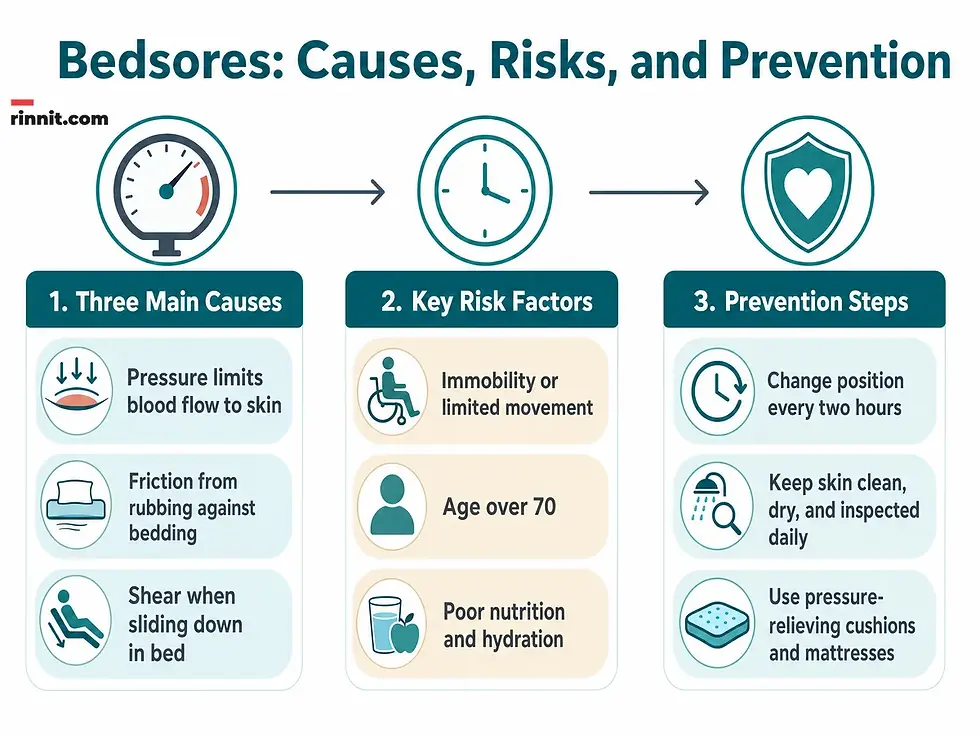
Pressure against the skin that limits blood flow to the skin causes bedsores. Limited movement can make skin prone to damage. Three main forces work together to cause these injuries.
Pressure. Constant pressure on any part of the body can lessen the blood flow to tissues. Blood flow delivers oxygen and other nutrients that keep tissues alive. Without these nutrients, skin and nearby tissues are damaged and might die over time. For people with limited mobility, pressure tends to happen in areas that are not well padded with muscle or fat and that lie over a bone, including the spine, tailbone, shoulder blades, hips, heels, and elbows.
Friction. Friction occurs when the skin rubs against clothing or bedding. It makes fragile skin more vulnerable to injury, especially if the skin is also moist.
Shear. Shear occurs when two surfaces move in opposite directions. For example, when a bed is raised at the head, a person can slide down in bed. As the tailbone moves down, the skin over the bone might stay in place, pulling in the opposite direction.
Who is at risk of bedsores?
Your risk of getting bedsores is higher if you have a hard time moving and cannot change position easily while seated or in bed.
Risk factor | Why it raises risk |
Immobility | Poor health, spinal cord injury, or another cause limits movement |
Incontinence | Skin becomes more vulnerable with extended exposure to urine and stool |
Lack of sensory perception | Spinal cord injuries and neurological disorders reduce sensation, so warning signs go unnoticed |
Poor nutrition and hydration | Skin needs daily fluids, calories, protein, vitamins, and minerals to stay healthy |
Conditions affecting blood flow | Diabetes and vascular disease raise the risk of tissue damage |
Age over 70 | Older adults are more likely to be affected |
What complications can bedsores cause?
Left untreated, bedsores can become dangerous. Some complications can be life-threatening.
Complication | Impact |
Cellulitis | Infection of the skin and connected soft tissues, causing warmth, swelling, and color changes; people with nerve damage often do not feel the pain |
Bone and joint infections | Septic arthritis can damage cartilage and tissue; osteomyelitis (bone infection) can reduce the function of joints and limbs |
Cancer | A Marjolin ulcer is a long-term, nonhealing wound that can become a type of squamous cell carcinoma |
Sepsis | Rarely, a skin ulcer leads to sepsis, a life-threatening complication of infection |
How are bedsores diagnosed?
Your health care professional will likely look closely at your skin to decide if you have a pressure ulcer. If one is found, they will assign a stage to the wound. Staging helps determine what treatment is best for you. You might also need blood tests to learn about your general health.
To understand your situation, your provider may ask questions such as when the bedsores first appeared, how painful they are, whether you have had them before and how they were treated, what care assistance is available to you, what your routine for changing positions looks like, what medical conditions you have been diagnosed with, and what you usually eat and drink.
Diagnostic component | What it covers |
Skin examination | Close look at the skin to confirm a pressure ulcer |
Staging the wound | Classifying depth and severity to guide treatment |
Blood tests | General health assessment that affects healing |
Care history | Prior bedsores, treatments, outcomes, and position-changing routine |
Nutrition review | Usual food and drink intake that affects healing |
How are bedsores treated?
Treating pressure ulcers involves several goals working together: lowering pressure on the affected skin, caring for the wound, removing damaged tissue, controlling pain, preventing infection, and eating well.
The treatment team
Bedsores usually need a team. Members of your care team might include a primary care professional who oversees the treatment plan, a wound care specialist, nurses or medical assistants who provide care and education, a social worker who helps you or your family access resources, a physical therapist who helps you move better, an occupational therapist who makes sure seating surfaces are right, a dietitian who tracks what you need to eat, a dermatologist, and in some cases a neurosurgeon, vascular surgeon, orthopedic surgeon, or plastic surgeon.
Reducing pressure
The first step in treating a bedsore is to lower the pressure and friction that caused it. Try to change position: if you have a bedsore, turn and change your position often. How often depends on your condition and the quality of the surface you are on. Also use support surfaces: a mattress, bed, and special cushions that help you sit or lie in a way that protects vulnerable skin.
Cleaning and dressing wounds
Care for pressure ulcers depends on how deep the wound is. If the affected skin is not broken, wash it with a gentle cleanser and pat dry. Clean open sores with water or saline each time a dressing is changed. Saline is a saltwater solution.
A bandage speeds healing by keeping the wound moist. It also creates a barrier against infection and keeps the skin around it dry. Bandage choices include films, gauzes, gels, foams, and treated coverings. You might need a combination of bandages.
Treatment goal | How it is achieved |
Reduce pressure | Change position often; use supportive mattresses and special cushions |
Clean the wound | Gentle cleanser on unbroken skin; water or saline on open sores at each dressing change |
Dress the wound | Films, gauzes, gels, foams, or treated coverings, sometimes combined |
Remove damaged tissue | Debriding by flushing with water or cutting out damaged tissue |
Control pain | NSAIDs such as ibuprofen or naproxen sodium, plus skin-applied pain medicines during wound care |
Support healing | A healthy diet; surgery such as flap surgery for large sores that fail to heal |
Removing damaged tissue
To heal properly, wounds need to be free of damaged, dead, or infected tissue. The health care professional may remove damaged tissue, also known as debriding, by gently flushing the wound with water or cutting out damaged tissue.
Medicines to control pain
Nonsteroidal anti-inflammatory drugs, also known as NSAIDs, such as ibuprofen and naproxen sodium, might reduce pain. These can be very helpful before or after changing position and with wound care. Pain medicines applied to the skin also can help during wound care.
Surgery
A large bedsore that fails to heal might require surgery. One method of surgical repair is to use padding from your muscle, skin, or other tissue to cover the wound and cushion the affected bone. This is called flap surgery.
How do you prevent bedsores?
Six habits form the foundation of prevention: frequently change your position to avoid stress on the skin, take good care of your skin, eat and drink regularly, quit smoking, manage stress, and exercise daily.

Tips for repositioning
Shift your weight frequently. Ask for help with changing your position every two hours.
Lift yourself, if possible. If you have enough upper body strength, do wheelchair pushups. Raise your body off the seat by pushing on the arms of the chair.
Look into a specialty wheelchair. Some wheelchairs allow you to tilt them, which can relieve pressure.
Select cushions or a mattress that relieves pressure. Use cushions or a special mattress to relieve pressure and help make sure your body is well positioned. Do not use doughnut cushions. They can focus pressure on surrounding tissue.
Adjust the height of your bed. If possible, do not raise the head of the bed above 30 degrees. This helps prevent shearing.
Tips for skin care
Keep skin clean and dry. Wash the skin with a gentle cleanser and pat dry. Do this cleansing routine regularly to limit the skin's exposure to moisture, urine, and stool.
Protect the skin. Use moisture barrier creams to protect the skin from urine and stool. Change bedding and clothing frequently if needed. Watch for buttons on clothing and wrinkles in bedding that can irritate your skin.
Inspect the skin daily. Look closely at your skin daily for warning signs of a bedsore.
Prevention habit | How to practice it |
Reposition regularly | Change position every two hours; wheelchair pushups if possible |
Relieve pressure | Pressure-relieving cushions and mattresses; no doughnut cushions |
Avoid shearing | Do not raise the head of the bed above 30 degrees |
Keep skin clean and dry | Wash with gentle cleanser, pat dry, limit moisture exposure |
Protect the skin | Moisture barrier creams; watch for buttons and wrinkles that irritate |
Inspect daily | Check skin every day for early warning signs |
Support healing | Eat and drink regularly, quit smoking, manage stress, exercise daily |
Coping and support
People with bedsores may have discomfort. They also can be socially isolated or depressed. Talk with your health care team about your needs for support and comfort. A social worker can help find community groups that provide services, education, and support for people dealing with long-term caregiving or terminal illness.
Parents or caregivers of children with bedsores can talk with a child life specialist for help in coping with stressful health situations. Family and friends of people living in assisted living facilities can support residents and work with nursing staff to make sure they receive the proper preventive care.
Bottom line
Bedsores are a sign of pressure that the body cannot escape, not a sign of poor care alone. They develop when sustained pressure cuts off blood flow to the skin, and they strike hardest at the people who cannot move easily: those in beds and wheelchairs, people with nerve damage, and adults over 70.
The good news is that bedsores are largely preventable and mostly treatable. Repositioning every two hours, protecting the skin, using pressure-relieving cushions, and inspecting the skin daily stop most problems before they start. Once a sore forms, treatment works: relieve the pressure, clean and dress the wound, control the pain, and feed the body well.
The watchword is early action. A sore that responds to repositioning within 24 to 48 hours can often be managed with home measures. A sore that drains, smells, or comes with fever needs medical care right away, because infections can spread to bone and, rarely, become life-threatening.
The best next step depends on your situation. If you or a loved one spends most of the day in a bed or chair, start a repositioning routine today and inspect the skin daily. If you spot early warning signs, contact a health care professional. And if signs of infection appear, seek care immediately.
Take the next step: If you or a loved one spends most of the day in a bed or chair, start a repositioning routine today and check the skin daily. Talk to a health care provider about any sore that does not improve in 24 to 48 hours.
FAQ
What causes bedsores?
Bedsores are caused by sustained pressure that reduces blood flow to the skin, combined with friction from rubbing against clothing or bedding and shear when the body slides while the skin stays in place.
What do bedsores look like at first?
Early warning signs include changes in skin color or texture, swelling, soreness, and skin that feels cooler or warmer than surrounding areas. The sore areas most often sit over bony points like the heels, hips, and tailbone.
How do you prevent bedsores in a wheelchair or bed?
Change position every two hours, use pressure-relieving cushions or mattresses (never doughnut cushions), keep the head of the bed below 30 degrees, keep skin clean and dry, and inspect the skin daily.
How are bedsores treated?
Treatment lowers pressure on the affected skin, cleans and dresses the wound with films, gauzes, gels, or foams, removes damaged tissue through debridement, controls pain with NSAIDs and skin-applied medicines, and supports healing with good nutrition; severe cases may need flap surgery.
Can bedsores become life-threatening?
Yes, in some cases. Infections can spread to joints and bone, and rarely a skin ulcer leads to sepsis, a life-threatening complication. Seek care right away for fever, bad-smelling drainage, or warmth and swelling around a sore.
Disclaimer: This article is for general informational purposes only and does not constitute medical advice. Always consult a qualified healthcare professional for diagnosis and treatment.
What are the stages of bedsores?
Bedsores are grouped into stages by how deep they go. Stage 1 is red or discolored skin that does not fade when pressed, stage 2 is a shallow open sore or blister, and stages 3 and 4 reach deeper into fat, muscle or bone.
Where do bedsores usually form?
They form over bony areas, such as the tailbone, hips, heels, ankles, shoulder blades and back of the head. In wheelchair users, the tailbone, buttocks, spine and backs of the arms and legs are common spots.
How often should someone be repositioned to prevent bedsores?
People in bed are usually helped to change position about every two hours. Wheelchair users should shift their weight often and get help changing position regularly. The care team can set a schedule that fits the person.
How long do bedsores take to heal?
Early-stage sores may heal in days to weeks once pressure is taken off the area. Deeper sores can take months to heal, and some need surgery to close.
What are the signs that a bedsore is infected?
Warning signs include more redness, warmth or swelling, pus or a bad smell, and worsening pain or fever. See a provider promptly, and get emergency care for fever with confusion, a fast heartbeat or weakness.
Related Reading
Skin Graft: Types, Surgery and Recovery explains skin graft surgery and recovery.
References
Mayo Clinic Staff. Bedsores (pressure ulcers) - Symptoms and causes. Mayo Clinic. February 22, 2024. https://www.mayoclinic.org/diseases-conditions/bed-sores/symptoms-causes/syc-20355893
Mayo Clinic Staff. Bedsores (pressure ulcers) - Diagnosis and treatment. Mayo Clinic. February 22, 2024. https://www.mayoclinic.org/diseases-conditions/bed-sores/diagnosis-treatment/drc-20355899
National Pressure Injury Advisory Panel. National Pressure Injury Advisory Panel. NPIAP. Accessed October 30, 2026. https://npiap.com/
Patton D, et al. Dressings and topical agents for preventing pressure ulcers. Cochrane Database Syst Rev. 2024;12(12):CD009362. PMID 39625073. https://doi.org/10.1002/14651858.CD009362.pub4
Dewidar O, et al. Prevalence, risk factors and management of pressure injuries and their implications for palliative care: A rapid overview of reviews. Palliat Med. 2026;40(1):21-30. PMID 41299841. https://doi.org/10.1177/02692163251393817
Klugar M, et al. Economic evaluations of interventions for the prevention and treatment of pressure ulcers: an umbrella review. JBI Evid Synth. 2025;23(8):1536-1564. PMID 40437976. https://doi.org/10.11124/JBIES-23-00488



Comments