Skene’s Gland: Anatomy, Function, and Health

Updated: 3 days ago
Medically reviewed by Dr. Baraa Alnahhal, MD · Last reviewed: October 17, 2026
Skene’s glands are two small paraurethral ducts located near the female urethral opening [1]. Often referred to as the "female prostate," these glands play critical roles in sexual health by providing lubrication and urinary health by secreting antimicrobial fluids [1]. While typically asymptomatic, they can become infected (skenitis) or develop cysts [1]. Maintaining paraurethral health involves routine hygiene and prompt medical attention for symptoms like painful urination or pelvic discomfort [1].
Quick Answer: What are Skene's glands?
Skene's glands are small paraurethral structures on either side of the female urethral opening that secrete lubricating fluid during arousal and provide antimicrobial protection to the urinary tract [1]. They are anatomically equivalent to the male prostate [1]. Common problems include skenitis, an inflammation often caused by infection, which needs medical evaluation and typically responds well to antibiotics [1].
What the research says
Anatomical studies point to the Skene’s glands as the source of female ejaculate. A review of 44 publications from 1889 to 2019 concluded that the ejaculate originates in the paraurethral (Skene’s) glands, differs from urine in its creatinine and urea concentrations, contains prostate-specific antigen and could have antibacterial properties, although the specific function remains debated (Rodriguez et al., Clin Anat, 2021 [2]).
Female ejaculation is a different phenomenon from squirting. A narrative review describes female ejaculation as the secretion of a few milliliters of thick, milky fluid containing prostate-specific antigen by the female prostate (Skene’s glands) during orgasm, whereas squirting is the transurethral expulsion of tenths of milliliters of a form of urine — two phenomena with different mechanisms (Pastor & Chmel, Int Urogynecol J, 2018 [3]).
Cancer of the Skene’s glands is extremely rare. A systematic review of the literature through December 2021 identified 15 published cases that met its criteria after review for pathologic accuracy, all adenocarcinomas resembling prostate cancer, with a median age of 71 years and no recurrence or death from the cancer during a median follow-up of 11.5 months (Slopnick et al., Urology, 2022 [4]).
What is the anatomy of Skene’s gland?
Skene’s glands, also known as paraurethral or periurethral glands, are small, specialized structures located at the lower end of the female urethra [1]. They are situated within the vestibule of the vulva, specifically near the urethral opening where urine exits the body [1]. These glands are approximately the size of a small blueberry, though their exact dimensions can vary significantly between individuals. Due to their deep location and small size, they are rarely visible to the naked eye during a self-examination [1].
Anatomical Feature | Description |
Location | Vestibule of the vulva, flanking the urethral opening. |
Size | Roughly equivalent to a small blueberry; varies by individual. |
Synonyms | Paraurethral glands, lesser vestibular glands, female prostate. |
Development | Formed from the same embryonic cells as the male prostate. |

What functions do Skene’s glands serve in the body?
The primary function of Skene’s glands is to support both urinary and sexual health. During sexual arousal, the tissues surrounding these glands swell due to increased blood flow, and the glands secrete a fluid that provides lubrication for the vaginal opening [1]. Research indicates that these glands may also be responsible for female ejaculation, as the fluid released during orgasm contains proteins similar to those found in male seminal fluid [2] [3].
Beyond sexual function, Skene’s glands contribute to the defense of the urinary system. They secrete a substance that lubricates the urethral opening during urination, which helps prevent the spread of harmful bacteria and reduces the risk of urinary tract infections (UTIs) [1]. This antimicrobial action is a vital component of the body's natural defense mechanisms in the pelvic region.
Functional Category | Primary Role |
Sexual Health | Provides lubrication during arousal; potential source of orgasmic fluid. |
Urinary Health | Lubricates the urethral opening; offers antimicrobial protection. |
Biological Analogy | Functions similarly to the male prostate in fluid production. |

What conditions and disorders affect Skene’s glands?
Skene’s glands can be affected by skenitis, an inflammation or infection, as well as duct cysts, trichomoniasis and, in extremely rare cases, cancer [1]. The most common disorder is skenitis, which is an inflammation or infection of the glands. Skenitis is frequently caused by the same pathogens responsible for gonorrhea [1] and can sometimes be misdiagnosed as a standard urinary tract infection due to overlapping symptoms.
Other potential issues include the development of Skene’s duct cysts, which occur when the ducts become blocked, and infections like trichomoniasis. In extremely rare cases—with only about 20 reported instances globally—cancer can develop within the Skene’s glands [1].
Cleveland Clinic notes that disorders of the Skene’s glands may affect the urethra, and that problems with the urethra can in turn affect the Skene’s glands [1].
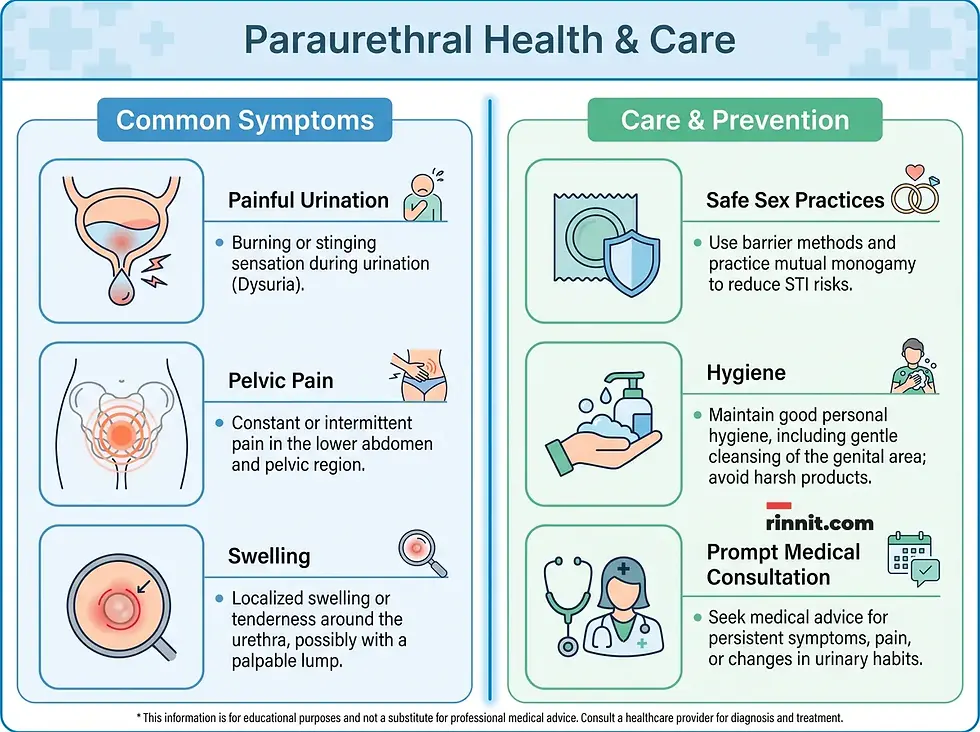
Common Symptoms of Paraurethral Issues
How can you maintain paraurethral and Skene’s gland health?
Maintaining the health of Skene’s glands involves standard pelvic hygiene and proactive medical care. Because infections like skenitis are often linked to sexually transmitted infections (STIs) [1], practicing safe sex is a primary preventive measure. If an infection occurs, healthcare providers typically prescribe antibiotics to resolve the issue [1]. In cases where a prolonged infection leads to the formation of an abscess, surgical drainage or removal may be necessary [1].
When to Consult a Professional
It is essential to seek medical advice if you experience persistent pelvic pain, changes in urinary frequency, or pain during intimate activities. Early evaluation ensures that conditions like skenitis are treated promptly, preventing complications such as abscesses or chronic inflammation.
Conclusion and Next Steps
Skene’s glands are vital yet often overlooked components of the female reproductive and urinary systems. By providing lubrication and antimicrobial protection, they ensure the functional integrity of the paraurethral area. Understanding their anatomy and potential disorders allows for better self-care and more effective communication with healthcare providers.
If you are experiencing any symptoms related to painful urination or pelvic discomfort, consider scheduling a consultation with a specialist to discuss your paraurethral health.
Frequently Asked Questions
What are Skene’s glands?
Skene’s glands are two small paraurethral ducts located near the female urethral opening that help with lubrication and infection prevention.
Where are Skene’s glands located?
Skene’s glands are located on either side of the female urethra, within the vestibule of the vulva.
What is the function of Skene’s glands?
Skene’s glands provide lubrication during sexual arousal and secrete antimicrobial fluids to protect the urinary tract from infections.
Are Skene’s glands visible?
Skene’s glands are not usually visible to the naked eye. They are about the size of a small blueberry and sit on either side of the urethral opening, but they are very hard to see because of their size and location.
What is skenitis?
Skenitis is the inflammation or infection of Skene’s glands, often caused by pathogens like those that cause gonorrhea.
Can Skene’s glands cause painful urination?
Yes, infection or inflammation of these glands (skenitis) can cause pain during urination, similar to a UTI.
Do Skene’s glands produce fluid during orgasm?
Yes, research suggests they may release a fluid similar to male seminal fluid during female ejaculation.
What are the symptoms of a Skene’s gland infection?
Symptoms include swelling near the urethra, painful urination, painful sex, and unusual vaginal discharge.
How is skenitis treated?
Skenitis is typically treated with antibiotics. If an abscess forms, surgical drainage may be required.
Is Skene’s gland cancer common?
No, Skene’s gland cancer is extremely rare, with only about 20 reported cases in medical literature.
Related Reading
Understanding Skene’s Gland Cysts: Symptoms and Care explains how Skene's gland cysts form and how they are treated.
The Urethra: Anatomy, Function, and Urinary Health describes the urethra, where the Skene's glands sit, and its common problems.
Bartholin Cyst: The Benign Lump Near the Vaginal Opening That's Usually Painless — and How to Handle It When It Isn't covers a similar gland cyst that forms near the vaginal opening.
Understanding Vulvar Anatomy: Function, Health, and Care explains the anatomy of the vulva and how to care for it.
References
Cleveland Clinic. Skene’s Gland. Cleveland Clinic. September 2, 2022. https://my.clevelandclinic.org/health/body/24089-skenes-gland
Rodriguez FD, Camacho A, Bordes SJ, et al. Female ejaculation: an update on anatomy, history, and controversies. Clin Anat. 2021;34(1):103-107. PMID 32681804. https://doi.org/10.1002/ca.23654
Pastor Z, Chmel R. Differential diagnostics of female "sexual" fluids: a narrative review. Int Urogynecol J. 2018;29(5):621-629. PMID 29285596. https://doi.org/10.1007/s00192-017-3527-9
Slopnick EA, Bagby C, Mahran A, et al. Skene’s gland malignancy: a case report and systematic review. Urology. 2022;165:36-43. PMID 35192863. https://doi.org/10.1016/j.urology.2022.02.004
Medical disclaimer
The information provided in this article is for educational purposes only and should not be used as a substitute for professional medical advice, diagnosis, or treatment. Always seek the advice of your physician or other qualified health provider with any questions you may have regarding a medical condition.



Comments