Bartholin Cyst: The Benign Lump Near the Vaginal Opening That's Usually Painless — and How to Handle It When It Isn't

Updated: 2 days ago
Medically reviewed by Dr. Baraa Alnahhal, MD. Last reviewed October 13, 2026. This content is for educational purposes and is not medical advice.

Quick Answer
A Bartholin cyst is a noncancerous, firm, round lump under the skin of the labia, formed when a blocked Bartholin gland causes fluid to back up [1]. It affects about 2% of females, most often between 20 and 40 [1]. Small painless cysts often need no treatment, while infected cysts may need antibiotics or draining [1]. Never squeeze or pop the cyst [1] [5].
What the research says
Two common office treatments had similar recurrence rates. In a multicenter randomized trial of 161 women with a symptomatic Bartholin cyst or abscess, recurrence within 1 year occurred in 12% (10 of 82) of women treated with a Word catheter versus 10% (8 of 79) treated with marsupialisation (relative risk 1.1, 95% CI 0.64 to 1.91). In the first 24 hours, 33% of the Word catheter group used analgesics versus 74% of the marsupialisation group, and treatment started after about 1 hour versus 4 hours (Kroese et al., BJOG, 2017) [6].
No single surgical treatment has been proven best. A systematic review of 8 randomised trials covering 699 women found that, for recurrence, the evidence comparing marsupialisation with a Word catheter was consistent with notable effects in either direction (risk ratio 0.76, 95% CI 0.41 to 1.40), and concluded that current trial evidence does not support any single surgical intervention (Illingworth et al., BJOG, 2020) [7].
Simple needle drainage is not recommended because the cyst tends to come back. A clinical review notes that about 2% of women will develop a Bartholin cyst or abscess in their lifetime, that healing and recurrence rates are similar among fistulization, marsupialization, and silver nitrate or alcohol sclerotherapy, and that needle aspiration and incision and drainage are not recommended because of a relatively increased recurrence rate (Omole et al., Am Fam Physician, 2019) [8].
What Is a Bartholin Cyst?
A Bartholin cyst is a firm, round bump near the opening to your vagina. It can cause irritation and pain but is often painless [1]. It is a noncancerous lump under the skin of your labia [1].
A Bartholin cyst (also called a vulvar cyst) is a type of vaginal cyst that forms on either side of your labia (vaginal lips) near the opening of your vagina. It's named after the Bartholin glands — two small glands located on either side of your vagina that produce a fluid that helps lubricate your vagina [1].
A Bartholin cyst occurs when a blockage happens at the openings of one of these glands, causing the fluid to build up and form a lump [1]. It typically only occurs on one of the two Bartholin glands. Some Bartholin cysts are small and don't cause any pain. If the cyst becomes infected with bacteria, an abscess can form. An infected Bartholin cyst can be painful and may require medical treatment [1].
What does a Bartholin cyst look like?
Bartholin cysts look like round, solid bumps under the skin on the lips of your vagina (labia). They're often painless. Some may become red, tender and swollen if an infection occurs. Other Bartholin cysts may look like they're filled with pus or fluid. Bartholin cysts can be as small as a pea or grow as large as a golf ball [1] [5]. The cyst may make one side of your labia appear larger or look lopsided [1].
Are Bartholin cysts hard or soft?
Bartholin cysts are typically solid and firm when you touch them. The cysts may be slightly softer when fluid is trapped inside [1].
How common are Bartholin cysts?
Bartholin cysts will occur in about 2% of females at some time in their lives [1]. They're more common when you're between 20 and 40 years old. The chance of developing a Bartholin cyst decreases after menopause [1].
Key fact | What it means |
Nature of the lump | Noncancerous, firm, round bump under the labia skin |
Prevalence | About 2% of females at some time in their lives |
Most common age | Between 20 and 40 years old |
After menopause | The chance of developing one decreases |
Side affected | Typically only one of the two Bartholin glands |
Size range | From as small as a pea to as large as a golf ball |
What Does a Bartholin Cyst Feel Like?
Many Bartholin cysts are small and don't cause symptoms other than minor irritation. If a Bartholin cyst forms an abscess (infection), symptoms may include discomfort and pain during sex, walking, sitting, or when inserting a tampon or wiping after using the restroom; swelling and tenderness in the area; fever or chills; redness; drainage from the cyst; and a change in size (the cyst gets larger) [1].
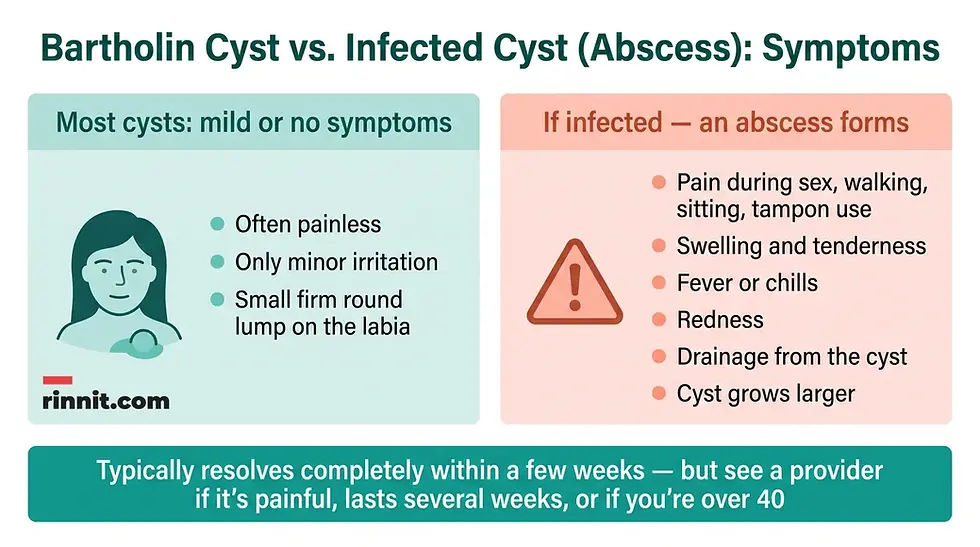
Symptom of an infected cyst (abscess) | How it shows up |
Pain and discomfort | During sex, walking, sitting, or when inserting a tampon or wiping |
Swelling and tenderness | In the area of the cyst |
Fever or chills | Signs of infection |
Redness | The area around the cyst turns red |
Drainage | Fluid drains from the cyst |
Change in size | The cyst gets larger |
What Causes a Bartholin Cyst?
Healthcare providers don't know the exact cause or why some people are prone to getting Bartholin cysts. Some possible causes include injury, irritation or extra growth of skin in the vulvar area of your vagina; chlamydia, gonorrhea or other sexually transmitted infections (STIs); and bacterial infections such as E. coli (Escherichia coli) [1].
Is a Bartholin cyst contagious?
Most Bartholin cysts don't become infected and can't spread during skin-to-skin contact. If an infected cyst bursts or ruptures, the bacteria inside can be contagious depending on the type of bacteria [1].
Are Bartholin cysts caused by an infection?
Bartholin cysts are typically not caused by a bacterial infection. They can become infected more commonly by E. coli (bacteria typically from your colon) and other bacterial infections or sexually transmitted infections like gonorrhea and chlamydia. These bacteria can clog the Bartholin gland and lead to a cyst [1].
What are the risk factors?
Healthcare providers aren't entirely sure why some people get Bartholin cysts and others don't. You may be more likely to get one if you've already had one. Other risk factors include being between 20 and 30 years old, being sexually active, having recent trauma or injury to your vulva, and having a sexually transmitted infection [1].
Risk factor | Detail |
Prior Bartholin cyst | You may be more likely to get one if you've already had one |
Age | Being between 20 and 30 years old |
Sexual activity | Being sexually active |
Trauma | Recent trauma or injury to your vulva |
STI | Having a sexually transmitted infection |
Once you have a Bartholin cyst, practicing good hygiene by keeping the area clean and dry can lower your risk for infection [1].
Can a Bartholin Cyst Become Cancerous?
Bartholin cysts are typically harmless and don't cause serious complications. But the cyst can become extremely painful when an infection develops. It's rare to develop cancer in your Bartholin gland, but in some cases, your provider may want to remove the cyst to check for cancerous cells [1].
How Is a Bartholin Cyst Diagnosed?
To diagnose a Bartholin cyst, a healthcare provider will do a physical exam. They'll look at the size of the cyst and look for signs of infection. If the cyst produces discharge, your healthcare provider may test the fluid for sexually transmitted infections (STIs) or other bacteria [1].
If you're older than 40, your healthcare provider may perform a biopsy to rule out cancer of your vulva [1]. During this test, your healthcare provider will remove a small sample of tissue from the cyst and look at it under a microscope.
What can be mistaken for a Bartholin cyst?
A Bartholin cyst can be mistaken for other types of cysts like a Skene's gland cyst or a sebaceous cyst [1]. It can also be mistaken for cysts or masses that are potentially cancerous. Your healthcare provider will consider factors like your age, active infections and health history when diagnosing and treating a Bartholin cyst.
Diagnostic step | What happens |
Physical exam | Provider looks at the size of the cyst and checks for signs of infection |
Fluid testing | If the cyst produces discharge, the fluid is tested for STIs or other bacteria |
Biopsy (if older than 40) | A small tissue sample is removed and examined under a microscope to rule out vulvar cancer |
How Is a Bartholin Cyst Treated?
Treatment for Bartholin cysts depends on the symptoms. If a cyst is small, painless and doesn't appear infected, it may not need treatment [1]. If symptoms persist or the cyst grows, then you may be developing an abscess. Your provider may want to drain or remove the cyst if it's infected or if it appears to be cancerous (rare) [1].
Treatment should be directed by your healthcare provider. Even if it's a treatment option you can do at home, it's best to talk to your provider first. Don't try to drain or squeeze a cyst as this could cause infection and make your symptoms worse [1] [5].
Treatment | How it works | When it's used |
Sitz baths | Sit in a bathtub with 3 to 4 inches of warm water a few times a day for several days — provides comfort, promotes healing, and could help an infected cyst burst and drain on its own | First-line home care |
OTC pain medications | Acetaminophen or ibuprofen for pain relief (follow label instructions) | Symptom relief |
Antibiotics | Prescribed if the cyst is infected or tests show an STI | Infection |
Surgical draining | The cyst is drained; several methods exist depending on its size | Infected cyst causing pain and discomfort |
Marsupialization | The cyst is opened and drained, then the edges of the cyst wall are stitched to form a permanent open pocket ("pouch") for continuous drainage | Often helpful for recurrent cysts |
Removal of the Bartholin gland | The Bartholin glands are surgically removed | Extremely rare cases where treatment isn't working |
What happens if it's left untreated?
Treatment may not be necessary if you don't have symptoms and the cyst isn't bothering you. These types of Bartholin cysts often heal on their own using at-home remedies like warm baths. If an infection develops and your cyst becomes large and painful, taking antibiotics or draining the cyst may be necessary [1].
Does a Bartholin cyst pop on its own?
It's common for Bartholin cysts to heal on their own. Most healthcare providers will recommend sitz baths to manage symptoms. If a cyst drains or bursts on its own, this is OK [1] [5]. Keep the area clean and dry to minimize the spread of infection. Don't squeeze or drain a Bartholin cyst yourself as this can cause infection. Contact your healthcare provider if the cyst becomes painful, infected or lasts several weeks without signs of improvement [1].
Should I pop a Bartholin cyst?
You should never squeeze, pop or insert sharp objects like needles into a cyst to force it to open. This can cause injury and spread infection [1]. It's normal for a Bartholin cyst to drain on its own after several days of treatment (like after sitz baths or with antibiotics).
How long does a Bartholin cyst last?
The length of time varies depending on its size and if it becomes infected. Typically, cysts resolve completely within a few weeks [1].
What comes out of a Bartholin cyst when it opens?
A Bartholin cyst could be filled with pus, mucus, bacteria, blood or other fluid. This discharge can be thick and range in color from light yellow to brown or red. An infected Bartholin cyst could have an unpleasant odor when it ruptures [1]. It's important to keep the area clean and practice good hygiene.

Can a Bartholin Cyst Keep Coming Back?
Yes, there are some people who get recurring Bartholin cysts. Healthcare providers aren't sure why this happens. Bartholin gland cysts are relatively easy to treat, but your healthcare provider may recommend a different approach if you get recurring Bartholin cysts [1].
Can I Prevent a Bartholin Cyst?
Healthcare providers don't know why most Bartholin cysts occur, so you usually can't prevent them. Since STIs are a risk factor, using a condom during sex can reduce your risk of getting a Bartholin cyst [1].
When Should I Call a Healthcare Provider?
Contact your healthcare provider if you have a painful lump on either side of your labia that doesn't go away after a few days of at-home care — for example, taking a sitz bath. If you suspect infection or your pain is severe, make an appointment with your healthcare provider [1].
If you're older than 40, a cyst on your vagina could be a sign of a more serious issue. In this case, contact your healthcare provider immediately [1].
What's the Bottom Line?
A Bartholin cyst is a firm, round, usually painless lump that forms near the vaginal opening when one of the body's lubricating glands gets blocked. It affects about 2% of females, mostly between 20 and 40 [1], and is almost always harmless. Most cysts need no treatment at all and clear up within a few weeks [1] — warm sitz baths are the go-to home care. But if it turns red, tender and painful, that's an infection (an abscess) that can need antibiotics or draining. The one rule that matters: never squeeze, pop or pierce it yourself. And if you're over 40 and find a lump, don't wait — contact your healthcare provider right away.
Conclusion and What to Do Next
A Bartholin cyst is usually a short-lived, harmless bump that resolves with simple home care, and treatment is straightforward when one gets infected. If you notice a new lump near the opening of your vagina, the safest first step is to let a healthcare provider confirm what it is, check for infection, and guide your care — especially if you're over 40 or the lump is painful or persistent.
Explore Rinnit.com's library of clear, practical health guides — from women's health and cysts to infection care and at-home remedies.
Frequently Asked Questions
What is a Bartholin cyst?
A Bartholin cyst (or vulvar cyst) is a noncancerous lump under the skin of your labia that forms on either side of the labia near the opening of your vagina. It's named after the Bartholin glands, two small glands that produce fluid to help lubricate your vagina.
How does a Bartholin cyst form?
It occurs when a blockage happens at the opening of one of the Bartholin glands, causing the gland's lubricating fluid to build up and form a lump — typically on only one of the two glands.
Are Bartholin cysts dangerous?
They're typically harmless and don't cause serious complications. The cyst can become extremely painful when an infection develops, and it's rare to develop cancer in the Bartholin gland.
How common are Bartholin cysts?
They occur in about 2% of females at some time in their lives. They're more common between 20 and 40 years old, and the chance of developing one decreases after menopause.
What does it look and feel like?
A round, solid bump under the skin on the labia — typically firm, sometimes slightly softer when fluid is trapped inside. It can be as small as a pea or as large as a golf ball, and may make one side of the labia look larger or lopsided.
What are the symptoms?
Many cysts are small and cause only minor irritation. If infected (forming an abscess), symptoms include pain during sex, walking, sitting, or tampon use; swelling and tenderness; fever or chills; redness; drainage; and the cyst growing larger.
Are Bartholin cysts contagious?
Most don't become infected and can't spread during skin-to-skin contact. If an infected cyst bursts, the bacteria inside can be contagious depending on the type of bacteria.
What causes them?
Providers don't know the exact cause. Possible causes include injury, irritation or extra skin growth in the vulvar area; chlamydia, gonorrhea or other STIs; and bacterial infections such as E. coli.
Who's at higher risk?
People who've had one before, those between 20 and 30, sexually active people, those with recent vulvar trauma, and people with a sexually transmitted infection.
How is it diagnosed?
With a physical exam to check the cyst's size and signs of infection; discharge may be tested for STIs or bacteria. If you're older than 40, a biopsy may be done to rule out vulvar cancer.
How is it treated?
Small painless cysts may need no treatment. Options include sitz baths (3–4 inches of warm water in the tub, a few times a day for several days), OTC pain relievers, antibiotics for infection or STIs, surgical draining, marsupialization (a stitched open pouch for continuous drainage, often for recurrent cysts), and — extremely rarely — removal of the Bartholin glands.
How long does it last?
It varies by size and infection, but cysts typically resolve completely within a few weeks.
Can it pop on its own?
Yes — it's common for them to heal and drain on their own, especially with sitz baths. If it bursts, keep the area clean and dry. Never squeeze or drain it yourself.
Can I prevent Bartholin cysts?
You usually can't, since providers don't know why most occur. But because STIs are a risk factor, using a condom during sex can reduce your risk.
When should I call my provider?
If a painful lump doesn't go away after a few days of at-home care like sitz baths, if you suspect infection or your pain is severe, or — if you're older than 40 — immediately, since a cyst at that age could signal a more serious issue.
Related Reading
Chlamydia: Symptoms, Causes, Treatment, and How to Protect Yourself: one of the infections linked to Bartholin cysts.
References
Cleveland Clinic. Bartholin Cyst. Cleveland Clinic. Updated May 10, 2024. https://my.clevelandclinic.org/health/diseases/17737-bartholin-cyst
American College of Obstetricians and Gynecologists. Disorders of the Vulva: Common Causes of Vulvar Pain, Burning, and Itching. ACOG. Reviewed February 2024. https://www.acog.org/womens-health/faqs/disorders-of-the-vulva-common-causes-of-vulvar-pain-burning-and-itching
Carlson K, et al. Bartholin Gland Cyst. In: StatPearls [Internet]. StatPearls Publishing. Last updated August 19, 2025. PMID 30335304. https://www.ncbi.nlm.nih.gov/books/NBK532271/
Kilpatrick C. Bartholin Gland Cyst and Bartholin Gland Abscess. Merck Manual Professional Version. Updated February 2026. https://www.merckmanuals.com/professional/gynecology-and-obstetrics/miscellaneous-gynecologic-disorders/bartholin-gland-cyst-and-bartholin-gland-abscess
NHS. Bartholin's cyst. NHS. Reviewed April 23, 2025. https://www.nhs.uk/conditions/bartholins-cyst/
Kroese JA, et al. Word catheter and marsupialisation in women with a cyst or abscess of the Bartholin gland (WoMan-trial): a randomised clinical trial. BJOG. 2017;124(2):243-249. PMID 27640367. https://doi.org/10.1111/1471-0528.14281
Illingworth BJG, et al. Evaluation of treatments for Bartholin's cyst or abscess: a systematic review. BJOG. 2020;127(6):671-678. PMID 31876985. https://doi.org/10.1111/1471-0528.16079
Omole F, et al. Bartholin Duct Cyst and Gland Abscess: Office Management. Am Fam Physician. 2019;99(12):760-766. PMID 31194482. https://pubmed.ncbi.nlm.nih.gov/31194482/
Medical disclaimer
The information in this article is for general informational purposes only and is not intended as professional medical advice, diagnosis, or treatment. Always seek the advice of your physician or other qualified health provider with any questions you may have regarding a medical condition. Never disregard professional medical advice or delay in seeking it because of something you have read here.



Comments