Saline Solution: Uses, Benefits, and Safety Guidelines

Updated: 3 days ago
Medically reviewed by Dr. Baraa Alnahhal, MD · Last reviewed: October 2026
Saline solution is a simple mixture of water and sodium chloride (salt) used for various health needs, including nasal irrigation, wound cleansing, and eye flushing. While it is generally safe and can be made at home for sinus rinsing, strict safety protocols regarding water sterility must be followed to prevent serious infections. Sterile, store-bought saline is required for eye care and contact lenses to ensure safety. [1]
Quick Answer
Saline solution is a mixture of water and salt, typically sodium chloride, used for rinsing sinuses, cleaning wounds and flushing eyes. Normal saline contains 0.9% salt, matching the balance of human blood. [1] It can be made at home for nasal irrigation with distilled or boiled water, but sterile store-bought saline is essential for eye care to prevent infection.
What the research says
Saline rinses may ease allergic rhinitis symptoms, with no adverse effects reported. A Cochrane review of 14 randomized trials (747 participants, adults and children) found that saline irrigation may improve patient-reported disease severity compared with no saline at up to four weeks (standardized mean difference -1.32, 95% CI -1.84 to -0.81, low-quality evidence), with no adverse effects reported in the studies that tracked them (Head et al., Cochrane Database of Systematic Reviews, 2018) [2].
In children with colds, saline rinses helped nose symptoms but not chest symptoms. A meta-analysis of four randomized trials (569 infants and children) found a benefit of saline nasal irrigation for rhinological symptoms (standardized mean difference -0.29, 95% CI -0.45 to -0.13) but no significant improvement in respiratory symptoms or health status, and it appeared to be a safe treatment (Cabaillot et al., Paediatric Respiratory Reviews, 2020) [3].
For chronic sinus problems, large-volume hypertonic rinses showed a benefit, but side effects were common. A Cochrane review of two trials (116 adults) found that daily 150 ml hypertonic (2%) saline irrigation improved sinus-related quality of life scores by 6.3 points at three months and 13.5 points at six months compared with usual care (low to very low quality evidence), while 23% of the saline group had side effects including nosebleeds (Chong et al., Cochrane Database of Systematic Reviews, 2016) [4].
What Is Saline Solution?
Saline solution is a mixture of water and sodium chloride, commonly known as salt. This solution plays a vital role in various healthcare applications because it can mimic the natural balance of fluids in the human body. "Normal saline" is a specific formulation containing 0.9% salt, which is equivalent to 9 grams of salt per 1 liter of water. [1] This concentration matches the water and salt balance found in human blood, making it suitable for intravenous (IV) use in hospital settings. [1]
Beyond the hospital, saline solution is a common home remedy for managing congestion, cleaning minor injuries, and maintaining hygiene for new piercings. It is valued for being inexpensive, easy to use, and generally safe when prepared and applied correctly.
What are the common uses for saline solution?
The applications of saline solution range from respiratory health to ocular hygiene. Understanding the appropriate type of saline for each use is critical for maintaining safety and preventing complications.
Nasal Irrigation and Sinus Health
When experiencing nasal congestion or stuffiness, saline solution can be used to thin mucus and flush it out of the sinuses. [1] This process, known as nasal irrigation, is often performed using devices such as neti pots, bulb syringes, or battery-operated water devices. [1] The saline helps clear the nasal passages, making it easier to breathe.

Wound Cleansing
Saline solution is an effective tool for irrigating minor cuts, scrapes, and wounds. Rinsing a wound with saline immediately after an injury occurs helps remove dirt and debris, which significantly lowers the risk of infection. [1] Healthcare providers often recommend keeping a sterile saline wound cleanser in a standard first-aid kit for this purpose. [1]

Eye Care and Contact Lenses
Sterile saline is frequently used to flush debris, insects, or other foreign particles from the eyes. [1] It is also used to rinse contact lenses after they have been properly disinfected with a commercial cleaning solution. [1] It is important to note that saline itself is not a disinfectant and cannot be used as a substitute for contact lens cleaning solutions. [1]
Piercing Aftercare
For new piercings, a 0.9% sterile saline solution is recommended for cleaning the site twice daily. [1] This helps prevent infection and promotes healing. Experts advise using store-bought sterile saline for piercings, as homemade versions may have incorrect salt concentrations that can lead to dryness or delayed healing. [1]
What concentrations of saline solution are available?
Depending on the medical need, different concentrations of salt are used. The most common types are organized in the table below.
Type of Saline | Salt Concentration | Primary Medical Use |
|---|---|---|
Normal Saline | 0.9% | IV fluids, wound cleansing, piercing care. |
Hypertonic Saline | 3%, 3.5%, or 7% | Clearing mucus in lung conditions (via nebulizer). |
Homemade Saline | Varies | Nasal irrigation (when prepared with sterile water). |
How do you make saline solution safely at home?
Saline solution for nasal irrigation can be made at home only with distilled, sterile or boiled and cooled water, never water straight from the tap. [1]
Water Safety Requirements
Never use water directly from the tap for nasal irrigation or homemade saline. Tap water contains low levels of organisms that are safe to swallow but can cause life-threatening brain infections when introduced to the sinuses. Only use the following types of water:
Distilled or Sterile Water: Purchased from a store with these specific labels.
Boiled and Cooled Water: Tap water that has been boiled for three to five minutes and then allowed to cool to a lukewarm temperature. [1]
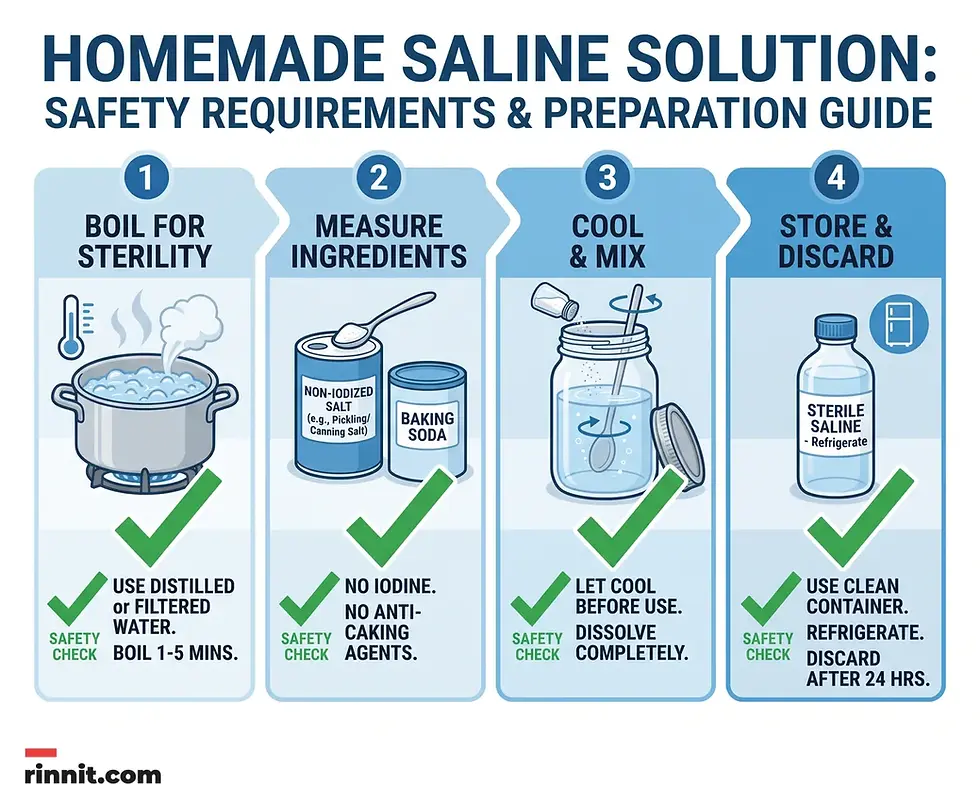
Preparation Steps
Mix Dry Ingredients: Combine 3 teaspoons of non-iodized salt with 1 teaspoon of baking soda in a clean, airtight container. [1]
Combine with Water: Add 1 teaspoon of the dry mixture to 8 ounces of lukewarm sterile or boiled water. [1]
Storage: Any leftover boiled water should be stored in a clean, sealed container and discarded after 24 hours. [1]
What are the risks of saline solution, and what precautions help?
The primary risk associated with saline solution is the use of non-sterile water or contaminated containers, which can lead to serious infections.
Eye Safety: Never use homemade saline solution in your eyes or for contact lenses. Doing so can lead to severe eye infections. [1] Always use sterile, store-bought eyewashes.
Nebulizer Use: Hypertonic saline should only be used in a nebulizer under the direct guidance of a healthcare provider, typically for conditions like cystic fibrosis. [1]
Infection Signs: Monitor for redness, swelling, pain, or warmth at the application site.
Conclusion and When to Seek Help
Saline solution is a simple yet powerful tool for daily health maintenance. Whether you are managing a cold or caring for a new piercing, following sterility guidelines is the most important factor in its safe use. If symptoms do not improve with nasal irrigation, or if you notice signs of an eye or skin infection, contact a healthcare provider immediately.
Frequently Asked Questions
Is saline solution just salt water?
Yes, saline solution is a specific mixture of sodium chloride (salt) and water, often balanced to match the body's natural fluid concentration.
Can I use tap water to make saline for my nose?
No, you should never use tap water. You must use distilled, sterile, or boiled and cooled water to avoid the risk of serious infections.
Is homemade saline safe for contact lenses?
No, homemade saline is not sterile enough for use with contact lenses or in the eyes. Use only commercial, sterile saline products for eye care.
What is hypertonic saline?
Hypertonic saline has a higher salt concentration than normal saline (above 0.9%) and is often used in nebulizers to help thin thick mucus in the lungs.
How often should I clean a new piercing with saline?
Experts generally recommend cleaning a new piercing site twice a day with sterile 0.9% saline solution to prevent infection.
Does saline solution disinfect wounds?
Saline solution cleanses wounds by flushing out debris and dirt, but it is not a disinfectant. It helps lower infection risk by removing contaminants.
Can I store homemade saline solution?
Boiled water used for saline should be discarded after 24 hours. The dry salt and baking soda mixture can be stored in an airtight container.
Why is baking soda added to homemade saline?
Baking soda is often added to homemade saline for nasal irrigation to help buffer the solution and make it less likely to sting or burn.
Can children use saline nasal rinses?
Yes, saline solution is safe for nasal irrigation in both children and adults when used according to a healthcare provider's instructions.
What are the signs of an eye infection from saline?
Signs include redness, pain, itching, swelling, or watery eyes. If these occur after using saline, seek medical attention immediately.
Related Reading
Nasal Irrigation: A Guide to Rinsing Your Sinuses explains how to rinse your sinuses safely with saline.
IV Fluids: A Comprehensive Guide to Intravenous Rehydration covers IV fluids, including saline, and when they are used.
Incision Care: A Comprehensive Guide to Post-Surgical Healing explains how to clean and care for a healing surgical wound.
Eye Drops: Types, Uses, Risks and How to Use Them Safely describes types of eye drops and how to use them safely.
References
Cleveland Clinic. Saline Solution. Cleveland Clinic. May 21, 2024. https://my.clevelandclinic.org/health/treatments/saline-solution
Head K, Snidvongs K, Glew S, et al. Saline irrigation for allergic rhinitis. Cochrane Database of Systematic Reviews. 2018;6:CD012597. PMID 29932206. https://doi.org/10.1002/14651858.CD012597.pub2
Cabaillot A, Vorilhon P, Roca M, et al. Saline nasal irrigation for acute upper respiratory tract infections in infants and children: a systematic review and meta-analysis. Paediatric Respiratory Reviews. 2020;36:151-158. PMID 32312677. https://doi.org/10.1016/j.prrv.2019.11.003
Chong LY, Head K, Hopkins C, et al. Saline irrigation for chronic rhinosinusitis. Cochrane Database of Systematic Reviews. 2016;4:CD011995. PMID 27115216. https://doi.org/10.1002/14651858.CD011995.pub2
Medical disclaimer
The information provided in this article is for educational purposes only and should not be used as a substitute for professional medical advice, diagnosis, or treatment. Always seek the advice of your physician or other qualified health provider with any questions you may have regarding a medical condition.



Comments