Understanding Ranulas: Causes, Symptoms, and Treatment Options

Updated: 3 days ago
Medically reviewed by Dr. Baraa Alnahhal, MD · Last reviewed: October 2026
Quick Answer: What is a ranula?
A ranula is a type of mucocele, or mucus-filled cyst, that forms under the tongue when saliva leaks from a salivary gland into surrounding tissue, often due to a blockage or injury. [1] It is usually clear or bluish and squishy. [1] Ranulas are not cancerous, but large ones can push the tongue out of place and make swallowing or speaking difficult. [1]
What the research says
Removing the sublingual gland gives the lowest recurrence. A systematic review of 71 studies (809 patients: 563 simple and 246 plunging ranulas) found that excision with removal of the sublingual gland on the same side had recurrence rates below 10%, versus 15% to 30% for excision without gland removal and for marsupialization. Sclerotherapy results varied by agent (3% to 10% recurrence with bleomycin, over 50% with OK-432, especially in plunging ranulas), and most recurrences appeared within 3 to 6 months. Because the studies were mostly retrospective case series, the authors could not pool the data statistically (PubMed: Nguyen et al., Oral Dis, 2026 [2]).
Experts agree that treatment has to address the gland. A clinical review of mucoceles, sialoceles, and ranulas describes ranulas as a subtype of mucocele arising from the sublingual gland, classified as superficial or plunging, and concludes that treatment of ranulas must address the sublingual gland (PubMed: Bowers & Schaitkin, Otolaryngol Clin North Am, 2021 [3]).
What are ranulas, and what types are there?
Ranulas are relatively common oral cysts that primarily affect the floor of the mouth. The name is derived from the Latin word for frog, reflecting the “frog-belly” appearance of the swelling. These cysts form when saliva, which normally flows into the mouth, is diverted into the soft tissues under the tongue. [1] This leakage is typically the result of a salivary gland being obstructed or physically damaged. [1]
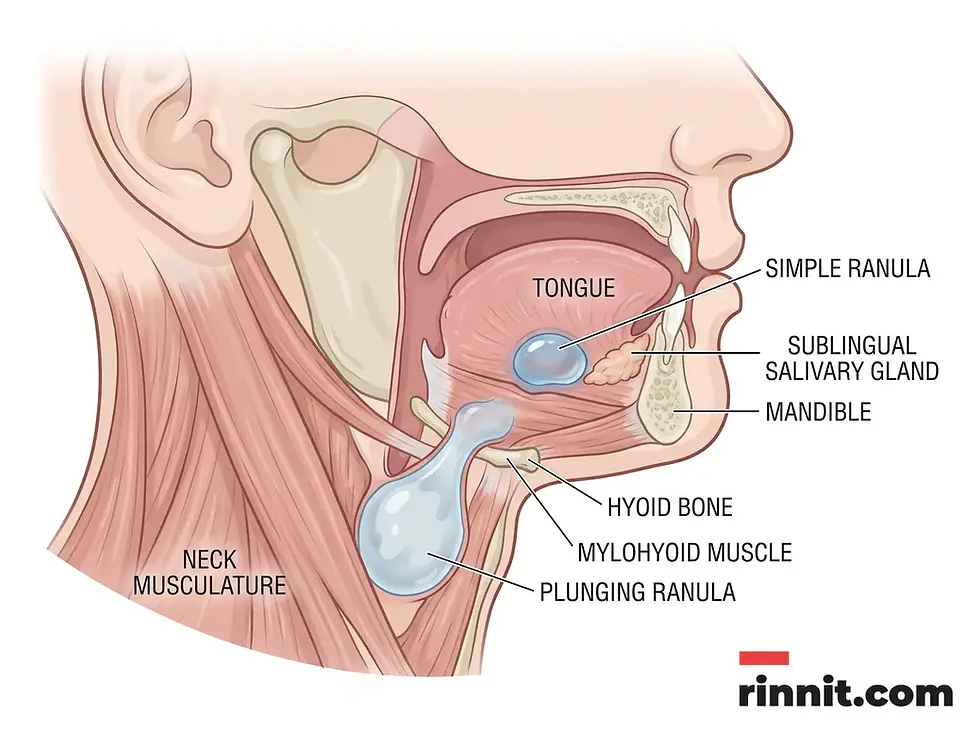
Medical professionals categorize ranulas into two distinct types based on their growth pattern and location. [1] Understanding these types is essential for determining the appropriate diagnostic and treatment pathway.
Ranula Type | Location and Characteristics |
Simple Ranula | Remains confined to the floor of the mouth, situated entirely under the tongue. |
Plunging Ranula | Expands downward, growing past the floor of the mouth and into the neck area. |
What are the symptoms of a ranula, and how does it affect function?
Most ranulas are painless, but their presence can cause significant discomfort and functional issues. A typical ranula appears as a clear or bluish lump that feels squishy when touched. [1] These cysts are dynamic; they may grow larger as saliva accumulates and then shrink if the fluid partially drains, though they frequently refill over time. [1] Most individuals do not notice symptoms until the cyst reaches approximately two to three inches in size. [1]
As the ranula grows, it can push the tongue out of its natural position. [1] This displacement often leads to secondary issues such as eating very slowly or developing a lisp while speaking. [1] In severe cases, a large ranula can press against the windpipe, leading to complications with breathing or swallowing. [1]
What causes ranulas, and who is at risk?
The primary cause of a ranula is the malfunction of a salivary gland. [1] When the duct that carries saliva is blocked or injured, the fluid has nowhere to go but into the surrounding tissue. In many cases, however, a ranula may develop without a clearly identifiable injury or cause. While these cysts can affect individuals of any age or sex, they are most frequently diagnosed in children and young adults between the ages of 20 and 40. [1]
Importantly, a ranula is not a serious medical emergency, nor is it related to sexually transmitted infections (STIs). [1] It is a localized issue specifically involving the salivary glands and oral tissue.

How are ranulas diagnosed and treated?
Diagnosing a ranula typically begins with a physical examination where a healthcare provider inspects the floor of the mouth and checks for neck swelling. [1] To confirm the diagnosis and determine the cyst's exact size and depth, imaging tests such as a CT scan, MRI, or ultrasound may be required. [1]
Treatment strategies are tailored to the size of the ranula and the severity of the symptoms. While small, asymptomatic cysts may be monitored to see if they heal on their own, larger or problematic ranulas require intervention.
Common Treatment Procedures
Needle Aspiration: The provider uses a fine needle to drain the fluid from the cyst. [1]
Incision and Draining: A small cut is made to allow the saliva to flow out naturally. [1]
Marsupialization: The cyst is cut open, and the edges are stitched to keep it open, allowing for continuous drainage. [1]
Surgical Removal: The ranula and the offending salivary gland are removed entirely. This is considered the only permanent solution to prevent the cyst from returning. [1]

What is recovery like after ranula treatment, and what is the outlook?
Recovery time varies significantly depending on the chosen procedure. Simple drainage typically heals within a few days, whereas surgical removal of a salivary gland may require one to two weeks of recovery. [1] Patients should monitor for warning signs post-treatment, such as heavy bleeding, persistent numbness in the tongue, or signs of infection like a high fever or pus at the site. [1]
Conclusion
While a ranula is not cancerous or life-threatening, its impact on daily functions like speaking and eating can be substantial. Understanding the difference between simple and plunging types, recognizing the clear or bluish appearance of the lump, and knowing the available treatment options are key to managing the condition. If you notice a persistent lump under your tongue, consulting a healthcare provider is the best way to ensure an accurate diagnosis and a clear path to recovery.
Frequently Asked Questions
1. What exactly is a ranula?
A ranula is a fluid-filled cyst that forms on the floor of the mouth, under the tongue. [1] It is caused by saliva leaking from a salivary gland into the surrounding tissue due to a blockage or injury. [1] It is a specific type of mucocele, which is a general term for any mucus-filled cyst in the mouth. [1] [3]
2. Is a ranula a type of cancer?
No, ranulas are not cancerous. [1] They are benign cysts filled with saliva. [1] While they are not a serious medical issue, they can cause discomfort and functional problems if they grow large enough to displace the tongue or affect breathing. [1]
3. What are the main types of ranulas?
There are two main types: simple and plunging. [1] A simple ranula stays confined to the floor of the mouth under the tongue. [1] A plunging ranula is larger and grows downward into the neck area.
4. What does a ranula look and feel like?
A ranula typically appears as a clear or bluish lump under the tongue. [1] It feels squishy to the touch. [1] The size can change over time, often growing as saliva collects and shrinking if it drains, though it usually refills. [1]
5. Can a ranula make it hard to breathe?
Yes, in severe cases. If a ranula grows large enough, it can press against the windpipe or push the tongue back, making it difficult to breathe or swallow. [1] This level of growth usually requires prompt medical treatment.
6. Who is most likely to get a ranula?
Ranulas can happen to anyone, regardless of age or sex. [1] However, they are most commonly seen in children and young adults between the ages of 20 and 40. [1]
7. How do doctors treat a ranula?
Treatment depends on the size and symptoms. Options include draining the fluid with a needle, marsupialization (stitching the cyst open to drain), or surgical removal of the ranula and the affected salivary gland. [1] Surgery is the only permanent fix. [1]
8. Will a ranula go away on its own?
Some small ranulas may heal on their own without intervention. However, many will persist or recur after simple drainage. If the cyst is causing issues with talking or eating, a healthcare provider will likely recommend treatment.
9. How long does it take to recover from ranula surgery?
Recovery from simple drainage takes just a few days. [1] If you undergo surgery to remove the salivary gland and the ranula, recovery typically takes between one and two weeks. [1]
Can a ranula come back after treatment?
Yes. Ranulas often come back after simple drainage. Removing the sublingual salivary gland along with the cyst has the lowest chance of the ranula returning.
Related Reading
Oral Mucocele: Understanding Mucous Cysts, Causes, and Care explains small saliva-filled cysts on the lip and mouth lining.
Salivary Gland Stones: Causes, Symptoms, and Removal Options covers stones that block saliva flow and cause gland swelling.
Salivary Glands: Location, Function, Symptoms and Care explains where the salivary glands are and common problems.
Salivary Gland Tumors: Complete Guide to Signs, Causes, Diagnosis, and Treatment explains growths in the salivary glands and how they are treated.
References
Cleveland Clinic. Ranula. Cleveland Clinic. Last updated Oct. 22, 2025. https://my.clevelandclinic.org/health/diseases/23451-ranula
Nguyen K, Goodman E, Vibhute M, et al. Systematic review and meta-analysis of the management and outcomes of recurrent ranulas. Oral Dis. 2026;32(7):1816-1827. doi:10.1111/odi.70274. PMID: 41841403.
Bowers EMR, Schaitkin B. Management of mucoceles, sialoceles, and ranulas. Otolaryngol Clin North Am. 2021;54(3):543-551. doi:10.1016/j.otc.2021.03.002. PMID: 34024482.
Medical Disclaimer
This article is for informational purposes only and does not constitute medical advice. Always seek the advice of your physician or other qualified health provider with any questions you may have regarding a medical condition. Never disregard professional medical advice or delay in seeking it because of something you have read here.



Comments